
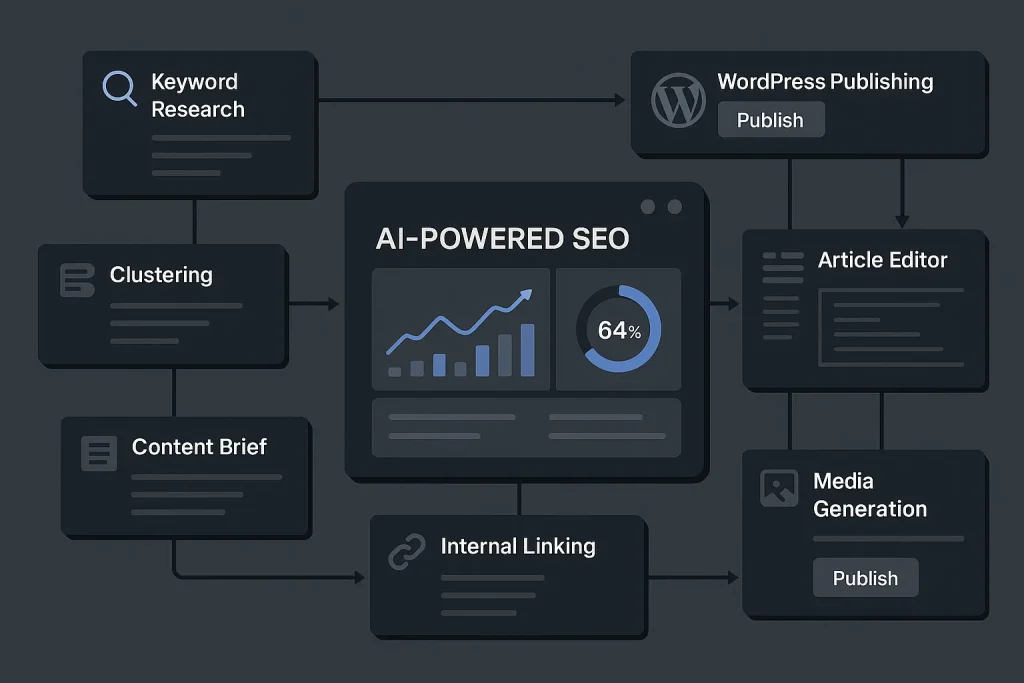
SEO stops scaling the moment every stage depends on manual handoffs. Teams lose time in keyword competitor analysis, briefs vary by writer, on page SEO is inconsistent across pages, and WordPress publishing turns into a separate queue instead of the final step in a controlled system. AI helps only when it becomes part of the process infrastructure, not a shortcut for churning out more text.
To operationalize seo with AI, the goal is not “generate articles faster.” The real goal is to turn website search engine optimization into a repeatable production model: find keywords for website growth, cluster opportunities by intent, generate usable briefs, create draft content under clear constraints, enrich pages with internal links and media, and ship directly into WordPress with defined review gates. On our reading, that is the line between isolated prompting and a functioning SEO engine.
Google’s position is clear enough. AI-generated content is not automatically disallowed; the problem is content produced mainly to manipulate rankings instead of helping users. So any AI-assisted SEO workflow has to be built around quality control, originality, evidence, and editorial accountability. We consider that non-negotiable. Without it, automation just scales weak decisions.
Those numbers make the operational case on their own. If top-of-SERP gains create disproportionate traffic impact, then the workflow behind content production has to be measurable, disciplined, and fast enough to iterate. AI is useful here for one reason: it can compress the lag between research, production, optimization, and publication.

What it means to operationalize SEO with AI
Operationalizing SEO means moving from one-off execution to a managed system. Instead of treating keyword research, seo content writing, editing, metadata, internal linking, and publication as separate craft activities, the team defines inputs, outputs, owners, quality gates, and reporting for each stage. AI sits inside that structure and accelerates the repetitive, pattern-based work that can actually be standardized.
That distinction matters. Many teams say they “use AI for SEO,” but they have not operationalized anything. They ask a model for blog ideas, generate first drafts, and then discover that topic prioritization, intent mapping, terminology, product messaging, factual reliability, and publication quality are all unstable. The result is more content, not a stronger system for website ranking on Google. We have seen this pattern enough times to call it what it is: speed without control.
A proper AI-enabled SEO operation usually has five core properties. First, the input data is structured: target keywords, topic clusters, SERP observations, entity requirements, internal link targets, and publishing constraints. Second, every article type has a template or playbook. Third, there is a review framework for quality and compliance. Fourth, publishing is integrated with the CMS instead of handled manually in batches. Fifth, the team monitors the same KPIs before and after deployment so optimization decisions are evidence-based.
For B2B teams, this matters even more because SEO output often serves several goals at once: pipeline support, category education, product discovery, and topic authority. AI can help build those assets faster, but only if the workflow preserves business meaning. Otherwise, automation simply amplifies inconsistency. On our view, that is the hidden cost most teams underestimate.
In practical terms, operational seo with AI means:
- standardizing how the team finds keywords for website expansion,
- making keyword search volume Google data and SERP context usable at scale,
- translating keyword clusters into briefs that writers or models can execute,
- controlling on page and off page SEO dependencies at the article level,
- publishing directly into WordPress with minimal rework,
- measuring clicks, impressions, CTR, and average position consistently over time.
The strategic outcome is not just efficiency. It is predictability. Predictable pipelines make planning, forecasting, and quality management possible. That, in our judgment, is where AI becomes genuinely valuable to SEO teams.
AI-driven SEO workflow: from research to publishing
The cleanest way to structure an AI-assisted workflow is to treat SEO as a production pipeline. Each stage should produce a clear artifact that the next stage can use. That one choice prevents prompt chaos and cuts down editorial drift.
A practical sequence looks like this: keyword discovery, competitor and SERP analysis, clustering, intent mapping, prioritization, brief creation, outline generation, draft production, editorial review, on page SEO enhancement, WordPress formatting, publishing, and post-publication monitoring. AI can support nearly every stage, but not every stage should be fully automated. We think that restraint is a strength, not a limitation.
The highest leverage usually comes from four areas. One is research acceleration: summarizing SERPs, extracting page patterns, and grouping terms. Another is structured brief generation. A third is first-draft production under clear topical and stylistic constraints. The fourth is CMS execution, especially where one-click publishing can turn approved content into draft or live posts without endless copying and pasting.
Where teams go wrong is by skipping the middle. They jump from keyword list to generated draft. That leaves major gaps in intent alignment, entity coverage, content structure, and differentiation. AI is strongest when it transforms structured inputs into structured outputs, not when it tries to replace planning.
A useful operating model is to define artifacts for each stage:
| Stage | Primary input | Operational output | AI role |
|---|---|---|---|
| Keyword research | Seed topics, Search Console, keyword tools | Candidate keyword set with opportunity notes | Expansion, cleaning, grouping, SERP summary |
| Clustering and intent | Keyword set, SERP overlap, business goals | Topic clusters and target page map | Intent labeling and cluster suggestions |
| Briefing | Target keyword, cluster, SERP notes, brand rules | Article brief, angle, outline, entities | Brief drafting and structure generation |
| Content production | Approved brief and constraints | Draft article with metadata and media notes | Draft generation, rewrites, gap filling |
| Publishing and QA | Final HTML, metadata, taxonomy, media | WordPress draft or published post | Formatting, field mapping, API posting |
When those outputs are defined in advance, AI has context. When they are not, the workflow collapses into disconnected generation. And disconnected generation rarely produces durable SEO gains.

Tooling stack for AI-assisted SEO and WordPress
An operational stack does not need to be sprawling, but it does need clear roles. Most teams need four layers: a data layer, an intelligence layer, a content layer, and a publishing layer. The data layer includes Google Search Console, analytics, and keyword tools. The intelligence layer includes AI systems for clustering, summarization, brief generation, and editorial assistance. The content layer handles drafting and revision. The publishing layer connects content to WordPress.
Google Search Console is central because it gives you the baseline operational metrics that matter most: clicks, impressions, CTR, and average position. It also allows filtering by search type such as web, image, video, and news. That is useful when AI-assisted content programs need surface-level segmentation instead of one blended performance number.
At the same time, Search Console is not a full rank-tracking system. Google’s own documentation makes that limitation fairly obvious in the browser interface, especially when teams want to track multiple individual queries over time. So many operations pair Search Console with dedicated tools to track keyword rankings more precisely. That matters when the team wants to know whether a refresh moved a target page from position 12 to 8 or from 5 to 3. In our view, that distinction is operationally important, not a reporting nicety.
On the CMS side, WordPress remains the obvious implementation path for many teams. W3Techs reports WordPress powers 41.9% of all websites and 59.5% of sites with a known CMS. Even among the top one million sites, its share remains large enough to make wordpress seo automation a mainstream concern rather than a niche integration problem.
Compatibility inside WordPress also matters. Large plugin ecosystems, page builders, and commerce layers can affect how one-click publishing works in practice. W3Techs historical subtechnology data indicates significant usage for tools such as Elementor and WooCommerce across WordPress sites. That does not make publishing impossible. It simply means robust workflows should account for custom fields, templates, featured images, slug handling, excerpt logic, and metadata sync. We would argue this is where many “simple” automation demos meet the real world and start to wobble.
WordPress also supports programmatic publishing through the REST API endpoint POST /wp/v2/posts. For AI-assisted systems, this is the hinge that connects content generation to execution. A pipeline can create a draft, attach title and content, set status, assign categories, and hand the result to an editor for review. The REST API’s _fields parameter is also useful for leaner integrations because it reduces response payloads when tools only need selected fields for sync or QA.
The right tooling stack therefore looks less like a pile of “AI apps” and more like a sequence of systems with assigned functions. That is what keeps seo operational rather than experimental.
AI-assisted keyword research and clustering
Keyword research is still the foundation, but AI changes the speed and consistency of how it gets processed. The goal is not to let a model invent keywords out of thin air. The goal is to combine source data, SERP observations, and business context into workable topic clusters faster than a manual team could.
A disciplined process starts with multiple keyword sources: Search Console queries, customer language from sales and support, competitor page themes, paid search terms, and data from keyword tools. Then comes the real work: clean the set, remove obvious noise, identify duplicates and near-duplicates, and label terms by likely intent and business relevance.
This is where AI can help in a meaningful way. It can normalize variations, suggest cluster labels, summarize SERP similarities, and propose whether a term belongs on the same target page as related variants. That supports tasks such as keyword competitor analysis and clarifies which pages should target which query groups. It can also connect raw terms to practical content types: glossary pages, feature pages, category pages, comparisons, tutorials, or editorial guides.
However, clustering should not rely on language patterns alone. It needs validation against SERP overlap and user intent. Two keywords may look similar linguistically and still deserve separate pages because Google treats them differently. The reverse is also true: several variations may point to the same dominant result type and should be consolidated to avoid cannibalization. We think this is one of the easiest places to make expensive mistakes quietly.
For example, a cluster around wordpress seo may include platform-specific setup questions, plugin-related tasks, technical configuration needs, and publishing workflow queries. A cluster around seo content writing may map to editorial methodology, prompt constraints, brief design, and quality control. A cluster around find keywords for website may fit an upper-funnel educational guide or a tool-led workflow article depending on audience and page type.
The operating principle is simple: AI should accelerate triage, not replace judgment. That means the clustering process should produce notes such as:
- primary target keyword and close variants,
- likely intent category,
- recommended page type,
- SERP pattern summary,
- business value and funnel role,
- risk of overlap with existing URLs.
Once this is done, the team can prioritize work based on opportunity and fit instead of publishing a random batch of low-coherence articles. That is a far better use of AI than asking it to improvise strategy after the fact.
The table below shows a practical way to evaluate keyword clusters before writing begins.
| Evaluation factor | What to inspect | Why it matters |
|---|---|---|
| Intent consistency | Are top results educational, commercial, product-led, or navigational? | Prevents mixing incompatible user goals in one page |
| SERP overlap | Do the same URLs rank for multiple terms? | Improves clustering accuracy and reduces cannibalization |
| Business alignment | Can the topic connect naturally to the offer or expertise? | Protects topical focus and commercial relevance |
| Content differentiation | What unique angle can your team add? | Supports people-first quality and avoids shallow summaries |
| Operational feasibility | Do you have SME input, examples, and enough data to produce a strong brief? | Prevents low-value publishing driven by volume targets |
If a cluster fails these checks, AI should not force content production. It should send the topic back for refinement. That is disciplined operations, and we think discipline matters more than output volume here.

Mapping search intent and prioritizing opportunities
Intent mapping is where operational SEO becomes strategic. Not every keyword deserves a new article, and not every article should target the same kind of demand. AI can classify intent quickly, but prioritization still depends on commercial fit, ranking feasibility, and content economics.
A useful approach is to score opportunities across four dimensions: demand signal, SERP achievability, business relevance, and production readiness. Demand signal may use keyword search volume Google data, Search Console impressions, or a mix of both. SERP achievability looks at competition, page type fit, and whether the current top results are beatable. Business relevance asks whether the topic can support the product, service, or brand authority. Production readiness measures whether the team has enough expertise, examples, and internal links to create something substantially useful.
AI can help summarize top-ranking page patterns, identify whether listicles or tutorials dominate, extract recurring subtopics, and flag whether the SERP rewards product pages or informational guides. It can also support gap analysis by comparing existing site coverage against the opportunity set.
The main risk here is false precision. Teams often overvalue a term because volume exists, or undervalue it because the phrase looks narrow. In B2B SEO, narrower terms can carry stronger commercial meaning. That is why prioritization should include both search opportunity and strategic fit, not just estimated traffic potential. On our view, this is one of the clearest differences between mature SEO and dashboard theater.
Search Console also shapes prioritization. If a page already has impressions and a middling average position for relevant queries, updating that page may produce faster gains than publishing a new one. Google defines average position as the topmost position of a site result averaged across impressions for a query set, which means reporting dimensions need to stay consistent over time. Property-level and URL-level views can look different, and mixed reporting logic distorts baselines.
The distribution is operationally important: gains near the top of the SERP matter far more than simply “showing up.” That is why AI systems should prioritize pages with realistic top-10 potential, not just topic volume.

Creating briefs and outlines with AI guardrails
Briefing is the control point where AI becomes useful without becoming reckless. A strong brief constrains the model before the first paragraph is generated. It tells the system what the page must accomplish, what it must avoid, and how the topic should be structured for both users and search engines.
A workable AI-ready brief usually includes the primary keyword, secondary variations, intended search intent, audience, business angle, target page type, essential subtopics, entity coverage, differentiation notes, internal link targets, prohibited claims, and formatting requirements. It should also specify the expected evidence standard. If the topic involves policy, medical, legal, financial, or technical claims, the brief should define what needs human validation before publication.
Google’s people-first content guidance matters directly here. It warns against producing large amounts of content across many topics, writing to arbitrary word counts, or simply summarizing what others have written without adding substantial value. An AI brief should therefore force specificity: what original angle will the page contribute, what practical detail can the brand credibly provide, and what reader need will the page satisfy better than a generic article. We consider this one of the most practical ways to keep AI output honest.
The outline phase should be guardrailed too. AI is good at creating logical section hierarchies, but it often defaults to generic headings. Editorial teams should define outline patterns for specific page types. A tutorial page might require prerequisites, setup steps, edge cases, QA, and troubleshooting. A strategic SEO article might require workflow design, tooling, metrics, governance, and implementation recommendations. Consistent outline logic improves both production quality and scalability.
Another useful practice is to maintain a rejection list inside the brief. This can include banned phrases, unsupported promises, competitor references that should not be copied, and sections that would be off-topic. It sounds simple. It also saves a surprising amount of cleanup later.
Well-built briefs improve delegation as well. A senior SEO strategist can define the brief template once, and junior editors or AI systems can execute within that framework. That is how scale happens without losing editorial control. On our reading, this is where operations starts to look like an asset rather than a burden.

Generating and editing SEO content with quality controls
Draft generation is the most visible part of AI-assisted SEO, but it is not the most important part. The real question is whether the system can produce a draft that is aligned, editable, fact-aware, and structurally useful. A fast draft that still needs a full rewrite is not operationally efficient. It is just a different kind of delay.
Quality control starts with generation inputs. The model should receive the approved brief, the intended audience, the desired tone, the list of required sections, relevant product or service context, terminology constraints, and a clear instruction to avoid unsupported claims. It should also be told whether to produce HTML-ready output, Markdown, or plain text for the publishing layer.
From there, editorial review should check at least six areas: intent match, factual accuracy, originality, clarity, structural completeness, and commercial relevance. Many teams add a seventh check for brand voice, especially in multi-author or multi-market environments.
For seo content writing, the draft should not merely include keywords. It should demonstrate topical command through useful explanation, practical sequencing, and appropriate specificity. If the content could be dropped into any random site without modification, it is usually too generic to justify publication. We think that test is blunt, but effective.
AI also needs help with restraint. It tends to over-explain basics, introduce formulaic transitions, and repeat the same semantic idea under slightly different headings. Editors should cut redundancy aggressively. That improves readability and often sharpens topical focus. In our experience, this is where human editing adds disproportionate value.
A robust review flow for website search engine optimization content usually includes:
- Structural review: Does the article answer the target intent and follow the approved outline?
- Claim review: Are all specific claims supportable, current, and consistent with source material?
- SEO review: Are title, meta description, heading hierarchy, internal links, entities, and media integrated naturally?
- Editorial review: Is the text concise, non-repetitive, and aligned with the site’s professional tone?
- Publication review: Is the output formatted correctly for WordPress, including images, tables, and call-to-action blocks?
This process may sound slower than pure automation, but it is faster than repairing low-quality published content at scale. More importantly, it aligns with Google’s guidance: original, useful, people-first content can be created with automation, but manipulative volume publishing is exactly what the system should avoid.

On-page optimization: entities, internal links, and media
Once the article is structurally sound, on page SEO turns it from a draft into a competitive asset. This includes title logic, metadata, heading hierarchy, entity coverage, contextual internal linking, media optimization, and clean HTML formatting. AI can assist in each area, but the inputs have to be explicit.
Entity coverage is often more reliable than raw keyword repetition. If a page on operational SEO with AI naturally covers Search Console metrics, keyword clustering, content briefs, WordPress REST API, publishing workflows, and E-E-A-T, it signals relevance through topic depth rather than forced exact-match repetition. This helps keep on page seo aligned with readability. We strongly prefer this approach to mechanical density chasing.
Internal linking is another major lever. In an operational system, internal links should not be added ad hoc at the end. They should be mapped at brief stage and validated before publishing. Each article should link upward to core commercial or pillar pages, laterally to closely related guides, and sometimes downward to more specific subtopic resources. AI can suggest likely anchors and target URLs, but editorial review should prevent overlinking and generic anchor text.
Media is part of on page quality too. Images, charts, comparison tables, and process diagrams improve comprehension and can support richer engagement. They also create opportunities for image search visibility if captions and alt text are relevant. In AI-assisted workflows, image handling should include metadata standards, placement rules, and size or performance requirements for WordPress.
For pages targeting website ranking on Google, title and snippet logic deserve operational treatment as well. Search Console’s click and impression data can show whether a page is underperforming in CTR relative to its position. Because CTR is clicks divided by impressions, teams can use post-publication data to decide whether title and meta description adjustments are worth testing.
The most common on-page failure in AI workflows is over-optimization through mechanical keyword insertion. The page starts reading like a template and loses credibility. Strong AI-assisted on page and off page seo begins with on-page relevance built around intent, entities, structure, and contextual linking, not density formulas. On our view, that is the difference between optimization and self-sabotage.
One-click WordPress publishing via plugins and APIs
One-click publishing is where operational design becomes tangible. It is the moment an approved article stops being a document and becomes a live asset. For most teams, this involves either a plugin-based workflow inside WordPress or an external system using the WordPress REST API.
The API route is often more flexible. WordPress supports creating posts programmatically through POST /wp/v2/posts, which allows external tools to send title, content, status, slug, excerpt, categories, and other fields directly into the CMS. This is especially useful when the content is generated or assembled outside WordPress, then pushed into the site as a draft or published item after approval.
In a controlled SEO workflow, one-click does not mean zero review. It means the publishing action is automated once quality gates are satisfied. Typical gates include approved brief, completed editorial review, metadata check, internal link validation, media attached, taxonomy assigned, and legal or brand clearance if required. We think that distinction needs to be said plainly, because “one-click” is often marketed as if governance were optional.
Plugin-based workflows can work well when the content team lives inside WordPress. External systems are better when the team needs centralized workflow logic across multiple sites or clients. In either case, the main architectural decision is whether WordPress is the authoring environment or the destination environment. That affects formatting, version control, and approval flows.
The table below compares the two common paths.
| Approach | Best for | Operational advantage | Main caution |
|---|---|---|---|
| WordPress plugin workflow | Single-site teams working inside WP | Lower implementation friction for editors | Can be limited by theme, builder, or plugin conflicts |
| External app via REST API | Multi-site, agency, or integrated SaaS workflows | Greater control over workflow, QA, and scaling | Requires cleaner field mapping and auth management |
| Hybrid draft push | Teams wanting automation plus manual final review | Balances speed with editor oversight | Needs clear status transitions and ownership rules |
For wordpress seo operations, the publishing layer should also handle slug standards, category assignment, featured image logic, excerpt handling, and optionally custom fields used by SEO plugins or page templates. If the system supports field filtering with _fields, integrations that sync or audit content can be made lighter and faster.

Governance, review, and compliance (E-E-A-T, brand, legal)
Governance is what keeps AI-assisted SEO from turning into a liability. It sets the rules for what can be automated, what requires human approval, and what evidence is needed before publication. Without governance, teams drift toward speed-first behavior that eventually damages quality, brand trust, or compliance.
E-E-A-T matters here because it forces teams to think beyond text generation. Experience and expertise are demonstrated through substance: practical detail, accurate explanations, credible attribution, and alignment with the site’s real competence. Authoritativeness and trust are reinforced by consistency, editorial review, and the absence of manipulative patterns. We think this is less glamorous than prompt engineering, but much more consequential.
For AI-generated drafts, governance should define at least the following: acceptable topic areas, prohibited claim types, fact-checking thresholds, review roles, brand voice constraints, legal escalation rules, and publication approval states. If the site operates in sensitive industries, the workflow should require domain-expert review before publishing or updating pages.
Google’s guidance on helpful, reliable, people-first content supports the same model. It explicitly warns against producing lots of pages on many topics without real expertise or clear audience value. That means content operations should stay topic-bound. If the site covers SEO, automation, WordPress, and content operations, the workflow should stay close to those areas rather than using AI to expand indiscriminately into unrelated demand.
Brand governance is equally practical. AI should know which phrases the company uses, which claims it avoids, how it refers to competitors, how CTAs are phrased, and which product positioning points must remain consistent. A prompt alone is not enough; these rules should live in reusable templates and validation checks.
Legal review requirements vary by business, but the operational principle is straightforward: if a page could create contractual, regulatory, or reputational exposure, AI must not be the final approver. The system should route the page accordingly. On our view, that is not bureaucracy. It is basic risk management.
Monitoring, QA, and continuous optimization
Operational SEO does not end at publication. It becomes real only when the team measures outcomes, diagnoses weak pages, and feeds those findings back into the workflow. AI can help summarize changes, detect patterns, and recommend refresh candidates, but the measurement framework itself should remain simple and stable.
Google Search Console provides the core metrics: clicks, impressions, click-through rate, and average position. These should be monitored before and after publication or major updates. The same reporting dimensions should be used consistently across time. If one report looks at property-level performance and another looks at individual URLs, trend interpretation becomes unreliable.
Performance should also be segmented by search surface where relevant. Google allows filtering by search type such as web, image, video, and news, which means teams can evaluate whether a content asset is gaining visibility in the area that matters most. Browser reports also do not blend Search, News, and Discover into a single unified view, so broader reporting may require exports or external dashboards.
For teams that need to track keyword rankings at query level over time, Search Console alone is usually insufficient. A dedicated rank tracker can complement it, while Search Console remains the source of truth for clicks and impressions. Used together, these tools answer two different questions: “Did our visibility move?” and “Did that movement produce traffic?” We think that separation is healthy because it keeps ranking vanity in check.
Continuous optimization should cover three layers:
Query-layer optimization: Identify emerging terms, low-CTR queries, and impression-heavy opportunities that need better alignment.
Page-layer optimization: Improve titles, intros, missing subtopics, internal links, or media based on performance.
System-layer optimization: Refine briefs, templates, prompts, review checklists, and publishing rules based on what successful pages have in common.
A mature team also tracks operational metrics such as time from keyword selection to publication, revision rate per draft, approval bottlenecks, and percentage of published pages requiring immediate fixes. Those numbers do not replace SEO KPIs, but they reveal whether the content engine is functioning efficiently. In our judgment, this is where real operational maturity becomes visible.
When these metrics are reviewed consistently, AI becomes part of a learning loop instead of a one-way publishing machine. That is the kind of loop we think teams should be building.
Implementation checklist and rollout plan
The fastest way to fail with AI in SEO is to deploy it everywhere at once. The better approach is phased rollout: standardize one workflow, validate quality, measure outputs, then expand. That keeps risk lower and exposes bottlenecks before they spread across the content program.
A practical rollout usually starts with one article type and one publishing path. For example, a team may begin with informational editorial content targeting mid-funnel queries, using a hybrid draft-push WordPress workflow. Once briefs, reviews, and publishing fields are stable, the team can expand to refresh workflows, comparison pages, or multi-site deployment.
An implementation plan should answer six questions clearly:
- Which content types are in scope first?
- Which keyword clusters and page templates will be used?
- Which steps are fully automated, assisted, or manual?
- Who approves briefs, drafts, and publication status?
- Which metrics define success after 30, 60, and 90 days?
- How will the team handle QA failures, factual issues, or underperforming pages?
For many teams, the right first milestone is not traffic growth. It is process reliability: can the team produce consistent briefs, get usable drafts, apply on page SEO predictably, and publish to WordPress without formatting breakage or metadata loss. Once those basics work, scaling becomes a management problem rather than an editorial crisis. We think that is a healthier target for the first phase.
That is also the point where automation should become more ambitious. Systems can start enriching posts with internal link suggestions, templated CTA blocks, taxonomy assignment, image metadata, and post-publication monitoring cues. But each new layer should be added only after the previous one is stable.
The result is a disciplined SEO operating model rather than a content experiment. Teams know how topics are chosen, how drafts are produced, how quality is enforced, and how publishing translates into measurable outcomes.
Using Autopilot SEO in an operational workflow
Teams that want to reduce manual coordination across research, drafting, optimization, media handling, and WordPress execution usually need more than a generic AI writer. They need a workflow product designed around SEO operations. That is where a platform such as Autopilot SEO fits naturally into the stack.
The product is built around the workflow logic described above: generating semantics, structuring articles, producing content, preparing images, and publishing into WordPress without manual copy-paste. For agencies, publishers, and site owners managing repeated content production, that can reduce friction between planning and execution while keeping the process tied to practical SEO outcomes rather than isolated prompts.
The commercial value is straightforward. Instead of stitching together separate tools for keyword processing, article generation, formatting, and CMS upload, the team can centralize more of the pipeline in one environment and maintain clearer control over output consistency. For organizations trying to operationalize seo rather than just experiment with AI, that is a meaningful difference.
Our view is simple. AI is already good enough to remove a lot of mechanical SEO work, but not good enough to replace operating discipline. The teams that win will not be the ones publishing the most. They will be the ones that build a repeatable system for research, seo content writing, review, wordpress seo execution, and measurement without letting quality slip.
The near-term outlook is realistic rather than dramatic. More teams will automate briefs, clustering, and CMS publishing first, because those are the easiest gains. Over time, the stronger programs will connect keyword search engine ranking data, editorial governance, and post-publication feedback into one loop. That is where AI-assisted website search engine optimization starts to look less like a trend and more like infrastructure.
FAQ
What does it mean to operationalize SEO with AI?
It means turning SEO into a repeatable workflow instead of a chain of manual tasks. AI can support keyword research, clustering, briefs, drafting, on page SEO, and WordPress publishing, but each step needs defined inputs, review rules, and KPIs.
In practice, operationalized seo uses templates, approval stages, and performance monitoring so content production stays consistent and measurable.
How can AI assist in keyword research without sacrificing relevance?
AI is most useful for cleaning keyword sets, suggesting clusters, summarizing SERP patterns, and labeling intent. It should not be the only source of truth for target selection.
Use AI after collecting data from Search Console, customer language, competitor pages, and keyword tools. Then validate clusters against SERP overlap and business relevance before assigning pages.
What is the best workflow to go from keyword research to one-click WordPress publishing?
The strongest workflow is: gather keyword data, run keyword competitor analysis, cluster by intent, prioritize topics, create an AI-ready brief, generate a draft, apply on page seo checks, review for quality and compliance, and push the approved article to WordPress through a plugin or the REST API.
One-click publishing should happen only after the brief, content, metadata, media, and internal links are validated.
How do I ensure E-E-A-T and avoid AI content penalties?
Focus on original, useful, people-first content and keep human editorial accountability in place. Google does not ban AI-generated content by default; it evaluates quality and treats manipulative automation as spam.
To protect E-E-A-T, stay within your real expertise, verify claims, add practical value beyond summaries, and use review gates before publication.
Which metrics should I track to measure AI-driven SEO performance?
Track clicks, impressions, CTR, and average position in Google Search Console as your core performance layer. If you need granular query monitoring, pair that with a dedicated tool to track keyword rankings.
Also monitor operational metrics such as draft revision rate, time to publish, and the share of articles requiring post-publication fixes. Those metrics show whether the AI workflow itself is improving.