
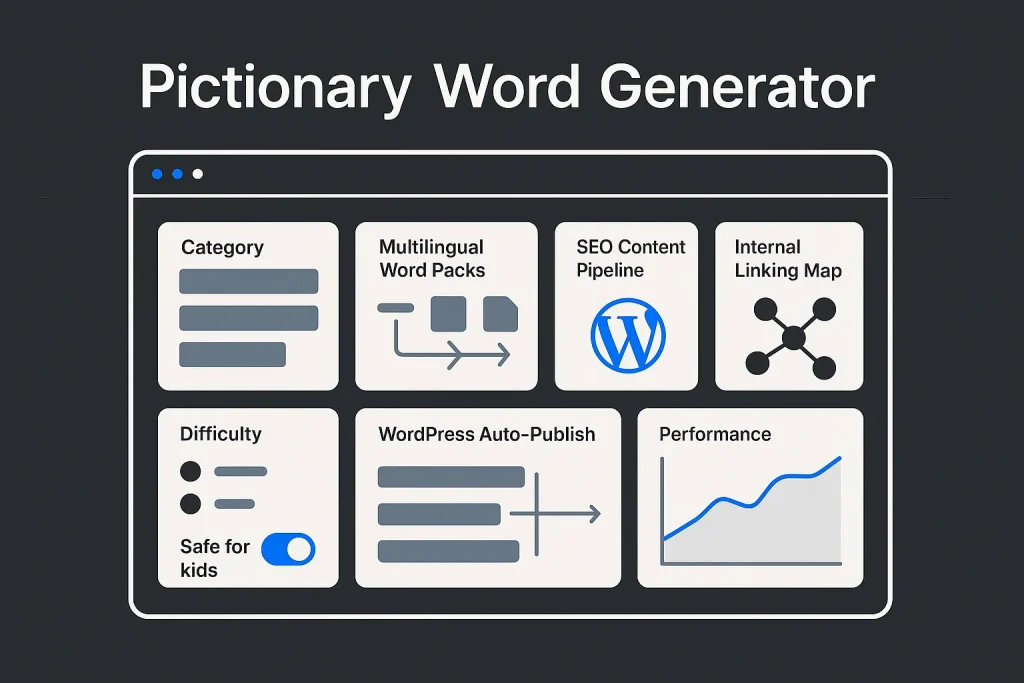
Search demand around drawing-and-guessing games stays surprisingly steady because the format is simple, repeatable, and easy to repackage into list posts, classroom resources, party guides, and printable activities. For bloggers, a pictionary word generator app is more than a novelty. It is a content input we can actually work with: a way to build structured prompt sets, segment them by intent, and turn them into searchable pages without copying branded or proprietary materials.
This topic sits in an interesting spot between entertainment and SEO operations. Pictionary has existed since 1985, which gives the keyword space strong brand recognition and long-term search familiarity, as noted in Wikipedia’s overview of Pictionary. But there is a line here. We need to treat the term as a brand reference, not an official affiliation, and build original prompt collections that are useful, safe, and clearly organized.

What is a Pictionary word generator app?
A pictionary word generator app is a digital tool that produces prompts for drawing-and-guessing gameplay. Sometimes it is just a random picker. Sometimes it works more like a full system with categories, difficulty levels, age filters, language options, and export-ready lists. For bloggers, that difference is not minor. A toy generator gives you one-off entertainment; a structured generator gives you reusable content inventory.
The clearest way to frame the category is by output format. Some tools generate one prompt at a time. Others behave more like a pictionary word list generator, producing batches you can use for game nights, classrooms, team-building sessions, and blog articles. This is where the keyword space opens up into practical subtopics such as easy pictionary words, hard pictionary words, themed prompts, and family-safe versus adult-only lists.
Mattel’s Pictionary Air listing on Apple’s App Store shows how broad this category has become beyond boxed cards. The app is presented as a free Family app with in-app purchases, which tells us users already expect digital clue packs, app-based play, and themed content extensions. The same listing also shows a 4.6 rating from roughly 36,000 ratings in the U.S. storefront snapshot, an age rating of 4+, and support for English plus 30 more languages via the App Store listing for Pictionary Air.
For SEO, this matters because a pictionary generator app query can hide several intents at once. Users may want a playable app, a random prompt tool, a list of words, printable materials, or party and classroom ideas. On our side, that means one mixed page is rarely enough. We usually get better results when we split those intents into distinct pages.
Who should use it and when bloggers benefit
Not every blogger needs content around party games. But when a site already covers family activities, ESL teaching, printable resources, classroom tools, parenting, remote team games, or creative prompts, the use case becomes very practical. In those cases, a random pictionary word generator can support a repeatable publishing model because one content seed can be repurposed into several audience-specific assets.
The biggest winners are publishers who can turn one base vocabulary database into many search-friendly variations. A single word pool can generate:
- kids-only pages with simple nouns and objects
- adult pages with more abstract, cultural, or humorous phrases
- difficulty-based clusters such as beginner, medium, and advanced
- theme pages such as holidays, movies, jobs, sports, travel, and classroom vocabulary
- regional versions using US vs UK spelling differences
That is where the workflow starts to look less like a game and more like content operations. Instead of drafting every page from scratch, we can use a generation-and-filtering process similar to how we approach idea clustering. The logic is close to what we covered in our guide to a random themes generator for blog ideas: raw output is not the final product. It is structured input for search-led publishing.

Bloggers also benefit when they want to reduce production friction. A page about pictionary words can become several linked pages if the prompts are tagged correctly from the start. Without that structure, sites often end up publishing thin, repetitive list posts that target similar terms and quietly compete with each other. On our experience, that is one of the most common mistakes in lightweight SEO niches.
Core features and filters to look for
An online pictionary word generator is only as useful as its filters. Bloggers should evaluate these tools less like players and more like editors. The real question is not whether the generator can produce a random word. It is whether it can produce a controlled dataset that matches audience, tone, and publishing format.
The most important features are editorial, not flashy:
- Difficulty filters: needed for pages targeting easy, medium, and hard prompts.
- Age or safety filters: required if you plan to separate family-safe content from pictionary words for adults.
- Category packs: useful for holidays, occupations, pop culture, school objects, animals, actions, and travel.
- Batch output: necessary for creating full articles, printable cards, or downloadable lists.
- Export options: copy, CSV, plain text, or structured blocks save time during publishing.
- Localization support: especially important if you publish in multiple English variants or additional languages.
- Moderation controls: a practical requirement when building content for schools, family blogs, or sponsored educational pages.
There is already a market signal for this structure. Mattel’s app listing highlights themed digital clue packs and paid add-ons, which supports the idea that users respond well to categorized prompts instead of one generic stream of words. On the browser side, skribbl.io explicitly supports custom words, which confirms that personalized word sets are already normal in this space.
The practical implication is straightforward. A standalone generator does not need to beat multiplayer gameplay. It wins by offering cleaner filters, safer moderation, better export formats, and easier reuse. We consider that the real dividing line between a casual tool and a publisher-friendly one.
| Feature | Why bloggers need it | SEO/content impact |
|---|---|---|
| Difficulty tiers | Lets you build beginner, medium, and advanced pages | Supports distinct intent targeting for easy and hard keywords |
| Safety filters | Keeps kids and family pages clean | Reduces risk of mismatch between query and page audience |
| Themed categories | Turns one database into multiple topic pages | Expands internal-linkable content clusters |
| Batch export | Speeds up article, PDF, and social-post creation | Improves publishing velocity without manual reformatting |
| Localization | Supports UK/US variants and multilingual packs | Prevents duplicate-content confusion and improves relevance |
In this niche, filters shape content quality more than interface design. That may sound unglamorous, but on practice it is exactly what saves time and protects relevance.
This editorial scoring model shows why localization, moderation, and difficulty logic usually matter more than novelty when the use case is content, not gameplay.
Step-by-step: generate clean, on-brand word lists
A good workflow starts before the first prompt appears. Bloggers often waste time by collecting words first and only later deciding who the list is for. That reverses the process. The cleaner approach is to define page intent, audience safety level, and content format before generating the source list.
1. Define the page type
Decide whether the output is a standalone article, printable page, classroom worksheet, party post, email freebie, or app-roundup comparison. That choice determines list length, complexity, and formatting.
2. Set the audience boundaries
Separate family-safe, school-safe, and adult-oriented content at the source level. Do not mix them in one raw prompt pool. This matters even more because the branded app category includes 4+ audiences, while broader web searches also include pictionary words list for adults.
3. Build category logic
Organize prompts by theme, not just by randomness. Categories such as animals, food, movies, jobs, travel, emotions, actions, and holidays give you reusable sublists and stronger article structure.
4. Tag for difficulty
Difficulty should reflect drawability, concept abstraction, and cultural specificity. “Apple” is easy. “Time zone” is harder. “Existentialism” may be technically possible, but for most audiences it is a bad prompt. We have seen too many lists confuse difficulty with obscurity. Good curation values playability over cleverness.
5. Remove weak entries
Delete prompts that are too obscure, too ambiguous, too brand-heavy, offensive, or dependent on inside jokes. This curation step is where a blog-quality pictionary app word list pulls away from a raw randomizer.
6. Format for publishing
Turn the approved dataset into article sections such as “50 easy pictionary words,” “30 hard pictionary words,” or “holiday pictionary prompts for classrooms.” That keeps search intent and user experience aligned.

If you also create image-driven companion content, this production flow pairs well with a random image generator for creative inspiration, especially for social carousels or printable cards that need visual differentiation.
Adult vs kids sets: difficulty, themes, and safety filters
One of the most common quality failures in this niche is weak audience separation. Bloggers publish one mixed list and then try to rank for both family queries and adult-party queries. That usually creates relevance problems. A page for children should not inherit the same vocabulary logic as a page targeting pictionary words for adults.
Kids lists usually work best with concrete nouns, visible actions, and familiar contexts. Adults can handle more abstraction, idioms, professions, pop culture references, and mildly complex scenarios. The moderation layer is not optional. It is part of the product. On our side, we would treat this as a publishing rule, not a nice extra.
| Segment | Best prompt style | Avoid | Useful page angles |
|---|---|---|---|
| Kids | Objects, animals, food, simple actions | Slang, romance, alcohol, adult references | Classroom, birthday, family night, ESL |
| Teens | School life, hobbies, sports, movies | Highly niche cultural references | Party games, youth groups, school clubs |
| Adults | Idioms, abstract ideas, careers, travel, humor | Illegal, explicit, defamatory, trademark-heavy prompts | Game night, team building, dinner parties |
Clear segmentation also improves SEO because the searcher’s expected vocabulary changes by audience. That sounds obvious, but many pages still ignore it and end up satisfying nobody particularly well.
A family-safe list usually performs best when most prompts are immediately drawable and only a smaller share adds themed variety.
Turn word lists into blog posts and social content
Raw prompts do not rank. Packaged assets do. The jump from a random pictionary word generator output to publishable content depends on formatting, segmentation, and media reuse. Bloggers who stop at the list itself leave a lot of value on the table.
A strong transformation model looks like this:
- a master spreadsheet or database for all prompts
- filtered article versions for kids, adults, holidays, and difficulty levels
- printable or downloadable formats for lead generation
- social snippets for short-form platforms
- internal links between related prompt sets and supporting guides
For example, one prompt bank can become an article on funny pictionary words, a printable PDF for classrooms, a short video challenge, and a newsletter freebie. When titles, headings, and page purpose differ, these are not duplicates. They are format-specific assets built from one content source. We have seen this work especially well when the prompt bank is tagged properly from day one.
Presentation matters here. If you use decorative typography in challenge cards or social images, consistency across titles and captions helps, but readability still comes first. That is close to the principle we discussed in our article on the Unicode text generator for bloggers: formatting can improve distinctiveness, but only when it does not damage comprehension or crawlability.

SEO best practices for “Pictionary words” content
The keyword space around pictionary words is broad, but the pages that tend to win are usually narrow and clear. Trying to rank one article for every variation often produces vague headings, mixed audiences, and weak click intent. A better structure is a hub-and-spoke model where the central page explains the tool or concept and linked child pages target specific needs.
Typical spoke pages include:
- easy pictionary word sets
- hard pictionary words for advanced players
- holiday prompts
- kids classroom lists
- adult party prompts
- how-to posts about generating and organizing lists
Google’s guidance on title links is useful here. Search results titles are generated automatically from multiple signals, and title display can be truncated depending on device width, according to Google Search Central documentation. The practical takeaway is simple: use clear, concise titles and headings instead of stuffing every modifier into one line.
For a page centered on a pictionary word generator app, the most reliable structure is:
- define the tool and its use case
- segment by audience and difficulty
- show examples of categories and filtering logic
- link to supporting pages with narrower intent
- avoid implying official brand ownership or app affiliation
Internal linking is not cosmetic in this niche. It is how we turn isolated list posts into a crawlable cluster. If you are building larger publishing systems, the workflow aligns well with the principles in building content machines for SEO agencies, even if the subject matter here is much lighter.
| Page type | Primary intent | Best keyword angle |
|---|---|---|
| Hub guide | Explain tools and workflows | pictionary word generator app |
| List post | Immediate playable prompts | easy pictionary words / hard pictionary words |
| Audience page | Age-specific filtering | pictionary words for adults |
| Tool comparison | Evaluate app options | online pictionary word generator |
Search intent alignment is usually more valuable than adding more prompts to an already overloaded page. On our view, this is one of those niches where restraint often beats volume.
The upward line reflects a practical editorial reality: a prompt list gains more business value each time it becomes more structured and reusable.
Automation: publish to WordPress with Autopilot SEO
Word-list content looks simple, but the operational overhead grows fast once you create variants by audience, theme, and difficulty. That is where automation starts to matter. WordPress remains a major publishing environment, and W3Techs reports WordPress powers roughly 43% of all websites, so publishing efficiency is not a niche concern.
For teams producing content at scale, the bottleneck is usually not idea generation. It is everything after that: clustering keywords, drafting structure, creating optimized text, adding images, inserting internal links, and publishing cleanly to WordPress. That is exactly the kind of workflow where SEO Autopilot fits. Instead of handling every prompt-derived page manually, teams can use the platform to generate SEO article structure, build content around segmented keyword targets, create supporting media, and push finished pages into WordPress with less operational drag.
Used correctly, the platform does not replace editorial judgment. It removes repetitive work around packaging, optimization, and publishing. For content teams building many list-based pages or supporting hubs around entertainment-style search terms, that speed matters. More details are available on the official SEO Autopilot site, especially for workflows that move from topic idea to published article in one pipeline.

Tool shortlist and comparison criteria
When bloggers compare tools in this niche, they should avoid shallow “best apps” lists built on feature count alone. The comparison should focus on output quality and reuse value. A playable app, a browser game, and a word-list generator solve different problems.
Use these criteria when reviewing a tool:
- Prompt quality: Are the words clear, drawable, and audience-appropriate?
- Control: Can you filter by age, theme, and difficulty?
- Exportability: Can you turn results into articles or downloadable assets without rework?
- Localization: Does the system support spelling variants or multiple languages?
- Moderation: Are there safeguards against NSFW or off-brand prompts?
- Content reuse: Can one output feed multiple page types?
A practical shortlist usually includes three categories: official or branded app expressions, browser-based multiplayer tools, and dedicated generators. Branded tools offer recognition. Browser games offer interaction. Dedicated generators often win on filtering and extraction for publishers. If we were choosing purely for SEO production, we would usually favor the tool that behaves like a reliable pictionary word list generator, not the one with the flashiest interface.
QA, accessibility, and localization tips (US vs UK spellings)
Localization is one of the most underused advantages in this topic. The App Store listing for Pictionary Air indicates support for 31 languages, which signals that multilingual or region-aware prompt systems are commercially relevant. Even within English, spelling changes can affect both search behavior and user trust.
For example, a US-oriented classroom page may use “color,” while a UK-adapted page may require “colour.” The same goes for “soccer” versus “football,” or “vacation” versus “holiday.” These are not tiny edits when the page’s whole value depends on specific vocabulary.
Accessibility matters more than many bloggers assume. Prompt lists should be easy to scan, clearly grouped, and free of confusing punctuation or obscure formatting. If the page includes printable cards, maintain adequate contrast and simple labels. If audio or video versions exist, add supporting text rather than making the prompt list image-only.

Metrics: measure engagement and iterate
Performance measurement in this niche should go beyond pageviews. A list post can attract traffic and still fail as a content asset if visitors do not scroll, click related pages, print the resource, or return for themed versions.
The most useful metrics are operational and behavioral:
- organic landing sessions by page segment
- CTR differences between broad and audience-specific titles
- scroll depth on long prompt pages
- internal click-through to related prompt categories
- download or copy interactions for printable resources
- return visits around seasonal or recurring themes
Iteration should follow user behavior. If easy pages outperform advanced ones, expand the simpler cluster. If holiday packs drive backlinks or shares, build deeper seasonal subtopics. If adult-themed pages show stronger dwell time but weaker click-through, the title and meta framing may need work. We have noticed that small framing tweaks often outperform big content rewrites in this kind of list-driven search space.
Common pitfalls and legal considerations (trademark and NSFW)
This topic looks harmless, but there are two real risk areas: trademark confusion and unsafe content mixing. The term “Pictionary” is a brand reference associated with Mattel. Bloggers can discuss the brand and compare tools, but they should not imply official ownership, partnership, or endorsement if none exists.
The second risk is copying commercial prompt decks or proprietary clue packs too closely. Original curation is safer than reproduction. The U.S. Copyright Office explains that fair use is evaluated case by case under four statutory factors, as outlined in its fair use guidance. It also states in its FAQ that there is no fixed legal rule allowing reuse of a set number of words or a certain percentage of a work, which is clarified in the Copyright Office fair use FAQ.
From a practical publishing perspective, the rules are simple:
- create original prompt sets instead of reproducing branded decks verbatim
- label brand references neutrally
- maintain clear safety boundaries for kids vs adults pages
- avoid explicit, hateful, defamatory, or illegal prompt suggestions
- review user-submitted or AI-assisted lists before publication
NSFW leakage is especially damaging when sites combine family and adult content under weak editorial controls. The safest model is separate databases, separate categories, and separate review rules. On our view, this is not just a legal or moderation issue; it is also a trust issue, and trust is much harder to rebuild than traffic.

Checklist and next steps
A successful pictionary word generator app workflow for bloggers is built on segmentation, not randomness. The highest-value pages are usually the ones that map one clear audience to one clear use case and package prompts in a way that both search engines and human readers can understand.
The shortest path to a strong content cluster is this:
- choose a primary audience: kids, adults, classroom, party, or holiday
- build an original prompt bank with category and difficulty tags
- apply strict safety filters before publication
- create separate pages for easy, hard, themed, and age-specific variants
- use concise titles and scannable headings
- connect related pages with internal links
- automate drafting and WordPress publishing when scale increases
For solo bloggers, this approach prevents low-quality repetition. For agencies and content teams, it creates a repeatable micro-cluster that can expand into seasonal, educational, and multilingual variations. That is the real opportunity here: not just a word game, but a reusable content framework.
We believe the main lesson is simple: the best-performing pages in this niche are rarely the biggest lists. They are the clearest ones. When pictionary words are segmented by audience, difficulty, and format, the content becomes easier to rank, easier to reuse, and easier to trust.
Looking ahead, we expect more publishers to treat lightweight entertainment queries as structured content systems rather than one-off posts. The sites that win will probably be the ones with cleaner moderation, stronger localization, and better packaging of pictionary words for adults, kids prompts, and themed sets into distinct assets. In other words, the edge will come from editorial discipline, not from generating more random words.
FAQ
Are Pictionary word generators free to use?
Many are free or partly free, but the feature depth varies. A basic generator may only provide random prompts, while a stronger pictionary word generator app can add categories, safety filters, and batch export options that are far more useful for bloggers.
How many Pictionary words do I need per game night?
For casual play, 30 to 60 prompts is usually enough for one session. For blog content, we would build a larger source bank so you can create multiple filtered pages such as easy pictionary words, themed packs, and adult-only variations without repeating entries too often.
What are the best categories for adults vs kids?
Kids usually respond best to animals, food, objects, school items, and simple actions. Adults can handle professions, travel, idioms, movies, and more abstract or humorous concepts, which makes pictionary words for adults a distinct content segment rather than an extension of a family-safe list.
Can I create a custom Pictionary word list and reuse it?
Yes, and in practice that is often the best publishing model. A custom source bank can power blog posts, printables, email freebies, and social content, provided the list is original, moderated, and organized into distinct use cases instead of copied from branded decks.
Is it legal to use the word “Pictionary” in my blog titles?
Using the word as a brand reference is not the same as claiming affiliation, but titles should avoid implying official endorsement. The safer route is descriptive usage, clear disclaimers where needed, and original prompt curation rather than reproducing proprietary clue packs.