
Manual content operations usually break in the same place: demand rises faster than editorial capacity. Content machines fix that bottleneck only when they are built as controlled production systems, not bulk publishing mills. For SEO agencies, the point is not to flood a site with articles. The point is to create a repeatable pipeline that turns strategy into publishable assets with predictable quality, lower operational drag, and clear margin logic.
That distinction is not academic. Google keeps rewarding helpful, reliable, people-first content and keeps warning against large volumes of search-engine-first pages with little value. So a modern seo content machine has to combine automation with editorial control, evidence, topical relevance, and review discipline. Raw volume without QA is not a scale strategy. It is deferred cleanup.
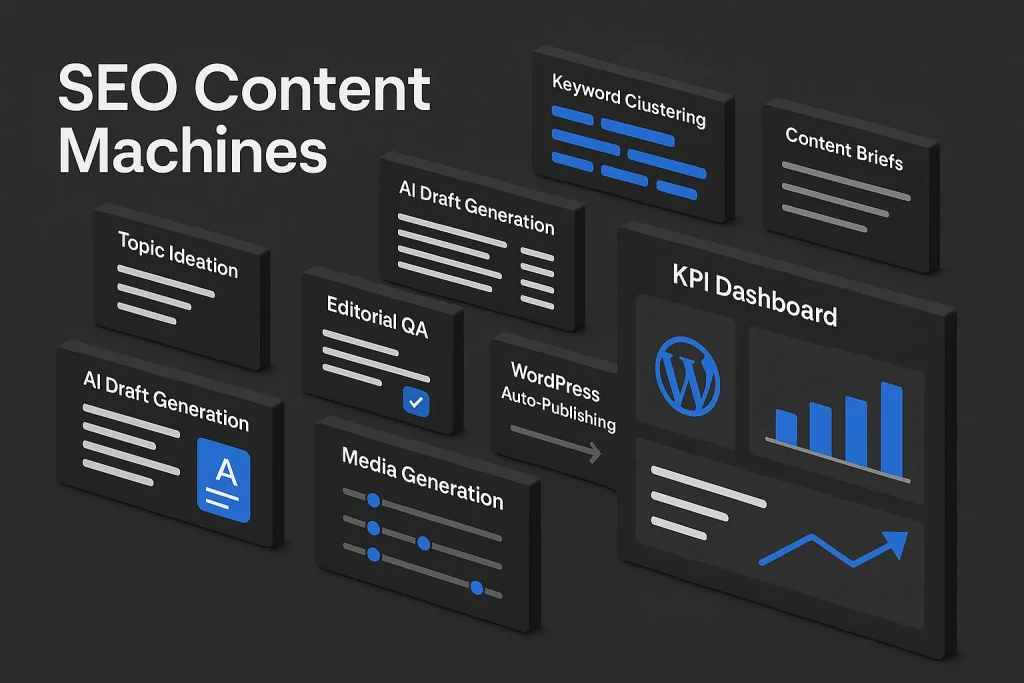
At the operating level, a content machine is an assembly line for briefs, drafts, optimization, links, media, approvals, and publishing. At the business level, it is a margin system. The agency that can standardize inputs, reduce handoff friction, and automate the repeatable middle of production can scale content at lower overhead than a team that treats every article like a custom build. We have seen this pattern repeatedly: the winners are not replacing editors. They are replacing chaos.
Those numbers support the real operating thesis: scalable agencies will rely on integrated workflows, not disconnected tools. According to W3Techs WordPress data, WordPress remains the dominant CMS base; Orbit Media 2025 shows faster content production cycles; and CMI 2025 confirms that AI adoption is moving into operational systems.

What Is a Content Machine for SEO Agencies?
A content machine is a managed production system for creating, optimizing, approving, and publishing content at scale. In agency terms, it is the combination of process design, role definition, templates, software, QA gates, and CMS execution that lets a team move from demand intake to published assets without reinventing the workflow every time.
That definition rules out a common mistake. A shared folder and a few freelancers are not a content machine. Neither is a prompt library connected to a language model. To build a content machine, an agency needs structure across five layers: strategic inputs, generation engine, editorial controls, publishing infrastructure, and measurement. If one layer is weak, efficiency drops. If several are weak, automation stops helping and starts multiplying inconsistency.
For SEO agencies, the exact shape of the machine matters because search performance depends on alignment. Topics need to fit the client’s topical authority and commercial intent. Keywords need logical clustering. Briefs need to define search intent and page structure. Drafts need revision for expertise and factual integrity. Internal links need to support information architecture. Publishing needs to preserve metadata, headings, schema fields where relevant, and formatting integrity inside WordPress.
So the most useful definition is operational: a content machine is a repeatable content production workflow that converts strategy into compliant, on-brand, search-ready pages with low variance across writers, editors, and accounts. On our view, that low variance is the real asset. Speed is useful, but consistency is what protects margin.
Google’s own documentation points in the same direction. Its guidance on helpful content prioritizes people-first usefulness over content created mainly to manipulate rankings, and its updated quality framing puts more weight on experience within E-E-A-T. See Google Search Central guidance on helpful content and the explanation of Google E-E-A-T. For agencies, the implication is simple: automation can accelerate production, but experience signals and editorial judgment still have to be built into the system.
What a content machine is not
It is not a blind bulk generator. It is not a publishing queue with no content QA workflow for SEO. It is not a spreadsheet of titles handed to anonymous writers without semantic guidance. And it is definitely not one giant prompt trying to handle research, writing, optimization, and CMS formatting in a single pass.
Those approaches fail for a simple reason: scale exposes defects faster. Weak briefs create irrelevant drafts. Weak QA creates hallucinated claims. Weak linking creates orphan pages. Weak publishing controls create formatting issues and metadata gaps. Weak performance review keeps agencies producing low-yield content because volume can look like progress when it is really waste.
What a healthy agency content machine does well
A strong content assembly line for SEO does four things well, again and again. First, it standardizes decisions that do not need to be reinvented. Second, it keeps human review where expertise materially changes the outcome. Third, it connects tools instead of creating endless copy-paste labor. Fourth, it measures production and search impact separately, because speed alone is not business value.
We think this is where many agencies misread automation. They chase faster drafting, when the bigger gain usually comes from fewer handoffs and fewer avoidable revisions.

Business Case and KPIs for Scaling Content
Agencies do not invest in content machines because automation is trendy. They invest because content production is one of the easiest service lines to wreck with unmanaged labor. Every unnecessary handoff, repeated briefing step, formatting correction, revision loop, and manual WordPress upload adds cost without adding client value. The business case for scale is operational efficiency plus output consistency.
There are three core business drivers behind a content at scale model for agencies:
- Margin protection: reduce labor hours per asset without lowering quality.
- Capacity expansion: increase the number of publishable pieces per month without proportional headcount growth.
- Service reliability: deliver a predictable publishing cadence, which supports client retention and planning.
Current market signals back this up. CMI reports that 45% of B2B marketers using generative AI are seeing more efficient workflows and 42% report improved content optimization, while 64% expect content teams to remain the same size. Demand for throughput is rising faster than headcount. Agencies that fail to standardize content operations will feel that pressure in margin first.
A practical way to design KPIs is to split production KPIs from SEO KPIs.
| KPI Group | What to Measure | Why It Matters | Typical Owner |
|---|---|---|---|
| Production | Brief cycle time, draft turnaround, QA pass rate, publish lead time | Reveals bottlenecks and labor waste | Content operations lead |
| Quality | Revision rate, factual corrections, plagiarism incidents, brand-tone deviations | Prevents scaling low-quality output | Managing editor |
| SEO | Indexation, rankings by cluster, internal link coverage, traffic by page type | Shows whether the machine creates discoverable assets | SEO strategist |
| Commercial | Gross margin per content package, retention, upsell rate, cost per published asset | Proves operational value to agency leadership | Account lead or ops director |
The key point is straightforward: a content machine is not judged by article count alone. It is judged by the ratio between effort, quality, publishing velocity, and business outcome.
The benchmarks from Orbit Media help frame planning too. Longer posts were associated with a 39% strong-results rate versus a 21% benchmark, and publishing multiple times per week reached a 37% strong-results rate. That does not mean every agency should publish only long-form content or force cadence at any cost. It means the machine should support two realities at once: deeper assets often outperform shallow ones, and steady publishing rhythm still matters.
For content operations, the implication is clear: agencies need a mixed portfolio model. Pillar content, standard commercial posts, and lighter support content should all live inside one controlled pipeline.
We would not over-romanticize volume here. On the ground, the agencies that win are usually the ones that know which asset types deserve depth and which ones simply need clean execution.

System Architecture: Inputs → Engine → Outputs
An agency content machine should be designed as a system, not as a chain of disconnected tasks. The simplest architecture is inputs, engine, outputs.
Inputs
Inputs define what the system is allowed to create and how. This includes the client’s ICP, service lines, target countries, primary offers, topical boundaries, content goals, page types, keyword clusters, internal linking priorities, brand voice instructions, compliance constraints, and editorial standards. Weak inputs create downstream waste because every later stage has to compensate for ambiguity.
Engine
The engine is the operational core. It turns raw content strategy into briefs, drafts, optimized pages, metadata, images, links, and publish-ready assets. In a modern ai content pipeline for agencies, the engine should also handle repeatable formatting logic and handoff rules. This is where agencies either gain leverage or create invisible friction.
Outputs
Outputs are not just articles. They are approved, structured assets that can be published, tracked, and improved. A useful output package usually includes the title, meta title, meta description, article body, section structure, internal links, media placeholders, CTA logic, category or taxonomy decisions, and publishing destination.
That architecture matters because it shows where standardization belongs. Keyword clustering belongs upstream. Draft generation belongs in the engine. Performance review belongs downstream. When agencies blur those boundaries, rework follows.
| Layer | Typical Components | Failure Mode | Operational Fix |
|---|---|---|---|
| Inputs | Topic maps, clusters, SEO briefs, brand rules | Irrelevant or overlapping content | Standardized brief templates and approval gates |
| Engine | AI drafting, SEO optimization, internal linking, media prep | Inconsistent quality and heavy manual corrections | Integrated automation with revision checkpoints |
| Outputs | Publish-ready pages, metadata, links, media, CMS entries | Formatting loss and publishing delays | Direct WordPress automation and validation checks |
Once this architecture is explicit, agencies can decide which steps should stay human-led and which should be system-led. On our experience, that clarity alone removes a surprising amount of waste.
The Core Stack: Why Autopilot SEO as the Engine
Most agency stacks already contain pieces of the workflow: keyword tools, docs, QA tools, a CMS, and project management software. The real problem is fragmentation. When every stage lives in a different interface and depends on manual handoffs, the agency pays a tax in copy-paste work, context loss, and review drift. A scalable content machine needs a primary engine that cuts that fragmentation down.
That is where Autopilot SEO fits best: as the system layer that connects topic ideation, semantic planning, article structure, drafting, image generation, internal optimization, and WordPress publication. For agencies trying to scale content production for SEO agencies, the value is not only speed. It is consistency across accounts.
Autopilot SEO is especially practical in an agency setting because the production problem is repetitive but not identical. Every client needs content. Every client needs keywords. Every client needs SEO structure. Every client needs publishing. But every client also has brand differences, market differences, and commercial priorities. The right engine automates the shared infrastructure while leaving room for account-specific controls.
OpenAI’s writing guidance recommends a Plan → Draft → Revise → Package workflow and explicitly treats AI outputs as drafts that need review. See the OpenAI writing guide. That model aligns neatly with an agency operating system built around Autopilot SEO: strategy and structure first, draft acceleration second, revision controls third, and publishing packaging last.
Agencies comparing tool sprawl with integrated systems should also look at the labor hidden in tool switching. A stack can seem cheap on paper and still be expensive in practice. We consider that one of the most common blind spots in content operations.
For a practical comparison framework, teams evaluating choosing the right workflow tool should assess not just writing quality, but also handoff reduction, internal linking support, publishing readiness, and editorial repeatability.

Workflow SOPs: From Topic Ideation to Published Post
A content machine becomes real only when it turns into SOPs. Agencies that rely on informal knowledge cannot scale cleanly because throughput depends on specific people remembering exceptions. Standard operating procedures should define the exact sequence, input requirements, decision points, and approval rules for each stage.
A practical workflow for an agency content assembly line looks like this:
- Topic intake and priority scoring: define client goals, target cluster, business value, and content type.
- Semantic planning: group primary and secondary keywords, map search intent, and assign internal link targets.
- Brief creation: specify angle, audience, outline, trust requirements, exclusions, CTA, and page-level SEO instructions.
- AI drafting: generate the first structured version inside the approved format.
- Editorial revision: improve factual precision, voice, examples, transitions, and argument quality.
- SEO QA: validate headings, keyword use, internal links, metadata, and formatting.
- Compliance and originality check: scan for duplication, unsupported claims, or risky language.
- Media and formatting: add visuals, alt text, captions, and layout elements.
- CMS packaging and publishing: push into WordPress, assign categories, review render, and schedule or publish.
- Post-publish monitoring: confirm indexation, track early engagement, and log fixes.
This is where standardized note capture can reduce upstream labor. Agencies doing discovery calls or SME interviews can convert raw conversations into briefs faster by using AI notes for SEO outlines instead of manually restructuring every call transcript.
The most important SOP principle is simple: every stage needs a definition of done. A brief is not done because it has a title. It is done when the target query, intent, internal linking targets, audience pain point, and commercial angle are explicit. A draft is not done because it hit word count. It is done when the argument is coherent, sections align with intent, and revision burden is acceptable.
How SOPs reduce variance
In agency operations, variance is expensive. One editor may enforce clean structure while another tolerates weak subheads. One writer may cite examples while another fills space with generic filler. One account manager may define internal link targets up front while another leaves them to the last minute. SOPs reduce that inconsistency by turning quality expectations into visible process rules.
This is also why a content production workflow should include template libraries: title formulas by intent, section frameworks by page type, CTA blocks by service line, and brand-adjusted tone instructions. Templates are not creative constraints. They are throughput safeguards.
We have found that agencies often resist templates for the wrong reason. They fear sameness. In practice, good templates do the opposite: they remove repetitive decisions so editors can spend more attention on substance.
Roles, RACI, and Throughput Planning
A content machine fails when nobody owns the bottlenecks. Role clarity matters as much as software. Agencies do not need huge teams to run a scalable pipeline, but they do need explicit responsibility across strategy, production, QA, and publishing.
A lean operating model usually includes these roles: SEO strategist, content operations manager, editor, specialist reviewer or SME, publishing manager, and account owner. In smaller agencies, one person may cover multiple roles. That is fine as long as ownership is still explicit.
| Function | Primary Responsibility | RACI Role |
|---|---|---|
| SEO strategist | Topic selection, clustering, intent mapping | Responsible |
| Content ops lead | Workflow design, SLA tracking, throughput planning | Accountable |
| Editor | Revision, tone control, readability, evidence cleanup | Responsible |
| SME or reviewer | Experience validation and trust signals | Consulted |
| Publishing manager | CMS packaging, scheduling, render checks | Responsible |
Throughput planning should be based on real operating data, not assumptions. Orbit Media’s average creation time of 3 hours and 25 minutes is a useful external benchmark, but every agency should measure its own time by content type. A 900-word FAQ expansion is not the same production unit as a 2,500-word pillar page. Throughput planning should therefore be based on weighted asset classes, not article count alone.
For example, an agency may define three classes: standard post, deep commercial page, and pillar asset. Each class gets a typical effort score across briefing, drafting, revision, QA, and publishing. Once those effort scores stabilize, managers can forecast monthly capacity without guessing.
The decline in non-AI usage shows that agencies are no longer deciding whether to automate. They are deciding whether to automate with enough governance to preserve quality. That is the real fork in the road.

Quality Controls: E-E-A-T, Fact‑Checking, Tone, Readability
The fastest way to break a content machine is to treat generated drafts as finished work. Trust data from CMI makes that clear: only 4% of B2B marketers reported a high level of trust in generative AI outputs, while most reported medium or low trust. That is not an argument against AI. It is an argument for a robust QA layer.
Quality control in agency content operations should address four issues.
E-E-A-T and experience signals
If a client’s topic depends on first-hand operational credibility, the article should include experience-based details, process nuance, examples, or reviewer input that signals real-world familiarity. This matters even more in B2B SEO, SaaS, finance, legal-adjacent, or health-adjacent content, where generic drafting is easy to spot and easy to distrust.
Fact-checking
Factual claims, named products, compliance language, and competitive assertions should be reviewed before publishing. Agencies need a visible rule: unsupported claims do not survive revision. If a fact cannot be validated, remove it or reframe it.
Tone control
Brand voice is one of the first casualties of unmanaged automation. A strong editor standardizes sentence rhythm, claim strength, vocabulary, and CTA behavior. For B2B content, that usually means cutting inflated claims, removing generic enthusiasm, and making transitions more direct.
Readability and structure
Readable content is easier to scan, easier to edit, and easier to reuse. Paragraph length, subhead hierarchy, list discipline, and example density all matter. Readability is not simplification. It is operational clarity in writing form.
Agencies that want a stronger post-generation editing framework can borrow from resources on writing human AI content that converts and use an AI writing checker for brand protection as part of the revision stage.
Originality checks should also be built into the workflow. Even when deliberate copying is not the issue, repetitive AI phrasing and accidental overlap can erode trust. That is why many teams include an AI plagiarism checker for content teams before publication.
The operational conclusion is blunt: scalable systems need revision protocols, not just generation speed. On our view, this is where a lot of agency AI experiments quietly fail.
On‑Page SEO and Internal Linking Automation
On-page optimization gets expensive when it is left to the end. A content machine should embed on-page SEO rules inside the brief and draft stages so the editor is refining, not rebuilding. That includes primary topic alignment, intent fidelity, heading structure, semantic coverage, metadata preparation, and internal linking targets.
Internal linking is one of the highest-leverage areas to standardize because it is repetitive, rules-based, and strategically important. An agency should define link logic by cluster, page hierarchy, anchor pattern, and destination priority. This is how automated internal linking in WordPress becomes useful rather than random. The system should know which pages deserve authority flow, which support pieces should point upward, and where contextual relevance matters more than anchor exactness.
A strong internal linking layer usually includes these controls: approved destination pools by client, page-type linking rules, maximum link density per article, exclusion rules for weak or outdated URLs, and post-publish link validation. Without those controls, internal link automation creates noise.
For agencies running multiple client accounts, it also helps to classify content into hub, spoke, and commercial pages. Hub pages attract broader informational demand, spoke pages deepen topical coverage, and commercial pages convert. The internal linking system should deliberately connect those three layers rather than leaving paths to editorial instinct alone.
We would underline one risk here. Internal linking automation is powerful, but sloppy rules can spread irrelevance at scale just as efficiently as they spread authority.

Media Generation and WordPress Publishing Automation
Production systems often focus heavily on text and underestimate packaging. That is a mistake. Many hours in agency workflows are lost after the article is already written: sourcing visuals, writing alt text, formatting lists, fixing embeds, assigning categories, cleaning heading hierarchies, and scheduling posts in WordPress. A real content machine removes as much of this repetitive work as possible.
WordPress is the logical default for this layer because of its market dominance and publishing flexibility. For agency operations, that matters in practical terms: if a client estate is concentrated in WordPress, standardization gets easier. Category mapping, featured image logic, metadata handling, media descriptions, and publishing workflows can be templated and reused.
The agency should define packaging standards before automation is activated. That includes title casing rules, slug conventions, featured image requirements, alt text guidelines, link rendering checks, shortcode or block exclusions, CTA placement, and post status rules. When those standards are defined, automate wordpress publishing workflow tasks become low-risk. When they are undefined, automation simply publishes inconsistency faster.
Media generation should also follow editorial constraints. Images should support the article’s argument or product context, not act as generic decoration. For B2B SaaS and SEO content, that usually means dashboards, workflows, analytics interfaces, content planning scenes, and CMS or publishing visuals. Alt text should be informative and natural, not stuffed with keywords.
The same principle applies to meta packaging. If title tags, descriptions, featured images, and taxonomy decisions are generated in one consistent workflow, the publishing step becomes an execution layer rather than a rewrite layer.
Budget expectations matter because they show where agency buyers are likely to support infrastructure investments: in systems that improve throughput and optimization without requiring equal team growth.
Measurement: Production Metrics and SEO Impact
Measurement has to answer two separate questions. First, is the machine running efficiently? Second, is the content performing? Agencies that merge those questions into one dashboard usually misdiagnose problems.
Production metrics should include cycle time from brief to publish, average revision rounds, percentage of drafts requiring major rewrite, publishing error rate, percentage of posts published on schedule, and touch time per asset class. These numbers show whether the pipeline is operationally healthy.
SEO impact metrics should include indexation coverage, rankings by cluster, internal link coverage, impressions by page type, clicks by content cohort, page-level updates required after publication, and traffic contribution by article class. These numbers show whether the machine is strategically aligned.
Precise public benchmarks for automated internal linking throughput or WordPress auto-publishing error rates are not consistently available, so agencies need their own baselines. This is one of the few areas where internal operating data is more valuable than market averages. A content machine should therefore include a measurement loop from day one.
A simple reporting model is to review production weekly and SEO impact monthly. Weekly review catches bottlenecks while they are still operational. Monthly review gives content enough time to enter search systems and produce directional signals.
We think this split is underrated. When agencies confuse production speed with SEO success, they end up optimizing the wrong bottleneck.

Risk Management: Duplicates, AI Detection, Penalties
Risk management in content operations should be practical, not theatrical. Agencies do not need superstition around AI detection tools. They need controls that reduce actual publishing risk.
The main risk categories are duplication, weak originality, unsupported claims, topic sprawl, over-automation, and publishing inconsistencies. Duplication risk includes both direct overlap and structural sameness across many articles. Weak originality shows up when content says familiar things in generic ways without client-specific insight. Unsupported claims create trust and legal risk. Topic sprawl happens when teams produce many pages across loosely related queries hoping something ranks, even though Google explicitly warns against that pattern. Over-automation becomes obvious when content lacks editorial value. Publishing inconsistencies damage UX and can weaken trust signals.
To manage risk, agencies should formalize red-flag checks before publish: topic relevance to client cluster, claim verification, originality scan, internal duplication review, thin-section detection, and render validation inside WordPress. AI detection scores alone should not govern publishing decisions because they do not reliably measure quality or usefulness. The more useful question is whether the content is distinctive, reliable, and structurally sound.
Google’s helpful content guidance remains the strongest directional standard here: prioritize usefulness, avoid mass production across many unrelated topics, and make sure automation adds value rather than replacing judgment.
On our view, this is the mature position. Not anti-AI. Not blindly pro-AI. Just operationally serious.
Cost Model and ROI Scenarios
The ROI of a content machine depends less on software price than on the cost of unmanaged labor. Agencies often underestimate the minutes lost in handoffs, formatting, approvals, and rework. Multiply those minutes across dozens or hundreds of monthly assets and the economics become obvious.
A practical cost model should include four categories: strategy labor, production labor, software and infrastructure, and QA overhead. Agencies should compare their current per-asset cost with a standardized future-state cost after automation. That comparison should be made by asset class, not by average article count.
For example, if the current workflow requires separate manual steps for research preparation, brief formatting, draft generation, editing, internal link insertion, image handling, and WordPress publication, the agency may have seven separate labor surfaces. A consolidated engine reduces several of them at once. Even if editorial review time remains substantial, the total cost per published asset can still drop because low-value labor declines.
ROI should also be evaluated at the account level. If an agency can deliver a higher monthly content volume with similar headcount, it can improve margin on existing retainers, support upsells, or serve more accounts without linear staffing growth. Given that 64% of B2B marketers expect content teams to stay the same size, this operational leverage is becoming central to agency competitiveness.
Another useful scenario is risk-adjusted ROI. A slightly slower but better-governed machine often beats a faster uncontrolled one because it produces fewer rewrites, fewer publish errors, and fewer client escalations. Sustainable ROI comes from reliable throughput, not maximum throughput.
We consider this one of the hardest lessons for agency owners to accept. Fast and messy feels productive. It usually is not.
30/60/90‑Day Implementation Roadmap
A content machine should be implemented in phases. Trying to automate every step at once usually creates confusion because the agency has not yet stabilized the process logic.
First 30 days: map and standardize
Audit the current workflow from topic intake to publishing. Identify every tool, handoff, approval step, and frequent failure point. Define standard asset classes, create brief templates, establish QA rules, and document publishing requirements. Pick a small client set for the pilot.
Days 31 to 60: integrate and pilot
Set up the primary engine, test generation templates, connect the publishing workflow, and run a controlled pilot for a limited number of article types. Measure cycle time, revision burden, and publish accuracy. Adjust templates and checkpoints rather than forcing volume too early.
Days 61 to 90: scale and instrument
Expand the machine to additional clients or content categories. Introduce dashboards for throughput, revision rates, and post-publish SEO metrics. Formalize ownership through RACI and refine internal linking and WordPress automation rules based on pilot lessons.
The most important implementation rule is sequence discipline. Standardize first, automate second, scale third. Reverse that order and you usually scale rework.
Case Snapshot: An Agency Content Assembly Line in Action
Consider a mid-sized SEO agency managing multiple B2B accounts with a mix of informational and commercial content. Before standardization, each account team handles briefs differently, drafts arrive in mixed formats, internal links are added late, and WordPress publication requires manual cleanup. Output is possible, but scale is expensive because every article behaves like a partial custom project.
After implementing a content assembly line for SEO, the agency restructures the system around a shared engine. Topic ideation follows cluster rules. Briefs are generated from standardized inputs. Drafting happens in a repeatable template. Editors focus on evidence, positioning, tone, and examples rather than rebuilding structure. Internal linking targets are pre-assigned. Media placeholders and metadata are included before CMS handoff. WordPress publishing becomes a controlled packaging step instead of a rescue operation.
The immediate effect is not always a dramatic jump in word count. The more important effect is lower operational variance. Articles move through the pipeline with fewer surprises. New team members ramp faster because the system is documented. Client delivery becomes more predictable. Margin improves because low-value labor declines.
This is also where an engine like SEO Autopilot becomes commercially useful. Rather than forcing agencies to stitch together ideation, drafting, optimization, and publication through fragmented tools, it centralizes the workflow that actually creates leverage.
Interesting detail here: the best gains often look boring from the outside. Fewer formatting rescues. Fewer missed links. Fewer revision loops. But that is exactly where scalable content operations are won.
Final Checklist for a Reliable Content Machine
A reliable content machine is not defined by how much it automates. It is defined by how well it balances speed, control, and search usefulness. Before scaling an agency pipeline, validate the following points:
- Topic selection is tied to clusters, intent, and business value.
- Every article type has a structured brief template.
- AI outputs are treated as drafts, not final authority.
- Editors have clear QA rules for facts, tone, readability, and E-E-A-T.
- Internal linking logic is planned before publication.
- WordPress packaging standards are documented and automated where safe.
- Production KPIs and SEO KPIs are tracked separately.
- Throughput targets are based on asset classes, not article count alone.
- Risk checks cover duplication, unsupported claims, and topic sprawl.
- Ownership is explicit across strategy, revision, and publishing.
If those conditions are in place, an agency can scale content without turning operations into a quality liability. If they are missing, automation will magnify disorder rather than output.
Why SEO Autopilot Fits This Model
For agencies building content machines, the priority is not another isolated writing tool. The priority is a production engine that supports semantic planning, article generation, optimization, media handling, internal linking logic, and WordPress publication inside one operational flow. That is the role SEO Autopilot is built to fill.
Instead of expanding headcount to cover every repetitive step, agencies can use SEO Autopilot to reduce manual work in briefing, drafting, formatting, and publishing while keeping human review where it matters most. For teams under pressure to deliver more content with stable staffing, that combination of automation and editorial control is the most practical route to scalable content operations.
We think the case is pretty clear. Agencies do not need more tools. They need fewer gaps between strategy, production, QA, and publishing.
On our view, the main lesson is simple: content machines work when they are treated as operating systems, not writing hacks. The strongest setups combine structured inputs, a stable engine, clear QA, and disciplined publishing. Businesses that get this right will scale content at lower operational cost without turning quality into collateral damage. Businesses that skip governance will publish faster for a while, then pay for it in rewrites, weak rankings, and client friction.
Our realistic forecast is that the next wave of agency advantage will come from better content operations, not just better prompting. We also expect more teams to adopt an ai content pipeline for agencies that connects drafting, QA, linking, and CMS execution in one flow. In that environment, the agencies with the best systems will not necessarily publish the most. They will publish the most reliably.
FAQ
What is a content machine in SEO?
A content machine in SEO is a structured production system that turns content strategy into publish-ready pages through repeatable workflows. It usually includes topic selection, keyword clustering, briefing, AI drafting, QA, internal linking, and CMS publishing.
How many posts per month can an agency produce with automation?
There is no universal number because capacity depends on article type, review depth, team structure, and client complexity. We recommend measuring throughput by asset class and touch time, then scaling from real operating data rather than generic output claims.
How do we prevent AI content penalties?
The safest approach is not to obsess over “avoiding AI” but to publish useful, reliable, reviewed content. Use AI as a draft accelerator, keep strong QA, avoid mass production across unrelated topics, verify claims, and align with people-first content principles.
Which roles are needed to run a content assembly line?
At minimum, agencies need ownership for SEO strategy, editorial revision, operations management, and publishing. Smaller teams can combine roles, but responsibility for briefs, QA, and CMS execution should still be explicit.
What KPIs prove the ROI of a content machine?
The most useful KPIs combine production efficiency and business outcome: cost per published asset, cycle time, revision rate, publish-on-time rate, indexation, traffic by content cohort, and margin per account. Article volume alone does not prove ROI.