
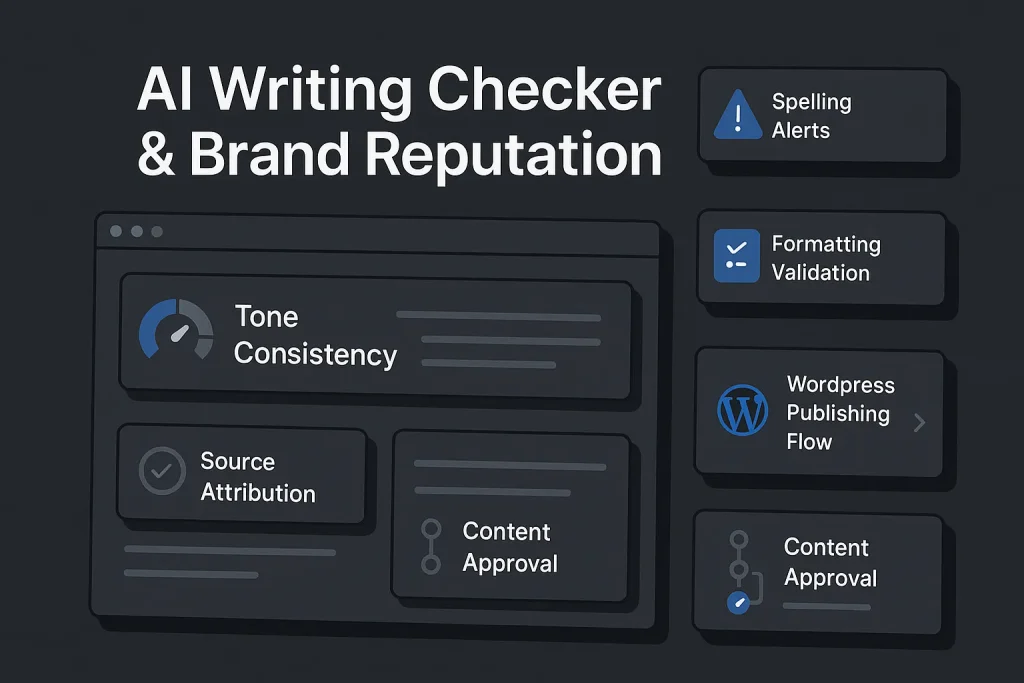
Brand damage rarely starts with a headline-grabbing scandal. More often, it begins with smaller, visible failures: inconsistent capitalization in headings, abrupt tone shifts between sections, sloppy punctuation, weak attribution, and posts that look rushed the moment they hit production. An ai writing checker matters because it catches those signals before readers, clients, and search engines do.
For content teams publishing at scale, editorial quality is no longer a nice final polish. It is process control. Google’s people-first guidance explicitly asks publishers to assess whether content contains spelling or stylistic issues or appears hastily produced, and it also warns teams to reevaluate workflows when they use extensive automation across many topics. We see that as a straightforward SEO operations issue, not just a brand one. An Google Search Central guidance on helpful content connects quality checks with trust, usefulness, and publishing discipline.
That last point matters for procurement and governance. A strong workflow does not treat an ai essay checker, best ai detector, or written by ai checker as a final authority. It treats automated checks as one layer in a broader editorial system that verifies language quality, structural consistency, and attribution hygiene before publication.

Executive summary: why an AI writing checker protects brand reputation
An ai writing checker protects brand reputation by reducing visible quality defects before they become public proof of weak process control. In business terms, it solves four problems at once: it lowers the risk of publishing sloppy content, supports a more consistent brand voice across large content volumes, improves readability for users, and adds a measurable QA step to SEO operations.
The reputational upside comes from consistency more than novelty. Readers usually forgive one typo. They do not forgive a pattern of avoidable friction. If a company blog swings between polished thought leadership and mechanical, uneven, AI-heavy copy, the issue is not only style. It tells readers the organization does not fully control its own publishing standards.
That is why tone, formatting, and wording checks matter as much as grammar. Microsoft’s writing guidance notes that small differences in grammar, spelling, and punctuation can feel abrupt and confusing to readers. For brands, abruptness becomes inconsistency. Inconsistency becomes lower trust.
At scale, this turns into a systems issue. A content team producing two posts a month can often fix errors manually. A team producing dozens of articles across product lines, regions, or client accounts needs machine-assisted editorial review before content enters WordPress. On our reading, that is the narrow but high-value role of an ai writer checker: identify predictable defects before they spread into production.
What an AI writing checker is (vs AI detector and plagiarism checker)
An AI writing checker is a quality-control layer that reviews content for language, structure, consistency, and presentation issues. Its main job is not to decide whether text was generated by AI. Its job is to determine whether the draft is fit for publication.
That distinction matters because many teams blur four different tools:
- AI writing checker: reviews spelling, grammar, tone, readability, heading logic, capitalization, style consistency, and sometimes citation or formatting hygiene.
- AI detector: estimates whether a text may resemble machine-generated writing patterns. This is where terms like best ai detector, turnitin ai checker, winston ai, originality ai, or walter writes ai usually enter the conversation.
- Plagiarism checker: compares content against known sources to identify overlap, duplication, or unattributed reuse, including some use cases for a plagiarism checker for ai generated text.
- Human editorial review: evaluates business accuracy, legal sensitivity, audience fit, and contextual nuance that no automated system can fully judge.
The market often mixes these categories because teams want one tool to do everything. We think that expectation is unrealistic. An ai paper checker, essay ai checker, or chatgpt essay checker may be useful for educational or draft-review scenarios, but enterprise publishing needs a broader workflow. The real question is not whether text is “AI.” It is whether low-quality output is about to become public-facing content.
The distinction is also supported by vendor guidance. Turnitin’s current explanation of AI writing detection explicitly acknowledges that false positives are possible and withholds exact scores in the 1% to 19% range. That is a clear signal: a detector should not act as a publishing gate by itself.
For SEO and brand operations, the more reliable model is layered QA:
- Draft generation or assisted writing.
- Editorial checks for spelling, tone, consistency, and formatting.
- Attribution and originality review where relevant.
- Optional detection signals as supporting evidence, not final judgment.
- Human approval before publication.
This is also the right frame when discussing a free ai checker, ai writing checker free, or ai checker for essays. Cost matters, of course. But on the practical side, the bigger issue is whether the tool supports a real business publishing workflow instead of performing one narrow classification task.

The three pillars: spelling, tone, and formatting consistency
Most reputational failures in content operations trace back to three editorial pillars: correctness, coherence, and presentation. In plain terms, that means spelling, tone, and formatting consistency.
Spelling and surface correctness
Spelling errors are the most obvious problem, but they are not the only one. Surface correctness also includes punctuation, grammar agreement, capitalization patterns, abbreviation rules, and repeated wording glitches. A post with frequent low-level errors feels rushed even when the underlying information is accurate.
Google’s people-first framing matters here because “sloppy or hastily produced” usually shows up through small defects rather than catastrophic mistakes. These are exactly the issues an ai written content checker should catch early. We have seen this repeatedly in scaled content programs: tiny errors rarely stay tiny once they become routine.
Tone consistency across sections and authors
Tone problems are harder to spot than spelling errors, but they create deeper brand friction. Common examples include a formal opening followed by sales-heavy language, switching between technical and oversimplified phrasing, inconsistent use of first-person voice, or abrupt changes in certainty level.
In B2B publishing, inconsistent tone damages credibility because buyers expect control. A cybersecurity vendor, SaaS platform, or agency that sounds authoritative in one section and generic in the next looks operationally immature. That is why an effective ai writer checker should flag tonal drift, not only grammar.
Formatting consistency as a trust signal
Formatting is often underrated because teams treat it as a design issue rather than an editorial one. In practice, formatting inconsistency changes how trustworthy content feels. Uneven heading levels, inconsistent bullet formatting, poor spacing, random bolding, mixed title case, and disorganized tables make content harder to scan and easier to dismiss.
Digital.gov’s plain-language principles emphasize active voice, clear organization, lists, and tables because readability depends on structure as much as wording. GSA content standards make the same point from a usability angle: public-facing content should be findable, understandable, and usable the first time people read it.
For scaled content operations, the implication is direct. An ai writing checker should inspect not only sentence-level quality but also repeatable style rules such as heading hierarchy, paragraph length, capitalization style, list treatment, spacing, and CTA formatting.
The following table shows how these three pillars affect brand risk in practice.
| Pillar | What the checker should inspect | Brand risk if ignored | Operational benefit |
|---|---|---|---|
| Spelling and grammar | Typos, punctuation, agreement, capitalization, repeated words | Content appears rushed or low-quality | Fewer visible errors at publish time |
| Tone consistency | Voice, formality, certainty, audience fit, promotional intensity | Mixed signals weaken authority and trust | More consistent brand expression across authors |
| Formatting consistency | Heading order, spacing, lists, tables, bolding, title case | Poor scanability and uneven presentation | Stronger readability and repeatable publishing standards |
These pillars are simple. That is exactly why they matter. They cover most of the visible issues that shape trust before deeper content quality is even assessed.
This comparison uses an editorial-risk weighting model rather than third-party market statistics: formatting and tone failures often create broader trust damage than isolated spelling mistakes because they affect the whole reading experience.
Where inconsistencies break trust: real-world brand risks and examples
Trust falls when users notice a mismatch between the brand promise and the publishing output. The most common failures are not theoretical. They show up every day in product blogs, resource centers, agency deliverables, and startup documentation.
Scenario 1: B2B SaaS thought leadership that reads like stitched output
A SaaS company publishes a long-form SEO article. The opening is polished, the middle section suddenly becomes repetitive and generic, and the final section shifts into exaggerated claims. Even if the article ranks, a prospective buyer may read it and conclude that the company’s communication standards are uneven. The issue is not just whether the draft was AI-assisted. The issue is that the final asset feels under-edited.
Scenario 2: Agency production at scale across multiple client voices
An agency runs content for ten clients. Without a standardized ai writing checker, editors rely on memory and ad hoc review. Some posts use sentence case headings, others title case. Some use concise B2B language, others read like consumer marketing. Over time, client perception shifts from “efficient partner” to “high-volume vendor.” We have seen that shift happen quietly, which is what makes it dangerous.
Scenario 3: WordPress publishing with broken formatting inheritance
A content team publishes from multiple tools into WordPress. Copy is technically correct, but list spacing, heading nesting, quote styles, and paragraph blocks vary across posts. The site starts to look fragmented. This matters because platform-level style consistency is not optional. WordPress documentation on styles shows that typography, spacing, padding, margins, and block layout can be standardized site-wide. If teams ignore those controls, every article becomes a formatting exception.
Scenario 4: Attribution hygiene becomes a public trust issue
When brands use AI-assisted drafting, attribution becomes part of quality control. Readers increasingly connect AI output with accountability. Pew Research reporting on public attitudes found that 54% of U.S. adults say generative AI programs should credit their sources, and 75% say sources should be credited when the output closely matches a journalist’s wording. For a brand team, that means citation hygiene is not academic housekeeping. It is reputation management.
These examples explain why a check essay for ai workflow is not enough for business publishing. An ai generated essay checker might answer a narrow classroom-style question. A brand team needs broader pre-publication checks that account for public trust, user experience, and consistent execution.
Evaluation criteria for enterprise-grade AI writing checks
Not every tool marketed as an AI checker is suitable for enterprise publishing. Many are built for one-off inspection rather than repeatable editorial operations. The right evaluation framework should prioritize controllability, transparency, and workflow fit.
Use the following criteria when assessing an ai writing checker for brand publishing:
| Criterion | Why it matters | What strong performance looks like |
|---|---|---|
| Editorial scope | A narrow detector cannot replace QA | Checks spelling, tone, readability, headings, formatting, and attribution cues |
| Rule consistency | Teams need repeatable standards | Applies the same voice and formatting logic across all drafts |
| Workflow integration | Quality gates fail if they sit outside production | Runs automatically before CMS publishing |
| Explainability | Editors need actionable feedback, not opaque scores | Flags specific issues by type and location |
| Human override | False positives and exceptions are inevitable | Supports manual approval and exception handling |
The best systems behave less like a novelty detector and more like a preflight checklist for content operations. That difference sounds subtle, but in practice it separates useful software from dashboard theater.
Teams comparing tools such as turnitin ai checker, winston ai, or originality ai should evaluate them within this broader framework. Detection outputs may be useful, but they do not replace editorial validation. If the organization also needs to rewrite AI content to improve engagement and rankings, that work should happen before publication inside a controlled workflow, not after the content has already gone live.
Workflow: pre-publication checks in Autopilot SEO before WordPress
The strongest comparison angle here is not “which detector is most accurate.” The more defensible business question is simpler: where should quality control happen in the publishing workflow? For scaled SEO operations, the answer is before content reaches WordPress.
Autopilot SEO’s built-in editorial checks fit this requirement because they can be framed as pre-publication quality control inside the content pipeline. That position is much stronger than claiming any single detector can definitively prove whether a draft was written by AI.
Why pre-publication is the right control point
Quality issues are cheaper to fix before publishing than after indexing, distribution, stakeholder review, or client approval. Once a post is live, even small corrections create extra coordination cost. Internal links may need updating, stakeholders may need re-notification, and readers may have already seen the flawed version.
Pre-publication checks solve this operationally by inserting a QA layer between draft completion and WordPress publication. On our experience, this is where teams get the clearest ROI: not in chasing perfect detection scores, but in reducing preventable cleanup work.
What the workflow looks like in practice
A practical Autopilot SEO workflow can look like this:
- Generate the article draft with topic, search intent, semantic coverage, and SEO structure.
- Run built-in editorial checks for spelling, punctuation, heading hierarchy, tonal consistency, and formatting patterns.
- Review flagged issues that may affect credibility, readability, or visual consistency.
- Approve or revise the draft based on business rules.
- Publish to WordPress only after the QA threshold is met.
This approach is especially useful for teams managing multi-site publishing, client content, or high-output editorial calendars. It creates one consistent gate instead of relying on each writer or editor to remember every style rule manually.
It also aligns with platform reality. WordPress offers centralized style controls, but those controls do not correct bad structure or inconsistent source usage by themselves. A smart workflow combines content-level validation with CMS-level consistency.
This workflow chart illustrates a maturity progression: the closer quality control moves to the draft stage, the fewer issues survive into the final publishing step.
If the team is also evaluating detector outputs, it helps to understand why every AI writing detector is flawed. That context supports a more realistic policy: use detectors as secondary signals, but put brand protection into editorial QA and WordPress publishing controls.
Metrics and governance: how to prove impact and stay compliant
A writing-check workflow should not exist as an abstract quality promise. It should produce measurable operational evidence. Content leaders need metrics that show whether editorial checks reduce errors, shorten revisions, and improve consistency over time.
Core metrics to track
The most useful metrics are process-oriented rather than vanity-oriented:
- Pre-publication issue rate per article: number of spelling, tone, or formatting flags before approval.
- Post-publication correction rate: how often live content requires editorial fixes.
- Time to publish: whether QA improves throughput by reducing back-and-forth revisions.
- Formatting conformity rate: percentage of articles that pass structural rules on first review.
- Attribution compliance rate: percentage of articles meeting internal citation or source-reference standards.
- Human override rate: how often editors accept exceptions to automated flags.
These measures help governance in two ways. First, they show whether the workflow is improving process quality. Second, they keep teams from over-trusting automation by showing how often human judgment still matters.
The table below connects governance goals to measurable indicators.
| Governance goal | Metric | What improvement looks like |
|---|---|---|
| Reduce visible quality defects | Post-publication correction rate | Fewer edits after the article is live |
| Standardize voice and structure | First-pass conformity rate | More drafts pass without structural revision |
| Protect attribution standards | Attribution compliance rate | Fewer missing or weak source references |
| Avoid automation overreach | Human override rate | Editors resolve edge cases without policy confusion |
Governance gets stronger when these metrics are reviewed monthly by editorial and SEO leads together, rather than being isolated inside content operations. We consider that cross-functional review one of the most overlooked habits in AI-assisted publishing.
This chart highlights why citation and source handling should be part of AI-assisted editorial QA, not an optional afterthought.

Implementation checklist and rollout plan for content teams
Rolling out an ai writing checker across a content team is primarily a process design task. The tool matters, but the operating model matters more. The goal is to turn editorial expectations into repeatable pre-publication rules.
Phase 1: define editorial standards
Start by documenting rules the checker must enforce. This usually includes voice principles, acceptable reading level, capitalization standards, heading hierarchy, list usage, citation expectations, and banned phrasing patterns. If these rules live only in the editor’s head, automation will not scale.
Phase 2: map the workflow
Identify where the checks should run. For most teams, the ideal point is after draft generation and before CMS publishing. This keeps the QA step close to production while still allowing human review.
Phase 3: pilot on a limited content set
Test the workflow on a controlled set of posts, such as one blog category, one client account, or one product vertical. Measure how many flags are generated, which ones are useful, and where false alarms appear.
Phase 4: train editors on overrides
Every checker needs exception logic. Editors should know when to accept, revise, or override a flag. This prevents tool worship and keeps the workflow practical for expert content, technical language, or intentional brand variation.
Phase 5: integrate with reporting
Connect checker outputs to weekly or monthly editorial reporting. If QA is invisible, adoption declines. If teams can see fewer post-publication corrections and more consistent first-pass approvals, the process becomes durable.
For teams also working on originality risk, it is useful to pair writing QA with an AI plagiarism checker for your content team. That pairing separates two related but different concerns: editorial quality and content overlap.

Limitations and risk management: false positives, edge cases, and human QA
No checker should be treated as a complete authority over publication decisions. This is especially true when teams combine writing-quality tools with detection systems marketed as a free ai checker, ai checker for essays, or written by ai checker. False positives, contextual ambiguity, and style exceptions make full automation risky.
False positives are a governance issue, not only a technical issue
When a detector incorrectly labels human writing as AI-like, the cost is not limited to a bad score. It can create unnecessary rewrites, editorial friction, and flawed policy decisions. Turnitin’s choice to stop displaying precise percentages in the 1% to 19% range is important because it shows that uncertainty must be handled explicitly, not hidden behind a numeric output.
Edge cases are common in expert and templated writing
Technical documentation, compliance language, product comparisons, glossary sections, and highly structured SEO templates often resemble repetitive or formulaic text. That does not make them low-quality. A checker that penalizes every repeated structure will generate noise and lower adoption.
Human QA remains the final brand safeguard
Editors still need to validate factual fit, audience relevance, legal exposure, and nuance. Automation can detect patterns, but it cannot fully assess whether a claim is strategically appropriate or whether a specific phrasing choice is right for a particular market segment. That is why human approval should remain the last gate before publication.
For teams under pressure to optimize detector outcomes, it is worth reading how to pass an AI text detector without sacrificing SEO value. The strategic lesson is not to game a score. It is to improve readability, originality, structure, and editorial control so that the content performs well under both human and algorithmic scrutiny. In some cases, teams also try to humanize ai output after the fact, but on our view that is a weaker approach than building stronger QA upstream.

Commercial perspective: where SEO Autopilot fits
For teams that publish SEO content at scale, the operational advantage comes from combining generation, editorial QA, and CMS delivery in one workflow rather than stitching together disconnected tools. In that model, the writing checker is not a standalone novelty feature. It is part of a controlled publishing system.
A practical example is SEO Autopilot, which is designed around the path from topic and semantics to article creation and WordPress publishing. Its built-in editorial checks are most valuable as a pre-publication layer that reviews content quality before a post goes live. For agencies, site owners, and marketing teams, that means fewer visible defects, stronger consistency, and better control over scaled content operations without relying on any single detector as the final authority.
We consider the core takeaway fairly simple: an ai writing checker is most valuable when it acts as part of editorial governance, not as a flashy score generator. The teams that benefit most are not the ones chasing a perfect detector result, but the ones reducing preventable mistakes before publication. In practice, spelling, tone, formatting, and attribution discipline do more for brand trust than another dashboard ever will. If a tool cannot support those basics, it is probably solving the wrong problem.
Our прогноз is cautious but clear. As AI-assisted publishing becomes standard, brands will be judged less on whether they use automation and more on whether they control it well. We expect stronger workflows to combine an ai writing checker, selective detector signals, and human approval into one measurable QA system. The winners will not be the loudest adopters. They will be the teams whose content still reads like it was handled by professionals.
FAQ
Is an AI writing checker the same as an AI detector?
No. An ai writing checker focuses on editorial quality: spelling, tone, readability, structure, and formatting consistency. An AI detector estimates whether text appears machine-generated, which is a different and less reliable publishing decision by itself.
How does an AI writing checker improve brand consistency?
It applies the same editorial rules to every draft before publication. That helps teams standardize voice, heading structure, capitalization, spacing, and citation hygiene across many authors and articles.
Do I still need a plagiarism checker if I use an AI writing checker?
Yes. A writing checker and a plagiarism checker solve different problems. The first improves editorial quality, while the second helps identify overlap, unattributed reuse, or source-similarity issues in AI-assisted content.
Can AI writing checkers integrate with WordPress publishing workflows?
Yes, and this is one of the most useful implementations for SEO teams. The strongest setup runs checks before WordPress publishing so issues with tone, formatting, and structure are fixed before the article becomes public.
What metrics show that writing checks protect brand reputation?
Track post-publication correction rate, first-pass approval rate, formatting conformity, attribution compliance, and human override rate. These metrics show whether quality problems are being caught early and whether the workflow is improving trust and operational consistency.