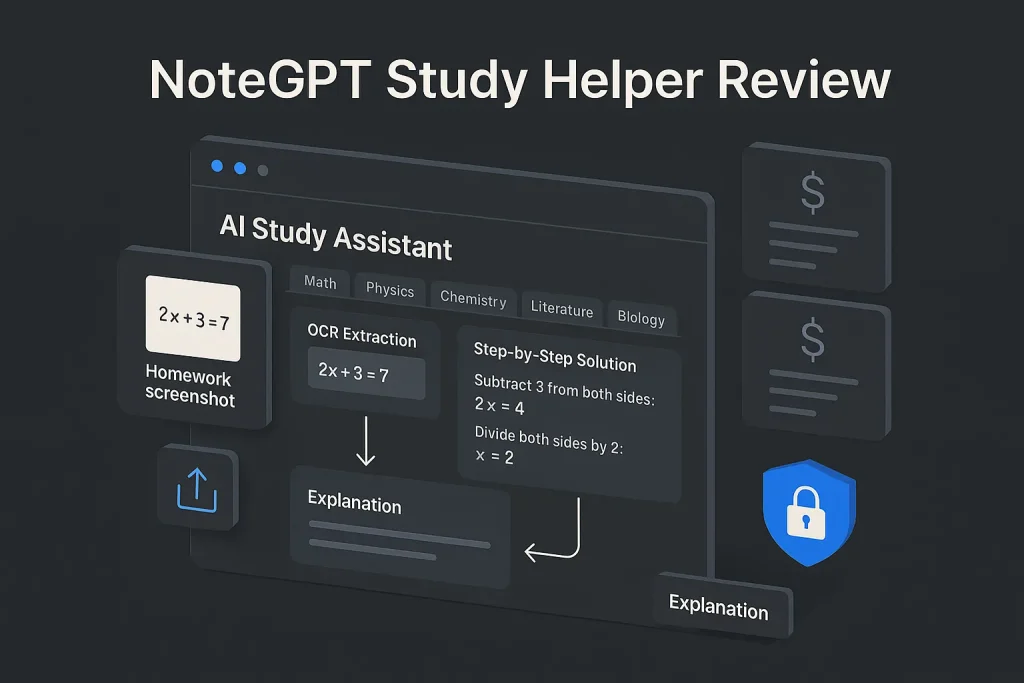
AI study assistants are no longer a novelty in education, and notegpt ai homework helper sits right in the middle of that shift. Students now expect a tool to read a screenshot, parse a worksheet, explain a formula, and return a usable answer in seconds. We think that is the real test now: not whether a tool can produce text, but whether it handles image inputs well, explains its reasoning clearly, fits actual study habits, and avoids obvious privacy or academic-integrity problems.
That distinction matters because this market is crowded with “free homework solver” promises that often hide caps, fuzzy accuracy claims, or thin subject coverage. NoteGPT positions its Homework Helper as a lightweight web tool with no sign-up barrier for initial use, support for image and PDF uploads, and cross-subject coverage. On our reading, it makes more sense to judge it not as a standalone answer machine, but as one part of a broader AI learning stack.
What Is NoteGPT’s AI Homework Helper?
NoteGPT’s AI Homework Helper is a browser-based study tool built to answer homework questions submitted as typed text, pasted content, uploaded images, or PDFs. On its product page, NoteGPT says the tool is free to start, with no sign-up required for initial use, and presents a simple three-step flow: upload the prompt, click Generate, and receive both a solution and a fuller explanation. According to the NoteGPT Homework Helper page, it supports multiple subjects rather than only math-style problem solving.
That matters for search intent around terms like ai homework helper picture, ai question solver from image, and ai homework helper screenshot. Most users are not starting with neat text in a blank field. They are working from phone photos of worksheets, screenshots from LMS platforms, cropped textbook pages, or PDFs downloaded from a class portal. If a tool cannot handle those formats, the friction starts before the learning does.

NoteGPT also has to be viewed in the wider context of AI adoption in education. Gallup reported in 2026 that 57% of U.S. college students use AI in coursework at least weekly, with about 20% using it daily, while 64% use AI daily or weekly to get help with coursework they do not understand and 60% use it to check answers on assignments, according to Gallup’s 2026 study of college students. That tells us these tools are no longer niche. They are becoming routine infrastructure.
Who It’s For: Students, Teachers, and Self‑Learners
The core audience is students who need fast support with prompts that are easier to capture than retype. That includes school students, college learners, and adults working through structured courses. In our view, the best fit is not for people hunting a one-line answer. It is for users who want help interpreting a problem, checking an answer, or getting a clearer explanation before moving on.
Teachers and tutors are a secondary audience, but they use tools like this differently. They are more likely to test how students might use it, generate alternate explanations, inspect the reasoning, or turn a question into discussion material. On the practical side, the key question is simple: does the output support understanding, or does it just make shortcut behavior faster?
Self-learners are also a strong match, especially those working through textbooks, certification prep, or online courses where screenshots and PDFs are common. In those settings, convenience is the product. An uploaded page can become an explanation, a summary, or the first draft of review notes without manual transcription.
The user trend supports that broader relevance. Pew reported in early 2025 that 26% of U.S. teens ages 13 to 17 had used ChatGPT for schoolwork, up from 13% in 2023, according to Pew’s reporting on teen school use of ChatGPT. That growth is hard to ignore. We would read it as a signal that user expectations are moving faster than school policy.
Core Features Overview
At product level, NoteGPT’s homework helper is defined by flexible inputs and low-friction access. The main features described on its site fall into five practical buckets: question intake, explanation output, subject breadth, pricing integration, and usage limits.
- Text, image, and PDF input: Users can type, paste, or upload content, which makes the tool more useful than a plain-text chatbot.
- Screenshot-friendly workflow: This matters for users searching for an ai homework helper screenshot workflow, not just a chat box.
- Step-by-step explanation: NoteGPT promotes not only solutions but also detailed explanations. We think that is the right emphasis, because raw answers alone have limited study value.
- Cross-subject coverage: The product page highlights math, physics, chemistry, literature, biology, and history.
- Free daily access: NoteGPT advertises 20 free tries per day, which is enough for meaningful testing but still a real limit.
A useful way to assess the product is to separate what the vendor states from what has been independently validated. The site is clear about formats, workflow, and pricing structure. What it does not provide, based on the source set here, is third-party benchmark evidence showing superior answer accuracy versus named competitors. On our side, that is not a deal-breaker, but it is a line worth keeping visible.
| Feature area | What NoteGPT states | Why it matters |
|---|---|---|
| Access model | Free to start, no sign-up required for entry use | Reduces friction for quick testing and one-off homework checks |
| Input formats | Typed questions, pasted text, images, PDFs | Supports real classroom materials and screenshot-based use |
| Output style | Solution plus detailed explanation | Improves study value compared with single-line answers |
| Subject range | Math, physics, chemistry, literature, biology, history | Useful for users who want one tool instead of separate niche apps |
| Free allowance | 20 free tries daily | Meaningful UX limit for comparison with paid study bundles |
For most users, two features will shape the first impression: input flexibility and the daily free limit. Everything else comes after that.

How Image‑Based Solving Works (Photos, Screenshots, OCR)
Image-based solving is one of the most practical hooks in this category. Many users simply do not want to retype equations, tables, or multi-part prompts. In that sense, ai question solver from image is not just a keyword. It describes the real job people need done.
Operationally, this kind of solving usually depends on a chain of steps: image ingestion, OCR or visual text extraction, layout interpretation, semantic parsing, answer generation, and explanation formatting. Users may never see that stack, but they feel it immediately when something breaks. A sharp, high-contrast image usually works better. Angled photos, messy backgrounds, handwriting, and cropped edges raise the risk fast.
For NoteGPT, the product page says users can upload an image or PDF directly and get a generated answer with explanation. That fits common use cases such as:
- Phone photo of a textbook question
- Screenshot from a digital worksheet or LMS
- Scanned assignment sheet in PDF form
- Cropped graph, formula, or paragraph excerpt
The practical limitation is obvious. OCR-based workflows add another failure point that typed prompts do not have. If the model misreads a denominator, skips a negative sign, or merges lines incorrectly, the answer may sound polished and still be wrong. We have seen this pattern across AI tools repeatedly. Good language can hide bad extraction.
In practical terms, image upload is one of the features that makes NoteGPT more relevant than a basic text chatbot for school workflows. That is a real advantage, not a cosmetic one.
Subjects and Problem Types Covered
NoteGPT markets the homework helper across math, physics, chemistry, literature, biology, and history. That spread matters because many competing solver tools lean hard toward quantitative subjects and get weaker once the task shifts from calculation to interpretation.
For quantitative subjects, users usually expect stepwise logic: formulas, substitutions, simplification, unit handling, and final answer checks. For text-heavy subjects, the expectation changes. A literature or history user may want a concise explanation of a passage, a summary of the prompt, or a structure for a response. Biology and chemistry often sit in the middle. They need both conceptual clarity and notation accuracy.
This breadth makes NoteGPT useful as a generalist assistant, but it also changes the standard we should apply. One tool can be solid across many categories without being the best in any single one. On our view, that is exactly how users should approach it. For advanced symbolic math, specialist engines may still win. For mixed coursework, note-making, and quick explanation layers, a generalist can be more efficient overall.

Accuracy and Reliability: Benchmark Methodology and Results
Accuracy is the hardest part of this category to review honestly because vendor pages usually show examples, not independent benchmark results. In the source set for this article, there was no exact third-party performance study comparing NoteGPT’s homework accuracy with named competitors under standardized conditions. So any sweeping ranking claim would be too much.
A responsible test methodology for notegpt ai homework helper should include at least four dimensions:
- Input fidelity: Did the tool correctly read the uploaded image, screenshot, or PDF?
- Answer correctness: Is the final result right?
- Reasoning quality: Are the intermediate steps coherent and genuinely useful for learning?
- Error transparency: Does the tool show uncertainty, assumptions, or alternative readings?
In practice, many AI homework tools fail not because they cannot solve a task, but because they confidently misread it or overgeneralize. That fits UNESCO’s broader warning that generative AI should not be treated as an authoritative source of knowledge and can be fast yet unreliable, according to UNESCO’s guidance on generative AI in education. On our reading, that warning is especially relevant for image-based tools, because a polished explanation can easily mask an OCR mistake.
That is why the most honest conclusion is conditional, not absolute:
- For clearly framed questions and clean uploads, AI study assistants are often efficient for first-pass help and answer checking.
- For multi-step math, dense technical notation, or ambiguous screenshots, users should verify outputs manually.
- For high-stakes assignments, the tool should support understanding, not replace source reading or instructor guidance.
| Reliability factor | Low-risk scenario | High-risk scenario | What to do |
|---|---|---|---|
| Image clarity | Straight, high-contrast screenshot | Blurred photo with cropped edges | Retake or paste the text manually |
| Notation sensitivity | Simple arithmetic or short prose prompt | Dense equations, symbols, subscripts | Check each step against the original |
| Prompt ambiguity | Single direct question | Multi-part worksheet with missing context | Provide clarifying text or split the task |
| Educational use | Checking understanding | Submitting output unchanged | Rewrite in your own words and cite sources if needed |
The reliability question is really a usage question. Blanket trust is the wrong model.
Step‑by‑Step: Solving Questions from Pictures and Screenshots
For users comparing an ai homework helper picture workflow, the submission process matters almost as much as the answer itself. The sequence is simple. The discipline is what improves results.
- Capture a clean input. Use a straight screenshot when possible. If you take a photo, make sure it is sharp, well lit, and fully framed.
- Upload only the relevant area. Remove unrelated page elements, ads, chat overlays, or notebook clutter.
- Check whether the extracted content matches the source. If the tool misreads symbols or numbers, retry before trusting the answer.
- Ask for explanation, not just the result. Step-by-step output makes it easier to spot where the model went wrong.
- Validate with source materials. Use textbook examples, class notes, or instructor methods to confirm the approach.
This is also where the gap between convenience and proof becomes clear. A fast explanation can help you start a problem. It is not the same thing as verified instruction. On our side, the safest pattern is straightforward: use the tool for orientation, then do the reasoning yourself if the work will be graded.

Study Workflows: From Answers to Notes, Summaries, and Review
The strongest use case for NoteGPT is not one-off answer retrieval. It is what happens after that. Once a student has an answer and explanation, the next useful steps are summary extraction, concept consolidation, error review, and review prep.
This is where a broader AI study stack becomes more valuable than a pure solver. One answer can turn into:
- a short concept note for revision,
- a plain-language explanation for weak topics,
- a flashcard-style question set,
- a list of common mistakes to revisit before an exam,
- or a summary of a larger PDF-based reading assignment.
That workflow helps explain why AI writing tools and study tools increasingly overlap. The user starts with homework support, but the durable value comes from turning that output into reusable learning material. We have seen the same pattern in content operations: raw inputs become structured outputs, then become publishable assets. Readers interested in that broader shift can compare it with AI powered writing assistant or a content pipeline for SEO growth, where the gap between one-off generation and full workflow orchestration is the central issue.
The bigger pattern is clear: study tools are evolving from answer bots into multi-output workflow products. On our view, that is where the category is heading fastest.
Academic Integrity: Responsible Use, Plagiarism, and Citations
Any serious review of notegpt ai homework helper has to deal with responsible use directly. AI homework tools are not neutral by default. They can help someone learn, and they can also make low-effort submission easier if there are no boundaries.
Pew reported in 2026 that 59% of teens think students at their school use AI chatbots to cheat at least sometimes, according to Pew’s 2026 research on how teens use and view AI. That does not mean every AI-assisted workflow is misconduct. It does mean the norms are still catching up, and that gap creates risk.
A responsible-use framework is fairly simple:
- Use the tool to understand methods, not to submit untouched output.
- Rewrite explanations in your own words after checking the reasoning.
- Follow course-specific policies on AI assistance, citations, and originality.
- Do not treat generated text as a cited academic source unless your institution explicitly allows it and explains how.
For writing-heavy assignments, plagiarism risk rises when students paste generated paragraphs directly into submissions. Teams and institutions working with AI-assisted drafting can reduce that risk through better review processes and originality checks; a useful adjacent reference is an AI plagiarism checker for your content team. Citation discipline matters too when AI helps summarize source material, which connects naturally to guidance on how to automate academic citations with an APA format generator.
The principle is not complicated. AI can speed up understanding. It cannot outsource academic responsibility.
Privacy and Data Security: What Happens to Your Uploads
Privacy is a major evaluation point for image- and document-based homework helpers because the workflow depends on uploads. Screenshots may include names, course portals, school logos, grades, or other identifying details. PDFs can carry instructor comments, class details, or metadata the user never notices.
NoteGPT’s privacy policy, last updated March 23, 2026, states that users may upload files, links, and inputted text to process requests and provide service functionality. The policy also says information may be disclosed when required by law or legal process, according to the NoteGPT privacy policy. That is not unusual. But for academic uploads, it is highly relevant.
Three practical implications follow:
- Upload minimization matters. Share only the part needed to solve the question.
- Remove identifiers where possible. Crop out names, student IDs, and unrelated document sections.
- Do not upload sensitive records. Avoid personal, legal, medical, or institutionally restricted files unless policy review clearly supports it.
Users often focus on answer quality first and data handling second. We think that order is backward, especially for underage learners, schools, and shared-device use. If the workflow depends on screenshots from logged-in systems, privacy discipline should come first.
Pricing and Limits: Free vs Pro
Pricing is where many “free homework helper” reviews get slippery. NoteGPT’s homework helper sits inside a broader platform rather than a standalone subscription. So the real question is not only whether it is free to try, but how usage fits into the platform’s credit and plan structure.
According to the product page, users get 20 free tries daily. According to NoteGPT pricing, AI math and homework help uses Basic Credits rather than Premium Credits. As of June 27, 2026, the Unlimited plan is listed at $19.92 per month on annual billing or $29 month-to-month, while the Max plan is listed at $69 per month on annual billing or $99 month-to-month. Unlimited includes unlimited basic quotas plus 2,800 Premium Credits per month, while Max includes unlimited basic quotas plus 10,000 Premium Credits per month.
This matters strategically because many users assume homework solving is sold as a separate product. It is not. It is bundled into a wider AI learning platform. For some buyers, that is efficient. For others who only need occasional answer checking, it may be more platform than they need.
| Tier | Price | Quota structure | Review takeaway |
|---|---|---|---|
| Free usage | $0 | 20 free tries daily | Good for trial and light use |
| Unlimited annual | $19.92/month | Unlimited basic quotas + 2,800 Premium Credits | Reasonable for frequent general platform use |
| Unlimited monthly | $29/month | Unlimited basic quotas + 2,800 Premium Credits | Higher flexibility, less pricing efficiency |
| Max annual | $69/month | Unlimited basic quotas + 10,000 Premium Credits | Best for heavy multi-tool users, not casual students |
| Max monthly | $99/month | Unlimited basic quotas + 10,000 Premium Credits | Premium-tier spend for power users |
The free tier is enough to test fit properly. Paid plans make sense only if the broader bundle matters to the user. That is the key buying filter.
Comparisons: NoteGPT vs Other Free Web Helpers
Even without unsupported performance claims, NoteGPT can still be positioned clearly against the wider field of free web-based homework helpers.
Compared with simple chat interfaces, its advantage is input flexibility. Image and PDF support is not a minor feature. Compared with highly specialized math solvers, its likely edge is subject breadth and a more complete study-tool ecosystem. Compared with pure answer-generator pages, its value is stronger when the explanation layer is useful and when the user wants to turn answers into notes or summaries.
The tradeoff is familiar. Broad tools are often decent at many tasks rather than exceptional at one. If a student only needs advanced symbolic math, a specialist may still be better. If the user wants one environment for screenshot solving, explanation, note conversion, and light study support across subjects, NoteGPT becomes easier to justify. On our view, workflow fit is the right comparison lens here, not feature-count theater.
Readers comparing adjacent AI writing tools may also want to contrast the review criteria with this honest review of Phrasly AI, where the central issue is not homework help but output transformation in a different content workflow.

The Future of AI Study Assistants and Content Automation
AI study assistants are moving toward workflow consolidation. The old model was one prompt in, one answer out. The next model is multimodal intake, structured explanation, note synthesis, citation support, review material generation, and cross-platform organization. NoteGPT already reflects part of that shift by packaging homework help inside a larger learning-assistant bundle rather than isolating it as a single-purpose solver.
There is also a broader operational lesson here. Educational tools and content systems are converging around the same logic: ingest messy source material, extract structure, generate usable output, and push it into the next stage. In education, that may mean turning a screenshot into an explanation and then into notes. In publishing, it means turning a topic into semantic structure, optimized copy, images, internal links, and final CMS publication.
That is where professional-grade automation platforms become relevant beyond the classroom. Marketing teams that have outgrown one-off writing assistants usually need a full production pipeline, not isolated generation. For organizations scaling SEO content rather than homework workflows, SEO Autopilot on the official site represents that more operational model: semantic planning, article generation, structure, visuals, and WordPress publishing in one system. The distinction is practical. A study helper solves a local task. A content automation platform manages repeatable output at business scale.
From a market perspective, this transition is arriving before governance is fully mature. UNESCO noted that only about 15 countries had government-endorsed AI curricula in schools in early 2022, which helps explain why user adoption has outrun policy design. We expect the next generation of tools to compete on transparency, workflow integration, and guardrails at least as much as on raw generation quality.

Verdict: Pros, Cons, and Recommendation
NoteGPT’s homework helper works best when judged as a practical, low-friction study utility rather than an academically authoritative solver. Its real strengths are easy access, support for text plus image/PDF inputs, screenshot-friendly workflows, broad subject positioning, and enough free daily usage to let users test it without immediate commitment.
Its limits are just as clear. There is no independent benchmark evidence in the reviewed source set proving superior accuracy against named competitors. Image-based solving inherits OCR and interpretation risk. Privacy is not a side issue because the workflow depends on uploads. And the paid value proposition makes the most sense for users who want the wider NoteGPT ecosystem, not only a standalone answer tool.
Our recommendation is pragmatic: use notegpt ai homework helper for first-pass explanation, answer checking, and screenshot-based study support; do not treat it as a substitute for verification, source reading, or course policy compliance. For students and self-learners who regularly work from images and PDFs, it is a credible generalist option. For users who need specialist precision in narrow domains or stronger privacy assurance, it should sit inside a reviewed tool stack rather than serve as the only source of truth.
We think the real takeaway is simple. Tools like this are most useful when they reduce friction without replacing judgment. The strongest workflows are the ones where AI handles capture, explanation, and organization, while the learner still owns verification and final understanding. Businesses and educators should also pay attention to the same pattern: convenience wins adoption first, but trust, policy, and workflow quality decide what lasts.
Looking ahead, we expect study assistants to become more multimodal and more tightly integrated with note systems, citation tools, and review workflows. We also expect more scrutiny around privacy, provenance, and academic guardrails. On our view, the tools that survive long term will not be the ones that simply answer fastest, but the ones that fit real learning behavior without creating unnecessary risk.
FAQ
Is NoteGPT’s AI Homework Helper free to use?
Yes. NoteGPT presents its AI Homework Helper as free to start, with no sign-up required for initial use. The product page also says users get 20 free tries daily, so the free version is real, but it is not unlimited.
Can NoteGPT solve homework from a picture or screenshot?
Yes, and that is one of its most useful features. NoteGPT says users can upload images and PDFs, which makes it suitable for an ai homework helper picture or ai homework helper screenshot workflow when a question is easier to capture than retype.
How accurate is NoteGPT compared to other AI homework tools?
There is no independent benchmark in the reviewed sources proving a fixed accuracy ranking against named competitors. In practice, we would treat it as useful for explanation and answer checking, but still worth verifying, especially for dense notation, unclear uploads, or multi-step problems.
Does NoteGPT store uploaded images or personal data?
Its privacy policy says users may upload files, links, and inputted text to process requests and provide service functionality. In plain terms, that means you should avoid uploading unnecessary personal information and crop screenshots before submission whenever possible.
Is using an AI homework helper considered plagiarism?
It can be, if generated output is submitted as original work without permission or attribution where required. Using AI to understand a problem, check an answer, or generate a study explanation is more defensible when the student rewrites the work independently and follows course rules on AI use.