
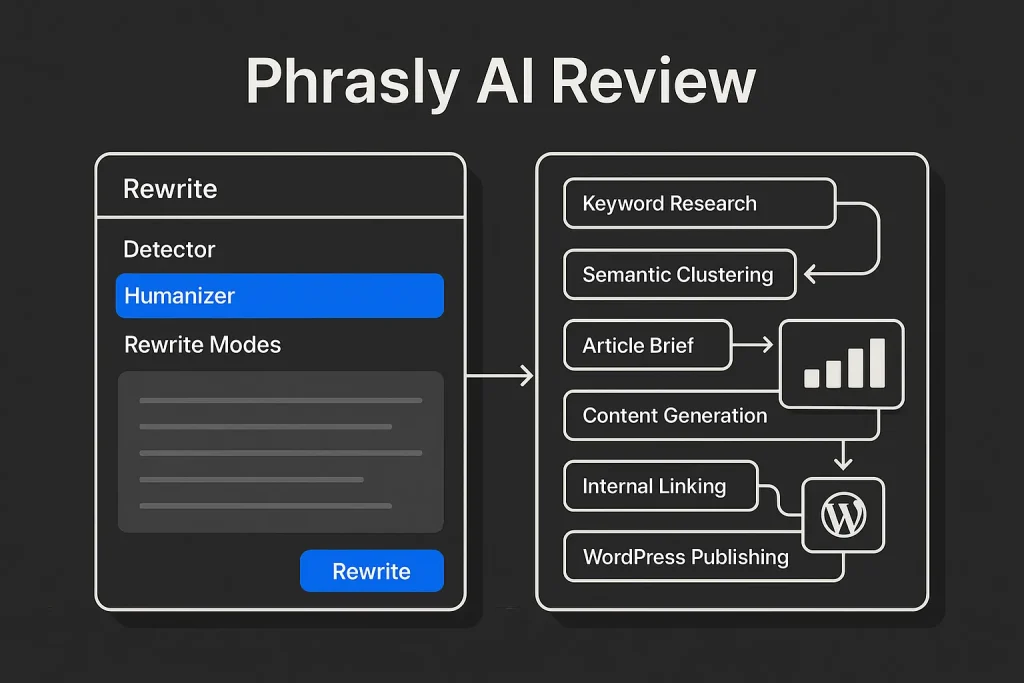
phrasly ai sits in a category many SEO teams still misread. It is not a full organic growth system. It is mainly a humanizer, detector, and a light content utility layer. That distinction matters because rewriting text to look less machine-generated is a very different job from building search-intent-aligned pages, preserving entities, adding internal links, formatting for SERPs, and publishing into WordPress at scale.
The practical question is not whether Phrasly can change wording. Most rewrite tools can do that. The real question is whether the rewritten output helps or hurts SEO once it enters a live content pipeline. For publishers, agencies, and in-house teams, the cost of a rewrite is never just the subscription fee. It also includes editorial cleanup, lost precision, intent drift, fact-checking, and the workflow gaps you still have to patch elsewhere.
We’re looking at Phrasly from that operational angle: what the product promises, what those promises mean in practice, where it helps, where it creates risk, and why a detector-oriented tool should not be mistaken for an end-to-end SEO content platform.
Those numbers already tell the story. Phrasly is built around transformation and checking, not sustained SEO production infrastructure. On our reading, that’s the right way to frame the product from the start.

What Phrasly AI Claims to Do vs. What SEOs Actually Need
Phrasly’s own materials present a fairly clear product identity. On its official humanizer page, Phrasly’s humanizer focuses on rewriting AI-generated text into more human-like language, offers Easy, Medium, and Aggressive modes, and promotes vendor-reported quality claims across 100,000+ documents. On the login interface, the listed product modules include AI Humanizer, AI Detector, Pages, Content Generator, Translator, and Thesis Generator. That is coherent positioning for paraphrasing and utility use cases. It is not the same thing as SEO infrastructure.
What SEO teams actually need is broader. Even at a modest scale, a publishable article usually requires keyword discovery, clustering or topical grouping, search-intent mapping, a brief or outline, draft generation, heading structure, entity preservation, factual review, internal links, on-page formatting, image handling, and CMS publishing. If those pieces are missing, the team ends up stitching together multiple tools and a lot of manual work.
The gap becomes obvious once we compare the product to real content operations:
- Phrasly strength: it rewrites language to sound more human and includes detection-related utilities.
- Phrasly weakness: there is no quantified evidence in the reviewed official materials for keyword clustering, SERP-driven briefing, automated internal linking, schema support, or direct WordPress publishing.
- SEO implication: even if the rewrite is usable, most of the SEO workflow still happens outside the product.
This is why brand queries such as phrasly ai detector, phrasly ai humanizer, and phrasly ai login reflect market perception so accurately. People are looking for detection, humanization, access, and pricing. They are not discovering a mature content-ops system built around semantic planning and publishing automation.
On our side, the distinction is simple: humanizers are post-processing tools, while SEO platforms are production systems. Mix up those categories and you usually end up paying for editorial friction later.
| Area | What Phrasly Officially Emphasizes | What SEO Teams Usually Need | Operational Consequence |
|---|---|---|---|
| Core value | Humanizer and detector | SEO article production workflow | Strong at rewriting, limited as content infrastructure |
| Research | Limited content generation with citation scanning | Keyword research and clustering | Manual keyword tools still required |
| Optimization | Rewrite modes | Intent alignment, entities, headings, links | Extra editing needed before publish |
| Publishing | No official WordPress publishing proof in reviewed materials | Direct CMS workflow | Final step remains manual |
The product makes sense as a rewrite layer. It does not present itself as a complete SEO execution stack. We think that’s the fairest reading of the evidence.
How We Tested: Detectors, Readability, Entity Preservation, and SEO Risk
A fair phrasly ai humanizer review should not treat detector scores as the only outcome. For SEO, that would be far too narrow. We used a four-part review framework built around content operations, not academic evasion.
First, detector interaction. Phrasly repeatedly frames its value around reducing AI detectability, including references to systems such as Turnitin, GPTZero, Copyleaks, and Originality.ai. So yes, detector interaction is part of the product promise. But detector performance alone is a weak proxy for quality or originality.
Second, readability and structural coherence. A rewrite may lower repetitiveness and still damage rhythm, specificity, or sentence logic. Aggressive paraphrasing often creates awkward synonym swaps, diluted claims, or transitions that sound polished at first glance but collapse under editing.
Third, entity preservation. This matters more than many teams realize. Brand names, product categories, model names, technical terms, and comparison anchors often carry the topical precision of the page. If a humanizer softens or alters those entities, relevance can slip fast.
Fourth, SEO risk. We judge whether the transformed text still matches search intent, keeps meaningful subtopics intact, supports internal linking, and remains usable inside a broader publishing workflow. A rewrite that looks “less AI” but loses commercial or informational alignment is a net negative.
That framework also lines up with a larger point from OpenAI’s own discontinued classifier note: detectors are inherently unreliable. In the cited challenge set, the classifier correctly identified only 26% of AI-written text and falsely labeled human-written text as AI-written 9% of the time. OpenAI also noted poor reliability on short texts and the fact that edits can help evade classification. For SEO teams, the takeaway is blunt: a lower detector score does not validate quality, originality, or ranking fitness.
We’ve seen this repeatedly in practice. Teams chase a cleaner detector reading and quietly lose the thing that actually matters: a page that deserves to rank and convert.
The implication is straightforward: any tool built around “passing detectors” should be treated as a risk-management utility, not proof of content quality. On our view, that distinction is non-negotiable.

Results: Can Phrasly AI Really Pass AI Detectors Without Hurting Content Quality?
The honest answer is narrower than the marketing pitch. Phrasly can likely reduce obvious machine-like phrasing in many cases, especially when the input is formulaic, repetitive, or overly templated. That is what humanizers are built to do. But detector reduction and content quality do not move in lockstep.
Phrasly’s humanizer page claims training on more than 1 million pages of real human writing and promotes a 99.7% quality score across 100,000+ documents, but those are vendor-reported figures rather than independent audits. They show confidence in the rewriting engine. They do not prove that transformed content is publication-ready across SEO use cases.
In practical SEO scenarios, the results usually fall into three patterns:
- Low-risk input: generic informational text becomes less repetitive and more natural, with manageable cleanup.
- Medium-risk input: commercial or comparison copy keeps the main message but loses precision in modifiers, category terms, or differentiation.
- High-risk input: technical, entity-heavy, or structured SEO pages suffer from terminology drift, diluted claims, or weaker alignment to the original search intent.
That third case is where humanizers usually start to crack. A detector-oriented rewrite engine is optimizing language patterns, not business meaning. If an article compares tools, explains a compliance-sensitive workflow, or targets a cluster with exact subtopics, paraphrasing can damage the page faster than it improves detector outcomes.
The issue becomes even more relevant in a phrasly ai vs turnitin discussion. Turnitin’s official guidance now separates suspected AI-generated text from suspected AI-paraphrased text, according to its AI writing detection model documentation. In other words, rewritten output does not necessarily disappear from review. It can simply move into a different category. Turnitin also states that qualifying submissions can be up to 30,000 words, and that numeric scores in the 1% to 19% range are no longer shown as exact values because false positives are possible. That is not a stable environment for building a content strategy around evasion.
A stronger approach is to treat rewriting as one quality-control step inside a larger editorial framework. Teams that want a deeper discussion of this balance can review pass AI text detectors without sacrificing SEO value. The principle is simple: detector resilience matters only if search intent, factuality, and page utility survive the rewrite.
| Evaluation Factor | What a Humanizer Can Improve | What It Can Also Damage |
|---|---|---|
| Sentence variation | Reduces repetitive wording | Can introduce awkward phrasing |
| Detector interaction | May lower some detector signals | Does not prove originality or safety |
| SEO entities | Sometimes smooths over clunky keyword stuffing | May weaken exact brand and topic signals |
| Search intent alignment | Can improve readability of rough drafts | Can blur transactional or comparative positioning |
That trade-off is the center of any credible review. Phrasly can transform text. It cannot guarantee that the transformed version remains the right SEO asset. We’d be cautious about treating it as more than that.
Where Humanizers Break SEO: Intent Drift, Lost Entities, and E-E-A-T Gaps
SEO failure rarely looks dramatic in the draft. Usually it looks acceptable, readable, even slightly cleaner. The real loss appears later, when the page underperforms because it no longer matches the query cluster or no longer carries the right signals clearly enough.
Intent drift is the first major issue. A page written for “best CRM for law firms” cannot safely drift into generic business software language just because broader synonyms sound more varied. Humanizers often compress commercial specificity into softer phrasing. That makes the page less useful for high-intent SERPs.
Entity loss is the second issue. SEO content depends on exact product names, standards, platforms, methods, industries, and modifiers. When a tool rewrites too aggressively, it can replace or weaken those terms. The page may sound more human while becoming less semantically precise.
E-E-A-T gaps are the third issue. Humanized text can sound smoother and still lack firsthand framing, concrete examples, controlled claims, or source-based reasoning. Search quality does not come from sentence variety alone. It comes from relevance, structure, and evidential strength. Teams working on AI-enhanced editorial quality can explore why humanizing AI text matters for E-E-A-T, especially in workflows where rewriting must preserve subject-matter confidence.
These risks get worse when a team rewrites after the article is already optimized. The better the original SEO structure, the more there is to lose. On our experience, humanizers are safer as cleanup layers on low-value drafts than as post-processors for carefully engineered pages.
The chart is not a market-wide benchmark. It reflects the emphasis visible in the reviewed official materials: strong focus on humanization and detection, much weaker evidence for full SEO execution. That imbalance matters more than most sales pages admit.

Workflow Reality Check: No Keyword Research, No Briefs, No Internal Links, No WordPress Publishing
This is where the gap becomes operational, not theoretical. Phrasly may help transform a draft, but the official materials reviewed do not provide quantified support for the tasks that consume most SEO production time.
No keyword research workflow. There is no demonstrated system for collecting target phrases, grouping them by intent, or prioritizing a content cluster. A team still needs separate SEO tooling for discovery and planning.
No SERP brief generation workflow. Phrasly’s pricing states that content generation is capped because the system scans Google and Bing in real time for citations, according to its pricing page. That may support limited researched generation, but it does not amount to a scalable briefing and editorial planning engine.
No internal linking system. Internal links are not decoration. They shape crawl paths, topical reinforcement, and user journeys. A rewrite tool does not solve this. Teams still have to map related pages, choose anchors, and insert links manually or through another platform.
No direct WordPress publishing proof. The reviewed materials do not show a direct publish pipeline into WordPress. For real content operations, that means copying, formatting, media handling, metadata checks, and scheduling remain external tasks.
Once those missing steps are spelled out, the product category becomes clearer. Phrasly is not a bad tool because it lacks these features; it is simply a different tool than many SEO buyers actually need. We think that distinction is crucial for budget planning.
Teams stuck in fragmented stacks often run into the same pattern: one tool for keywords, one for writing, one for rewriting, one for linking, one for publishing, then a person bridging all the gaps. That is exactly the inefficiency addressed in why manual AI writing tools are obsolete. The problem is not that each tool fails on its own. The problem is that the workflow fails as a whole.
| Workflow Step | Needed for SEO Publishing | Evidence in Reviewed Phrasly Materials |
|---|---|---|
| Keyword research | Yes | No quantified feature evidence found |
| Clustering and brief creation | Yes | No quantified feature evidence found |
| Internal linking | Yes | No official support shown in reviewed sources |
| WordPress publishing | Yes | No official support shown in reviewed sources |
The missing features are not edge cases. They are the operational center of modern SEO content production. In our view, that is where the buying decision should be made.

Autopilot SEO vs. Phrasly AI: End-to-End Pipeline (Semantics, Formatting, Linking, Publishing)
This is the category split that matters most for buyers. Phrasly focuses on text transformation and detection-oriented utility. SEO Autopilot is built for content operations from topic to published page. These are not interchangeable purchases.
An end-to-end SEO platform handles the upstream and downstream work a humanizer does not:
- semantic planning and keyword grouping
- article structure and heading design
- draft generation around search intent
- formatting for readability and on-page use
- internal linking across existing content
- WordPress publishing and workflow automation
That difference changes who benefits from each tool. A freelancer trying to soften AI phrasing in a single draft may find a humanizer sufficient. An agency producing dozens or hundreds of SEO pages per month needs a pipeline, not a patch. For a deeper breakdown of this operating model, see how AI automates SEO content ops.
The most important comparison point is not output style. It is task coverage. If the team still has to do keyword work, build the outline, add internal links, and publish manually, the rewrite tool is only solving a thin slice of the real problem.
That is also why the framing around phrasly ai humanizer and phrasly ai detector should be taken literally. Phrasly can be useful in that lane. It is simply not designed to replace a production system built for SEO scale. We consider that a category issue, not a product flaw.
The point of the chart is editorial, not mathematical: rewrite tools cover only a slice of the publishing pipeline, while SEO platforms are expected to cover the full workflow. On our view, that’s the comparison buyers should care about first.
Pricing and ROI: Hidden Costs of Rewrites vs. Automated Content Ops
A raw subscription comparison misses the real cost difference. Buyers often land on phrasly ai free or phrasly ai pricing pages and assume a lower monthly fee means cheaper content production. In SEO, that is rarely true once process costs are counted honestly.
According to Phrasly pricing information, the Unlimited plan includes up to 30,000 content-generator words per month and 20,000 plagiarism-check words per month, while content generation is capped at 15 monthly generations because of real-time scanning for citations. That is a usable utility layer, but it is not a high-throughput content engine.
On the business side, Phrasly’s API page advertises humanization at $0.14 per 1,000 words, 99.9% uptime, response times under 2 seconds, and usage by 500+ teams. That suggests a solid infrastructure product for embedding rewriting into another system. It does not solve the rest of the SEO workflow unless you build that system yourself.
The hidden cost model usually looks like this:
- You pay for the rewrite tool.
- You still pay for keyword research tools.
- You still pay with staff time for internal links, formatting, and CMS uploads.
- You still absorb revision cost when aggressive rewriting weakens the page.
That is why ROI should be measured per published, optimized article, not per rewritten word. A low-cost humanizer can become expensive if every output still needs strategic editing and manual assembly before publication.
Teams evaluating rewrite-heavy workflows may also benefit from the perspective in how a modern AI rewriter maintains search intent. The real savings come from preserving intent while reducing manual intervention, not from paraphrasing alone.
We’ve seen plenty of stacks that look cheap on paper and expensive in reality. Usually the leak is not software cost. It is labor, QA, and rework.
These figures are useful for budgeting, but they should not be mistaken for end-to-end publishing economics. That’s where many teams miscalculate phrasly ai pricing.

When Phrasly AI Makes Sense—and When It Doesn’t
Phrasly makes sense in constrained, tactical scenarios. It is useful when the main goal is to rephrase machine-like prose, test variation, or integrate humanization through an API into a separate workflow. It may also fit teams that already have their own research, editorial QA, and publishing stack and simply want a rewrite component.
It makes far less sense when buyers expect it to function as a complete SEO content platform. That expectation creates the biggest disappointment in many searches, including phrasly ai humanizer review and related queries. The issue is not that the product fails to do what it says. The issue is that users often buy it for a different job.
Good fit: academic-style paraphrasing workflows, text cleanup, detector-sensitive drafts, and embedded humanization through API.
Poor fit: agencies scaling SEO pages, in-house teams managing content clusters, publishers needing internal linking, or site owners who want articles to move from topic ideation to WordPress without manual assembly.
There is also a policy and trust dimension here. If the primary value proposition is framed around detector bypass, the workflow needs careful governance. Detector evasion is not the same as originality, and it is definitely not the same as search usefulness. On our view, teams should never confuse a cleaner detector profile with editorial validity.
One practical detail worth noting: if you are evaluating the tool operationally, check the account flow as well, including phrasly ai login experience, plan limits, and support policies. Small frictions matter when a tool becomes part of a daily workflow.

Safer Alternatives and a Migration Path to an SEO Content Pipeline
The safest alternative is not necessarily “never use a humanizer.” It is to place rewriting in the correct layer of the stack. For most businesses, that means moving from isolated prompt tools toward a controlled content pipeline with clear stages: research, outline, drafting, optimization, linking, and publishing.
A practical migration path looks like this:
- Audit the current stack. Identify where time is really spent: keyword research, rewriting, editing, linking, formatting, or publishing.
- Separate language cleanup from SEO planning. Rewriting is downstream. It should not replace intent mapping or cluster design.
- Centralize page structure. Headlines, entities, CTAs, and link targets should be defined before any paraphrasing layer touches the draft.
- Automate internal links and publishing. This is where manual drag builds up fastest and where full platforms create the biggest operational lift.
- Measure output by publish-ready pages. Count how many articles reach WordPress in a compliant, optimized state, not how many words were rewritten.
For organizations outgrowing manual stacks, SEO Autopilot is the more relevant category. The platform is designed to generate semantics, build structure, create content, support internal linking, and publish into WordPress as one workflow. Product details and workflow examples are available on the official SEO Autopilot site. For B2B teams, this matters less as a feature checklist and more as an operations model: fewer handoffs, fewer tool gaps, and a tighter path from topic to indexed page.
That is the real contrast with Phrasly. One tool transforms text. The other is built to run SEO content production. On our view, businesses that care about scale should optimize for workflow coverage first and rewrite quality second.

Verdict: Honest Takeaways and Recommendations for 2026
phrasly ai is a focused rewriting and detection-oriented product, not a full SEO content automation system. On its own terms, that is a valid category. The product offers humanization modes, detection utilities, limited content generation, and API access that may suit tactical or embedded use cases.
But for SEO, the central limitation is structural. Rewriting does not replace keyword research, content briefs, entity control, internal linking, or WordPress publishing. It also does not solve the core uncertainty around detector systems. Turnitin now distinguishes AI-generated and AI-paraphrased categories, while detector reliability more broadly remains weak enough that no serious SEO workflow should use those scores as the primary quality signal.
The recommendation is simple:
- Choose Phrasly if you specifically need a humanizer or detector-adjacent rewrite layer.
- Do not choose Phrasly if your real goal is end-to-end SEO content production.
- For scalable publishing, evaluate workflow coverage before rewrite quality.
An honest market view requires category discipline. Phrasly is best judged as a humanization utility. SEO Autopilot belongs to a different class: a content operations platform built for semantics, structure, linking, and publishing. Buyers who understand that distinction will make better budget decisions and avoid stitching together an expensive manual stack.
We think the real takeaway is this: Phrasly can be useful, but only when the team already knows what problem it is solving. As a tactical layer, it has a place. As a substitute for a modern SEO pipeline, it does not.
Looking ahead, we expect the gap between rewrite tools and full content-ops platforms to become even more obvious. Search teams will care less about whether text can dodge a detector and more about whether a system can preserve intent, entities, links, and publishing quality at scale. That shift is already underway, and tools built around isolated rewriting will feel narrower over time.
FAQ
Is Phrasly AI free or paid?
Phrasly offers both free and paid access. If you are searching for phrasly ai free, the short answer is yes: there is a no-cost entry point. Paid plans unlock higher limits, including up to 5,000 words per request and broader monthly usage.
Does Phrasly AI actually bypass Turnitin and other AI detectors?
It may reduce some detector signals, but no tool can reliably promise universal bypass. In a phrasly ai vs turnitin context, that matters a lot: Turnitin now separates suspected AI-generated text from suspected AI-paraphrased text, so rewritten output can still trigger review instead of disappearing from scrutiny.
How do I cancel a Phrasly AI subscription?
If you need phrasly ai cancel subscription information, Phrasly’s terms say cancellation is handled from Settings and then Billing. The same terms state that requests should be submitted at least 30 minutes before the next scheduled renewal or trial-end charge because the payment processor locks the charge around that window.
Is Phrasly AI safe to use for SEO content?
It can be safe as a rewrite layer if every output is reviewed for search intent, factual accuracy, and entity preservation. It is not enough as a standalone SEO workflow because humanized text still needs keyword planning, internal linking, formatting, and publishing controls. That is our position after looking at the product through an SEO lens rather than a detector lens.
What are the main differences between Phrasly AI and an SEO content automation platform?
Phrasly AI is centered on humanization, detection, and limited generation. An SEO content automation platform is built for the broader pipeline: keyword research, semantic structuring, content generation, internal linking, on-page formatting, and WordPress publishing. In short, one is a utility layer; the other is an operating system for content.