
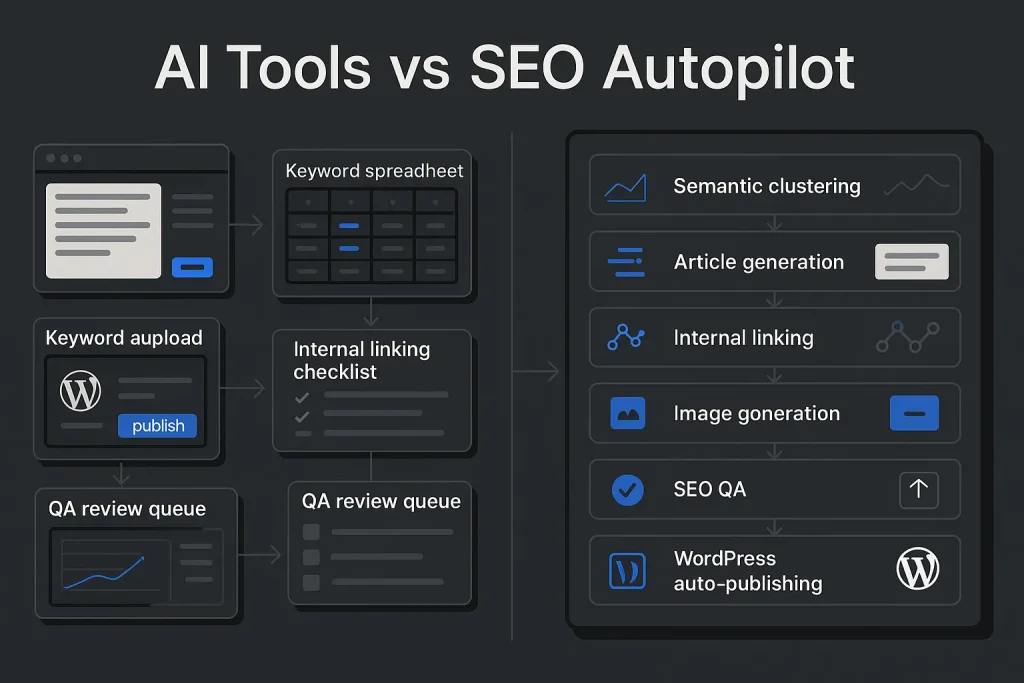
Most ai writing tools solve only the smallest slice of the SEO production problem: putting words on a page. The expensive work starts after generation—keyword clustering, search intent matching, internal linking, on-page QA, CMS formatting, image handling, editorial review, and safe publication. In 2026, the gap between an ai writing assistant and a complete publishing system is no longer a minor feature difference. It is the line between producing occasional drafts and running a scalable content engine.
The market still talks about manual copy-paste software as if it were end-to-end automation. We don’t buy that. Tools built mainly for ai writing can speed up ideation or first drafts, but they rarely remove the operational drag that slows SEO teams down. According to Ahrefs research, 97% of companies edit and review AI content before publication, 80% manually check it for accuracy, and only 4.04% say that more than three quarters of their published output is pure AI without human contribution. To us, that does not show automation failed. It shows most teams automated the drafting layer and left the rest of the workflow untouched, as shown in Ahrefs’ 2025 content marketing study.

Manual AI Writing Tools vs SEO Reality: What They Actually Cover
Manual tools such as an ai blog writing tool, ai copywriting tools, or a generic ai powered writing assistant are usually optimized for one narrow outcome: text generation inside a prompt box. That makes them useful for headlines, short sections, product descriptions, outline expansion, rewriting, or summarization. It does not make them complete SEO systems.
In real content operations, a publishable SEO article needs at least five layers of work. First, the team has to choose a query cluster worth targeting. Second, it must define search intent and page angle. Third, it needs a structure that supports topical completeness instead of generic prose. Fourth, the article has to fit the internal link graph and entity context of the site. Fifth, the content must move safely into the CMS with correct formatting, metadata, media, and review checkpoints.
An ai writing tool usually enters at layer three. Full SEO autopilot starts at layer one and keeps going through layer five. That distinction matters. On our view, SEO outcomes depend less on raw text generation than on the editorial and technical execution wrapped around that text.
Google’s documentation on helpful content and AI makes the standard clear: AI content is not banned, but it gets no ranking privilege. It still needs to be useful, original, and aligned with people-first expectations and E-E-A-T, according to Google’s guidance on AI-generated content and Google’s helpful content documentation. That shifts the conversation away from “Can AI write?” toward a better question: can the system produce reliable, structured, relevant, safely published SEO assets at scale?
A manual assistant can help a marketer write faster. It cannot, by itself, decide which cluster to target, insert the right internal links, validate the page structure against the website’s taxonomy, map the article into a content hub, and publish it to WordPress with production-safe formatting. That is why many teams using best ai writing tools still feel stuck operationally. We see this constantly: the draft gets faster, but the pipeline does not.
The 80% Gap: Tasks Manual Tools Leave to Your Team
The strongest case against manual copy-paste workflows is not philosophical. It is operational. After draft generation, most of the SEO workload still sits with the team. This is the 80% gap: most of the work happens outside the prompt interface.
For a B2B team publishing at volume, that remaining work often includes cluster selection, cannibalization checks, SERP angle comparison, H2/H3 structuring, anchor text selection, source validation, fact review, image sourcing, CMS formatting, category assignment, slug cleanup, meta title writing, meta description checks, schema decisions, featured image uploads, and publication scheduling. Even excellent artificial intelligence writing software does not remove those tasks by default.
The result is a misleading productivity model. A writer sees faster first drafts and assumes the system is efficient. The operations lead sees a queue building around editing, internal linking, and publishing. The SEO manager sees inconsistencies in entity coverage, overlapping content targets, and weak integration with existing pages. The bottleneck simply moves downstream.
Teams often discover that an ai blog post writer reduces writing time but increases coordination overhead. More outputs mean more pages to validate, more links to place, more metadata to standardize, and more room for silent errors. On our experience, partial automation often increases throughput and friction at the same time if the rest of the workflow stays manual.

Below is the simplest way to understand the gap.
| Workflow layer | Typical manual AI tool | Full SEO autopilot | Main operational risk |
|---|---|---|---|
| Topic and keyword selection | User-driven | Integrated into workflow | Publishing content for the wrong query cluster |
| Outline and draft generation | Usually strong | Strong and workflow-aware | Generic output disconnected from SEO strategy |
| Internal linking | Mostly manual | Automated suggestions or insertion | Orphaned pages and weak topical graph |
| WordPress upload | Copy-paste into CMS | Direct publishing pipeline | Formatting errors and queue delays |
| QA and compliance checks | Human checklist | Embedded review gates | Bad pages go live unnoticed |
The difference is not whether AI can write. The difference is whether the system can execute SEO work after the text exists. That’s the part many vendors still gloss over.
Data: Time, Cost, and Error Rates of Copy-Paste Workflows
Most organizations underestimate the cost of fragmented execution because they measure only writing speed. That creates a false baseline. A draft produced in ten minutes looks efficient until the team spends another hour on SEO validation, linking, formatting, media preparation, and CMS upload.
Ahrefs found that companies using AI publish a median of 17 pieces per month versus 12 for those not using AI. That is roughly 42% more output, also summarized by Ahrefs as a 47% higher monthly publishing frequency. The key takeaway is not that AI guarantees rankings. It is that AI increases production capacity when paired with an operational model that can absorb the extra volume. If the surrounding workflow stays manual, publishing speed improves far less than teams expect.
The same research also reports median annual growth of 29% among companies using AI versus 24% among companies not using AI. The delta is real, but modest. We think that nuance matters. It suggests that “using AI” is not enough; execution quality still decides whether higher output becomes stronger SEO performance. The gap between a draft assistant and a full pipeline is exactly where that performance difference shows up.
Conductor’s 2025 State of SEO adds the operational layer. It reports that 91% of respondents said SEO had a positive impact on site performance and marketing goals in 2024, while SEO issues remained unnoticed for at least four weeks on average and could cost up to $75,000 in lost revenue. That is a process problem. Valuable SEO work gets delayed not because teams doubt SEO, but because execution and monitoring are too slow, according to Conductor’s State of SEO 2025 report.
Higher throughput is available, but only when the system can process more than draft creation. That’s the practical dividing line.
The chart makes the pattern obvious: AI drafting is common, but fully unsupervised publishing is not. That leaves a large opening for workflow automation that preserves review while removing manual handoffs. In our view, that is where the real market is moving.

What “Full SEO Autopilot” Means in 2026
Full SEO autopilot does not mean uncontrolled mass publishing. It means the core content workflow—from topic selection to live page delivery—is unified, systematized, and quality-aware. The standard in 2026 is not whether a platform can generate paragraphs. The standard is whether it can orchestrate SEO operations reliably.
A mature autopilot platform should cover semantic research, article planning, structure generation, draft creation, internal link logic, metadata generation, media support, WordPress publishing, and review checkpoints in a connected flow. It should reduce repetitive work without removing human oversight where oversight still matters.
This is also the right way to read Google’s position on automation. Google warns against using automation or AI primarily to manipulate rankings. The goal is not blind scale. The goal is a people-first workflow that automates the mechanical parts of production while preserving content quality, relevance, and crawlability. Safe autopilot, in other words, is an execution model, not a spam model.
A strong end-to-end system also understands site context. It knows which pages already exist, where internal links should point, how categories relate, which anchor text patterns are appropriate, and when a draft should be held for review instead of pushed live. That is what turns a generic ai content writing tools stack into an actual content operations platform.
For teams exploring the move from a general ai writing assistant to integrated operations, the practical reference point is a workflow like this AI assistant for SEO content ops and WordPress auto-publishing, where automation spans clustering, structure, and publication rather than stopping at the draft.
Feature-by-Feature Comparison: Assistant vs Autopilot
The comparison gets clearer when reduced to platform behavior instead of marketing labels. Many vendors market themselves as the best ai tool for content writing, but that phrase usually measures copy generation quality, not SEO execution completeness.
| Capability | Manual assistant model | Autopilot model |
|---|---|---|
| Prompt-based drafting | Core strength | Included but not isolated |
| Keyword clustering | Usually external or manual | Built into pipeline |
| Site-aware internal linking | Rare | Expected |
| Metadata and publishing package | Manual completion | Generated with article |
| Direct WordPress publishing | Copy-paste | Native flow or API-based automation |
| Quality gates | Human memory and checklists | Structured review before live status |
The decisive shift is that autopilot platforms convert scattered tasks into one governed workflow. That is why the real comparison is not between one writer app and another. It is between a writing interface and a content operating system.
Teams evaluating these differences often benefit from reading adjacent workflow comparisons such as where AI writing assistants stop and full-funnel automation begins. The pattern is consistent across vendors: drafting alone is not content operations. We would add one more point here: even the best ai writing tools can look impressive in demos and still underperform in production if they cannot govern the messy middle.
Internal Linking, Entities, and Topical Authority at Scale
Internal linking is where manual workflows collapse first at scale. A single article may need only a few strategic links, but a growing content library creates graph complexity fast. Each new page has to connect to existing clusters, support crawl paths, reinforce entity relevance, and avoid becoming isolated.
Google explicitly states that internal links help users and search engines understand site structure, and that every important page should have at least one link from another page. Google also recommends standard HTML <a> elements with href for crawlable links, as described in Google’s documentation on crawlable links. This matters because improvised, script-heavy, or editor-inconsistent linking practices create technical risk and discovery problems.
HTTP Archive’s Web Almanac shows just how large the linking problem already is. The median desktop page contains 43 internal same-site links, and the median mobile page contains 39. At the 90th percentile, those counts rise to 174 on desktop and 161 on mobile, according to the HTTP Archive SEO chapter. Even if a team links conservatively, each new post enters a dense environment where link placement decisions do not scale well by memory alone.
This is where manual ai tools for writing become structurally weak. They generate text but usually do not understand the current state of the site’s link graph. A full autopilot system can evaluate target pages, suggest anchors, prevent orphaning, and integrate the new article into topical clusters automatically or semi-automatically.

Entities and topical authority depend on repetition with structure, not repetition with noise. If ten articles mention the same topic but link inconsistently, target overlapping intent, or fail to reference core hub pages, the site loses clarity. Good automation strengthens hierarchy. It makes cluster pages, supporting pages, and transactional pages work together instead of existing as isolated text assets.
For teams building hub-and-spoke architectures, a workflow such as an automated workflow around your AI SEO tool is materially more useful than another standalone artificial intelligence writing tools subscription. We’ve seen this play out in practice: the link graph, not the draft quality, often becomes the real scaling constraint.
WordPress Auto-Publishing and QA: From Draft to Live Safely
WordPress remains the central CMS environment for content-led SEO growth. As of June 2026, WordPress powers 41.5% of all websites and holds 59.3% of the CMS market among sites with a known CMS, according to W3Techs data on WordPress usage. Any serious SEO automation discussion therefore has to account for how content actually reaches WordPress.
Manual transfer from an ai writing assistant free plan, a prompt tool, or even one of the free ai writing tools can look harmless at low volume. At scale, it creates formatting drift, metadata inconsistency, omitted images, broken headings, missed categories, weak slugs, and editorial bottlenecks. Every copy-paste event is also a quality-control event.
Safe auto-publishing means the article arrives with structure intact. Headings should map correctly. Links should remain crawlable. Featured image logic should be predictable. Draft and published states should be controlled. Review steps should exist before a page goes live. The publishing system should work with WordPress, not around it.
Organizations with higher SEO maturity tend to converge on integrated platforms rather than disconnected tools. Conductor reports that high-maturity organizations are four times more likely to use a fully integrated enterprise SEO platform than low-maturity organizations. The lesson is broader than enterprise software procurement: mature teams reduce manual handoffs because handoffs create delay and inconsistency. On our reading, this is one of the clearest signals that workflow depth matters more than another shiny writer UI.
If your process still ends with a person moving text from one window to another, the system is not automated. It is only assisted.

Teams trying to close that final gap can use references like this guide to a fully automated WordPress content engine for SEO teams to move from writer-centric workflows to CMS-native operations.
ROI Model: Throughput, Cost per Article, and Payback Period
The ROI of full automation does not come from replacing editors with a button. It comes from reducing the cost of coordination across repetitive tasks. Every manual handoff adds waiting time, context switching, and error potential. Every automated step compresses cycle time.
A practical ROI model for content teams should measure at least three variables: articles produced per month, staff time per article, and rework rate after drafting. Manual ai content writing tools improve the first variable somewhat. Full SEO autopilot improves all three.
Consider a simple operational scenario. A team using manual tools may reduce first-draft time significantly but still spend large blocks of time on clustering, editorial cleanup, internal linking, formatting, image handling, and WordPress publishing. A team using full autopilot may keep human review in place while cutting the mechanical work around the article. The result is not just more output. It is lower marginal cost per additional article.
The Ahrefs data on 17 versus 12 monthly articles is useful here. It suggests that AI adoption increases production capacity. But since 97% still review content and 80% manually verify accuracy, the clearest ROI opportunity is not “more raw AI.” It is reducing non-draft work. If a platform removes multiple workflow steps while preserving review, its economic effect can exceed what a better prompt interface alone can deliver. We consider that a much stronger business case than chasing another marginally better ai writing assistant free or testing more free ai writing tools.
| ROI factor | Manual AI workflow | Full autopilot workflow | Business effect |
|---|---|---|---|
| Drafting time | Reduced | Reduced | Baseline productivity gain |
| SEO operations time | Mostly manual | Compressed by workflow automation | Lower cost per article |
| Publishing delay | Queue-dependent | Shorter and more predictable | Faster time to indexable asset |
| Consistency across articles | Depends on individuals | System-level standardization | Lower rework and fewer silent defects |
The strongest payback usually appears when a team publishes enough content for manual coordination to become more expensive than the software layer replacing it. That threshold arrives sooner than many managers expect.
When Manual Tools Still Make Sense—and When They Don’t
Manual tools are not useless. They are simply overused outside their natural scope. A standalone ai re writer, prompt assistant, or general ai writing assistant still makes sense when the job is narrow and the publishing consequences are limited.
They remain practical for ad copy drafts, email variants, headline ideation, short-form rewriting, note expansion, content repurposing, and occasional blog support in low-volume environments. If a founder publishes one article every few weeks and manually controls every detail, a broad autopilot system may be unnecessary.
They stop making sense when the team has any of the following characteristics:
- multiple writers or editors involved in handoffs
- regular publication targets across categories or clusters
- existing content hubs that need systematic internal linking
- WordPress as the production CMS
- recurring SEO QA issues or delayed publishing cycles
- pressure to scale without proportionally increasing headcount
This is also where many “best of” reviews become misleading. Lists of the best ai tools for writers usually compare prompt quality, interface polish, or brand awareness. They rarely compare publishing architecture, site-aware linking, cluster management, or CMS automation. For SEO operations, those are the decisive factors. A tool can be a fine ai blog writing tool and still be the wrong system for a serious content team.

A useful parallel appears in analyses like AI paragraph writer vs long-form AI in a WordPress workflow. Different tools fit different layers, but none of them should be mistaken for a full production system unless they govern the full path to publication.
Migration Path: Upgrading from Jasper/Copy.ai to Autopilot
Migration should begin with workflow mapping, not tool replacement. The question is not “Which platform writes better paragraphs?” The question is “Which tasks still happen manually after the draft is generated?” That is where the migration scope lives.
A practical transition usually follows four phases. First, document the current content pipeline from keyword ideation to publication. Second, identify repetitive steps that do not require creative judgment. Third, move those steps into automation while keeping editorial approval intact. Fourth, connect the output directly to WordPress and internal link logic.
Typical migration friction points include old editorial habits, inconsistent category structures, scattered keyword spreadsheets, and teams that still treat every article as a one-off asset. Autopilot performs best when the content model is cluster-based, the CMS structure is stable, and the team agrees on review rules.
In many cases, the fastest migration pattern is hybrid. Keep the manual tool for edge cases such as rewrite-heavy pages, unusual brand voice needs, or one-off campaign assets. Shift recurring SEO production into autopilot. This lowers disruption while proving gains in throughput and consistency. We’ve found this is often the least political way to modernize a content stack.
For organizations making that shift, the most relevant operational blueprint is often an automated WordPress content engine for SEO teams rather than another generic dashboard for ai writing. If your current stack also leans on quillbot ai or other rewrite-first tools, the same rule applies: useful for isolated tasks, weak as a workflow backbone.
Buyer’s Checklist: How to Evaluate Automation Platforms
Choosing a platform requires a different checklist than choosing an ai blog writing tool. The key question is not whether the output reads smoothly in isolation. The key question is whether the platform removes enough SEO operations work to materially change throughput and consistency.
Evaluate the platform on these dimensions:
- Semantic coverage: Can it generate or support keyword clustering instead of only drafting?
- Site awareness: Can it work with existing pages, categories, and internal linking needs?
- CMS integration: Does it publish to WordPress directly or only export text?
- QA control: Are there review states, validation rules, and publish safeguards?
- Metadata support: Can it produce titles, descriptions, image fields, and structured article packaging?
- Editorial scalability: Does it reduce handoffs, not just typing time?
- Google alignment: Does it support people-first quality rather than mass low-value output?
The best platform is the one that makes SEO execution more reliable with less manual coordination. For many teams, that will not be the same product that wins consumer-facing comparisons of best ai writing tools or quillbot ai alternatives. The same caution applies to rewrite-heavy products tied to quillbot’s positioning or any lightweight ai writing assistant free offer: they may solve a task, but not the system.
Case Snapshot: From Keyword to Published Post in One Click
A realistic one-click workflow does not mean zero oversight. It means that one approved trigger can launch a connected chain: semantic target selection, structured outline, draft creation, on-page packaging, internal linking, media preparation, and WordPress delivery. The editor then reviews a near-complete publishing asset instead of assembling one from scratch.
In a manual tool stack, the equivalent process often spans several tabs and people. A strategist chooses a topic. A writer uses an ai writing tool to generate a draft. An editor reshapes the structure. An SEO specialist adds internal links. A content manager uploads it to WordPress. A reviewer notices a formatting issue after preview. The page sits in draft status until someone returns to it. Each step is understandable. The sequence as a whole is inefficient.
In an autopilot model, those steps are consolidated. The draft is generated within a site-aware system. Linking logic references existing pages. Metadata and media fields are prepared as part of the asset. Publishing is pushed into WordPress with cleaner formatting and clearer approval states. Human input remains, but the system carries the burden of repetition.

That is the real case for replacing manual assistants in SEO-driven publishing. The advantage is not just faster text. It is fewer operational gaps between intent and execution. And on our view, that is exactly why many teams outgrow standalone ai tools for writing faster than they expect.
Commercial Fit: Where SEO Autopilot Enters the Workflow
Teams that have outgrown manual ai writing tools usually do not need another prompt box. They need a system that connects semantic research, article structure, content generation, internal linking, and WordPress publishing into one controllable workflow. That is the category where SEO Autopilot operates.
Instead of stopping at draft assistance, the platform is designed to automate the practical layers that consume most SEO production time. You can review how the product approaches end-to-end execution on the official SEO Autopilot site. For agencies, content teams, and site owners who want to scale without expanding manual coordination, that workflow model is materially more relevant than another standalone ai copywriting tools subscription.
The business case is straightforward: if your bottleneck is no longer writing but everything around writing, the right investment is not a better assistant. It is a full SEO autopilot.
We think the practical takeaway is simple. Manual ai writing tools are not disappearing because they are bad; they are becoming secondary because they solve too little of the real workflow. The teams that win will be the ones that automate clustering, linking, QA, and publishing—not just drafting. The biggest risk for businesses now is mistaking faster text generation for actual operational scale.
Our прогноз is fairly conservative. Over the next cycle, more vendors will keep branding themselves as an ai writing assistant or even the best ai tool for content writing, but buyers will increasingly judge them by CMS integration and workflow depth. We also expect more stacks built around artificial intelligence writing software to absorb functions once handled by separate rewrite, publishing, and SEO ops tools.
FAQ
Are AI writing tools enough for SEO in 2026?
No. AI writing tools are useful for drafting, rewriting, and ideation, but they do not cover the full SEO workflow. You still need keyword clustering, internal linking, QA, metadata packaging, and WordPress publishing to turn a draft into a competitive search asset.
What is the difference between an AI writing assistant and full SEO content automation?
An ai writing assistant mainly helps generate or improve text. Full SEO content automation handles the broader pipeline: topic targeting, content structure, internal links, optimization checks, and auto-publishing to WordPress with review control. That is a much bigger job than drafting alone.
How does automated internal linking improve rankings and topical authority?
Automated internal linking helps distribute relevance across related pages and reduces the risk of orphaned content. It also makes it easier to maintain consistent anchor patterns and connect new articles to hub pages, which strengthens topical organization and crawl paths. In practice, it is one of the first places where full autopilot beats a standalone ai blog post writer.
Can auto-publishing to WordPress hurt SEO or site quality?
It can if automation is unmanaged. Safe auto-publishing should preserve clean HTML links, heading structure, metadata, and review checkpoints. When the workflow is site-aware and quality-controlled, WordPress auto-publishing reduces formatting errors and shortens the path from draft to live page.
How do I transition my team from manual AI tools to an SEO autopilot workflow?
Start by mapping every manual step after draft generation. Then automate recurring tasks such as clustering, internal linking, article packaging, and WordPress publishing while keeping human review for accuracy and brand fit. The goal is not to remove editors; it is to remove repetitive production friction.