
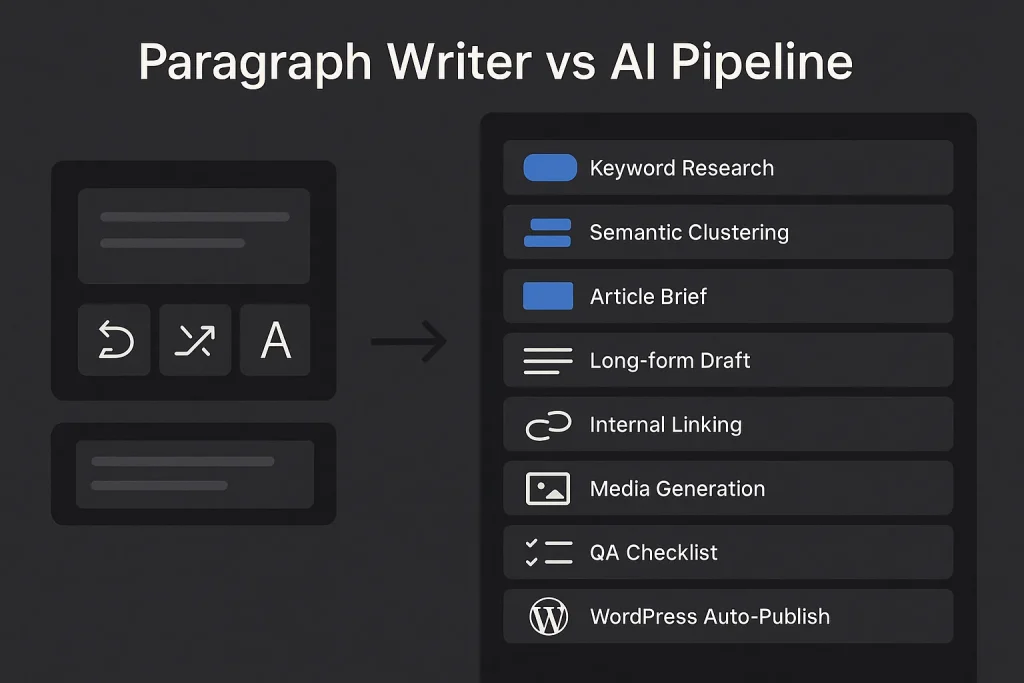
An ai paragraph writer is useful when the task is narrow and local: improve a weak section, rewrite a paragraph for clarity, remove repetition, or get past a blank page. Where teams get into trouble is assuming paragraph-level help equals a publishing system. It doesn’t. In a WordPress workflow, the real workload is broader: keyword research, structure, sourcing, internal links, media, formatting, QA, and publishing. On our view, that gap between a paragraph tool and a long-form pipeline turns into a scaling problem much earlier than most teams expect.
For agencies, bloggers, and in-house marketing teams, the distinction is operational, not semantic. A paragraph writer helps with fragments. A long-form AI pipeline manages the chain from topic to published post. On WordPress-driven sites, that difference matters because the CMS sits at the center of modern publishing. According to W3Techs WordPress data, WordPress powers 41.9% of all websites and 59.5% of sites with a known CMS, with 49.1% usage among the top 1 million websites. For content teams, WordPress automation is no longer a niche advantage. It is mainstream operating logic.

What is an AI paragraph writer?
An AI paragraph writer is a focused writing assistant that generates, rewrites, expands, shortens, or polishes one paragraph at a time. In practice, this is the category people reach for when they need quick wording help, not end-to-end content production. It may appear as a standalone generator, a browser-based text tool, or a feature inside a broader assistant.
The common use cases are simple:
- rewrite a rough paragraph into cleaner business English;
- expand a short note into a fuller explanation;
- compress a long passage into a concise summary;
- change tone for a landing page, blog section, or outreach email;
- generate a first draft when a writer has direction but no momentum.
That is why search demand clusters around terms like ai paragraph rewriter, paragraph writer ai, ai paragraph checker, free ai paragraph writer, and best ai paragraph writer. Most users want speed and low friction. They paste text, get a revision, and move on.
From a workflow perspective, an AI paragraph writer is a micro-tool. It can improve language quality inside an existing process, but it does not define the process. It does not know your topical map, content calendar, linking model, category taxonomy, or publishing standards unless those layers are added around it manually.
This matters for SEO teams because good paragraphs do not automatically become strong pages. Search performance depends on coverage, relevance, structure, search intent match, internal linking, evidence, formatting, and publishing consistency. We have seen this repeatedly in audits: a polished paragraph is useful, but it is still just a component. Not a finished asset.
Strengths of paragraph writers: fixes, rewrites, and ideation
The value of a paragraph tool is real when the unit of work is small. If a marketer needs to improve one product section, produce alternate wording for a CTA block, or turn a rough note into a polished paragraph, a paragraph writer is efficient. It reduces friction at the sentence and paragraph level and can cut time spent on iterative edits.
In practical terms, these tools are strong in five areas. First, they remove awkward phrasing. Second, they help with versioning, such as switching from formal to direct tone. Third, they support ideation by giving writers a starting point. Fourth, they can turn bullets into readable prose. Fifth, they lower the mental cost of getting from zero to a usable draft fragment.
That explains the appeal of queries such as ai writing paragraph, ai write a paragraph, ai to write a paragraph, ai for paragraph writing, and write a paragraph ai. In many cases, users are not trying to automate a content operation. They are just trying to solve a local writing bottleneck. And for that, these tools work well.
Paragraph-level tools are also useful inside editorial review. An editor may use them to rewrite a clumsy section, simplify jargon, tighten intros, or create alternative transitions. In that sense, a paragraph tool becomes a productivity layer inside a human process. On our experience, it is especially helpful for refresh projects, where the page already exists and only certain sections need revision.
The ceiling appears when teams move from isolated edits to repeatable production. As soon as the workflow includes briefs, keyword maps, headers, schema-friendly formatting, media, cross-linking, and publication logistics, a paragraph writer stops removing the main bottleneck. It only speeds up one station on the assembly line. That is useful, but limited.

The bottleneck: manual copy-paste, formatting, images, links, and WordPress publishing
The weak point of the paragraph model is not language generation. It is operational fragmentation. A team can use a paragraph writer to improve text, but someone still has to move content into the CMS, preserve heading hierarchy, format lists, source visuals, write alt text, insert internal links, verify external references, assign taxonomies, and publish or schedule the post.
That is the hidden cost. The rewrite feels fast, so the tool looks efficient. The workflow stays slow because the surrounding tasks remain manual. We have seen this pattern often: teams celebrate faster drafting while their publishing queue barely moves. Once content volume rises from a few articles per month to a real calendar, the bottleneck becomes obvious.
WordPress is especially relevant here because it is both flexible and process-heavy. The platform supports structured publishing, categories, tags, media libraries, revisions, and user roles. It is built for repeatable publishing, which is exactly why so many small tasks have to be completed correctly. The good news is that the stack is automatable. The WordPress REST API exposes posts, pages, taxonomies, media, users, revisions, and other objects through predictable endpoints. So the question is not whether full workflow automation is technically feasible. It clearly is. The real question is whether the chosen AI tool is built to use that capability.
An ai paragraph writer free option or even a premium paragraph ai writer can produce acceptable text snippets. But those categories usually do not handle the full content operation. The team still does the heavy lifting by hand, and manual work compounds with every article.
This is also where formatting debt shows up. Content that looked fine in a plain editor may break visually in WordPress. Lists need cleanup. Quotes need styling. tables need proper HTML. Links need checking. Featured images and inline visuals require sourcing and metadata. None of that happens inside the paragraph box. On our view, this is where many “cheap” tools become expensive in practice.
These figures matter because they show why WordPress-centered automation is commercially relevant: the CMS is common enough that workflow efficiency has broad payoff.
When a paragraph writer is enough—and when it isn’t
A paragraph writer is enough when the job is limited in scope, low in dependency, and not tied to a larger publishing pipeline. If a founder wants to clean up an about-page section, or a marketer needs two alternate versions of a product paragraph, a lightweight tool is often sufficient.
It is also enough when the surrounding workflow already exists and the AI is only filling a support role. For example, a mature editorial team may already have briefs, keyword data, editors, designers, and publishing assistants. In that environment, a paragraph writer generator free or premium rewriting tool can be one small utility among many.
It is not enough when any of the following conditions apply:
- the team publishes on a schedule and needs repeatability;
- SEO performance depends on structured keyword coverage rather than isolated prose quality;
- the workflow requires internal links, source handling, and media management;
- content needs to move into WordPress consistently with minimal manual effort;
- multiple stakeholders are involved and need predictable outputs, not ad hoc text fragments.
As soon as the content operation is volume-driven, the correct comparison is no longer human writer vs AI paragraph tool. The real comparison becomes manual orchestration vs integrated pipeline. That is why teams searching for ai writer paragraph, ai to write paragraph, or write paragraph ai eventually hit a second problem: they solved drafting friction but not production throughput.
A practical rule is simple. Use a paragraph writer for isolated editorial interventions. Use a long-form pipeline when content must move predictably from topic discovery to indexed article publication. On our view, this is the cleanest dividing line, and it saves teams from buying the wrong category of tool.

What are long-form AI pipelines for WordPress?
Long-form AI pipelines are systems that connect multiple content tasks into one workflow. Instead of generating one paragraph at a time, they manage the sequence required to produce a complete article aligned with SEO, editorial standards, and publishing requirements.
In a WordPress context, a long-form pipeline typically starts before writing begins. It includes topic selection, keyword research, semantic grouping, search intent mapping, outline generation, draft creation, linking logic, media preparation, quality checks, and CMS publication. In other words, it treats content as an operational process rather than a text-generation prompt.
This makes the pipeline fundamentally different from an artificial intelligence paragraph writing tool. One produces a content fragment. The other produces a publishable asset.
There is also a quality reason for this broader model. Google’s guidance is clear that systems prioritize helpful, reliable, people-first content, and it warns against extensive automation that adds little value beyond existing material. The official Google Search Central documentation raises the bar for scaled publishing by emphasizing value, sourcing, expertise, and transparency where appropriate. A raw paragraph generator is not designed to meet that standard on its own. A long-form pipeline can be, if it includes structure, review, evidence, and QA.
Long-form systems are also closer to how teams actually work. Marketing operations are not measured by how quickly one paragraph gets rewritten. They are measured by how efficiently the team can publish reliable content at scale without breaking process quality. We consider that a much more honest KPI.
That is where workflow thinking becomes valuable. Teams that need a fully automated WordPress content engine for SEO teams are usually beyond the paragraph-tool stage. Their bottleneck is orchestration, not wording.
| Workflow layer | AI paragraph writer | Long-form AI pipeline | Operational effect |
|---|---|---|---|
| Text generation | Single paragraph or short passage | Full article draft with structure | Higher output consistency |
| Keyword workflow | Usually manual | Integrated research and clustering | Better intent alignment |
| Links and sources | Added by hand | Planned during drafting and QA | Lower editorial drift |
| WordPress publishing | Manual copy-paste | Automated posting workflow | Less production overhead |
| Scalability | Low to moderate | High when controlled | Supports publishing programs |
The key difference is not prose quality alone. It is whether the system removes workflow steps or leaves them behind for humans.
Pipeline building blocks: keyword research, clustering, briefs, drafting, images, links, QA, and auto-publish
A useful long-form AI pipeline is modular. Each module addresses a specific production risk. When these modules are connected, the system becomes more predictable and easier to scale.
Keyword research and intent mapping
Strong articles begin with search demand and intent, not prose generation. The pipeline should identify primary and secondary queries, separate informational from commercial intent, and avoid bundling incompatible intents into one page. This prevents elegant writing from targeting the wrong search problem.
Clustering and content scope
Keyword clusters help define the breadth of the article. A paragraph tool cannot determine whether the page should include adjacent entities, supporting subtopics, or related questions. A pipeline can. That is how it builds pages that cover a subject rather than merely discussing it.
Brief creation
Briefs turn keyword data into editorial instructions: target angle, audience, objections, internal link opportunities, source needs, and conversion context. This stage is what stops AI from producing generic text disconnected from business goals. On our view, briefs are one of the most underrated parts of SEO content ops.
Draft generation
Only after the scope is defined should the article be drafted. At this stage, the AI writes sections with role clarity. It is no longer just asked to ai write paragraph or ai to write paragraph. It is asked to produce a complete content asset with structure, hierarchy, and relevance.
Images and media handling
Publishing requires visuals, captions, alt text, and media organization. Long-form pipelines can standardize these tasks and attach metadata systematically instead of leaving every article to manual asset cleanup.
Internal and external links
SEO strength depends on contextual linking. Internal links support topical depth and crawl paths. External references support factual grounding and trust. Pipelines can embed both into content assembly rather than relying on an editor to remember them at the end. In practice, this is one of the first places where a pipeline clearly outperforms a standalone paragraph writer ai workflow.
Teams exploring an AI assistant for SEO content ops and auto-publishing usually discover that linking and structure are where real scale begins.
QA and policy review
Quality assurance is not optional. It includes factual checks, formatting checks, intent match review, duplicate-idea cleanup, policy review, and publication readiness. This is also the stage where human review should remain active.
WordPress auto-publish
The final step is machine-readable output into the CMS: title, body, media, taxonomies, status, and scheduling. When integrated cleanly, this step removes the copy-paste bottleneck that makes paragraph tools inefficient at scale.

Paragraph writer vs long-form pipeline: speed, cost, SEO depth, and risk comparison
The comparison should be framed around operations, not novelty. Both tool types can save time. They save time in different places. A paragraph writer saves time inside a paragraph. A long-form pipeline saves time across the entire publishing chain.
That difference changes the economics. A paragraph tool may be cheaper in software cost, but more expensive in labor cost once manual handling is counted. A pipeline may look more sophisticated, but it can reduce repeated human effort across multiple stages. We think this is the part many teams underestimate because labor is spread across editors, SEOs, and publishers rather than shown as one line item.
SEO depth also diverges sharply. Paragraph tools can produce readable text, but they do not inherently guarantee query alignment, topical completeness, internal linking logic, or publication consistency. A pipeline can be engineered around those requirements.
Risk follows the same pattern. Fragmented workflows create inconsistency. One article gets sources, another does not. One page gets proper links, another is rushed. One draft matches intent, another wanders. Integrated workflows reduce this variance through system-level constraints and review gates. On our view, that reduction in variance is often more valuable than the raw writing speed itself.
Adoption data supports the shift toward broader AI workflows. Pew Research reported that 21% of U.S. workers said at least some of their job is done with AI, up from 16% about a year earlier, while 65% still said they do not use AI much or at all. In another Pew update, 31% of Americans said they interact with AI at least several times a day, up from 22% in February 2024. And HubSpot’s AI marketing materials reported that text-based content creation was the most common generative-AI use case among marketers at 52%. The pattern is fairly clear: teams start with writing assistance, then move toward workflow automation.
| Criterion | Paragraph writer | Long-form AI pipeline |
|---|---|---|
| Best use case | Small rewrites, ideation, polish | End-to-end article production |
| Human handling | High after draft generation | Concentrated in review and approval |
| SEO coverage | Limited unless manually expanded | Built around keywords and intent |
| WordPress readiness | Low | High |
| Scaling risk | Operational fragmentation | Quality control complexity |
The pipeline is not automatically better in every situation. It is better when scale, consistency, and WordPress execution matter.
Why Autopilot SEO replaces the entire workflow for agencies and bloggers
Autopilot SEO is the practical answer to the scale problem because it is built as a long-form production system, not a paragraph utility. A paragraph writer fixes local text issues. Autopilot SEO handles the broader content operation: deep keyword research, article structure, full draft generation, images, SEO elements, internal logic, and direct WordPress publishing.
That changes the role of the content team. Instead of spending hours moving between tools, marketers can focus on editorial control, business positioning, and review. The software handles the repeatable mechanics. On our view, that is the right division of labor: humans for judgment, systems for throughput.
For agencies, this means one strategist can manage far more output without turning the process into uncontrolled content volume. For bloggers and site owners, it means a post can move from idea to published asset without repeated manual handoffs.
Autopilot SEO is especially relevant when the team needs complete articles rather than snippets. It can move beyond the grammarly ai paragraph writer style use case or a basic free ai paragraph writer pattern and support full SEO production. The distinction is structural: one category edits text, the other runs a workflow.
There is also a reliability advantage. Because long-form generation is tied to keyword research, structured outputs, and publishing steps, the final asset is closer to production-ready. That reduces the hidden labor that usually follows paragraph-level generation. We think that hidden labor is the real tax most teams should be measuring.
Teams evaluating this shift should review how a one-click workflow around an AI SEO tool changes staffing, approval, and output consistency. The core gain is not only faster writing. It is fewer disconnected tasks.

Implementation blueprint: migrate from paragraph edits to a WordPress-ready pipeline
The transition from paragraph tools to a full pipeline should be operational, not ideological. Most teams do not need to eliminate paragraph tools entirely. They need to reposition them as optional micro-utilities inside a stronger system.
A clean migration path looks like this:
- Audit the current workflow. Identify where time is spent after text generation: keyword gathering, outline creation, formatting, image sourcing, linking, and WordPress entry.
- Standardize inputs. Define target keyword rules, article structure expectations, source policies, link rules, and publication fields.
- Automate upstream tasks. Move topic discovery, clustering, and briefs into a repeatable system before drafting.
- Automate draft assembly. Generate complete article structures, not isolated paragraphs.
- Add review gates. Keep human approval for factual review, intent fit, and final editorial sign-off.
- Integrate WordPress publication. Remove manual copy-paste by connecting the content output to WordPress posting and scheduling.
- Measure operational outcomes. Track time-to-publish, edit burden, publication consistency, and content inventory growth.
This shift usually exposes how much invisible labor existed in the old process. Teams often think they have an AI workflow because drafting became faster. In reality, they have a partially accelerated manual workflow. That distinction matters.
If the goal is sustainable publishing, the correct model is not “generate more text.” It is “reduce manual handling across the full chain.” That is exactly where a writer-human-AI content pipeline for WordPress becomes more durable than standalone paragraph generation.
Quality and risk controls: E-E-A-T, human-in-the-loop, and policy compliance
Scaling content with AI creates two risks at once: quality drift and compliance drift. Both need controls. A long-form pipeline is safer than isolated paragraph generation only if it includes review checkpoints and explicit publishing standards.
The first control is search-intent validation. A draft that answers the wrong query elegantly is still a weak SEO asset. The second is source discipline. If an article references facts, trends, or market data, those claims should be grounded. The third is expertise framing. B2B content performs better when it reflects operational reality, not generic summary text.
The fourth control is human review. This does not require line-by-line rewriting of every section, but it does require accountability. Someone should confirm that the page is useful, accurate, and commercially aligned. That is how teams stay closer to Google’s helpful-content direction instead of treating automation as an excuse for uncontrolled volume. On our view, human-in-the-loop is not a concession. It is the quality layer that makes scale viable.
There is also a business case for disciplined automation. Semrush’s AI content marketing report says 68% of businesses report increased content marketing ROI with AI. That figure is best read as evidence for integrated outcomes, not for random paragraph generation. ROI rises when AI is connected to process efficiency and publishable outputs.
For many teams, quality assurance also includes editorial consistency: intro style, heading logic, linking behavior, CTA placement, and taxonomy rules. These are hard to enforce when content is assembled manually from many paragraph-level prompts. They are much easier to enforce when the workflow itself carries those rules. We have noticed that consistency is often what separates “AI content that ranks” from “AI content that just fills the blog.”
The useful reading of these signals is not “automate everything blindly.” It is “design AI systems that preserve value, review, and publication discipline.”

Decision framework: choosing the right tool for your team
The right tool depends on where the bottleneck actually is. If the team struggles with wording, a paragraph writer is enough. If the team struggles with throughput, consistency, and WordPress execution, it is not.
Use this decision logic:
Choose a paragraph writer when the content volume is low, the output is mostly hand-crafted, and AI is only needed for local rewrites. This fits one-person teams, occasional blog updates, landing-page edits, and refresh projects.
Choose a long-form pipeline when the team publishes regularly, needs SEO depth, manages multiple posts at once, or wants to reduce manual assembly. This fits agencies, affiliate publishers, SaaS content teams, editorial operations, and growth-focused blogs.
Choose Autopilot SEO when the team wants the WordPress workflow itself replaced rather than merely assisted. That means keyword research, structure, article generation, media and links, and auto-publishing are part of one operating system.
The practical question is not whether an ai paragraph writer can produce decent prose. It can. The practical question is whether your business needs sentence help or workflow replacement. In many cases, that answer becomes obvious once you map who still has to touch the content after the draft exists.
Teams that are actively trying to scale blog publishing with AI without sacrificing SEO quality usually need the second category.
| Team situation | Recommended tool | Why |
|---|---|---|
| Occasional page edits | AI paragraph writer | Fast local improvements with minimal setup |
| Small blog with manual publishing | Hybrid approach | Paragraph tool plus basic workflow standards |
| Agency or multi-site publisher | Long-form AI pipeline | Process efficiency matters more than micro-edits |
| WordPress-first SEO operation | Autopilot SEO | Replaces research-to-publish workflow end to end |
The more standardized the publishing process becomes, the less strategic value there is in relying on paragraph-only tools.
Conclusion: scale content without sacrificing quality
A paragraph writer is a legitimate tool for isolated text problems. It can rewrite, expand, and unblock a draft quickly. But it does not solve the broader workflow that determines whether content actually ships, performs, and scales inside WordPress. Once the process includes keyword research, clustering, links, images, formatting, QA, and posting, the main bottleneck shifts from prose generation to operational coordination.
That is why long-form AI pipelines are the better fit for agencies, bloggers, and marketing teams that publish regularly. They remove manual handoffs, improve consistency, and align AI output with real SEO and CMS requirements. The mature move is not to abandon AI paragraph tools completely. It is to stop expecting them to do the work of a publishing system.
For teams ready to replace fragmented manual production with an integrated SEO workflow, Autopilot SEO is the practical upgrade. The platform handles deep keyword research, full SEO article generation, structured outputs, and WordPress auto-publishing in one process. More details are available on the official SEO Autopilot site for teams that want a WordPress-ready long-form pipeline rather than another standalone writing widget.
We think the real takeaway is simple: the winning setup is usually not the tool that writes the prettiest paragraph, but the one that removes the most friction from research to publish. Businesses that keep treating workflow problems as writing problems will keep hitting the same ceiling. Businesses that systematize the pipeline will publish faster and with fewer quality swings.
Our прогноз is fairly pragmatic. Paragraph tools will remain useful as editorial utilities, especially for rewrites and quick fixes. But the market will keep moving toward integrated systems that combine planning, drafting, QA, and WordPress execution. For teams serious about organic growth, that shift is less a trend than an inevitability.

FAQ
When should I use an AI paragraph writer vs a long-form AI pipeline?
Use an ai paragraph writer for isolated rewrites, short expansions, tone adjustments, and writer’s block. Use a long-form AI pipeline when you need complete SEO articles, structured keyword coverage, internal links, media handling, QA, and WordPress publishing at repeatable scale.
Is an AI paragraph writer good for SEO content quality and rankings?
It can help improve readability and clarity, but it is not enough on its own for strong SEO performance. Rankings depend on search intent match, topical coverage, page structure, links, evidence, and content usefulness, not just polished paragraphs. If you only use a write paragraph ai tool, expect help with wording, not a full SEO system.
How do long-form AI tools auto-publish articles to WordPress?
They connect article outputs to WordPress through structured integrations or the WordPress REST API. That allows the system to send titles, body content, media, taxonomies, status, and scheduling data directly into the CMS without manual copy-paste. In practice, that is the difference between an ai write a paragraph utility and a pipeline built for production.
What are the risks of relying only on paragraph generators for content production?
The main risk is workflow fragmentation. Teams still have to handle research, structure, links, sources, media, formatting, and publishing manually, which creates inconsistency, slows production, and increases the chance of low-value or poorly aligned SEO content. Even the best ai paragraph writer will not solve that on its own.