
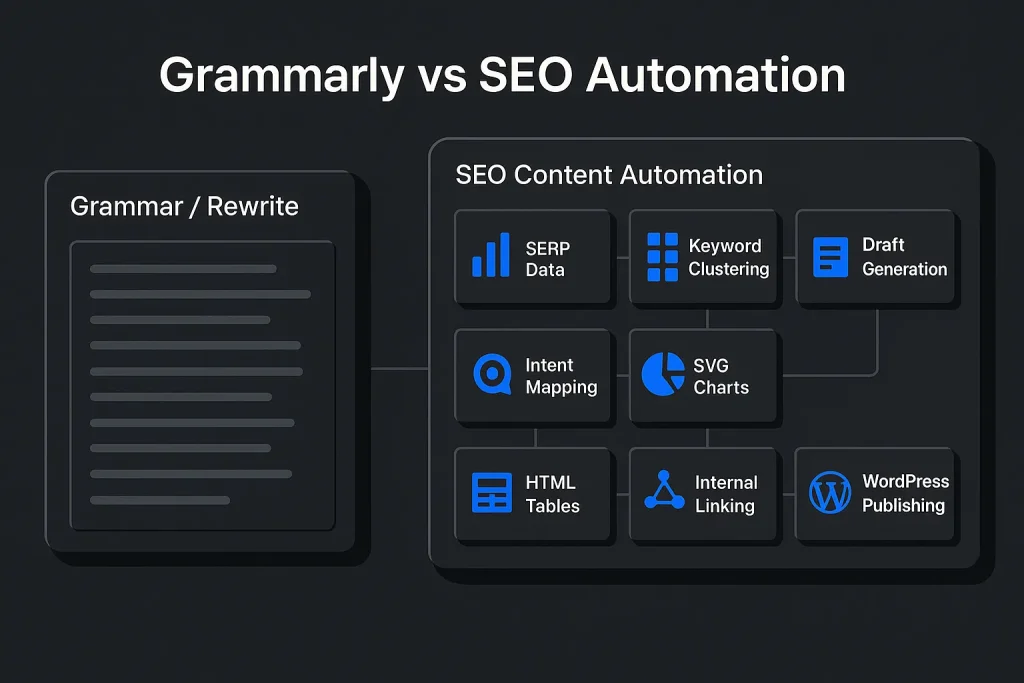
Grammarly AI writer is genuinely useful when the job is to tighten sentences, rewrite awkward passages, or smooth out tone inside an existing workflow. But that is editing work, not search-led content operations. For growth teams, agencies, and content-heavy SaaS companies, the real bottleneck is rarely the last sentence on the page. It is the missing operating layer between topic discovery, keyword prioritization, content structure, media packaging, internal linking, and direct CMS publishing. That gap is exactly why a strong writing assistant can still leave an SEO team with a weak production system.
The distinction is not academic. Content scale does not come from better paragraph suggestions alone. It comes from infrastructure: a repeatable process that decides which pages should exist, how they map to intent, how they connect to each other, and how they reach production without constant manual handoffs. Grammarly’s public positioning is fairly clear here. It presents itself as an AI communication assistant for drafting, rewriting, clarity, and tone, not as a native SEO platform or publishing engine.
We do not see that as a flaw. It is simply a scope boundary. The mistake happens when teams confuse sentence assistance with content infrastructure. Then they overestimate what an editor can do and underestimate the operational cost that still remains after the copy looks cleaner.
Those adoption numbers matter if we are judging communication software. According to Grammarly support documentation, the product is trusted by over 40 million people and 50,000 organizations. Its broader company materials also state that it works across more than 1 million applications and websites, as shown on Grammarly’s About page. But none of that means native keyword clustering, SERP harvesting, topic hub planning, or WordPress publishing. It shows editing reach, not SEO operating depth.

Introduction: Grammarly is an editor; SEO requires an operating system
Most teams adopt AI at the point where friction is most visible. A marketer sees a rough paragraph and opens a writing assistant. An SEO lead sees ten missing landing pages, broken linking logic, inconsistent briefs, delayed publishing, and no scalable topic map. Both are solving real problems. They are just solving them at very different layers of the stack.
An editor improves local quality. An SEO system governs production logic. One works on sentences, paragraphs, and tone. The other works on search demand, page sequencing, coverage depth, entity relevance, cluster design, and publishing throughput. If a team ignores that difference, it can spend a lot of time polishing copy that was never strategically scoped in the first place.
Google’s own guidance on helpful, people-first content supports that view. Good content is not merely fluent content. It has to match user needs, search intent, and page purpose. That is why Google Search Central guidance matters here: it pushes teams toward useful, audience-aligned pages instead of content produced mainly to manipulate rankings. On our side, we would put it even more bluntly: if the planning is wrong, elegant prose will not save the page.
From an operations angle, the content workflow usually breaks into three categories:
- Assistance tools: rewrite, paraphrase, tone adjustment, grammar correction, and prompt-based drafting.
- Production tools: outlines, draft generation, templates, media packaging, and workflow acceleration.
- Infrastructure tools: semantic clustering, intent planning, internal link orchestration, publishing automation, and portfolio-level throughput management.
Grammarly AI writer sits mainly in the first category and only partly in the second. Full-funnel SEO automation starts in the second category, but it becomes truly valuable in the third. That is the line many teams miss.
The prompt allocation model makes this visible. Grammarly’s AI usage is metered at the prompt level, not organized around large-scale content production. Based on Grammarly’s published prompt limits, the free tier includes 100 AI prompts per month, Premium includes 1,000, and Pro, Business, and Education plans include 2,000. That setup fits a prompt-based writing assistant. It does not look like a bulk content engine built to move many pages through an end-to-end SEO workflow.
Where Grammarly AI Writer stops: blind spots and missing SEO capabilities
The quickest way to judge any AI writing product is to separate what it improves from what it does not even see. Grammarly can improve phrasing, clarity, and consistency inside a given text window. It cannot natively decide whether the topic should exist, what keyword cluster it belongs to, which competing pages define the current SERP standard, or which supporting pages should link into it after publication.
That is the real boundary. A writing assistant is text-aware. An SEO engine has to be search-aware, site-aware, and workflow-aware. On our experience, this is where the category confusion usually starts.
1. No live SERP harvesting as a native operating layer
Search-driven production starts outside the document. Teams need to know what Google is rewarding for a query set right now, how intent splits across modifiers, what formats dominate, which entities recur, and how commercial versus informational expectations shift inside a cluster. Grammarly’s public product materials focus on prompt-driven drafting and rewriting, including GrammarlyGO-style assistance for creating and improving text, as described in its support documentation on generative features. They do not document native live SERP collection or rank-aware query mapping.
For SEO, that omission is decisive. Without SERP awareness, the tool cannot reliably tell the difference between a query that needs a product-led comparison page, one that needs a tutorial, and one that needs a short definition article supported by deeper cluster pages. That is not a small missing feature. It is the planning layer itself.
2. No keyword clustering logic
Even the best free ai writing generator or ai writer generator does not become an SEO platform just because it can produce readable paragraphs. Keyword clustering is not a copy task. It is a planning function that groups related queries into pages, prevents cannibalization, and defines page hierarchy. A grammarly ai writer generator can help phrase content after the page plan exists, but it does not build that plan natively.
In practical terms, clustering answers several questions before writing even starts:
- Which queries belong on one page and which need separate pages.
- Which page should target the head term.
- Which modifiers deserve standalone support content.
- Which pages should be transactional, educational, or comparison-led.
- How internal links should move across the cluster.
If a team still does all that manually in spreadsheets while using Grammarly only to polish the output, then Grammarly is not the production engine. It is one useful tool inside a larger human workflow. We think that distinction saves a lot of wasted budget.

3. No native structural packaging for HTML tables and SVG visuals
Many strong B2B pages are not just paragraphs. They are structured assets. They include comparison tables, framework summaries, KPI blocks, process charts, and reusable visual logic that improves comprehension and scannability. Grammarly can help rewrite the captions around those components, but its public documentation does not position it as a native generator of HTML comparison tables, SVG charts, or publish-ready visual content packages.
That matters because structured packaging is part of production efficiency. When a team needs an article to include comparison logic, clean HTML, and infographic-ready output, the value is not simply that text exists. The value is that all required page components exist in formats the CMS can publish without manual rebuilding. On our view, this is one of the most underestimated time sinks in content ops.
4. No internal link graph orchestration
Internal linking is one of the clearest dividing lines between paragraph generation and full-funnel automation. A single article can look polished and still fail strategically if it does not connect to its parent cluster, sibling pages, or conversion paths. Grammarly does not publicly present itself as a system for automatically inserting context-aware internal links across a topic hub.
For SEO teams, that is not a minor gap. Internal linking shapes crawl pathways, topical reinforcement, editorial discoverability, and page-level authority distribution. A refined paragraph without cluster-aware linking is still an isolated asset.
5. No direct WordPress publishing as a native workflow outcome
Publishing is where many content operations slow down. A draft in a browser extension or editor window is not yet a live page. Someone still has to move content into the CMS, check formatting, upload media, validate links, align categories, and publish. Grammarly’s public materials do not present it as a direct WordPress publishing system. That matters because WordPress remains the dominant CMS environment. According to the W3Techs WordPress 2024 market report, WordPress powers roughly 43.5% of all websites and about 61% of CMS-based websites.
For an SEO team managing dozens or hundreds of pages, direct CMS integration has huge throughput value. If the system stops at “text generated” instead of “page published,” the workflow still depends on human transfer labor. We have seen this become the quiet bottleneck in otherwise well-funded teams.
Another clue that this is editor-oriented software is the text-size boundary. Grammarly states that users can check up to 100,000 characters at a time in the web editor, according to its documented editor limitations. That is practical for document review. It is not the same thing as portfolio-level content throughput management.
To make the gap concrete, the comparison below separates editor functionality from SEO infrastructure requirements.
| Operational layer | What Grammarly AI writer covers | What full-funnel SEO automation covers |
|---|---|---|
| Sentence quality | Grammar, clarity, tone, rewrites | Usually includes draft creation, then optional QA |
| Topic selection | Prompt-dependent, manual | Search data, clustering, prioritization logic |
| SERP awareness | Not a documented native layer | Core requirement for planning and page design |
| Internal links | Manual insertion | Automated or rule-based insertion across clusters |
| Publishing | No native WordPress publishing flow documented | Direct CMS publishing is part of the workflow |
The short version is simple: Grammarly improves language output inside a workflow; it does not replace the workflow itself.
Why manual, paragraph-by-paragraph writing bottlenecks growth teams
The problem with editor-led production is not that it fails on quality. The problem is that it scales linearly with human attention. A marketer opens a document, drafts a section, asks for a rewrite, improves a paragraph, moves to the next section, then repeats the process article by article. That can produce decent copy at small volume. At scale, it becomes expensive, slow, and fragile.
The bottleneck shows up most clearly in agencies, in-house growth teams, and portfolio businesses where one process has to support many sites, categories, or regional variants. On paper the workflow looks manageable. In practice it leaks time at every handoff.
Manual operations compound across the pipeline
When teams rely on a grammarly ai paragraph writer or a grammarly ai writer free online style workflow one article at a time, the hidden labor does not vanish. It piles up around the document:
someone chooses the topic manually, someone validates the keyword, someone builds the outline, someone checks competitors, someone writes or rewrites each section, someone adds comparison elements, someone sources images, someone inserts internal links, and someone pastes the final text into WordPress. Every handoff creates queue time. Every queue time cuts throughput.
That is why growth teams eventually stop measuring content capacity in “articles per writer” and start measuring it in system terms: pages moved from idea to published status per week, per cluster, with acceptable QA. We think that is the healthier metric because it reflects business output, not just editorial effort.
Why browser-extension workflows do not scale cleanly
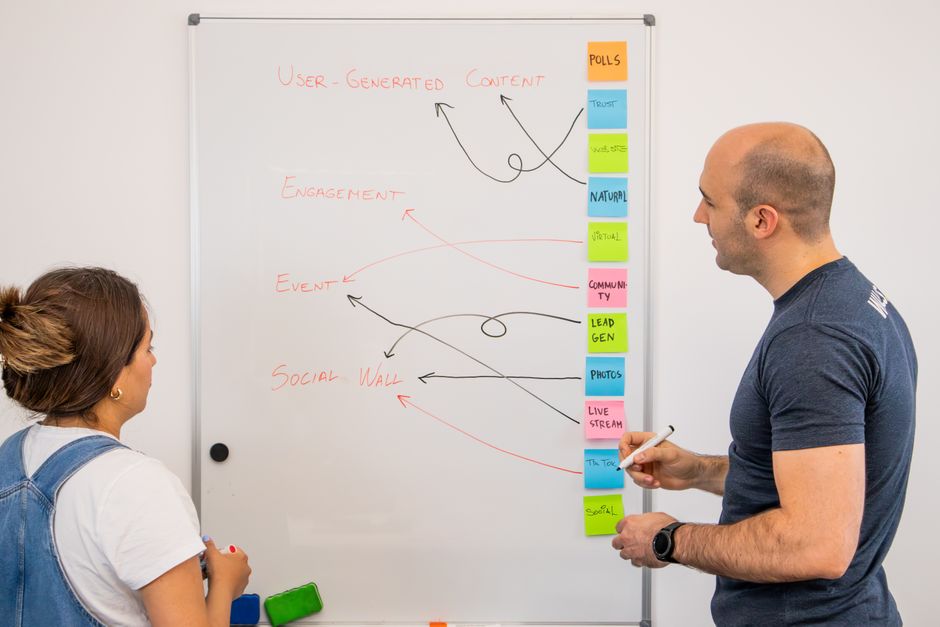
Browser-side assistance is excellent for local intervention. It is weak as a system of record. It does not naturally give portfolio-level visibility into which clusters are complete, which pages are pending, which linking paths are missing, and which content assets are blocked at publishing.
Three operational issues usually follow:
- No centralized planning logic: content decisions stay scattered across briefs, docs, chats, and spreadsheets.
- No standardized output package: each article may need fresh manual assembly before publishing.
- No clean throughput accounting: managers can see that text is being edited, but not whether the SEO system is expanding efficiently.
A grammarly ai humanizer use case can absolutely make drafts read more naturally. It cannot tell a head of content whether the quarter’s priority clusters are moving on schedule, whether commercial pages are being delayed by editorial effort, or whether internal link coverage is keeping pace with publishing volume. That is a management blind spot, not just a writing limitation.
Throughput is a compounding advantage
In SEO operations, small inefficiencies become structural constraints when multiplied across many pages. If each article needs extra manual work for structuring, asset preparation, linking, and publishing, then the cost is not one extra task. The cost is a lower ceiling on content velocity. Teams end up with respectable copy quality and weak market coverage.
A useful lens here is touchpoint count. An editor-led flow often involves many human touchpoints per article: research, outline, draft, rewrite, formatting, media, linking, upload, QA, and publish. A full-funnel engine compresses those into coordinated layers instead of repeated manual interventions. The exact numbers vary by team, but the pattern is stable: fewer handoffs usually mean more consistent output.
Full-funnel SEO content automation: the 7 layers
Full-funnel SEO automation is best understood as an integrated production architecture, not as a single generation prompt. It connects upstream research with downstream publishing. That is the decisive difference from tools that begin and end at the writing box.
The seven layers below describe the minimum operating model for a modern content engine. On our view, if two or three of these layers are still manual, the team is not automated in any meaningful sense.
1. Data harvesting
The system gathers input from keyword sets, competitor signals, SERP patterns, topic inventories, and site structure. This is where search demand enters the workflow. Without this layer, content creation starts from intuition or ad hoc prompting instead of market evidence.
2. Keyword clustering
Queries are grouped into pages based on semantic overlap and ranking logic. Clustering reduces cannibalization and turns a flat keyword list into a page map. This is where the system stops thinking in isolated keywords and starts thinking in content architecture.
3. Search-intent planning
Each page gets an operational purpose: informational, commercial investigation, product-led comparison, how-to guidance, or another intent pattern. That choice determines angle, CTA intensity, heading logic, and supporting assets. Editors often try to fix language after the fact; intent planning prevents teams from producing the wrong page shape in the first place.
4. Draft creation
Only after the strategic layers are defined does generation become efficient. At this stage, AI can produce first drafts, section logic, argument sequencing, and on-page structure that align with the planned topic role. Draft creation inside a full-funnel system is not just “write me an article.” It is “build the right page for this search function.”

5. Media or schema packaging
Many pages need more than body text. They need FAQ sections, comparison tables, callout blocks, image metadata, schema-friendly structures, and sometimes infographic components. Packaging is what turns a draft into a page asset. It affects editor workload directly and often determines publishing speed.
6. Internal-link insertion
This layer places the page inside the site graph. It can reference relevant parent pages, supporting guides, comparison assets, and category hubs. Internal links should not be an afterthought added five minutes before publication. They are part of cluster-level SEO logic.
7. Direct CMS publishing
The final layer pushes the finished package into the content management system, preserving structure, formatting, and metadata. This is where the SEO workflow becomes operationally complete. A content engine that stops before WordPress still depends on manual transfer before it creates business value.
The table below shows how the seven layers map to actual production outcomes.
| Layer | Operational purpose | If missing |
|---|---|---|
| Data harvesting | Feeds demand and SERP signals into planning | Topics are chosen blindly |
| Keyword clustering | Builds page architecture and reduces cannibalization | Content map stays fragmented |
| Intent planning | Shapes article type and conversion role | Pages miss user expectations |
| Draft creation | Produces first-pass content from a strategic brief | Writers rebuild from scratch |
| Media/schema packaging | Makes output publication-ready | Formatting remains manual |
| Internal links | Connects the page to the site graph | Assets stay isolated |
| CMS publishing | Moves content into production | Final mile remains a bottleneck |
A complete engine is not defined by how well it rewrites one paragraph. It is defined by how many of these layers it can execute with control and consistency.
How automation handles structure, media, internal links, and WordPress publishing
Once teams move beyond draft generation, the real advantage of automation shows up in the packaging layer. This is where full-funnel systems materially outperform single-document tools.
Structure is generated as output, not rebuilt manually
A modern content engine can produce headings, comparison blocks, FAQ sections, and clean formatting as part of the article package. That means the content is much closer to publishable state from the start. By contrast, using a grammarly ai writer free or a prompt-only assistant often leaves the team rebuilding structure manually in the editor or CMS.
For teams comparing a paragraph tool to a larger system, this breakdown of paragraph writers versus long-form AI in WordPress workflows captures the same distinction at a narrower level: local drafting support is helpful, but it does not replace production architecture.
Media packaging reduces non-writing labor
SEO pages increasingly need visual support, even in B2B. Not decorative stock images, but assets that clarify processes, comparisons, or workflows. Automation helps by creating repeatable image prompts, metadata, captions, and structured visual blocks that fit the page purpose. That does not remove editorial review. It removes repetitive assembly work.
Internal links become a system rule, not an afterthought
High-volume content programs cannot rely on writers to remember every relevant page relationship. Internal links need rules: link to the parent hub, reference sibling comparison pages, connect bottom-funnel assets, and prevent orphan content. Full-funnel platforms can apply those rules at scale.
That is one reason workflows described in AI-assisted SEO content ops from clustering to WordPress auto-publishing are structurally different from document-first writing flows. The engine knows where the page belongs before the article is finalized. In our experience, that single shift eliminates a surprising amount of cleanup work.
WordPress publishing turns content into production output
Publishing automation matters because throughput ends at the live URL, not at the finished draft. A system that can move content directly into WordPress shortens the path from planning to indexed asset. It also improves formatting consistency and reduces copy-paste errors, missing metadata, and forgotten internal links.
Teams looking to operationalize that transition can study how an AI writer becomes a WordPress content engine for SEO teams. The key point is not the presence of AI itself. It is the presence of a workflow that actually completes the chain.
Because WordPress represents such a large portion of the web, direct publishing integration has disproportionate workflow value. If the destination CMS dominates the market, automation that reaches that CMS is not a convenience feature. It is a meaningful reduction in operational drag.
Best-practice stack: let automation do 95%, keep Grammarly for final QA
The highest-leverage setup is not “replace Grammarly with SEO automation,” and it is not “use Grammarly for everything.” It is layered specialization. Let the SEO engine handle the heavy production tasks, and let Grammarly handle the last-mile language polish where its strengths are strongest.
This division of labor is practical because each tool is then matched to the job it was actually built for. On our side, we consider this the most sensible stack for teams that care about both scale and quality.
What automation should own
Automation should own the repeatable, high-volume, structurally expensive tasks: topic intake, semantic grouping, outline logic, first drafts, on-page packaging, internal links, and WordPress transfer. These are the tasks that destroy throughput when humans do them page by page.
What Grammarly should own
Grammarly should own the final editorial pass: sentence cleanup, tone consistency, clarity improvements, and small rewrites before publication. That is the layer where a communication assistant creates incremental quality gains without becoming the bottleneck of the whole system.
This separation is especially important for teams that started with a grammarly ai writer free online workflow and now need scale. The question is not whether Grammarly is useful. It is whether it is being asked to do work that belongs to a search-aware publishing engine.
For implementation logic at workflow level, this guide on moving from brief to one-click publishing shows how the stack changes once the goal shifts from assistance to throughput.

Why 95% automation is the realistic target
The 95% figure is not a universal benchmark. It is an operating principle. Most repetitive production steps can be systematized, while final QA remains a human-controlled review layer. For B2B SEO teams, this is usually the safest balance because it protects quality without dragging manual bottlenecks back into every stage of the pipeline.
Put simply: automate the infrastructure, review the language, and keep humans focused on exceptions instead of repetition.
Implementation checklist and KPIs to audit your pipeline
Teams trying to understand whether they are still editor-led or actually running a full-funnel content system should audit the workflow, not just the writing quality. The checklist below is diagnostic more than aspirational. If several items are still manual, the team is still carrying hidden scale costs.
Implementation checklist
- Topic selection is driven by clustered search demand rather than ad hoc prompts.
- Each article has an explicit intent role before drafting begins.
- Drafts are generated from structured briefs, not blank documents.
- Tables, FAQ blocks, and visual components are created as part of output packaging.
- Internal links are inserted by system logic or editorial rules, not memory.
- WordPress publishing is integrated into the workflow instead of handled by copy-paste.
- Final proofreading is separated from upstream production tasks.
- Managers can track output at cluster level, not only article level.
The KPI set should also reflect system performance, not just editorial preference.
| KPI | What it shows | Why it matters | Warning sign |
|---|---|---|---|
| Pages published per month | Throughput capacity | Measures operational scale | Draft volume is high, live pages are low |
| Average time from brief to publish | Workflow speed | Reveals handoff drag | Formatting and upload take too long |
| Internal links per new page | Cluster integration quality | Shows whether assets are isolated | New pages launch without cluster support |
| Cluster completion rate | Coverage depth | Indicates strategic consistency | Many isolated articles, few complete hubs |
| Manual touches per article | Human dependency | Maps hidden labor cost | High QA effort before every publish |
These KPIs are more useful than asking whether the team uses AI. The strategic question is whether AI is reducing system friction or simply improving copy inside the same old bottlenecks. We would argue that many teams still measure the wrong thing and then wonder why output does not scale.
Conclusion: align tools with workflow and ROI, not vice versa
Grammarly is a strong editor because it is optimized for editing. It helps with readability, rewrite quality, and communication polish across a massive surface area of apps and websites. None of those strengths make it a native replacement for search-led planning, clustering, content packaging, internal-link logic, or WordPress publishing. That is where full-funnel SEO automation begins.
For B2B teams, the practical decision is not whether to choose one category and reject the other. The practical decision is to stop forcing a writing assistant to carry infrastructure work. Use the editor where editorial quality is being refined. Use the automation engine where search-driven production needs to scale.
When those roles are separated correctly, ROI becomes easier to see: the system handles throughput, and the editor handles final quality. That is a cleaner operating model than trying to build a content factory one paragraph at a time.

Commercial fit: where SEO Autopilot enters the workflow
Teams that need more than prompt-based drafting usually need a system that moves from SEO planning to publishable output with fewer manual steps. In that setup, Grammarly remains useful as a proofreading layer, while the production engine handles semantics, structure, internal links, media packaging, and CMS delivery. A practical example of that model is SEO Autopilot, which is built around end-to-end SEO article generation and WordPress publishing rather than around isolated paragraph assistance.
For agencies, publishers, and in-house growth teams, the business value is straightforward: less time spent stitching together briefs, drafts, links, assets, and uploads; more control over throughput and consistency across the content portfolio.
We believe the main takeaway is simple. Grammarly AI writer is worth keeping, but only in the role where it is strongest: final editorial QA. The bigger gains come from fixing the system around the document, not endlessly improving the document inside a weak system. Teams that separate editing from infrastructure usually move faster, publish more consistently, and make ROI easier to defend.
Our realistic forecast is that this split will become standard. More teams will treat tools like a free ai writing generator, an ai writer generator, or even a grammarly ai writer free workflow as entry points, not as full operating models. The next competitive edge will come from orchestration: better clustering, cleaner packaging, stronger internal links, and direct publishing with less human drag.
FAQ
Is Grammarly AI Writer good enough for SEO content?
It is useful for improving readability and tone, but it is not enough as a complete SEO production system. Grammarly AI writer helps refine text; it does not natively replace SERP analysis, keyword clustering, internal-link orchestration, or WordPress publishing.
Can Grammarly AI publish directly to WordPress?
Based on the official materials referenced in this article, Grammarly is not presented as a native WordPress publishing engine. Teams still need a separate workflow or platform to move structured SEO content into WordPress at scale.
What are the core steps in a full-funnel SEO content pipeline?
The core steps are data harvesting, keyword clustering, search-intent planning, draft creation, media or schema packaging, internal-link insertion, and direct CMS publishing. Those seven layers turn AI generation into an operational SEO system rather than a standalone writing interaction.
How do growth teams scale beyond paragraph generators?
They move from document-first work to system-first work. In practice, that means using automation for planning, structuring, packaging, linking, and publishing, then keeping tools like Grammarly for the final QA pass.
Should I still use Grammarly if I automate my SEO content workflow?
Yes, if you use it for the role where it adds the most value. Grammarly is strong as a final proofreading and tone-check layer after the SEO engine has already handled research, clustering, structure, and publishing preparation.