
A domain ranking check is often treated like strategy when it is really just a narrow proxy. It can tell a team something about backlink strength at the domain level, but much less about whether a planned page will satisfy search intent, complete a topic cluster, or earn visibility in a SERP shaped by page-level relevance and internal context. That gap is exactly where content roadmaps get distorted. We see it often: teams optimize around a third-party score instead of the variables that actually improve ranking eligibility.
In practice, this creates two expensive mistakes. First, teams underinvest in commercially relevant topics because a domain rating checker or da pa checker suggests the site is “not strong enough yet.” Second, teams assume a healthy domain authority score will carry weak execution, so they ship fragmented pages with thin differentiation, inconsistent internal links, and no semantic sequence. Both errors start with the wrong question. The real operational question is not whether the site looks authoritative in a dashboard. It is whether each page enters a coherent topical system that helps Google discover, interpret, and trust it.
The distinction matters even more now because search has moved further away from simplistic domain-level heuristics. Google’s ranking systems work primarily at the page level, while broader site signals add context rather than blanket permission for every URL to rank, as explained in Google’s ranking systems documentation. If your roadmap still starts with a google domain ranking check or a free domain rank checker screenshot, the plan is probably reacting to a vanity signal instead of building ranking depth.
This is also why the familiar toolkit of domain rating, dr checker, traffic checker, keyword rank checker website, and website domain rating checker should be treated as diagnostics, not as a roadmap engine. They can support analysis. They should not decide topic selection, cluster design, or publishing cadence. On our view, that line matters more than most teams admit.

Stop chasing DA/DR: what a “domain ranking check” really measures
Most teams use the phrase “domain ranking check” too loosely. In reality, these tools estimate domain-level strength through proprietary models, usually centered on backlink quantity, backlink quality, and link graph relationships. Useful? Yes. But that is not the same thing as ranking probability for a specific page on a specific query. The gap between those two ideas is where bad roadmap decisions usually begin.
Ahrefs defines Domain Rating as a proprietary logarithmic 0–100 score based on the relative strength of a site’s backlink profile, as described in the Ahrefs DR definition. Moz positions Domain Authority as a predictive comparative score rather than a Google metric. In plain terms, a domain rating checker or free domain rating checker gives you a model of external link strength, not a direct view into Google’s internal ranking logic.
That sounds obvious on paper. In planning meetings, it often gets ignored. Teams use site domain authority as if it were a master key for content competitiveness. They run a check domain seo workflow, open a domain ranking tool, compare a competitor’s domain authority score, and then let that gap decide keyword selection. On our experience, this is one of the fastest ways to talk yourself out of winnable opportunities.
There is a second limitation. Ahrefs also states that domain rating is relative by design, not an absolute universal measure, which the company explains in its documentation on how DR is calculated. A score that looks low in one SERP can be perfectly workable in another because competition changes by query type, vertical, intent mix, freshness demands, and the presence of forums, marketplaces, directories, or AI-generated summary layers. A free online website rank checker cannot compress all of that into one domain number without losing the plot.
What a domain ranking check does measure well:
- Relative external link profile strength compared with other domains in the tool’s index.
- Broad off-page credibility patterns that may correlate with visibility at a portfolio level.
- Whether a site is likely operating from a stronger or weaker backlink base than direct competitors.
What it does not measure well:
- Whether a page satisfies the exact query intent better than competing pages.
- Whether your content cluster covers the surrounding subtopics and entities needed to support that page.
- Whether internal links help Google discover, connect, and contextualize your URLs.
- Whether editorial throughput is fast enough to build topical momentum before competitors fill the gap.
That is why the phrase page authority domain authority should be handled carefully in planning discussions. Even if a tool estimates page-level strength, it still models observable factors from outside Google. It does not replace editorial judgment, semantic architecture, or operational publishing discipline.
For B2B teams, the practical conclusion is simple: use a domain ranking check as a context metric, not a planning metric. It belongs in competitor benchmarking and link profile review. It should not sit at the top of the roadmap logic. We consider that a basic governance rule, not a nuance.
Those three facts alone are enough to disqualify DR/DA as the primary roadmap filter.
A simple comparison makes the overreach easy to see.
| Metric | What it captures | What it misses | Best use |
|---|---|---|---|
| Domain Rating / Domain Authority | Relative backlink profile strength | Intent fit, topical depth, internal architecture | Competitive context and off-page benchmarking |
| Topical coverage depth | Cluster completeness across entities and subtopics | Off-page authority trends | Roadmap prioritization and gap analysis |
| Content velocity | How quickly clusters get drafted, edited, and published | Topic quality by itself | Execution planning and throughput management |
| Internal link integrity | Crawl paths, anchor clarity, hub-to-spoke structure | Backlink power | Cluster performance and discovery efficiency |
The operational takeaway is straightforward: DA/DR can frame context, but the roadmap itself should be driven by metrics tied to pages, clusters, and publishable output.

Why metric-first roadmaps fail (missed intent, thin pages, no clusters)
A metric-first roadmap starts with the wrong gate. Instead of asking which topic clusters create the clearest path to qualified traffic and commercial relevance, teams begin by checking whether the site “deserves” the keyword according to a domain ranking tool. That decision structure introduces bias into keyword selection and content sequencing.
The first failure mode is avoidance. A team runs a website domain rating checker, sees a modest score, compares it with stronger competitors, and drops commercially important topics even when the SERP includes niche pages, specialized vendors, forums, or mixed-intent results. That creates under-coverage exactly where expertise, specificity, and cluster support could outperform generic high-authority domains.
The second failure mode is overconfidence. A team with stronger site domain authority assumes high DR will compensate for weak page construction. They publish isolated posts, duplicate angles, or lightly rewritten articles without building the surrounding semantic support. The roadmap looks active in a spreadsheet. Underneath, the architecture is thin. Google sees disconnected assets instead of a coherent topical system.
These errors usually show up in four operational symptoms:
- Missed intent matching. Topic selection is filtered by domain authority score rather than by the quality of the answer users need.
- Thin pages. Writers publish stand-alone articles that do not differentiate, clarify entities, or answer adjacent follow-up questions.
- No cluster sequence. There is no hub-to-spoke logic, so supporting pages arrive late or never.
- Measurement confusion. Teams celebrate a better dr checker score while rankings on target pages remain flat.
The misleading part is that domain-level metrics can create a false sense of precision. They look quantitative, so they feel rigorous. In reality, they are often less actionable than page-level and workflow-level measures. Knowing your domain rating does not tell you which subtopics are still uncovered, which article needs better internal anchors, or whether your editorial cycle time is too slow to build topic depth before a competitor expands into the same cluster.
Consider a common B2B SaaS scenario. The team wants to rank for a commercially relevant topic with clear mid-funnel intent. A keyword tool shows established competitors with higher DR, so the team postpones the pillar page. Instead, they publish several low-risk blog posts on peripheral terms. Three months later, the site has more URLs but still lacks the core cluster: no central guide, no support pages for implementation, no comparison content, no glossary entities, and weak internal link paths. The roadmap looked prudent. In reality, it traded strategic relevance for comfort. We think this is one of the costliest SEO habits because it feels responsible while quietly killing momentum.
The opposite scenario is just as damaging. A larger site runs a domain ranking check, concludes it has enough authority, and scales production aggressively. Because the plan is volume-led rather than cluster-led, the site accumulates repetitive pages. Google’s guidance on people-first content emphasizes usefulness, reliability, and content created to benefit people, not pages made mainly to manipulate rankings, as stated in Google’s helpful content guidance. High domain-level authority does not protect repetitive or shallow pages from quality evaluation.
There is another subtle problem: domain metrics compress complexity into one number, while content planning requires multiple coordinated decisions. A serious roadmap must resolve topic coverage, page purpose, internal relationships, update cadence, SERP format, and publishing order. A single domain authority score cannot meaningfully instruct all of those decisions. It mostly tempts teams to oversimplify them.
For a practical extension of this distinction, the article on page rank vs topical authority for B2B sites is useful because it reframes authority as a function of coverage and structure rather than as a vanity score.
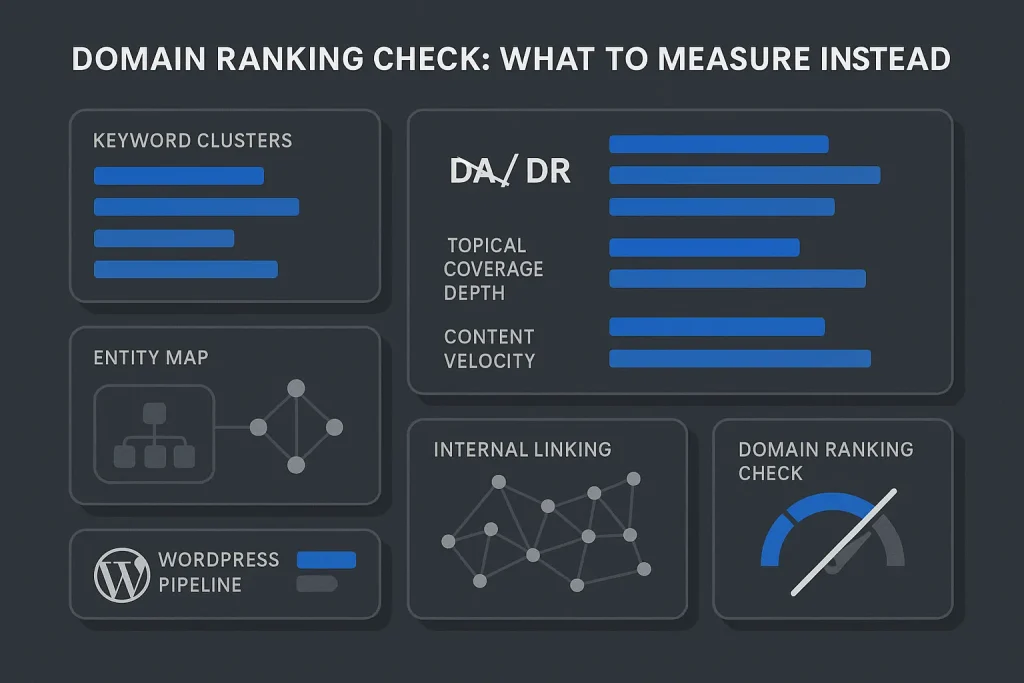
The point of the chart is not numerical precision. It shows why roadmap-critical signals extend well beyond a domain metric snapshot.

Google’s reality in 2026: topical depth, entities, and helpful content
The modern search environment leaves even less room for domain-level shortcuts. Google’s systems evaluate pages in context: query intent, helpfulness, reliability, topical relationships, discoverability, and the broader usefulness of the site’s content patterns. None of that maps neatly to a da pa checker output.
Google’s ranking systems documentation makes two points that matter here. First, ranking works primarily at the page level. Second, the helpful content system is part of core ranking systems rather than a separate vanity-style filter, according to Google’s official guide to ranking systems. The implication is simple: Google is not taking a domain ranking check from a third-party tool and using it as a shortcut for page quality or intent satisfaction.
That page-level reality shifts attention toward topical depth and entity relationships. Topical depth means the site covers not only the head term but also the subtopics, adjacent questions, definitions, workflows, comparisons, implementation details, and exceptions that make a page genuinely useful. Entity relationships mean the content reflects how concepts connect in the real world and in search behavior. If you publish one isolated page about a topic without the surrounding semantic support, the page may look complete to a writer but still appear context-thin to search systems and users.
This matters even more in a search landscape influenced by AI Overviews. In March 2025, Google stated that AI Overviews were already used by more than 1 billion people, according to Google’s update on AI-driven search experiences. In May 2025, Google expanded AI Overviews to more than 200 countries and territories and more than 40 languages, and reported more than a 10% increase in usage for the query classes where the feature appears in markets such as the U.S. and India, as noted in Google’s AI Overviews expansion update. That raises the bar for pages that want sustained visibility. They need to answer clearly, contextually, and comprehensively enough to compete in a SERP where synthesis and follow-up interpretation are becoming more prominent.
It also reinforces why a google domain ranking check is the wrong compass. AI Overviews are integrated with Google’s core web ranking systems. They do not select sources because a site scores well in a third-party dr checker. They surface information that best helps answer the underlying question. If your roadmap is still optimizing for the appearance of domain strength rather than the substance of coverage, the competitive gap only widens.
Google’s spam policies add another constraint. Scaled content abuse is explicitly called out when large volumes of low-value pages are produced mainly to manipulate rankings. That means throughput alone is not enough. Publishing faster only works when the output is clustered, useful, and structurally coherent. High domain-level strength does not immunize repetitive pages. This is why teams need to separate volume from coverage. One creates more URLs. The other creates more semantic value.
For B2B marketers, the strategic implication is clear: authority is increasingly demonstrated through consistency of answer quality across a topic system. A site that covers a domain in depth, ships updates reliably, and maintains clean internal pathways often creates stronger ranking conditions than a site that relies on domain rating and sporadic publication. This is especially true in technical niches where users need layered explanations and implementation guidance rather than generic summaries. On our view, this is where smaller but better-structured sites still have room to win.
Search now rewards organized topical systems more consistently than vanity snapshots of domain strength.
As AI Overviews expand, the content that wins is the content that explains a topic system cleanly, not the content sitting on a domain with a reassuring vanity metric.

Metric 1 — Topical coverage depth (cluster completeness, gaps)
If DR and DA are weak planning metrics, what should replace them? The first and most important answer is topical coverage depth. This measures whether your site covers enough of a query cluster to be considered a credible destination for the user’s broader information need. It is not one page versus one keyword. It is one page supported by the surrounding pages, definitions, comparisons, examples, implementation steps, and linked context needed to complete the topic.
Topical coverage depth matters because Google ranks pages in context. A single page can rank without a full cluster, but a consistent pattern of ranking across a theme usually depends on cluster completeness. When a site covers the central entity and the meaningful subtopics around it, internal links become more useful, anchors become more descriptive, and each page inherits stronger semantic support.
In practical terms, topical coverage depth can be measured through a cluster audit. For each priority topic, define the core query set, the supporting subtopics, the entity list, and the content formats required. Then score which parts are already published, which are incomplete, and which are missing. This gives the roadmap a clear expansion logic that a domain ranking check cannot provide.
A workable measurement model includes:
- Cluster completeness ratio: published pages divided by required pages in the target cluster.
- Intent coverage: percentage of key informational, commercial, and comparative intents addressed.
- Entity coverage: whether key concepts, tools, terms, and process components are explained across the cluster.
- Refresh coverage: whether core pages are updated when the SERP or product context changes.
This approach is more strategic than asking “what is a good domain authority score for this site?” because it ties publishing directly to market coverage. It also helps smaller sites enter competitive spaces intelligently. Instead of chasing the broadest head term first, they can build topic ownership around a cluster where expertise and completeness matter more than raw domain rating.
For example, a site targeting SEO automation should not only publish a page about AI SEO tools. It should build connected content around semantic clustering, content briefs, internal linking logic, WordPress auto-publishing, entity-first optimization, content QA, and topic-specific use cases for agencies or in-house teams. That architecture signals seriousness far more effectively than a superficial increase in site domain authority.
This is also where semantic planning systems outperform manual spreadsheets. The article on how an AI assistant automates SEO content ops shows how clustering and publishing workflows can be connected into one operational layer instead of being handled as separate tasks.
A useful way to operationalize coverage is to classify every planned page into one of four roles: hub, spoke, proof, and conversion. Hubs define the topic and consolidate navigation. Spokes answer subtopics. Proof pages support trust through examples, comparisons, or implementation details. Conversion pages capture commercial intent. If your cluster has only spokes and no hub, or only top-of-funnel pieces and no conversion layer, depth is incomplete even if the article count looks healthy.
The next table gives a practical editorial framework. On our view, this is far more useful than running another free domain rating checker and calling it planning.
| Coverage dimension | What to audit | Common gap | Roadmap action |
|---|---|---|---|
| Head topic coverage | Main pillar page and primary intent | No canonical hub page | Publish or rebuild the hub first |
| Subtopic coverage | FAQs, workflows, use cases, comparisons | Supporting pages missing or superficial | Create spoke pages in sequence |
| Entity coverage | Terms, tools, concepts, adjacent processes | Topic treated as one keyword only | Expand briefs with entity map |
| Commercial coverage | Solution pages, ROI pages, product comparisons | Traffic exists but no commercial bridge | Add mid- and bottom-funnel assets |
When the cluster is complete, each page stops carrying the whole burden alone.
A cluster with visible gaps may still have published content, but it does not yet have defensible topical depth.
Metric 2 — Content velocity and throughput (draft-to-publish speed)
The second metric is content velocity, more precisely measured as throughput and draft-to-publish cycle time. This matters because topical authority is not only about what you publish, but how consistently and how quickly you can close cluster gaps. A competitor that ships complete, well-linked topic sequences in six weeks will usually build stronger topical momentum than a team that debates each keyword for three months while checking a free domain rating checker every Monday.
Velocity is not a vanity metric if it is defined correctly. The useful definition is operational: how many cluster-aligned drafts move from brief to publish in a set period, and how long each asset spends in the pipeline. This shows whether your content system can compound knowledge or whether it introduces delays that leave strategic gaps open.
There are three reasons this metric matters more than a domain ranking check for roadmap execution:
First, search opportunities decay. Competitors publish, SERPs change, product categories mature, and AI-generated summaries absorb more informational demand. Slow publishing means slower accumulation of semantic context.
Second, clusters benefit from temporal proximity. When a hub page and its spokes are published close together, internal links, crawl paths, and semantic reinforcement form faster. When they are stretched across quarters, the hub lacks support and the spokes lack a center.
Third, velocity reveals process quality. If cycle time is erratic, the bottleneck may be in briefing, editing, approvals, media handling, or CMS publishing rather than in writing itself. That is actionable. Domain authority is not.
Useful throughput metrics include:
- Median days from topic approval to first draft.
- Median days from draft to publish.
- Published pages per cluster per month.
- Percentage of briefs converted into published pages within the target window.
- Update cycle time for aging core pages.
Teams that still ask “check my website keyword ranking” or “check my website ranking in google” as their weekly heartbeat often miss this operational layer. Rankings matter, but they are lagging indicators. Throughput is a leading indicator. It determines how quickly the site can produce the coverage that rankings later reflect.
This is where automation materially changes outcomes. A system that can generate semantic inputs, produce structured drafts, suggest internal links, create assets, and move content into WordPress reduces non-strategic delay. Used properly, this does not mean publishing low-value pages at scale. It means reducing the time spent on repetitive workflow steps so editors can focus on quality control, differentiation, and commercial alignment. The article on scale your blog without sacrificing SEO quality is directly relevant to this balance.
The right benchmark is not “publish more.” It is “publish complete clusters faster without lowering editorial standards.” That is what creates a defensible content system. We have seen teams obsess over check my website keyword ranking dashboards while ignoring the workflow delays that actually caused the ranking problem.

Metric 3 — Internal link integrity (context, anchors, crawl paths)
The third metric is internal link integrity, and it is routinely undervalued because it looks less glamorous than domain rating. That is a mistake. Internal linking is where your semantic architecture becomes operational. It helps Google discover new URLs, understand how pages relate, and interpret anchor context. It also helps users move through the cluster in a logical sequence.
Google’s SEO Starter Guide states that the vast majority of new pages discovered every day are found through links, and it highlights the value of descriptive anchor text in helping both users and Google understand linked pages, as outlined in the Google SEO Starter Guide. That makes internal link integrity a measurable system variable, not an editorial afterthought.
Internal link integrity should be evaluated across three layers:
Crawlability. Can Googlebot reach important pages through clear paths from known URLs? If new pages are buried or orphaned, discovery and interpretation are weakened.
Anchor descriptiveness. Do internal anchors communicate the destination clearly, or are they generic phrases that waste semantic opportunity?
Hub-to-spoke structure. Do core pages link down to supporting pages and receive reinforcing links back from them? Or are links scattered without hierarchy?
This is where weak clusters quietly fail. A team may publish decent articles, run a traffic checker, inspect a keyword rank checker website, and still wonder why the cluster underperforms. The reason is often not article quality in isolation. It is the absence of connective tissue. Without strong internal linking, Google has fewer signals about which pages belong together, which page is central, and how the subtopics reinforce the main theme.
A measurable internal link integrity model can include:
- Percentage of indexable pages with at least one contextual inbound internal link.
- Average number of descriptive internal links from hub pages to priority spokes.
- Percentage of anchors using meaningful topic descriptors rather than generic language.
- Count of orphaned or weakly connected pages inside active clusters.
- Time from page publication to first internal link placement from a relevant existing page.
Internal links also solve an executive reporting problem. Unlike a domain ranking check, they provide concrete remediation paths. If a cluster is underlinked, add pathways. If anchors are vague, improve anchor language. If spokes do not link back to hubs, fix the structure. This turns SEO from a reactive reporting exercise into an operational discipline.
The evolution toward entity-first optimization makes this even more important. The article on AI for SEO in WordPress with entity-first content is relevant here because entity coverage and internal links work together: one defines meaning, the other distributes it.
On our view, internal linking is still one of the most underused levers in B2B SEO because it is fixable, measurable, and rarely blocked by external factors. That makes it far more valuable than another round of score-watching in a website domain rating checker.
| Integrity signal | Why it matters | What to fix when weak |
|---|---|---|
| Contextual inbound links | Supports discovery and cluster association | Link new pages from relevant published assets |
| Descriptive anchors | Clarifies destination meaning for users and Google | Replace generic anchor phrases with topic-specific wording |
| Hub-to-spoke pathways | Signals topical hierarchy and page roles | Rebuild cluster navigation and reciprocal support links |
| Orphan rate | High orphan counts waste content and slow interpretation | Add navigation paths from hubs and related articles |
When internal links are treated as infrastructure, clusters become easier to discover, interpret, and strengthen over time.

Building a semantic-first roadmap with Autopilot SEO
A semantic-first roadmap begins with cluster logic, not a free domain rank checker. The process is disciplined: identify the commercial and informational topic set, map the entities and supporting subtopics, define page roles, sequence publication, and connect the cluster with deliberate internal links. This is exactly the kind of work that benefits from automation because the challenge is not only writing. It is coordinating research, structure, production, media, linking, and publishing at scale without losing relevance.
For B2B teams, the most practical way to operationalize this is to reduce manual friction across the full content pipeline. Instead of treating keyword research, outlining, article drafting, image generation, internal linking, and WordPress publication as disconnected tasks, they can be managed as one system. That creates the throughput needed to build topical coverage depth while preserving review controls.
SEO Autopilot is built around that operating model. The platform generates semantic inputs, structures content, produces drafts, supports internal linking logic, prepares visuals, and publishes to WordPress in a unified workflow. That makes it easier to build clusters instead of isolated pages and to improve content velocity without defaulting to low-value scale. More importantly, it aligns production with the metrics that actually matter: cluster completeness, cycle time, and link integrity.
Teams evaluating process modernization can review the product on the official SEO Autopilot site. In operational terms, the advantage is not “AI writes articles.” The advantage is that the system shortens the path from topic decision to published, connected asset. That is what allows a semantic-first roadmap to function consistently.
A practical workflow looks like this:
- Define the priority cluster based on business value and search intent, not on domain authority score thresholds.
- Map the hub, spokes, commercial pages, and entity coverage requirements.
- Generate structured briefs and drafts in a consistent editorial format.
- Insert internal links based on topic relationships and hub-to-spoke logic.
- Publish to WordPress quickly enough that the cluster becomes visible as a system, not as scattered URLs.
- Review gaps, update weak pages, and expand the cluster based on uncovered subtopics.
This workflow is far more useful than a weekly ritual of check your website ranking for keyword, compare DR, and revise targets emotionally. It gives the content team a repeatable operating framework. It also gives leadership cleaner reporting because the KPIs relate to actions the team can control.
If the roadmap needs one principle, it is this: authority is built through cumulative semantic coverage and clean execution. A domain ranking check can help describe the starting environment, but it cannot build that authority for you. We believe this is the practical dividing line between SEO programs that compound and those that just report.
Conclusion: ship depth, not vanity scores
The core mistake behind many failed content roadmaps is not poor effort. It is poor instrumentation. Teams over-trust a domain ranking check because it looks objective, fast, and comparable. But DA/DR-style metrics measure a narrow part of the system: backlink profile strength. They do not tell you whether a page deserves to rank, whether a cluster is complete, whether your pipeline can close gaps fast enough, or whether internal links are helping Google understand the topic architecture.
The better roadmap uses three operational metrics instead. Measure topical coverage depth so you know whether the cluster is complete. Measure content velocity so you know whether execution is fast enough to compound. Measure internal link integrity so your pages are discoverable, connected, and semantically reinforced. Those are controllable variables. They are also much closer to how modern search actually evaluates and surfaces useful content.
For B2B SEO, that shift is material. It changes planning from score-watching to system-building. It reduces false negatives where valuable topics are abandoned too early. It also reduces false confidence where strong domain metrics hide weak content architecture. In a search environment shaped by helpful content logic, page-level evaluation, and expanding AI-assisted results, semantic completeness is a stronger strategic asset than vanity domain metrics.
The most resilient teams will still use a domain rating checker, dr checker, or traffic checker for context. They just will not let those tools dictate the roadmap. They will let the roadmap be dictated by coverage, throughput, and structure.
We think the real lesson is simple: the roadmap should reflect what you can improve, not just what a dashboard can score. Domain metrics still have a place, but it is a supporting role. The teams that win are usually the ones that publish complete clusters faster, connect them better, and keep improving the system instead of chasing reassurance from a free online website rank checker or a free domain rank checker.
Looking ahead, we expect this gap to widen. As SERPs become more synthetic and AI-assisted layers absorb more basic informational demand, shallow pages on “strong” domains will lose some of the advantage they once had. In our view, businesses that invest now in semantic coverage, faster editorial throughput, and cleaner internal architecture will be in a much better position to hold visibility over the next few years.
FAQ
Does a low domain rating mean I can’t rank for competitive keywords?
No. A low domain rating can limit some off-page advantages, but it does not automatically block rankings. If the page matches intent well, sits inside a complete cluster, and benefits from strong internal links, it can still compete on valuable queries. On practice, we often see smaller sites win where the answer is sharper and the cluster is better built.
What is a good domain authority score for a new site?
There is no universally “good” number because a domain authority score is a third-party comparative metric, not a Google benchmark. For a new site, the more useful question is whether you are building topical coverage and a crawlable internal structure fast enough to support priority pages. That matters more than what a da pa checker says in month one.
How do I measure topical authority without relying on DR/DA?
Measure cluster completeness, intent coverage, entity coverage, and supporting page depth. A better alternative to a domain ranking check is a cluster audit that shows what is published, what is missing, how pages connect, and whether the topic system covers real user needs end to end. If you want a practical layer on top, you can also check domain seo alongside that audit, but not instead of it.
How fast should I publish to build topical coverage effectively?
Fast enough that core hub pages and supporting spokes appear close together, not months apart. The exact number varies by team, but the useful KPI is draft-to-publish cycle time and output consistency across a cluster rather than raw article count alone. If you only pause to check my website ranking in google after every post, you are probably measuring too late.
How many internal links should an article have to support a cluster?
There is no fixed number that works for every page. The right amount is the number of contextual, descriptive links needed to connect the article to its hub, adjacent spokes, and relevant commercial pages without forcing anchors unnaturally. If you need a sanity check, use a keyword rank checker website or free online website rank checker for diagnostics, but let structure and clarity guide the final decision.