
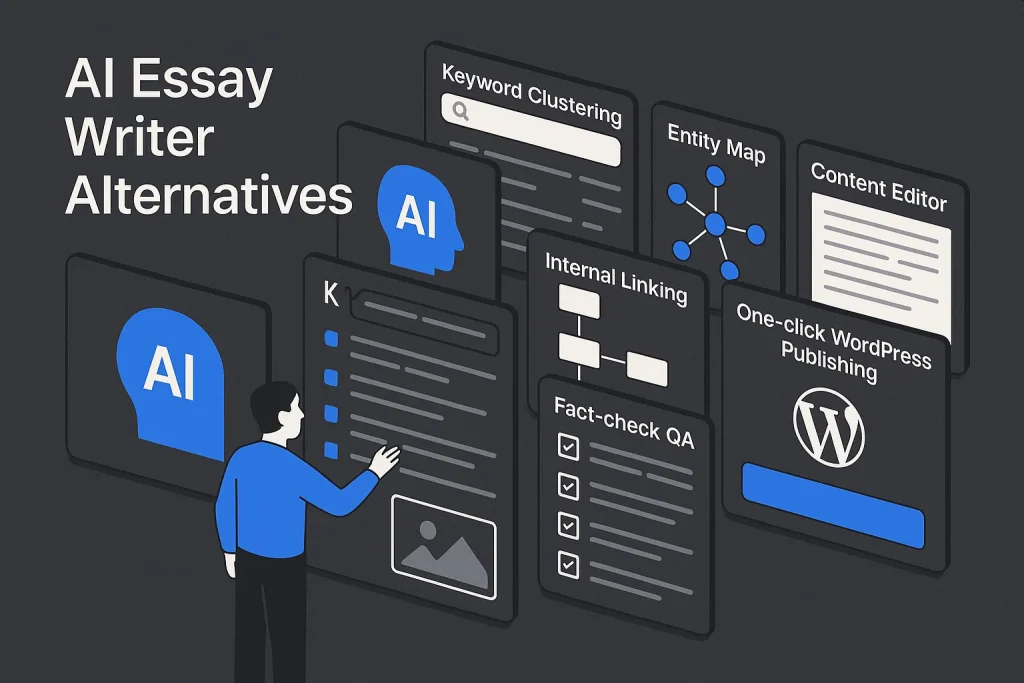
The phrase ai essay writer sounds practical, but for marketing teams it usually points to a deeper operational gap. They do not need another tool that spits out paragraphs on command. They need a system that can turn a topic into a publishable, search-viable asset. Drafting alone does not create rankings, topical authority, or efficient content operations. The real requirement is Google-ready content with search intent alignment, semantic depth, internal links, media, on-page structure, and a clean publishing workflow.
That gap matters even more now because AI usage is no longer a differentiator by itself. HubSpot’s State of AI report says 66% of marketers globally use AI in their roles, and SAS research reports 85% of marketers were using generative AI in 2025. The novelty phase is over. If everyone can generate text, the advantage shifts to workflow quality, content governance, and search performance.
Google’s ranking systems do not reward text simply because it exists at scale. According to Google’s guidance on helpful, reliable, people-first content, the standard is user value, not search-engine-first output. And under Google spam policies, scaled content abuse becomes a direct risk when pages are produced mainly to manipulate rankings with little original value. On our view, that is the real dividing line: not AI vs human, but shortcut drafting vs an actual SEO content system.
Below, we break down seven smarter alternatives to a generic essay tool. Each one solves a different bottleneck in content operations: semantic planning, SERP coverage, internal linking, citations, programmatic scaling, quality assurance, and WordPress publishing. Some teams will combine several of them. That is usually the better move. Defaulting to a free essay writer or another single-box prompt tool is rarely a strategy; it is often just a temporary patch.
What marketers really mean when they search “AI essay writer”
In search behavior, “ai essay writer” is often shorthand for “I need content faster.” But in a B2B marketing environment, the request is rarely about essays. It is usually about blog posts, landing pages, comparison pages, knowledge-base articles, or supporting topical clusters. The language starts broad because users reach for the closest familiar term, then refine once they realize a generic drafting assistant does not solve distribution, indexing, or workflow complexity.
That distinction matters because the intent behind related searches like free essay writer, free ai essay writer, write me an essay ai, write essay with ai, or ai website to write essay usually splits into two very different use cases. One is consumer or academic drafting. The other is commercial content production for websites that must satisfy brand standards, search intent, topical consistency, and CMS constraints. Those are not the same job. They should not be evaluated by the same standard either.
Marketers usually want five things when they type terms like ai write essay or use ai to write essay:
- Fast first drafts that reduce blank-page time.
- Better structure based on search intent rather than generic prose.
- Coverage of entities, subtopics, and related terms needed for SEO completeness.
- A path from draft to publish without copy-paste chaos.
- Consistency across many articles, not just one-off outputs.
That is why the “essay writer” framing quickly becomes misleading. A generic tool may help with write essay ai style prompts, but marketing teams need repeatable content operations. We would put it bluntly: they need a content engine, not a one-screen text generator.

Why generic essay tools don’t ship Google-ready marketing content
A generic AI essay writer is optimized for fluency, not for search performance. It can produce coherent paragraphs quickly, but it usually lacks the upstream and downstream layers that make content commercially useful. The result is passable text with weak SERP targeting, shallow subtopic coverage, inconsistent internal linking, and manual cleanup before publishing.
The first failure point is query interpretation. Search content needs intent mapping. A tool that can generate ai to write essay output may not distinguish between informational, commercial, and comparison intent well enough to shape headings, examples, objections, and calls to action. It may produce a smooth article that still misses what ranking pages are actually doing. We see this constantly in AI-assisted drafts: readable copy, wrong page logic.
The second failure point is topic depth. Marketing content needs entity coverage and topical completeness. If the article is about SEO automation, the text should naturally connect concepts such as clustering, briefs, schema, internal linking, indexing, and CMS publishing. Generic essay systems often stay on the surface because they are not built around search topic models or SERP decomposition.
The third failure point is operational. A polished paragraph is not a finished asset. Teams still need title tags, metadata, image handling, internal anchors, editorial QA, and publishing logic. This is where a simple ai essay writer free online tool becomes expensive in practice. It saves drafting time, then quietly adds coordination costs everywhere else.
There is also a policy risk. If teams use AI to mass-produce thin pages, they move into exactly the territory Google flags as scaled content abuse. The issue is not whether AI was involved. The issue is whether the pages exist primarily to rank without delivering enough original value. That is why marketers need controls around uniqueness, editorial judgment, factual verification, and page purpose.
Even basic technical best practices are not enough on their own. Google’s Search guidance makes clear that meeting technical requirements does not guarantee indexing or rankings. In other words, format is necessary but insufficient. On our view, content systems need stronger page-level relevance, site-level consistency, and clearer information architecture. That is where generic essay tools usually fall short.
These numbers show the strategic reality: AI is mainstream, so the edge comes from better systems, not from using an AI essay writer at all.
Evaluation criteria for smarter alternatives (SERP depth, entities, internal links, WordPress automation, QA)
Before comparing alternatives, the right benchmark is not “does it write well enough.” The right benchmark is “does it move the full content job closer to a publishable, defensible, search-ready asset.” For marketing teams, five evaluation dimensions matter most.
1. SERP depth and intent mapping
The tool or workflow should identify what top-ranking pages are covering and why. That means intent type, common heading patterns, comparison framing, commercial modifiers, and content gaps. A draft without SERP logic often reads fine and performs poorly. We consider this one of the most underestimated gaps in teams that rely on simple prompt tools.
2. Entity coverage and semantic structure
Google increasingly rewards pages that help users understand a topic in context. This does not mean stuffing synonyms. It means covering the subject with enough semantic breadth that the page is useful. Marketers should look for workflows that support entity-first briefs, cluster logic, and strong section architecture.
3. Internal linking and topic graph contribution
Single-article quality matters, but content performance also depends on how the page strengthens the site’s topic graph. Good alternatives support contextual internal linking, anchor planning, related page suggestions, and cluster expansion. A standalone draft is not enough.
4. WordPress automation and publishing readiness
Because WordPress remains the dominant CMS, workflow integration matters. W3Techs data reports WordPress powers 43.4% of all websites and 61.4% of websites with a known CMS in one 2026 reading, and still about 41.9% of all websites and 59.4% of recognized CMS sites in a later update. For many teams, the winning alternative is the one that connects research, drafting, images, links, metadata, and publishing in one pipeline.
5. Quality assurance and compliance control
Marketers need factual review, duplication checks, style consistency, claim moderation, and editorial signoff. Teams evaluating a best ai essay writer free option often miss this layer, then spend more time editing than expected. On practice, that is where “cheap” tools become expensive. The smarter alternative is the one that reduces rework.
The comparison below summarizes how to evaluate alternatives against the real needs of SEO teams.
| Criterion | Why it matters | Weak essay tool behavior | Stronger alternative behavior |
|---|---|---|---|
| SERP depth | Improves intent fit and competitive completeness | Generic prose from a prompt | Outline informed by ranking patterns and intent |
| Entities | Builds semantic completeness | Shallow topical coverage | Entity-aware briefs and structured subtopics |
| Internal links | Strengthens clusters and crawl paths | No site context | Contextual link suggestions and anchor logic |
| Publishing | Cuts manual handoffs | Copy-paste to CMS | WordPress-ready metadata and direct publish flow |
| QA | Reduces factual and brand risk | Minimal governance | Fact-check, duplication review, and editorial controls |
The best replacement for an ai essay writer is rarely one feature. It is a workflow that scores well across several of these dimensions.

Alternative 1: AI SEO content automation suites (from topic to one-click WordPress publish)
This is the most complete alternative for teams that want to move beyond drafting. An AI SEO content automation suite connects topic ideation, keyword mapping, structure generation, long-form drafting, image support, internal links, metadata, and publishing. Instead of asking a tool to ai write my paper or ai to write a paper, the team builds a governed pipeline that produces search-ready assets at scale.
The advantage is not only speed. It is continuity. The same system can preserve rules across dozens or hundreds of articles: heading logic, metadata patterns, cluster mapping, publication cadence, and WordPress formatting. That consistency becomes a major operational asset for agencies, in-house teams, and publishers.
These suites are especially effective when the content process is fragmented today. If keyword research lives in one tool, briefs in docs, writing in a chatbot, links in spreadsheets, and publishing in WordPress manually, every article turns into a coordination problem. An integrated suite cuts those handoffs. On our view, this is often the first serious upgrade mature teams should make.
A useful reference point here is how to turn an AI writer into a fully automated WordPress content engine for SEO teams. The core shift is from output generation to system design.
Best fit
Use this alternative when the business goal is scale with control. It suits content agencies, affiliate operations, SaaS blogs, and B2B sites that publish frequently and need repeatable standards.
Where it beats a generic essay tool
A basic ai essay writer app may generate readable copy. A content automation suite reduces the full-cycle cost of content production. It also makes internal linking, image placement, and CMS publishing part of the same process instead of post-production tasks.
Main caution
Teams still need editorial rules. Automation improves throughput, but weak prompts, weak briefs, or weak page strategy will scale weak outcomes. The platform should support review, not replace judgment.
Alternative 2: Semantic clustering and entity-first brief generators
If the current bottleneck is not drafting but planning, this category is often a better upgrade than a writing tool. Semantic clustering and entity-first brief generators help marketers define what the page must cover before a single paragraph is produced. This is especially useful when teams already have capable writers or editors but lack briefing consistency.
The strategic gain is simple: better briefs produce better drafts regardless of which writer is used. A strong brief clarifies the primary topic, secondary entities, related questions, user intent, content angle, internal link opportunities, and expected conversion role. It turns vague requests like write my paper ai into structured editorial tasks.
Entity-first planning also supports brand and organization signals. Google notes that Organization structured data can help it better understand administrative details and disambiguate the brand in search. That does not mean schema alone improves rankings, but it reinforces the importance of treating content as part of an entity-aware system rather than isolated prose.
For marketers building topic clusters, brief generators help answer questions such as:
- What entities must be present for topical completeness?
- Which supporting pages should this article link to?
- What subtopics belong here and which deserve separate pages?
- Which claims require sourcing or caution?
- What is the likely search intent behind the query?
This category is a strong choice when the team has writers but weak planning discipline. It is less useful if the team also needs heavy automation in publishing or image generation. We have seen this pattern often: the draft quality problem was really a briefing problem all along.
CMI’s 2025 benchmarks show why this layer matters: free AI usage is widespread, but workflow-level value comes from how AI is embedded into production, not from drafting alone.
Alternative 3: Long-form SEO draft generators with citation control
Some teams do need heavy writing support, but with more structure than a generic essay generator provides. In that case, long-form SEO draft generators with citation control are a stronger fit. These tools focus on comprehensive article creation while giving teams more control over headings, evidence, formatting, and editorial claims.
This is the category to consider when the current workflow depends on prompts like get ai to write your essay, essay write ai, or write essay with ai, but the output requires too much cleanup before publication. Better systems let marketers define sections, include source-backed statements, and maintain a clearer separation between claims and opinion.
Citation control is particularly important in B2B content. Teams often publish on SEO, software, compliance, analytics, or operational topics where vague assertions weaken credibility. If the workflow supports source-aware drafting, editors can more quickly verify what needs human review and what should be softened or removed. This is also where searches like ai essay writer with citations free become understandable: users are really asking for safer drafting, not just faster drafting.
There is still a limit. Citation-aware drafting does not replace subject-matter judgment. A model can format claims cleanly and still misread source nuance. For that reason, this alternative works best where editorial review is available.
Teams comparing drafting workflows may also find value in AI paragraph writer vs long-form AI in a WordPress content workflow. The main lesson is straightforward: output length matters less than editorial control and downstream readiness.

Alternative 4: Programmatic SEO page builders (templates, variables, and bulk updates)
Programmatic SEO is not a direct replacement for every essay workflow, but it is a much smarter alternative when the content job is template-driven at scale. If a team is producing location pages, integration pages, glossary entries, use-case pages, product combinations, or comparison variants, an essay generator is the wrong instrument. The better alternative is a system that combines structured data, templates, variables, and bulk maintenance.
The strength of programmatic workflows is consistency and maintenance efficiency. Instead of manually asking a tool to ai write a paper for each page, the team defines page types, reusable components, field logic, and quality thresholds. The output can then be updated in bulk when product details, offers, terminology, or compliance language change.
This approach works best where each page has a stable information architecture and meaningful variable content. It works poorly where deep editorial nuance is required for every page. Many sites need both: programmatic systems for scalable page families and long-form workflows for high-value editorial pages.
The SEO risk is thinness. If template pages differ only superficially, they can create duplication, weak user value, and index bloat. Programmatic SEO only works when the template still produces useful, differentiated pages. On our view, this is one of the most misused growth tactics in AI-era SEO.
Alternative 5: Internal linking automation to build topical authority
Most essay tools behave as if each article lives alone. SEO performance does not. Internal linking automation is a smarter alternative when the business already has content but cannot connect it into a coherent topical system. This category does not replace drafting entirely, yet it often produces larger SEO gains than another writing tool because it improves crawl paths, distributes relevance, and clarifies cluster relationships.
Internal linking automation can identify relevant anchors, map parent-child relationships, surface orphan pages, and suggest contextual connections between new and existing content. That turns content from a pile of URLs into a navigable knowledge graph.
For many teams, this is the missing middle between writing and ranking. They can already write essay ai outputs or buy content drafts, but they struggle to integrate those pages into the site architecture. Without links, even decent pages remain isolated. We would argue this is one of the highest-ROI fixes for content-heavy sites.
A useful operational perspective appears in this guide to automating SEO content ops from semantic clustering to WordPress auto-publishing. Linking is not a cosmetic step. It is part of the content system itself.
Internal linking automation is strongest when paired with semantic clustering. The cluster defines what belongs together; the link layer expresses that structure on the site.
CMI’s numbers show that marketers are increasing AI investment on both the creation and optimization sides. Internal link automation sits directly in that optimization layer.
Alternative 6: Fact-checking and AI humanization pipelines for E-E-A-T
When a team already has a draft generation process but struggles with quality risk, the smarter alternative is not another writer. It is a QA pipeline built for accuracy, specificity, tone control, and editorial confidence. This includes fact-checking workflows, claim review, duplication checks, brand voice adjustment, and what many teams call AI humanization.
The term “humanization” is often overused. In a serious marketing context, it should not mean random style decoration or artificial informality. It should mean making content more precise, less repetitive, better evidenced, and more aligned with human editorial standards. The goal is not to hide AI. The goal is to remove generic AI patterns that reduce usefulness.
This category is essential because marketers using free or lightweight writing tools often encounter recurring issues:
- Confident but unsupported claims.
- Repeated phrasing across sections.
- Weak examples and generic transitions.
- Overuse of common SEO tropes without specificity.
- Brand voice drift between articles.
According to CMI 2025 B2B benchmarks, 51% of B2B marketers using generative AI reported fewer tedious tasks, 45% reported more efficient workflows, 42% reported improved content optimization, and 38% reported improved creativity. Those are meaningful operational benefits, but they do not eliminate the need for quality control. In fact, the more content a team produces, the more important QA becomes.
This alternative is especially relevant for high-trust pages: product-led thought leadership, comparison articles, decision-stage content, and pages tied to compliance-sensitive claims. We believe this layer will become non-negotiable as AI-generated sameness becomes easier to spot.

Alternative 7: Integrated WordPress workflows (media, images, scheduling, republishing)
For many SEO teams, the most practical alternative to an ai essay writer is not a better writer at all. It is an integrated WordPress workflow that manages content after drafting: media insertion, image generation or selection, metadata, scheduling, revisions, republishing, and performance-driven updates. This is where operational friction often hides.
WordPress dominance makes this category strategically important. When such a large share of sites use the same CMS, workflow efficiency in WordPress becomes a direct content advantage. A team that can move from idea to scheduled article with proper media, links, and formatting will outproduce a team still exporting text from a chatbot and fixing everything manually.
Integrated workflows are particularly valuable for ongoing content maintenance. Marketing content is rarely finished after first publish. Teams need to update titles, refresh examples, revise links, replace outdated claims, and republish when the topic changes. An essay tool does not solve that lifecycle.
For teams assessing adjacent AI writing categories, Where Grammarly AI Writer stops and full-funnel SEO content automation begins is a useful comparison. The critical difference is workflow completeness.
This alternative is strongest when speed-to-publish matters and when the team already knows that production delays happen after the draft is written. On practice, that is more common than teams first admit.

Quick scorecard: when to use each alternative
No single replacement wins in every context. The right alternative depends on the bottleneck: planning, drafting, scaling, linking, QA, or publishing. The scorecard below maps the strongest fit by operational need.
| Alternative | Best when | Main gain | Main limitation |
|---|---|---|---|
| AI SEO automation suite | You need end-to-end production | Reduced handoffs and faster publishing | Needs clear editorial rules |
| Semantic brief generator | Planning quality is weak | Better topic coverage | Does not solve publishing |
| Long-form draft generator | You need structured drafting support | Faster article creation | Still needs QA and CMS work |
| Programmatic SEO builder | Pages follow repeatable patterns | Scalable template production | Thin pages if template logic is weak |
| Internal linking automation | Content exists but stays disconnected | Stronger topical authority | Not a full drafting solution |
| Fact-checking and humanization | Risk reduction is the priority | Higher editorial confidence | Adds review time |
| Integrated WordPress workflow | Publishing and maintenance are slow | Operational efficiency after drafting | Needs content inputs from elsewhere if not all-in-one |
The scorecard makes the decision simpler: replace the essay tool with the workflow layer that solves your actual bottleneck.
Migration plan: move from “essay writer” tools to an SEO content engine
The safest migration path is incremental. Teams do not need to replace every tool at once. They need to identify where the current process loses the most time or quality, then build the next layer around that point.
Step 1: Audit the current workflow
Map the process from keyword selection to post-publish updates. Measure where delays happen: briefing, drafting, editing, internal links, image handling, or CMS upload. Many teams assume drafting is the bottleneck because it feels visible. In practice, formatting and review often consume more hours.
Step 2: Define the minimum publish-ready standard
Set a checklist for every article: intent-aligned title, complete H2 structure, supporting entities, internal links, metadata, images, factual review, and WordPress formatting. This becomes the quality floor. Without a defined floor, automation just accelerates inconsistency.
Step 3: Replace one weak layer first
If your briefs are weak, add semantic clustering first. If your drafts are weak, upgrade to long-form SEO drafting. If your content is orphaned, prioritize link automation. If your team is stuck in manual publishing, fix the WordPress layer. The best replacement for a generic free ai essay writer depends on the current failure mode.
Step 4: Build template logic and governance
Create repeatable rules for article types, tone, formatting, CTA placement, and claim review. This is where scalability starts. Without templates and governance, every article remains a one-off project.
Step 5: Connect outputs to performance data
Track what happens after publication: indexing, rankings, link growth, time on page, assisted conversions, and update intervals. The workflow should learn from outcomes, not just produce more drafts. We have found that teams mature much faster once performance data starts shaping the content process itself.
Teams planning this transition may also benefit from this comparison of scalable SEO content and one-click WordPress publishing alternatives, especially if publishing speed is already a core requirement.

Risks and compliance: avoiding hallucinations, duplication, and policy violations
The most important compliance principle is simple: do not confuse scalable text generation with scalable content quality. AI-assisted production becomes risky when speed removes verification, differentiation, and user purpose.
There are three major risk categories.
Hallucinations and unsupported claims
Even fluent outputs can include invented details, weak causal claims, or exaggerated comparisons. This is especially dangerous in SEO and software content, where the wording may sound technical enough to pass quick review. Teams need claim filtering and editorial skepticism.
Duplication and template drift
Repeated prompts often produce repeated structures, phrasings, and examples. Across dozens of pages, this can create a site-wide pattern of sameness. The risk is not just plagiarism. It is low differentiation across your own inventory.
Policy misalignment
Google’s concern is not the presence of AI but the purpose and value of the page. If teams use a tool to mass-produce superficial articles targeting keyword variants with minimal original utility, they increase spam risk. This is where queries like ai essay writer with citations free or best ai essay writer free can push teams toward the wrong decision framework: they optimize for cheap drafting rather than defensible publishing.
A safer operating model includes claim review, page-level purpose validation, cluster planning, and update policies. It also includes a willingness to publish less when the topic cannot support differentiated value. On our view, restraint is now an SEO advantage, not a weakness.
The market signal is clear: AI adoption is rising fast, but publishing still happens largely inside WordPress environments. Safer growth depends on integrating governance into that workflow.
Metrics to track: indexation, entity coverage, internal link gain, assisted conversions
Replacing an essay tool should change measurement, not just tooling. If the new workflow is better, the improvement should appear in operational and search metrics. Not every metric needs a dashboard from day one, but every team should track four areas.
Indexation and crawl inclusion
Monitor how many newly published pages get indexed and how quickly. If publication volume increases but indexation rate falls, the workflow may be producing low-priority pages or creating quality ambiguity.
Entity coverage and content completeness
Track whether briefs and final pages cover the expected subtopics, terms, and relationships for the cluster. This can be done through editorial review, entity scoring systems, or controlled content audits. The goal is not mechanical term matching. The goal is better topic coverage.
Internal link gain and cluster connectivity
Measure how many contextual internal links each new article receives and contributes. Also track orphan page count and hub-page support. A strong content engine should improve the site graph over time.
Assisted conversions and business role
For commercial content, monitor whether articles participate in conversion paths, demo views, lead submissions, product page visits, or newsletter signups. A page can rank and still fail commercially. Workflow quality should improve business usefulness, not just output volume.
Budget signals suggest marketers are ready to make these investments. CMI reports 46% of B2B marketers who know their budgets expected content marketing budgets to increase in 2025, while 41% expected them to stay the same and 8% expected them to decrease. That favors workflow upgrades that create measurable efficiency and better content performance, not just cheaper text generation.

Commercial fit: where SEO Autopilot enters the workflow
Teams that have outgrown a generic ai essay writer usually need one system that can bridge research, structure, content generation, media, linking, and WordPress publishing without forcing constant manual assembly. That is the operational gap SEO Autopilot is built to address.
The platform focuses on end-to-end SEO article production rather than isolated drafting. Through the official SEO Autopilot website, marketers can evaluate a workflow that generates semantics, article structure, content, images, and publish-ready outputs for WordPress in one process. For agencies, blog operators, and in-house teams, the main value is not only speed. It is reducing fragmentation across the content pipeline while keeping SEO structure central to execution.
If the current stack relies on a free essay writer, scattered prompts, and manual publishing cleanup, moving to a workflow-oriented platform is often the more rational step than upgrading to another text box.
We think the practical takeaway is clear. Marketers searching for an ai essay writer are usually not shopping for prose; they are trying to remove friction from the content pipeline. The strongest alternatives are the ones that improve search intent fit, entity coverage, internal links, QA, and publishing readiness at the same time. In other words, the winning tool is rarely the one that writes the fastest. It is the one that reduces the most downstream waste.
Looking ahead, we expect the gap to widen between simple drafting tools and full SEO content systems. More teams will still use AI to write essay-style first drafts, and some will continue to test a free ai essay writer or even a best ai essay writer free option for lightweight tasks, but competitive advantage will come from orchestration, not generation alone. The businesses that treat AI as workflow infrastructure rather than a text shortcut are the ones most likely to build durable organic growth.
FAQ
What are the best alternatives to an AI essay writer for SEO content?
The best alternatives depend on the bottleneck. For SEO teams, the strongest options are AI SEO automation suites, semantic brief generators, long-form draft tools with citation control, internal linking automation, QA pipelines, and integrated WordPress publishing workflows. A generic ai essay writer is usually weaker because it solves drafting but not search readiness.
Can AI essay writers create Google-ready blog posts for marketers?
Sometimes, but not reliably on their own. An ai essay writer can help produce a first draft, yet Google-ready content usually requires intent mapping, entity coverage, internal linking, fact review, metadata, and CMS formatting before publication.
How do I replace an AI essay writer with a WordPress SEO content workflow?
Start by auditing your current process from topic selection to publishing. Then replace the weakest layer first: briefing, drafting, internal links, QA, or WordPress automation. The goal is a workflow where content moves from research to publish without manual fragmentation.
Which AI tools help with internal linking and entity coverage?
Semantic clustering tools, entity-first brief generators, and internal linking automation tools are the most useful categories. They help connect new articles to the wider site structure and improve topical completeness, which a standard free ai essay writer or ai essay writer free online tool usually does not handle well.
Do free AI essay writer tools risk Google penalties?
Using a free ai essay writer does not create a penalty by itself. The risk comes when teams publish large volumes of low-value, repetitive, or manipulative content without sufficient originality, usefulness, and editorial review.