
Most rewritten content fails long before it reaches indexing or ranking analysis. The core problem is not duplication alone. It is semantic damage. A basic ai rewriter that swaps synonyms, shuffles clauses, or changes sentence order without protecting entities, relationships, and task intent usually produces text that looks different but says less, says the wrong thing, or says the right thing in the wrong way. For SEO teams, that is the line between scalable content operations and scalable content decay.
Traditional rewriters were built for surface variation. Search systems now judge meaning. That mismatch explains why old spinners and low-grade rewriting ai workflows keep producing pages that feel unstable: headings promise one thing, paragraphs drift into adjacent ideas, named entities get flattened into generic terms, and supporting context disappears. On our side, we see this constantly in audits. An ai sentence rewriter or ai paragraph rewriter is only useful when it protects the original search task instead of merely changing wording.
Google has stated that its systems prioritize helpful, reliable, people-first content, and that SEO is useful when it helps search engines understand that content rather than when it turns content into search-engine-first output, as explained in Google’s helpful content guidance. That framing matters. Rewriting quality is now less about textual uniqueness and more about whether the page still solves the same user job with the same factual and conceptual integrity.

Why legacy word spinners fail (synonyms, syntax churn, entity loss)
Legacy word spinners were built on a bad assumption: change enough words, and the output becomes safer, fresher, or more rankable. That logic no longer matches how search works. Search engines do not read pages as strings of replaceable tokens. They evaluate whether a page matches a query, answers a task, holds topic coherence, and deserves trust.
A legacy ai paraphrasing tool usually works at one of three shallow levels: synonym substitution, sentence inversion, or paragraph permutation. Each one can do real damage.
- Synonym substitution replaces terms that are not true semantic equivalents in context. “Ranking signal” becomes “classification marker.” “Internal links” becomes “inside references.” Grammatically possible, strategically wrong.
- Sentence inversion changes emphasis and logic. Cause becomes effect. Limitation becomes recommendation. Caution becomes endorsement.
- Paragraph permutation breaks discourse flow. Definitions appear after conclusions, examples come before framing, and qualifiers vanish from the passages where they mattered.
The damage is often subtle. To a non-specialist reviewer, the text may still look fine. But ranking systems process more than fluency. According to Google’s ranking systems guide, systems such as RankBrain and neural matching help Google understand how words relate to concepts and how queries connect to pages. That is exactly where blunt synonym swapping fails. It changes wording while weakening concept alignment.
Entity loss is the most common failure mode in spin-style output. An entity can be a person, company, product, standard, platform, location, framework, or a highly specific concept. In SEO writing, entities also include query-defining terms such as “WordPress,” “search intent,” “E-E-A-T,” “passage ranking,” and “internal linking.” A weak ai rewriting tool may replace a precise entity with a broad category, drop it entirely, or move it too far from its supporting modifiers. That weakens relevance and trust at the same time.
Another structural problem is context erasure. Legacy systems often keep the head term while deleting the evidence around it. A page still says “technical SEO,” but no longer includes crawl budget, indexation, canonical handling, log analysis, rendering, or site architecture. On our view, this is one of the fastest ways to create content that looks topically relevant but is actually thin.
Google’s Search Quality Evaluator Guidelines also place strong emphasis on trust and identify auto-generated main content or copied content with no added value among signals associated with the lowest quality ratings, as outlined in the Search Quality Evaluator Guidelines PDF. Spinner-based rewriting often lands in that exact zone: low-added-value wording changes with reduced semantic precision.
For that reason, the gap between an ai re writer and a real rewriting system is not cosmetic. It is architectural. One is built to alter text. The other is built to preserve meaning under transformation.
What search intent encodes: tasks, entities, and relationships
Search intent is often reduced to four labels: informational, navigational, commercial, and transactional. Useful for planning, yes. Not enough for rewriting. At passage level, intent encodes at least three layers: the task to be completed, the entities involved in that task, and the relationships that make the answer actionable.
Take a simple example. A user searching for “best ai rewriter for SEO teams” is not just looking for a list of tools. The query implies a task structure: compare options, understand quality controls, evaluate workflow fit, and reduce editing overhead. It also implies entities: SEO teams, rewriting tools, semantic quality, content briefs, WordPress, and ranking risk. If a tool can rewrite with ai but removes those operational relationships, the page may still contain the main keyword while missing the actual need.
Intent also encodes constraints. A query about “free online paraphrasing tools” expects different framing than one about “enterprise content rewriting QA.” The first may tolerate a lightweight comparison. The second needs governance, semantic checks, editorial controls, and likely CMS integration. This is why a generic best paraphrasing tool online free style rewrite often underperforms in B2B search. It keeps lexical similarity but misses the problem model. We think this is where many teams confuse phrase coverage with intent coverage.
RankBrain and neural matching matter here because they push evaluation beyond literal phrase presence. A document does not stay aligned with search intent simply because it repeats the same head term. It stays aligned when its internal passages still support the same conceptual path from query to answer.
Passage-level evaluation raises the bar further. Google’s ranking systems guide notes that passage ranking helps identify relevant sections within a page. That means one garbled section can weaken a page even if the rest of the article is acceptable. A paragraph-level rewrite that introduces subtle semantic drift can reduce relevance exactly where the query expects a precise answer.

The table below shows the difference between surface query matching and intent-preserving rewriting logic.
| Layer | What a spinner changes | What a modern rewriter protects |
|---|---|---|
| Task intent | Rephrases claims without preserving user job | Keeps the same practical objective and answer path |
| Entities | Drops, generalizes, or mislabels named concepts | Retains named entities and their modifiers |
| Relationships | Breaks cause, sequence, comparison, or dependency | Preserves subject-object logic and supporting context |
| Coverage | Keeps main keyword, loses subtopics | Maintains supporting terms and passage completeness |
For SEO content, preserved intent is not a stylistic preference. It is the minimum requirement for staying relevant after transformation.
How paragraph-level rewriters distort intent (and why it hurts rankings)
Paragraph-level tools are often sold as a fast way to make text “unique.” In practice, they are one of the most common sources of intent drift. The reason is simple. Paragraphs are not independent units. They inherit meaning from the section above, provide evidence for the section below, and rely on repeated entities to maintain topical continuity.
An ai paragraph rewriter that works in isolation often damages cross-paragraph cohesion. It may preserve local grammar while breaking global logic. For example, if a section originally distinguishes “rewrite,” “refresh,” and “regenerate,” a paragraph rewriter may collapse the differences by normalizing all three into “improve” or “update.” The text reads smoothly, but the editorial distinction disappears. That alone can weaken search value for a query seeking decision guidance.
Passage ranking makes this worse. If Google evaluates individual sections for relevance, a broken paragraph is not hidden by stronger paragraphs elsewhere. A single low-fidelity rewrite can become the weakest unit in an otherwise solid article.
There is also a compliance angle. Google’s spam policies documentation warns against tactics designed primarily to manipulate rankings, including scaled content abuse. That does not mean every rewrite is spam. It means rewriting at scale with no attention to utility, factual fidelity, or user benefit creates risk. On our reading, the danger is not that content is machine-assisted. The danger is that it is machine-expanded without editorial purpose.
Independent benchmark reporting reinforces the practical limit of paraphrase-based transformation. In the RAID study summary published by Originality.ai, the benchmark used more than 6 million text records across 12 detectors, 11 LLMs, and 11 adversarial attack types. Their reporting claimed 96.7% accuracy on paraphrased content versus 80% for the next closest competitor and a 59% average for the rest. The SEO takeaway is not about detector politics. It is that paraphrasing leaves patterns. Surface rewriting is not the same thing as meaningful editorial transformation.
Even when paraphrasing changes form, it does not reliably improve semantic quality. In many cases, it does the opposite by reducing conceptual precision while leaving machine-shaped artifacts behind.

Modern AI rewriting: embeddings, entity graphs, and constrained decoding
A modern rewrite ai system does not start by asking which words can be changed. It starts by asking which meanings must survive. That shift changes the whole pipeline.
The first layer is semantic representation. Instead of treating text as a flat sequence, a modern rewriter maps passages into embeddings that capture contextual similarity. This lets the system compare source and rewrite beyond exact word overlap. Two sentences can differ lexically while staying semantically close. They can also look similar while drifting in meaning. Embedding-based comparison helps separate those cases.
The second layer is entity graphing. A rewrite engine should identify named entities, recurring concepts, modifiers, and dependency links. If the source says “RankBrain helps Google understand how words relate to concepts,” the rewrite must preserve the relation between RankBrain, Google, words, and concepts. It cannot safely flatten the sentence into “Google uses AI to understand searches better” if the section’s purpose is to discuss conceptual mapping rather than broad AI usage.
The third layer is constrained decoding. This is where a strong ai rewriting tool differs sharply from a generic text generator. It does not allow free-form variation across every token. It applies constraints around must-keep entities, required support terms, prohibited substitutions, factual anchors, and sometimes tone or jurisdictional compliance rules. In effect, the model gets freedom inside boundaries rather than freedom at the expense of fidelity.
This matters for SEO because semantic relationships are often carried by narrow wording choices. For example:
- “Helpful content” is not interchangeable with “optimized content” in every context.
- “Duplicate content” is not equivalent to “spam.”
- “Paraphrased text” is not the same thing as “human-edited content.”
- “LSI keywords” in industry language often means supporting semantic terms, even if the strict historical phrasing is imprecise.
A modern rewriter has to understand these distinctions well enough to preserve them. Otherwise, it will produce confident but strategically wrong output. We consider this the real dividing line between a demo-friendly tool and a production-ready one.
The limitation of direct-output detectors under paraphrase attacks, discussed in the PADBen benchmark on arXiv, also illustrates a broader point: changing form is easier than preserving verifiable authorship cues or semantic integrity. For SEO workflows, rewriting should be judged by fidelity and utility, not by how aggressively it masks source phrasing.
Preserving entity relationships and LSI coverage in rewrites
In operational SEO, “LSI coverage” is usually shorthand for preserving the supporting vocabulary that helps a page stay topically complete. It is not a Google-endorsed metric or a guaranteed ranking factor. It is an internal editorial control. Used properly, it helps teams verify that a rewrite still covers the topic’s expected conceptual terrain.
A strong use ai to rewrite text workflow therefore needs two preservation layers:
Entity preservation means the rewrite keeps the same named concepts, brands, products, systems, standards, and technical nouns where they matter. If the source passage depends on “WordPress,” “RankBrain,” “helpful content,” or “internal linking,” those should not be diluted into generic substitutes.
Coverage preservation means the rewrite retains supporting semantic terms and co-occurring concepts that explain the topic. For an article about an ai rewriter, that may include search intent, passage-level relevance, semantic drift, factuality, entity overlap, topic relationships, workflow automation, and editorial QA.
What basic spinners get wrong is that they treat supporting terms as replaceable noise. In reality, those terms often form the page’s explanatory backbone. Remove too many and the page becomes under-specified. Replace them carelessly and the page becomes conceptually unstable. On our projects, this is usually where rankings soften first: not from one bad phrase, but from cumulative semantic thinning.
The practical way to preserve these layers is to split content into three buckets before rewriting:
- Immutable elements: named entities, legal phrasing, factual claims, product names, citations, and mission-critical definitions.
- Protected semantic elements: support terms, qualifiers, examples, comparisons, and adjacent concepts necessary for intent coverage.
- Flexible expression elements: transitions, sentence rhythm, explanatory framing, redundancy removal, and readability improvements.
That structure lets a rewriter improve flow without damaging meaning. It also creates a measurable QA model later in the process.

The comparison below shows how preserving entities and support terms changes rewrite quality.
| Rewrite component | Low-grade output | Intent-preserving output |
|---|---|---|
| Named entities | Generalized or dropped | Retained with correct modifiers |
| Support vocabulary | Randomly simplified | Maintained where needed for relevance |
| Examples and qualifiers | Shortened away | Preserved to protect context |
| Keyword usage | Mechanical swapping | Natural integration around meaning |
For teams comparing an ai text rewriter free utility with a production-grade system, this is the dividing line that matters.
Guardrails for factuality, citations, tone, and compliance
Rewriting is not only a semantic task. It is also a governance task. Once content enters a production workflow, the rewrite has to respect factual claims, preserve source attribution where relevant, maintain the intended tone, and avoid introducing compliance issues.
Factuality guardrails start with claim anchoring. A system should detect statements that function as facts rather than opinions or stylistic framing. Dates, counts, source attributions, product capabilities, policy descriptions, legal boundaries, and medical or financial claims all need stronger protection than ordinary explanatory prose.
Citation guardrails matter just as much. If the source passage references Google documentation, benchmark research, or evaluator guidance, the rewrite cannot dissolve that sourcing into unsourced generalization. That weakens trust. It also makes the page harder to defend during editorial review.
Tone guardrails matter because B2B writing usually needs consistent calibration. A commercial SaaS blog may allow direct recommendations, but it still needs precision and restraint. A free ai sentence rewriter style utility usually optimizes for fluency or novelty, not tone discipline. That is why outputs from generic tools often sound too promotional, too generic, or too consumer-facing for expert audiences.
Compliance guardrails include spam risk, policy language, and sector sensitivity. Google’s documentation makes a crucial distinction: duplicate content itself is generally not a spam violation by default, but manipulative scaled content patterns remain risky. So the better question is not “How do we make this text different at any cost?” It is “Does this rewritten page add clarity, value, and accurate framing?” In our experience, that framing leads to better editorial decisions almost every time.
For deeper editorial governance, a rewriting system should support rule-based blocks such as:
- Do not alter quoted claims or source-specific language beyond minimal grammar cleanup.
- Do not replace product names, plugin names, policy labels, or standards terminology.
- Do not remove uncertainty markers when the original text is cautious.
- Do not upgrade possibility into certainty.
- Do not compress examples if they are the only support for a claim.
These are not abstract writing preferences. They are the controls that separate enterprise-grade rewriting from bulk paraphrase output.

Measuring semantic fidelity: entity overlap, entailment, and coverage
Without measurement, rewrite quality becomes subjective. Teams need a repeatable way to decide whether a passage was improved, merely changed, or damaged. There is no public Google threshold for entity overlap or semantic coverage that guarantees rankings, so these should be treated as internal QA controls rather than ranking factors. Even so, they are extremely useful for managing editorial quality at scale.
Three measurements are especially effective.
Entity overlap checks whether the critical named entities and high-salience concepts in the source passage remain present in the rewrite. This does not require literal duplication of every word, but it does require retention of the concepts that define the passage.
Entailment tests whether the rewrite logically preserves the source claim. If the source says “Google says duplicate content is generally not a spam violation by itself,” the rewrite must still entail that statement. “Google penalizes duplicate pages less than before” is not an equivalent claim.
Coverage verifies that the passage still includes enough supporting terms and topic connections to answer the same search task. A rewritten definition of “ai rewriter” that loses references to search intent, entities, and semantic drift may remain readable while becoming strategically incomplete.
The KPI block below summarizes the most useful QA frame for rewriting teams.
Teams can also score fidelity at the section level rather than only at the document level. That matters because passage quality often varies inside the same article. On our view, section-level QA catches more real problems than a final “looks good” review.
A measured workflow makes it easier to compare outputs from a best ai rewriter candidate against free utilities or generic paraphrase engines.
Inside Autopilot SEO’s rewriting module and WordPress workflow
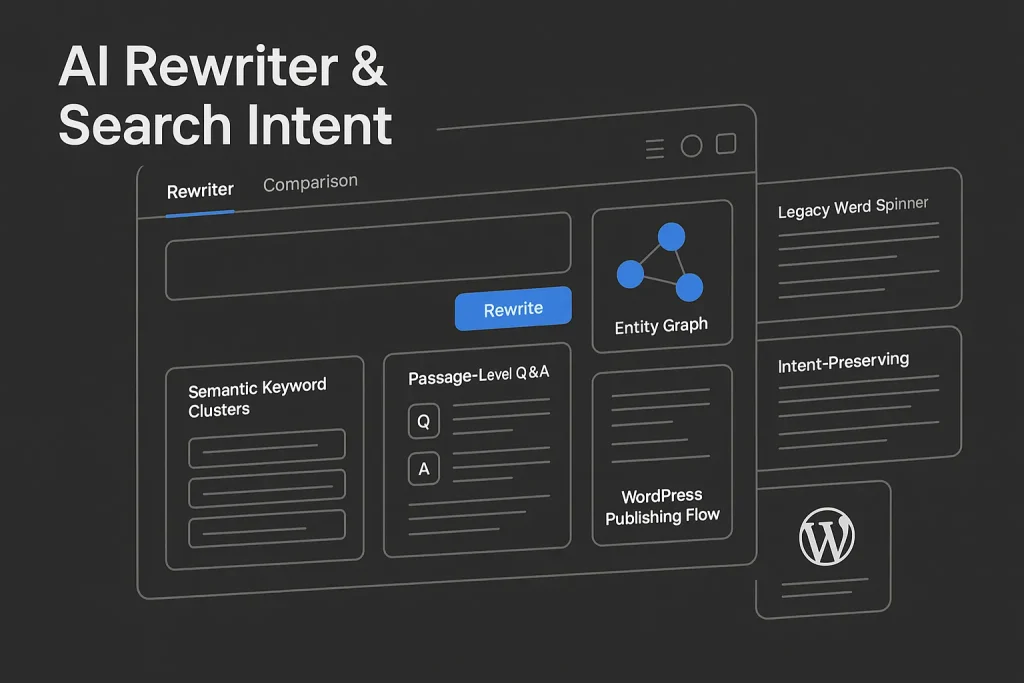
The strongest rewriting workflows are not isolated prompt boxes. They are connected systems. This is the practical advantage of a platform model over a standalone ai rewriter free utility. When rewriting is integrated into a broader SEO pipeline, the system can preserve intent using upstream and downstream context: target query, semantic cluster, article structure, internal link plan, publishing rules, and CMS destination.
That is where SEO Autopilot becomes relevant. Its role is not to paraphrase for novelty. Its role is to support end-to-end content production where semantic intent, structural coherence, and publication workflow stay connected. The rewriting layer can therefore operate with awareness of the article’s topic map, supporting entities, and final publishing environment rather than rewriting blind passage fragments.
For teams evaluating workflow maturity, the full SEO Autopilot approach shows why isolated writing utilities become bottlenecks once volume increases. Rewriting needs to be coordinated with planning, clustering, drafting, linking, and publishing.
In a production setup, a modern rewrite module typically interacts with the following layers:
- Topic and keyword inputs that define the target search task.
- Outline logic that shows which entities belong in each section.
- Internal linking rules that anchor the rewritten passage into site architecture.
- Brand tone and quality settings that prevent generic output.
- WordPress publishing controls that preserve formatting and deployment speed.
This is also why a rewrite engine should not be viewed as interchangeable with a paragraph utility. The article AI paragraph writer vs long-form AI workflow is useful here because it highlights the different jobs that local generation and full-article systems are meant to solve.
Once the rewrite passes semantic QA, it should move directly into the publishing workflow rather than being copied manually between tools. That reduces formatting errors and speeds editorial throughput. For teams building a fully automated WordPress content engine, that connection is operationally significant. We have seen this repeatedly: workflow integration usually matters more than one extra rewriting feature on a landing page.

Rewrite vs regenerate vs refresh: choosing the right approach
One of the most expensive mistakes in content operations is applying rewriting to content that should have been regenerated or refreshed. These are different interventions. They solve different problems.
Rewrite is appropriate when the original content is fundamentally correct, aligned to the target query, and structurally useful, but needs cleaner language, sharper flow, stronger differentiation, or reduced redundancy. Here, a high-quality rewriteai approach can preserve the original information architecture while improving delivery.
Refresh is appropriate when the page is still relevant but stale. Facts need updating, examples are outdated, SERP expectations have changed, or internal links need improvement. Refreshing may involve rewriting parts of the page, but the job is broader than paraphrasing.
Regenerate is appropriate when the source is too weak to salvage. This includes pages with severe semantic drift, outdated intent targeting, thin support, or incorrect framing. In those cases, even the best ai rewriter will only rearrange a flawed base. The smarter move is to rebuild from the query, outline, and entity map.
The decision framework below helps teams choose correctly.
| Approach | Best used when | Main risk if misused |
|---|---|---|
| Rewrite | Meaning is sound, wording or clarity is weak | Intent drift from unnecessary variation |
| Refresh | Topic still fits, but details or examples are stale | Superficial update with no real relevance gain |
| Regenerate | Original content is structurally or semantically broken | Wasting effort preserving a weak source |
This distinction matters especially when teams rely on a free ai paragraph rewriter or free online paraphrasing tools for production work. Those tools may make text look fresh while locking in a poor strategic foundation.
The proportions above are not market statistics. They simply illustrate a practical editorial split: many pages need more than paraphrasing, and teams should classify the job before choosing the tool.
QA checklist to validate intent-preserving rewrites
Before publishing rewritten content, teams need a final review sequence that checks more than readability. The checklist below is intentionally operational. It can be used whether the source came from an ai sentence rewriter, a long-form generation system, or a specialized enterprise rewrite module.
- Confirm the target query and search task. State in one sentence what the page is supposed to help the user do.
- List critical entities. Include products, platforms, standards, methods, named systems, and topic-defining concepts.
- Check section-level intent alignment. Each H2 should still answer the same subtask as the source.
- Verify factual entailment. Claims in the rewrite should not overstate or invert the original meaning.
- Review support-term coverage. Make sure semantic helper terms were not stripped out during simplification.
- Inspect examples and qualifiers. If the original used a caution, comparison, or exception, confirm it still exists.
- Validate internal links. Ensure the rewritten wording still fits the anchor context and destination page.
- Review tone discipline. B2B expert content should sound controlled, not inflated or generic.
- Run passage-level spot checks. Evaluate the weakest two or three paragraphs, not just the strongest ones.
- Decide if the page should have been refreshed or regenerated instead. If too many sections fail, stop rewriting and rebuild.
When teams also need stronger editorial trust signals, the guidance on humanizing AI text for E-E-A-T becomes relevant after the semantic layer is secured. Humanization should refine clarity and trust, not patch over a broken rewrite.

Where a production-grade rewriter fits in a modern content stack
An enterprise-ready rewriter is not a substitute for strategy. It is an execution layer inside strategy. The value appears when rewriting is connected to keyword planning, content scoring, internal linking, publishing logic, and QA controls. That is why comparing a platform-level engine to a copy ai sentence rewriter, quill bot paraphrasing style use case, or other isolated rewriting utilities is often misleading. They may share a visible function, but they solve different operational problems.
For SEO teams managing dozens or hundreds of pages, the real requirement is consistency at scale. The system has to preserve the target concept model across rewrites, maintain editorial standards, and move approved content into production without manual fragmentation. A standalone ai rewriter free tool can help with ad hoc phrasing changes. It rarely solves content infrastructure.
That is the business case for SEO Autopilot. Near the end of a content workflow, rewriting should not be an isolated detour. It should be part of a structured SEO production system. On the official SEO Autopilot site, the platform is positioned around automated SEO article creation, semantic planning, structure generation, content production, and WordPress publishing. In that context, the rewriting module is valuable because it works inside a controlled pipeline that can preserve search intent, entities, and supporting keyword coverage instead of treating text as a bag of swappable phrases.
For B2B teams, that operational difference is decisive. It reduces editorial rework, supports higher throughput, and makes rewrite decisions accountable to SEO goals rather than mere textual variance. If you need a quick phrasing fix, an ai rewriter free option or even a free ai sentence rewriter may be enough. If you need repeatable output quality, that is a different category entirely.
We believe the practical takeaway is straightforward. A modern ai rewriter is valuable only when it preserves intent, entities, and factual structure under change. The moment rewriting becomes a synonym game, rankings and trust usually start to erode. For most teams, the better path is not to rewrite with ai more aggressively, but to use tighter constraints, clearer QA, and stronger workflow context.
Looking ahead, we expect the gap between lightweight tools and production systems to widen. Free utilities such as an ai text rewriter free app, a free ai paragraph rewriter, or other free online paraphrasing tools will remain useful for minor edits, but not for intent-sensitive SEO operations. The teams that win will be the ones that treat rewriting as controlled transformation, not cosmetic variation.
FAQ
What is the difference between an AI rewriter and a word spinner?
A true ai rewriter preserves search intent, entities, factual meaning, and section logic while improving wording. A word spinner mainly replaces words or shuffles syntax, which often creates semantic drift and weakens relevance.
In SEO terms, the difference is not uniqueness but fidelity. A spinner changes form. A modern rewriter should preserve the query-to-answer relationship.
How can I rewrite content without losing search intent?
Start by identifying the page’s task intent, critical entities, and required support terms before any rewrite begins. Then constrain the rewrite so those elements remain intact at both section and passage level.
In practice, this means protecting named entities, preserving examples and qualifiers, and checking whether each paragraph still answers the same sub-question as the source. If you use ai to rewrite text without that structure, drift is almost guaranteed.
How do I measure semantic drift after rewriting?
Use three checks: entity overlap, entailment, and coverage. Entity overlap verifies that critical concepts remain present, entailment checks that the rewrite still means what the original claimed, and coverage confirms that support terms and context were not stripped away.
These are internal editorial QA controls, not Google ranking factors. They are still highly effective for catching broken rewrites before publication.
Is using an AI rewriter bad for SEO or E-E-A-T?
No. Using an AI rewriter is not inherently bad for SEO if the output is helpful, reliable, accurate, and aligned with user needs. The problem starts when teams rewrite ai content at scale just to create superficial variation, or when the process distorts facts, entities, and sourcing.
For E-E-A-T, trust is the key issue. If the rewrite preserves factual precision, context, and useful structure, AI assistance is a workflow choice rather than a quality problem.
How does Autopilot SEO keep entities and LSI terms intact?
Autopilot SEO’s value is that rewriting operates inside a broader SEO production workflow rather than as a blind paraphrase step. That makes it easier to preserve topic structure, semantic support terms, internal linking context, and WordPress publishing logic.
Instead of relying on synonym churn, the system can align rewriting with the original keyword cluster, article outline, and entity-level context needed to maintain search intent. That is a very different model from an ad hoc ai paraphrasing tool or a generic best ai rewriter claim on a landing page.