
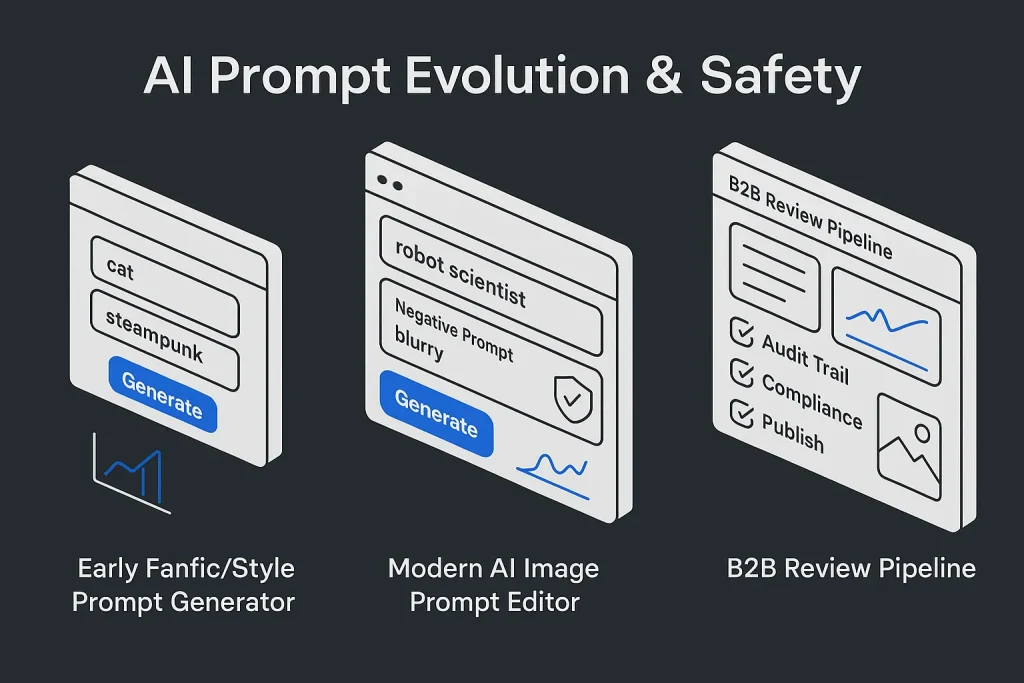
The nsfw prompt generator no longer refers to one neat tool category. It now sits between fanfic prompt spinners, hobbyist image workflows, downloadable model ecosystems, and enterprise systems that treat prompting as a governed input layer rather than a creative free-for-all. That shift matters. Prompt engineering has moved from “find the right words” to “set the right constraints,” especially when teams care about brand safety, policy compliance, auditability, and repeatable visual quality.
For digital creators, the visible change is stylistic: prompts got longer, more structured, and more cinematic. For B2B teams, the real change is operational. Models are now judged not just by output quality, but by moderation accuracy, prohibited-use enforcement, disclosure expectations, and review workflow fit. On our view, adult-adjacent prompting makes more sense as a governance problem than as a loophole-hunting exercise.
What “NSFW Prompt Generator” Means Today
Today, the phrase nsfw prompt generator covers several categories that look similar in search results but behave very differently in practice. Some tools only generate text ideas for roleplay, fanfiction, or character scenarios. Others create prompt templates for image systems. A third group combines text generation with image or video models, where prompt interpretation is shaped by model policies, moderation systems, and product-level distribution rules.
That distinction matters because adjacent queries such as spicy otp prompts generator, nsfw otp prompt generator perchance, otp prompt generator angst, proship prompt generator, problematic prompt generator, and nsfw prompt generator poly often describe subcultures, writing formats, or relationship tropes more than one unified software category. They may cluster together in search behavior. They are not interchangeable in a real workflow.
A practical way to map the space is to split it into four operational layers:
- Idea generators: text-only systems that suggest scenarios, tropes, pairings, or emotional beats.
- Prompt formatting tools: utilities that turn a rough concept into a structured prompt with subject, style, angle, lighting, mood, and exclusions.
- Generation interfaces: products that send prompts into image or video models and apply policy filters.
- Enterprise workflows: governed systems that add approval, moderation, provenance, permissions, and archival controls.
For hobbyist users, the goal is often novelty or niche specificity. For business teams, it is consistency and risk reduction. We think that is the line too many articles blur. The same prompt idea can feel harmless in private ideation and still be unusable in a commercial pipeline.

Search demand also hides a common misunderstanding: users often assume prompt sophistication alone determines what an AI system can produce. It does not. Modern systems enforce output rules at multiple levels. The prompt is only one layer; policy classifiers, moderation models, feed rules, account restrictions, and product design all shape the final result.
For B2B content leaders, this should sound familiar. A writer brief is not the whole publishing system. It lives inside editorial controls, review steps, internal linking rules, style guidance, and CMS permissions. AI image prompting has matured in the same direction. On the practical side, that is good news for teams that value predictable output over chaos.
From Fanfic Generators to AI Art: A Short Timeline
The modern prompt economy did not start with enterprise governance. It started with experimentation. Early prompt use in creator communities focused on inspiration: pairings, short scenes, scenario cards, and style fragments. In those spaces, generators were mostly combinational tools. They mixed descriptors, emotional states, and story tropes to get users past the blank page.
The jump into mainstream AI art accelerated when DALL·E 2 was announced on April 6, 2022, a milestone documented in the DALL·E release timeline. That moment made prompt phrasing visible as a creative skill. Instead of naming only the subject, users started layering medium, composition, color treatment, camera perspective, and stylistic references.
Another decisive shift came in August 2022 when Stable Diffusion became publicly downloadable. Open-weight access changed the economics of experimentation. Users could test custom prompting, embeddings, local workflows, and fine-tuning without waiting for a closed demo queue. This is where prompting expanded from simple noun-plus-style phrases into stacked instruction sets.
We can sum up that expansion in three generations:
Generation 1: subject-plus-style prompting. Example: “portrait of a cyberpunk detective, digital art.” This phase leaned on broad style matching.
Generation 2: cinematic descriptive prompting. Prompts added angle, depth of field, lens cues, materials, mood, lighting, texture, and environmental context.
Generation 3: controlled workflow prompting. Prompts became one component inside a larger system that also used negative prompts, policy checks, moderation thresholds, model routing, and review states.
That history explains why a niche query like nsfw prompt generator perchance can still attract search traffic while professional image teams care far more about safe prompt templates than unrestricted wording. The market split in two. One branch optimizes for edge cases and novelty. The other optimizes for operational reliability. We have seen the same split in SEO tooling: hobbyist hacks get attention, but systems win budgets.
The timeline below captures the move from creative experimentation to governed deployment.
| Period | What changed | Prompting impact |
|---|---|---|
| Pre-2022 niche tools | Text prompt spinners for fanfic, roleplay, and trope ideation | Prompts worked as inspiration seeds, not governed production inputs |
| April 2022 | DALL·E 2 mainstream attention | Prompt phrasing became visible as a creative skill |
| August 2022 | Stable Diffusion public download | Custom prompting and local experimentation scaled rapidly |
| 2023-2026 enterprise phase | Governance, moderation, and provenance frameworks matured | Prompts became inputs inside auditable workflows |
The key takeaway is not that prompts became more complex. It is that prompts became accountable.
The move from open experimentation to managed deployment is the real story behind modern prompt engineering.
How AI Models Handle NSFW Prompts: Policies, Filters, and Limits
Mainstream AI image and video systems do not treat adult-content prompting as a simple style preference. They treat it as a policy domain with technical enforcement. That is a crucial distinction for anyone moving from hobbyist experimentation to commercial use.
OpenAI’s Sora system card states that its policies prohibit explicit sexual content and reports 97.59% end-to-end moderation accuracy on its nudity and suggestive-content evaluation set. We would not overread a single number, but it tells us something concrete: safety performance is being measured as part of the system, not bolted on at the end. Separate from generation, the Sora feed policy also lists graphic sexual content among categories removed from distribution surfaces. That shows a two-layer model: one policy for what the system should generate, another for what a platform will distribute or recommend.
Google follows a similar hard-boundary approach in its Gemini image policy documentation, which explicitly blocks attempts involving child sexual abuse or exploitation content. Anthropic’s public policy materials make comparable statements on child sexualization and abuse restrictions, and add stronger requirements for developers serving minors. The pattern is consistent across major providers: there may be gray areas around style or suggestiveness, but child-safety boundaries are absolute.

In practice, AI systems handle prompt risk through overlapping controls:
- Input screening: the system inspects the text prompt before generation.
- Model-level behavior tuning: the model is trained or aligned to refuse or steer away from certain outputs.
- Output moderation: generated images or video frames may be scanned after creation.
- Distribution filtering: even if content is generated, it may be hidden from feeds, recommendations, or public galleries.
- Account and workflow controls: age gating, rate limits, manual review, and escalation policies may apply.
This is why prompt work for adult-adjacent content often creates inconsistent user expectations. A wording variation might pass an input check and still end in a blocked output, hidden distribution, or account review. For enterprises, that inconsistency is not a bug in the business sense. It is proof that the product prioritizes safety layers over maximum generation freedom.
Adobe’s enterprise positioning reinforces the same split. In February 2025, Adobe said in its Firefly commercial safety announcement that the video model was designed to be IP-friendly and commercially safe. The wording matters. Enterprise tools are selling predictability, permissions, and compliance posture. Hobbyist tools are often selling range, speed, or edge-case aesthetics. On our reading, that gap will only widen.
The difference is easier to see when framed as workflow logic rather than product marketing.
For operational teams, the lesson is simple: prompt strategy has to be written with model policy, moderation, and distribution constraints in mind from the start.
Prompt Safety by Design: Patterns, Negative Prompts, and Guardrails
Prompt safety by design means treating safety as part of composition, not as cleanup. This is where the conversation gets useful for commercial teams. Instead of asking how to force a model toward a risky output category, teams should ask how to preserve mood, tension, style, and visual clarity while staying inside approved boundaries.
The most effective prompt design pattern is decomposition. Break the brief into safe components that can be controlled independently:
Subject: who or what is in the scene.
Context: where the scene takes place.
Composition: framing, camera angle, crop, depth, motion.
Lighting: soft, dramatic, studio, ambient, high contrast.
Surface detail: fabric, metal, glass, skin tone rendering, reflections.
Mood: tense, moody, intimate, mysterious, editorial.
Exclusions: what must not appear.
Negative prompts are useful here, but only when they are treated as clarity tools rather than policy bypass tools. In a safe workflow, exclusions help remove distortions, unwanted anatomy issues, cluttered backgrounds, low-detail rendering, or elements that conflict with the brand. They are much less useful when users expect them to override platform policy. On the ground, that expectation usually wastes time.
For example, a creator starting with an “edgy nightlife intimacy” concept does not need explicit descriptors to get a compelling result. A compliant rewrite can shift emphasis toward silhouette, wardrobe, framing, neon reflections, distance between subjects, facial direction, and editorial tension. The emotional payload stays. The policy risk drops.
That logic is very close to SEO content operations. Strong briefs do not rely on stuffing exact-match keywords into every line. They define search intent, semantic scope, exclusions, formatting rules, and review criteria. If your team already uses structured briefs for content, structured prompt templates are a natural extension.

A practical internal template for safe prompting usually includes:
- Objective: what asset is being produced and for which channel.
- Approved style cues: editorial, cinematic, product, illustration, studio, documentary.
- Mandatory exclusions: explicit sexual content, minors, exploitative framing, unsafe body emphasis, prohibited symbols.
- Technical targets: aspect ratio, lighting, color palette, background complexity, text-safe areas.
- Review flags: anatomy issues, suggestive ambiguity, likeness concerns, watermark artifacts, brand inconsistency.
When this template is enforced consistently, prompt quality becomes more predictable across teams. That predictability is what enterprises are actually buying.
Hobbyist NSFW Tools vs. B2B Content Pipelines
The difference between hobbyist tools and B2B content pipelines is not just ethical or legal. It is architectural. Hobbyist systems are built to maximize immediacy. B2B systems are built to minimize downstream risk.
A hobbyist prompt workflow often looks like this: idea, prompt, iterate, export. A business workflow is longer: brief, prompt draft, policy validation, generation, moderation, revision, approval, archival, and channel-specific publishing. Every extra step reduces spontaneity, but it increases control. In our experience, that trade-off is exactly what serious teams want.
This distinction matters when teams compare niche prompt generators with structured production systems. A query such as problematic prompt generator may imply provocative experimentation. A B2B creative operations team, by contrast, has to think about client approval, ad policy, CMS governance, rights management, and documentation. The same goes for fandom-style searches like spicy otp prompts generator or proship prompt generator: they may be relevant culturally, but they do not map neatly onto commercial asset production.
The comparison below shows the operational split.
| Dimension | Hobbyist tool logic | B2B pipeline logic |
|---|---|---|
| Primary goal | Novelty, niche aesthetics, fast iteration | Repeatability, compliance, brand consistency |
| Prompt structure | Flexible and experimental | Template-driven and documented |
| Safety model | Often reactive | Proactive guardrails and review |
| Approval | Usually individual user choice | Multi-role signoff and escalation paths |
| Distribution | Local or community sharing | Website, ads, email, CMS, stakeholder review |
When content teams create blog covers, product visuals, or landing-page assets, this B2B model is far more relevant than niche prompt culture. Teams experimenting with visuals for publishing workflows can borrow from using Bing Image Creator for blog covers and from practical tips for getting stronger blog visuals from an AI image generator to formalize safe prompt structures that still produce useful assets.
The core business insight is simple: prompt engineering becomes valuable when it can be standardized across campaigns, not when it works only as an individual trick.
Broader AI adoption helps explain why prompt design is now discussed as a workplace process rather than a niche creative habit.
Ethical and Legal Considerations for Adult Content in AI Workflows
Ethical and legal review starts with a basic distinction: adult content involving consenting adults is not the same category as exploitative or illegal content, and modern policy frameworks do not treat them as equivalent. But in commercial AI workflows, even lawful adult themes can create platform, brand, advertising, distribution, and contractual risks.
The first hard boundary is child safety. Mainstream providers explicitly prohibit child sexual abuse or exploitation content. That is not a soft moderation preference. It is a strict policy line with severe legal implications.
The second major issue is commercial suitability. A piece of content may be technically lawful and still be disallowed by an AI provider, rejected by an ad platform, unsuitable for a client brand, or inconsistent with local age-rating expectations.
The third issue is provenance and disclosure. The EU AI Act framework introduces transparency duties for some AI-generated or manipulated content such as deepfakes. That does not mean every generated visual triggers the same compliance burden, but it does mean teams need procedures for identifying where disclosure or documentation may be required. Content provenance standards such as C2PA also matter because they provide a way to attach source and editing metadata to generated media.
Risk management is now formalized beyond vendor terms of service. NIST published the AI Risk Management Framework on January 26, 2023, and notes that its Generative AI Profile was released on July 26, 2024, as described on the NIST AI RMF page. For teams, that means prompt engineering can be mapped into a broader control framework: identify risks, document controls, assign responsibilities, and review outcomes.

From an operational standpoint, legal and ethical review should cover at least these questions:
Who is the audience? Internal concept art, gated subscriber content, public social media, and ad campaigns all carry different risk levels.
What platform rules apply? AI provider policy, social platform policy, ad network policy, marketplace rules, and client contracts may all differ.
Can the team prove review happened? If a complaint or dispute arises, undocumented prompt experimentation is a weak position.
Is likeness involved? Adult-adjacent outputs that imply real people, public figures, or identifiable individuals create major legal and reputational hazards.
Is disclosure needed? Depending on jurisdiction and context, manipulated or generated content may require transparency or internal tagging.
For B2B teams, the operational rule is conservative for good reason: if the asset is meant for public brand communication, risk should be evaluated before generation, not after export. We consider that one of the clearest dividing lines between experimentation and professional practice.
Brand-Safe Alternatives: SFW Styles, Composition, and Moderation Layers
Most teams do not need explicit content to achieve the visual qualities they are actually chasing. What they usually want is one or more of the following: intimacy, tension, elegance, vulnerability, nightlife atmosphere, dramatic contrast, seductive styling, or high-fashion mood. All of that can be translated into safe, commercially usable prompt language.
For example, instead of explicit descriptors, teams can use controlled alternatives such as:
Editorial intimacy: close framing, muted expressions, shoulder-level crop, soft practical lighting, premium wardrobe detail.
Cinematic tension: side profile silhouettes, low-key lighting, negative space, rain reflections, urban night color palette.
Luxury mood: satin textures, glass reflections, deep navy and gold accents, studio shadow falloff.
Romantic narrative: distance, eye contact direction, body orientation, environment cues, gesture emphasis.
In practice, these alternatives often produce stronger commercial assets because they remain usable across websites, newsletters, social distribution, and ad review. Teams exploring visual workflows can also learn from Google image generator options for blog graphics where the practical issue is not maximum visual edge but repeatable quality for publishing contexts.
Moderation layers reinforce this brand-safe approach. A well-run workflow does not rely on one prompt writer making perfect choices every time. It uses layered controls:
This layered design is the bridge between creative freedom and commercial reliability. We have noticed that teams who adopt it early spend less time fixing avoidable problems later.

Governance for Teams: Roles, Audit Trails, and Review Workflows
Once prompting enters a team environment, governance becomes mandatory. This is true even for companies that are not producing sensitive content. Prompts are business inputs. They affect output quality, brand exposure, compliance status, and client trust.
A practical governance model separates responsibilities across roles:
Creative lead: defines approved aesthetic direction and prompt templates.
Operator or designer: runs generation, documents iterations, and flags anomalies.
Reviewer: checks for policy, brand consistency, and channel suitability.
Compliance or legal stakeholder: sets escalation rules for sensitive categories.
Content operations manager: controls storage, naming, approvals, and publication readiness.
The weakest AI workflows keep only the final image. The strongest workflows preserve the full chain: brief, prompt version, model used, generation date, moderation result, reviewer comments, selected output, edit history, and publishing destination. That record becomes essential when teams need to explain how an asset was produced or why one version was rejected.
Audit trails are also increasingly relevant because AI adoption is no longer niche. According to Pew Research reporting from June 2025, 34% of U.S. adults had used ChatGPT, about double the share recorded in summer 2023. Pew also reported that workplace AI use rose from 8% of U.S. workers in 2024 to 21% in 2025. When prompt use spreads that quickly, governance stops being optional and becomes operating infrastructure.
The higher the volume of prompt use inside an organization, the more valuable repeatable review workflows become.

Teams that already run structured content operations will recognize the same logic in SEO publishing. A content calendar, keyword brief, editor review, and CMS handoff create order. The same operating model is discussed in building scalable content machines for SEO agencies, and the lesson carries over: scale is only useful when quality controls scale with it.
Case Study: Turning an Edgy Brief into Brand-Safe Visuals
Consider a marketing team working on a campaign for a nightlife app aimed at adults. The original creative brief asks for “seductive late-night energy, close chemistry, upscale mood, cinematic visuals.” An inexperienced operator may translate that into increasingly explicit prompt wording and then waste time fighting platform refusals.
A stronger workflow reframes the brief into safe visual variables.
Original business intent: premium nightlife tension and adult sophistication.
Unsafe interpretation: direct sexualization, revealing body emphasis, explicit intimacy cues.
Safe translation: editorial eveningwear, low-key lounge lighting, mirrored bar reflections, shallow depth of field, side-profile interaction, confident posture, dark sapphire and gold palette, upscale interior texture, no nudity, no explicit posing.
The result is not a watered-down image. It is a commercially deployable image. The mood remains mature and stylish, but the output is now suitable for a much wider range of channels and stakeholders. On our view, this is where good prompt work proves its value.
Here is how the transformation works step by step:
Step 1: isolate the business signal. Determine whether the client really wants explicitness or instead wants luxury, desire, exclusivity, or tension.
Step 2: convert emotional language into visual language. Replace ambiguous or risky adjectives with framing, palette, styling, and environment cues.
Step 3: add explicit exclusions. State “no nudity,” “no explicit sexual behavior,” “no fetish framing,” and channel-specific restrictions if needed.
Step 4: define review criteria. The reviewer should know what to reject before generation begins.
Step 5: archive the approved prompt pattern. Once the team gets a compliant result, turn it into a reusable template.
This is the practical future of prompt engineering in business settings. It is not about pushing systems to the edge. It is about translating risky briefs into usable, scalable prompt logic. Even if someone comes from fandom search behavior around nsfw otp prompt generator perchance, otp prompt generator angst, or nsfw prompt generator poly, the commercial workflow has to convert that ambiguity into clear, reviewable inputs.

Implementation Checklist for Safe Prompt Engineering
Teams that want repeatable results should implement prompt safety as a process, not an ad hoc decision. The checklist below is the fastest way to operationalize that.
- Define content categories. Separate prohibited, restricted, review-required, and freely approved visual concepts.
- Create prompt templates. Use fixed fields for subject, context, style, composition, lighting, exclusions, and channel target.
- Map platform constraints. Document provider rules, ad policy limits, client restrictions, and jurisdiction-specific issues.
- Run pre-generation checks. Validate prompt language before sending it to a model.
- Moderate outputs automatically. Use platform tools or internal checks to flag unsafe or borderline results.
- Require human review. Automated filters do not replace editorial judgment.
- Store prompt and approval history. Keep versioned records for accountability and reuse.
- Tag final assets by suitability. Website-safe, social-safe, ad-safe, internal-only, or restricted-use labels reduce future mistakes.
- Train teams on safe substitutions. Show operators how to convert risky concepts into compliant visual descriptors.
- Review templates quarterly. Policies, provider capabilities, and business needs change quickly.
For content teams already working with AI at scale, the bigger opportunity is convergence. The same discipline used for SEO briefs, keyword mapping, editorial review, and WordPress publication should also govern prompt-based asset creation.
That is where SEO Autopilot becomes relevant in a broader content operations stack. Visual prompts, article briefs, semantic planning, and publishing controls work better when they are part of one repeatable system rather than separate manual tasks. Teams that want to industrialize content production can evaluate SEO Autopilot on the official site as a way to automate article creation, semantic structure, internal linking logic, and WordPress publishing while keeping governance and consistency at the center of the workflow.
The long-term pattern is clear: prompt literacy is becoming mainstream, but unmanaged prompting is not a durable business process. The advantage now belongs to teams that can turn creative intent into safe, auditable, production-ready systems.
We think the real lesson here is straightforward: the market is moving away from raw prompt cleverness and toward controlled prompt operations. The teams that win will not be the ones chasing the most provocative wording, but the ones building reusable systems that protect quality, compliance, and speed at the same time. That matters for agencies, SaaS brands, and in-house content teams alike. It also reduces a costly trap: confusing niche search intent with production-ready workflow design.
Looking ahead, we expect more providers to tighten moderation, add provenance layers, and make review logs standard rather than optional. We also expect prompt templates to become more like editorial briefs: structured, versioned, and tied to channel rules. Businesses that adapt early will move faster with less rework. Everyone else will keep burning cycles on preventable friction.
FAQ
What is an NSFW prompt generator and how is it used?
An nsfw prompt generator is usually a tool that creates text ideas, prompt templates, or structured inputs for adult-themed writing or visual generation. In practice, usage varies a lot: some tools are text-only trope generators, while others feed prompts into AI image or video systems that apply their own safety policies.
Do mainstream AI image models allow NSFW prompts and how do safety filters work?
Mainstream models usually restrict or prohibit explicit sexual content, especially in commercial products. Safety filters work in layers: they can inspect prompts before generation, steer model behavior during generation, scan outputs afterward, and apply separate distribution rules that limit what is shown publicly.
How can teams keep prompts creative while preventing unsafe or policy-violating outputs?
The best move is to shift from explicit wording to structured visual direction. Teams should use safe descriptors for mood, lighting, composition, wardrobe, palette, and setting, then add clear exclusions and a review workflow so creativity stays controlled and commercially usable.
Are NSFW prompts legal for commercial projects and what compliance risks exist?
Legality depends on jurisdiction, platform policy, audience, and the specific content involved. Even when adult content is lawful, commercial projects still face provider restrictions, advertising limits, disclosure obligations, brand-safety concerns, and serious risks around likeness, consent, and prohibited categories.
What SFW alternatives can I use to test composition, lighting, or style without adult content?
Use prompts focused on editorial fashion, cinematic nightlife, silhouette portraits, luxury interiors, dramatic studio lighting, and romantic narrative distance. These alternatives let teams test angle, contrast, framing, and atmosphere without introducing explicit content risk.