
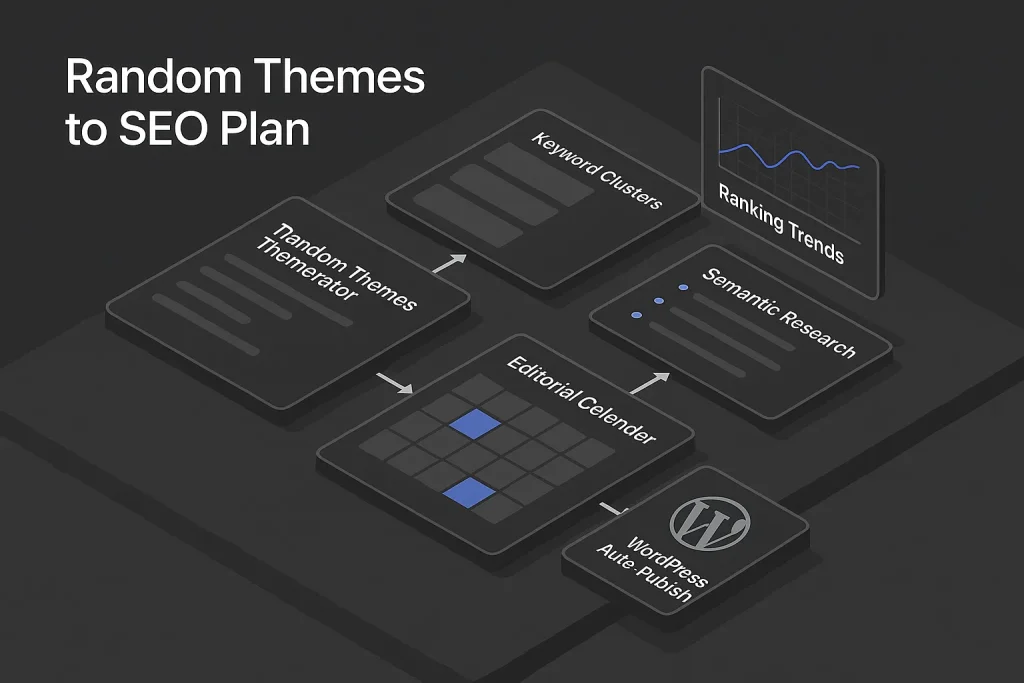
A random themes generator becomes useful at the exact moment many content teams stall: the backlog looks thin, the brief is fuzzy, and every new topic feels either too broad or already exhausted. In our experience, the real problem is rarely a lack of ideas. It is the lack of a dependable way to turn raw prompts into topics that match audience intent, editorial scope, and search demand.
That distinction matters more than most teams admit. Blogging is still an active operating channel, not some leftover tactic from an older playbook. HubSpot’s 2025 blogging data shows that 56% of marketers at companies with blogs expect blogging to grow in importance, while another 32% expect its role to stay the same. To us, that makes ideation part of content infrastructure, not a side exercise for “creative days.”
Used well, a random prompt breaks inertia, narrows the field, and creates momentum. Used badly, it fills your queue with off-topic posts, weak topical relevance, and articles that never had SERP fit to begin with. Our position is simple: randomness should be the spark, not the strategy.

What Is a Random Themes Generator and Why It Works
A random themes generator is a prompt tool that outputs an unexpected topic, theme, category, or angle. It might be a wheel, a button-based prompt tool, an art selector, a story prompt engine, or a category mixer. The result can be abstract, practical, niche-specific, or completely open-ended.
Its value is straightforward: it lowers activation energy. You do not start with a blank page. You start with a constraint. That constraint does not have to be brilliant. It just has to be specific enough to force the first decision.
For solo bloggers, that may be enough to get moving. For B2B teams, it is only the first filter in a larger system that includes topic qualification, intent mapping, keyword clustering, structure generation, drafting, internal linking, and publication. We have seen the same tool feel productive in one workflow and chaotic in another. The difference is almost never the tool itself. It is the system around it.
The most common use cases fall into four buckets:
- Idea ignition: generate a non-obvious angle when the editorial queue is dry.
- Constraint-based creativity: force a narrower frame to stop overthinking.
- Volume exploration: build a pool of rough ideas before prioritization.
- Format shifting: move from article mode to video, social, lead magnet, or series mode.
Where teams usually go wrong is assuming the generator itself is the planning system. It is not. A random theme wheel can produce novelty, but it cannot validate business relevance, search intent, or content depth. It does not know whether “content audit horror stories” should be a timely blog post, a newsletter section, or a weak fit for your domain.
That is the real line between ideation tools and SEO systems. Ideation tools create possibilities. SEO systems reduce those possibilities into profitable choices. On our side, that distinction is non-negotiable.
The numbers support the operational point: ideation is recurring work. The 2025 B2B Content Marketing research from CMI, based on responses from 980 marketers, reflects planning at scale rather than occasional inspiration. Randomness can help at the top of the funnel, but it cannot replace the pipeline.
How Random Prompts Beat Writer’s Block (Cognitive Triggers and Constraints)
Writer’s block in content marketing is often misdiagnosed. Usually, the issue is not that a marketer has no ideas. It is that the team has too many possible directions and no confidence in which one deserves the next 3 to 6 hours of work. Random prompts work because they cut through that paralysis.
Constraint is the mechanism. When the brain stops evaluating thousands of possible openings and reacts to one bounded stimulus, momentum improves. Research on creativity and constraints backs this up. Limits do not automatically kill originality; in the right conditions, they sharpen it. That is why research on creative constraints matters for editorial work, not just design theory.
For example, “SEO trends” is too broad to start with. “A random theme generator for drawing, adapted into a metaphor for content ideation systems” is odd, but usable. It may not be publishable as-is. Still, it gives the team something to transform. And that transformation is where the real work starts.
Three cognitive effects make random prompts useful in practice:
- They remove the burden of first choice. The generator picks the first direction, so the team can focus on adaptation instead of selection.
- They create low-stakes momentum. A random prompt feels provisional, which lowers perfectionism during early drafting.
- They expose adjacent associations. One imperfect idea often reveals three better ones through comparison, expansion, or contradiction.
This matters even more for B2B writers who assume creativity fades during ideation. On the contrary, one weak prompt can lead to a stronger chain if the team develops it for another 10 to 20 minutes. We have seen this repeatedly in planning sessions. The first prompt is often mediocre. The second-order thinking is where the value appears.
That is also where AI helpers stop being novelty and start becoming infrastructure. Pew Research data from June 2025 shows that 34% of U.S. adults have used ChatGPT, 58% of adults under 30 have used it, and 28% of employed adults use it for work. In content operations, that means idea-generation tools are already normal behavior.
The market is already comfortable using AI to begin the thinking process. The competitive edge now comes from how teams qualify what AI or random prompts produce. That is the harder part, and on our view, the part that actually separates content teams.

Types of Theme Generators: Wheel, Art, Story, Party — When to Use Each
Not all generators produce the same kind of output. Their usefulness depends on the job you need done.
Random theme wheel tools are best when you need speed and variety. They surface broad categories fast and work well in early ideation sessions. Their weakness is obvious: they are often too generic for direct SEO execution.
Random art theme generator and random theme generator art tools are more visual and abstract. They help when your team needs metaphors, campaign angles, visual storytelling concepts, or creative crossovers. They are less useful for direct B2B prioritization unless you translate the output into a practical business lens.
Aesthetic theme generator tools usually focus on mood, tone, and style rather than search demand. They can help with branding consistency, voice development, or naming a content series, but they rarely solve SEO planning on their own.
Random theme generator for drawing tools are more niche, yet they are surprisingly effective for content teams because they enforce constraints. In practice, narrow prompts often create more movement than broad business-topic wheels.
Random party theme generator tools may sound irrelevant for SEO, but they have a place in campaign naming, webinar framing, event-led content, seasonal promotions, and audience engagement formats where packaging matters almost as much as topic selection.
The practical rule is simple:
| Generator type | Best use case | Main weakness |
|---|---|---|
| Random theme wheel | Fast brainstorming and category exploration | Often too broad for direct SEO execution |
| Random art theme generator | Creative angles, campaigns, visual concepts | Needs translation into audience and search language |
| Aesthetic theme generator | Voice, branding, series consistency | Weak signal for demand and intent |
| Random theme generator for drawing | Constraint-based ideation and concept expansion | Can feel too niche without adaptation |
| Random party theme generator | Event, promo, social campaign packaging | Usually not suitable for evergreen SEO topics |
The stronger the generator is at novelty, the weaker it usually is at search alignment. That is not a flaw. It just tells you where the tool belongs in the workflow. We would not ask a brainstorming tool to do the job of a clustering system.
If your team already uses adjacent creativity tools, the logic is similar to this guide on a random image generator for creative inspiration: the prompt source can improve output, but only when it is connected to a deliberate process.
A 20-Minute Workflow: Turn One Random Theme into 10 SEO-Ready Blog Topics
The fastest way to waste a good prompt is to publish it too literally or kill it too early. A better model is a short conversion workflow that expands one random theme into a usable topic set.
Here is a practical 20-minute process that works well for B2B blogs.
Minute 1–3: Capture the raw theme without judgment
Example prompt: “invisible systems.” On its own, that is not a publishable blog topic for a SaaS company. It is just a seed.
Minute 4–7: Translate the theme into business contexts
Ask which operational area fits the theme: onboarding, reporting, SEO workflow, content governance, internal linking, publishing automation, or campaign planning.
“Invisible systems” can become:
- Why the best content operations are invisible to clients
- Invisible SEO bottlenecks that delay content publication
- The hidden systems behind scalable blog production
- Why editorial workflows fail before drafting begins
Minute 8–12: Expand into audience-specific variants
The same seed should produce variants for agencies, in-house marketers, founders, bloggers, and technical teams. A founder may care about content throughput. An SEO manager may care about cluster coverage. A WordPress editor may care about publishing friction.
Minute 13–16: Map each idea to search behavior
At this stage, stop thinking like a writer and start thinking like a search strategist. Which ideas signal informational intent? Which fit comparison intent? Which work better as thought leadership than search content?
Minute 17–20: Select 3 primary topics and 7 support angles
Do not try to publish all ten. Choose three high-fit topics for the main queue and keep the rest as support content, newsletter ideas, social posts, or internal cluster pages.
A raw random theme can expand like this:
| Seed theme | SEO-ready angle | Likely intent | Best format |
|---|---|---|---|
| Invisible systems | Hidden SEO workflow issues slowing blog production | Informational | How-to article |
| Invisible systems | Why content operations break between ideation and publishing | Informational | Operational guide |
| Invisible systems | Tools for automating editorial workflows in WordPress | Commercial | Comparison page |
| Invisible systems | How agencies scale content without adding editors | Mixed | Case-style article |
The goal is not to preserve the original phrase. The goal is to preserve the creative tension while moving closer to searchable language and buyer relevance. On our view, this is where most teams either build a usable pipeline or drift back into vague brainstorming.
If your idea sources come from meetings, calls, or workshop notes rather than generators, the same conversion logic applies to AI notes for SEO outlines. The source changes. The qualification layer does not.

Validate SEO Potential: Search Intent, SERP Fit, and Keyword Clustering
This is the point where most random-topic workflows break down. Teams assume that if an idea feels original, it will also perform in search. That assumption is expensive.
Google’s guidance is consistent: ranking systems favor useful, reliable, people-first content over content created mainly to capture traffic. Google’s helpful content guidance also warns against mass-producing material across many unrelated topics in the hope that something will rank. A random themes generator is safe for ideation, then, but risky as a standalone editorial model.
Validation requires three checks.
1. Search intent
Figure out whether the audience wants explanation, comparison, examples, tools, templates, or step-by-step instruction. If your random idea creates a mismatch, the article may read well and still fail in search.
For example, random theme ideas as a query often implies brainstorming utility. A post that turns philosophical about creativity may satisfy a reader but miss the dominant intent if searchers want generator options, usage examples, or categorized ideas.
2. SERP fit
Study the current results before writing. If page one is dominated by tool pages, listicles, or interactive wheels, a deep editorial essay may be the wrong format. If the results are mostly educational, a lightweight roundup may not compete.
3. Keyword clustering
One article should not try to cover every variation of random themes generator, random theme wheel, random art theme generator, and random party theme generator at equal depth. These may sit close together, but they still reflect adjacent micro-intents. Cluster them by overlap, not convenience.
The traffic stakes justify the discipline. Backlinko’s CTR research, based on roughly 4 million search results, found that the first organic result gets an average 27.6% of clicks, the top three results together get 54.4%, and only 0.63% of users click to the second page. Inspiration without fit rarely earns meaningful traffic.
The click curve leaves very little room for accidental SEO. A good idea that misses the SERP is usually invisible. That sounds harsh, but in practice it is true.
One more myth is worth clearing up here. Google does not use a preferred word count as a ranking factor. So long-form output from a random prompt is not automatically better than concise content. What matters is whether the page is useful for that query and that audience.
Random vs Context-Aware Planning: Why Autopilot SEO Wins for Consistency
Random generators solve the first five minutes of ideation. Context-aware SEO systems solve the next five weeks of execution.
The difference is not cosmetic. It changes output quality, topical coverage, workflow stability, and publishing efficiency.
With a random generator, the workflow usually looks like this: a prompt appears, the team reacts, someone tries to reshape it into an article, keyword research happens later if it happens at all, and publication quality depends on whoever is available to clean up the result.
With context-aware planning, the logic flips: the system starts from topical relevance, semantic relationships, likely intent, and site goals; then it proposes topic clusters, article structures, and publishing opportunities. Creative variation still exists, but it happens inside a meaningful content map.
That is where Autopilot SEO is structurally stronger than a stand-alone generator. Instead of offering isolated prompts, it aligns ideation with clustering, article generation, optimization, internal linking, and WordPress publication. Consistency comes from context retention. We consider that a major advantage, especially for teams publishing on a schedule rather than in bursts.
A direct comparison makes the difference easier to see:
| Dimension | Random generator | Context-aware Autopilot SEO workflow |
|---|---|---|
| Starting point | Novelty and surprise | Semantic relevance and site goals |
| Topic quality control | Manual and inconsistent | Built into clustering and planning logic |
| SEO fit | Checked after ideation | Integrated before drafting |
| Scalability | Low without extra ops work | High across recurring content cycles |
| Publishing readiness | Requires multiple handoffs | Moves toward generation and autopublishing |
Creative teams often need both layers. The generator creates divergence. The SEO system creates convergence. The mistake is trying to scale divergence without a convergence mechanism. We have seen that produce noisy calendars and weak organic growth more times than we can count.
That is also the real frame behind any serious workflow tool comparison: not which interface feels more exciting, but which system can maintain quality from idea to published asset.

From Sparks to a Calendar: Automating Topic Selection and Scheduling
A team that only generates ideas eventually creates backlog noise. A team that converts ideas into a calendar creates assets.
The content calendar is where random inspiration either matures into a program or disappears into a spreadsheet graveyard. The difference comes down to selection rules.
A reliable scheduling model uses at least five fields for each proposed topic:
- Cluster: what larger topic group the idea supports
- Intent: informational, commercial, or mixed
- Business relevance: direct product fit, supporting education, or brand thought leadership
- Content type: article, landing page, comparison, case study, or support post
- Publishing priority: now, later, seasonal, or dependent on another asset
Once these fields exist, automation becomes realistic. Topic selection stops being emotional and starts following rules. A prompt that maps to a high-priority cluster and fills a known gap moves forward. One that does not fit any active cluster gets deferred, repurposed, or dropped.
This is where many editorial teams realize they do not actually have an ideation problem. They have a routing problem. Good ideas are entering the system, but nothing is assigning them a place in the sequence. On our view, that is one of the most common hidden bottlenecks in content operations.
An automated calendar layer solves three operational issues:
First, it prevents cannibalization. Similar ideas are grouped before drafting rather than after publication.
Second, it protects coverage. Core topics are expanded systematically instead of abandoned in favor of novelty.
Third, it improves publishing throughput. When topic qualification, structure, and scheduling are linked, the team spends less time rescuing half-formed ideas.
In practice, a theme like “friction” might generate ten angles. An automated planning layer may schedule only three of them this month: one educational post, one commercial comparison, and one supporting FAQ-style page. That is far better than publishing all ten with overlapping intent.
The continued importance of blogging makes planning discipline more important, not less. Content teams do not need more ideas in isolation. They need better sequencing.

Avoiding Pitfalls: Thin Content, Off-Topic Angles, and Over-Randomization
Random ideation works best when the team knows what to reject.
Thin content appears when a prompt is interesting but unsupported. A phrase like “digital ghosts” may sound compelling, but if the team forces it into an article without practical substance, the result becomes decorative rather than useful.
Off-topic angles appear when a prompt is adapted too loosely. A B2B SaaS blog can use creative framing, but it still needs clear relevance to user problems, workflows, or decisions. If the translation step is weak, the article may feel original yet disconnected from your domain authority goals.
Over-randomization appears when the team keeps chasing novelty across unrelated subjects. This is exactly where SEO risk rises. Publishing across scattered topics weakens topical coherence and makes internal linking less meaningful.
A simple editorial safeguard helps. Before approving any topic born from a random prompt, ask whether the idea:
- fits an existing cluster or intentionally creates a new one
- matches a recognizable audience need
- can be supported with examples, process detail, or evidence
- belongs on your site rather than on social or email only
- has a realistic path to internal linking
If two or more of those answers are weak, the topic is probably not ready for SEO publication.
Another useful discipline is format reassignment. Not every good prompt deserves a full article. Some should become LinkedIn posts, sales enablement examples, workshop exercises, webinar titles, or sub-sections inside stronger cluster pages. We consider this a sign of editorial maturity: knowing when to downgrade an idea without wasting it.
This is also where drafting quality matters. Teams that publish AI-assisted content based on fragile prompts need stronger editorial control, not less. The standard is still readability, relevance, structure, and factual discipline, which is the same principle behind writing human AI content that converts.
Recommended Tools and Prompt Patterns to Start Fast
Tools matter less than prompt design, but some combinations are consistently useful.
At the top of the funnel, use simple generators for divergence: random theme wheel tools, creative prompt sites, or category mixers. Then move the outputs into an AI assistant or SEO workflow platform for expansion, filtering, and planning. If your use case is more visual, a random art theme generator, random theme generator art, or even an aesthetic theme generator can be a surprisingly effective starting point for campaign concepts and content series framing.
Effective prompt patterns include:
- Translate and narrow: “Turn this random theme into five blog ideas for a B2B SaaS audience.”
- Intent map: “Classify these ideas by informational, commercial, and mixed search intent.”
- Cluster fit: “Group these ideas into clusters and identify which should be pillar pages versus support posts.”
- SERP adaptation: “Rewrite these ideas so they match how users would actually search.”
- Calendar output: “Build a four-week publishing plan from these topics, avoiding overlap and cannibalization.”
The best pattern is sequential, not magical. Do not ask one tool to do everything in one prompt if your workflow depends on traceability. Separate ideation, validation, structuring, and publishing steps so weak assumptions are easier to catch.
A practical stack might look like this:
Step 1: random prompt source for idea ignition.
Step 2: AI assistant for adaptation and angle expansion.
Step 3: keyword research and SERP review for validation.
Step 4: clustering and content planning in a structured SEO system.
Step 5: generation, optimization, internal linking, and publishing.
Teams that skip step 3 or 4 usually confuse content activity with content strategy. Output volume may look healthy, but the architecture stays weak. We have also noticed that teams searching for random theme ideas often stop too early at the inspiration stage. That is the easy part. The hard part is turning those ideas into pages with actual search value.

Measure Impact: Rankings, Engagement, and Pipeline Influence
If random-theme ideation enters your workflow, it should be measured like any other acquisition input. Otherwise, teams will overvalue novelty and undervalue outcomes.
The most useful measurement model tracks three layers.
Rankings and search visibility
Measure whether topics derived from prompts rank at all, how fast they index, what position bands they reach, and whether they contribute to cluster-level visibility rather than isolated wins.
Engagement quality
Track scroll depth, time on page, bounce patterns, assisted internal clicks, and return visits where possible. A creative topic may attract attention and still fail to move readers deeper into the site.
Pipeline influence
For commercial blogs, measure whether these posts assist conversions, newsletter signups, demo paths, or product-page visits. A topic that never ranks highly can still create downstream value if it supports middle-of-funnel movement.
A practical review cadence is monthly for page-level metrics and quarterly for cluster performance. Page-level analysis shows whether the topic worked. Cluster-level analysis shows whether the topic belonged.
If you find that random-prompt articles generate above-average engagement but weak rankings, the likely issue is intent mismatch. If they rank weakly and engage weakly, the issue is probably topical fit. If they rank well but convert poorly, the problem may be internal linking, CTA placement, or a mismatch between the topic and the next step. This is where a random themes generator stops being an ideation question and becomes a performance question.
Random ideation should be judged by its conversion into usable assets, not by the entertainment value of the initial prompt. That is our benchmark, and frankly, it is the only one that matters for business content.
The operational lesson is strict: creative prompts are valuable only when they improve topic throughput without weakening content relevance.

Using SEO Autopilot to Move Beyond Randomness
Random generators are useful for escaping the blank page, but they are not enough for teams that need consistent publishing, topical coherence, and operational efficiency. Once the initial spark appears, the harder problem is building a repeatable system that can qualify, structure, generate, optimize, and publish content without creating editorial chaos.
That is where SEO Autopilot becomes the stronger layer. The platform is built for end-to-end SEO article production: semantic planning, cluster-aware structure, AI-generated drafts, image support, internal linking logic, and WordPress publishing workflow in one system. For agencies, in-house marketers, and site owners, that means a random themes generator can stay a creativity input while the actual content engine remains context-aware and scalable.
In practical terms, the best model is hybrid: use randomness to start thinking, then use a structured SEO system to decide what deserves publication. That preserves creativity without sacrificing search fit.
We believe that is the real takeaway from this whole discussion. Randomness is useful when it breaks inertia, but it becomes dangerous when it starts steering the roadmap. The teams that win in organic search are not the ones with the most surprising prompts. They are the ones with the best filtering, clustering, and publishing discipline.
Looking ahead, we expect more teams to blend light ideation tools with context-aware systems rather than choosing one or the other. The likely trend is not “more random content,” but smarter qualification layers around it. Businesses that build those layers now will publish with more consistency and waste far fewer cycles on ideas that never had ranking potential.
FAQ
Are random theme generators good for SEO or just for brainstorming?
They are best for brainstorming first and SEO second. A random themes generator can surface fresh angles quickly, but it does not validate search intent, SERP fit, or topical relevance on its own. For SEO, the output should always be checked through keyword research, clustering, and audience fit before publication.
How do I adapt a random theme to fit a B2B niche audience?
Translate the theme into a business problem, workflow, or decision point. Start by mapping the prompt to operational areas such as lead generation, content planning, reporting, automation, internal linking, or WordPress publishing. Then rewrite the idea in the language your audience actually uses in search and in day-to-day work.
What’s the difference between a random theme wheel and a keyword cluster?
A random theme wheel generates a surprise prompt. A keyword cluster organizes related search terms around shared intent and topical relevance. The wheel helps you start; the cluster helps you build a scalable SEO architecture.
How many blog posts should I create from one random theme?
Usually three to ten candidate ideas is a healthy range, but only a subset should become full articles. Expand one random theme into multiple angles, then prioritize the topics that best match search intent, cluster gaps, and business relevance. The rest can become support content, social posts, or future backlog items.
Can I automate publishing these ideas to WordPress without manual steps?
Yes, if your workflow includes generation, review logic, formatting, and WordPress integration in the same system. The important part is not just autopublishing, but making sure the topics were validated first. Otherwise, automation only speeds up the publication of weak ideas.