
Agency teams adopted the ai story writer for a simple reason: narrative scale is now a business requirement. Brands need case-driven landing pages, thought-leadership articles, founder stories, campaign explainers, product narratives, and vertical-specific content faster than most manual teams can realistically deliver. The upside is clear enough—faster drafts, more angles per campaign, less production drag, and wider content coverage. But the downside is just as clear. When a model writes confidently about details it cannot verify, it stops being an efficiency tool and starts becoming a trust liability. For agencies, that is not a style problem. It is an E-E-A-T problem, a client-risk problem, and often a governance problem too.
That tension defines the current market for story generator ai tools. Many of them are genuinely good at tone, pacing, and narrative flow. Far fewer are built to protect factual integrity before the first paragraph appears. In brand storytelling, that gap matters more than most teams admit. A strong narrative with invented claims, distorted chronology, or shaky industry references can damage authority faster than a mediocre article ever will. On our view, agencies do not need software that merely sounds intelligent. They need a controlled content system that can persuade without drifting away from verifiable information.
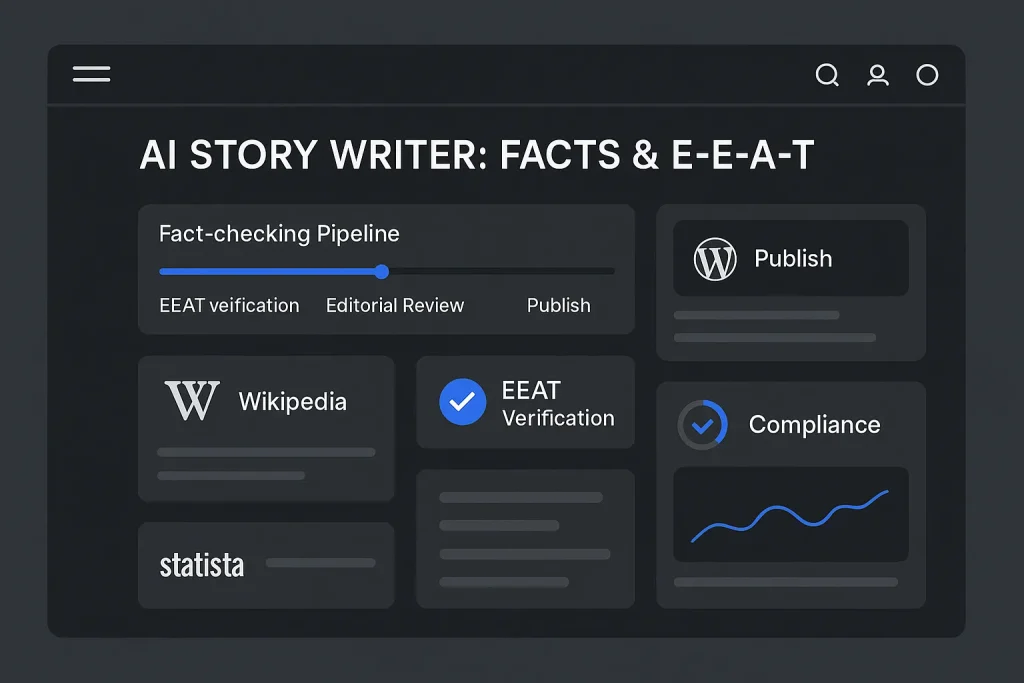
The practical standard is not complicated: engaging storytelling should rest on researched inputs, source-aware generation, human review, and a documented publishing workflow. That is where Autopilot SEO changes the category. Instead of asking a model to improvise facts, the platform uses a Pre-Research Algorithm that gathers up to seven authoritative outbound sources before writing begins. For agencies working with E-E-A-T-sensitive content, that difference is not cosmetic. It is the line between high-volume production and high-volume reputational exposure.

Why agencies love AI story writers—and what can go wrong
Agencies are squeezed from both sides of the funnel. Clients want more assets, faster turnarounds, tighter budgets, broader topic coverage, and stronger organic performance. Search, meanwhile, keeps rewarding clarity, relevance, and evidence. That is why story writing ai tools look so attractive: they compress ideation, drafting, reframing, and repurposing into one workflow. A strategist can move from a client brief to several narrative angles in minutes. A content lead can test variants for tone, persona fit, and offer positioning without reopening the whole editorial process.
The appeal gets even stronger in recurring content operations. Agencies managing several client accounts at once often need founder narratives, product explainers, comparison pages, category pages, email sequences, and social derivatives in parallel. A story ai writer can cut blank-page time, speed up iteration, and help junior teams produce workable first drafts faster. For early experimentation, even a free ai story writer or best free ai story generator can seem good enough. That is where many teams make the wrong call. Narrative fluency is easy to mistake for knowledge.
Most generic tools are built to continue text plausibly, not to certify factual truth. So they may invent dates, exaggerate product history, create customer scenarios that never happened, misread market trends, or blend several sources into one polished but inaccurate paragraph. In fiction, that may be fine. In agency work, it is risky. When teams use ai to write a story for a client and the output contains unsupported claims, three failures land at once: editorial failure, brand failure, and SEO trust failure.
The breakdown usually shows up in familiar places:
- Brand history: invented launch years, acquisitions, milestones, or founder statements.
- Industry context: unsupported trend claims presented as settled facts.
- Product narratives: benefits described as if they were verified outcomes.
- Case references: examples that sound credible but do not exist.
- Comparative messaging: implied superiority without evidence.
These errors are especially common when teams rely on a story generator ai, ai short story generator, or ai story generator based on prompt workflow that starts with a creative prompt but no validated source base. The prompt may define industry, tone, and objective, but the model still fills factual gaps probabilistically. That is acceptable for ideation. It is not acceptable for published client content.
For a practical framework on scaling AI content without wrecking quality, see scaling your blog without sacrificing SEO quality. We see the same pattern repeatedly: speed without quality controls is not scale. It is just cleanup postponed.

E-E-A-T risk explained: hallucinations, accuracy, and brand trust
E-E-A-T is often treated like a surface-level checklist—author box, a few citations, clean formatting, done. In practice, it works more like a trust model expressed through content quality, source discipline, topical fit, and consistency of claims. Google does not reward content because it looks expert on the surface. It rewards content ecosystems that behave credibly over time. If an agency keeps publishing narratives with factual drift, invented statements, or unsupported assertions, that behavior weakens trust no matter how polished the copy sounds.
Hallucinations sit right at the center of that risk. In the context of an ai story writer, a hallucination is not only a totally false statement. It can also be something subtler: a vague source turned into a precise statistic, a hypothesis written as fact, a generalized trend attached to the wrong segment, or a real company event described with the wrong timing. In our experience, those are the most dangerous errors because they often survive a quick editorial skim.
For agencies, the E-E-A-T implications go well beyond one article:
Experience: content that claims lived knowledge without real grounding feels synthetic.
Expertise: technical or industry inaccuracies signal weak command of the topic.
Authoritativeness: repeated factual instability makes the site less reliable as a reference point.
Trustworthiness: the most fragile layer; once readers or clients catch errors, every future claim gets examined harder.
This matters even more for agencies serving B2B brands in SaaS, finance, health-adjacent, legal-adjacent, enterprise software, or technical services. In those categories, a storywriting ai workflow without pre-research controls can publish text that sounds executive-ready while quietly eroding credibility. On our reading, that is one of the biggest hidden costs of careless AI adoption.
The chart below shows where AI-generated brand stories usually fail when there is no source-first process.
The highest-risk category is unsupported claims because they hit SEO credibility and client liability at the same time. We would treat that as the first area to harden in any workflow.

Ethical guidelines for agencies using AI storytelling
The ethics debate around AI-assisted content is often too abstract to be useful. Agencies do not need a philosophical manifesto on whether AI is good or bad. They need operating rules: when AI assistance is acceptable, how disclosure works internally, what review standards apply, and who owns factual integrity. In that frame, using an ai storywriter is not inherently unethical. Publishing unchecked client content with fabricated or unsupported information is.
Three ethical principles should guide agency use of AI storytelling.
First, truth outranks fluency. If a model can produce elegant copy but cannot verify the underlying statement, that statement should be treated as untrusted until validated. For teams that write a story with ai in a commercial setting, this is the non-negotiable rule.
Second, persuasion does not justify inference. AI models are very good at filling narrative gaps with plausible connective tissue. Agencies should ban the system from “completing” a client story with assumed customer outcomes, estimated statistics, inferred founder motives, or competitive conclusions unless those details exist in source material.
Third, accountability stays human. The tool can draft. The agency is still responsible. That includes legal review, editorial review, factual review, and final sign-off.
These principles need to become policy, not just good intentions. Agencies should define which content types can use AI-assisted drafting, which require source-backed pre-research, which need subject-matter review, and which should remain mostly human-authored. A creative campaign concept can usually tolerate more generative freedom than a regulated product page or a founder article published under an executive byline. That distinction matters a lot in practice.
A disciplined policy also separates fiction-style generation from factual storytelling. Terms like best ai story generator, best ai for story writing, or ai story generator free unlimited usually reflect consumer expectations around creativity, speed, and experimentation. Agency content has a different threshold. The real test is not whether the output is imaginative. It is whether the output is supportable.
Teams also benefit from a clear internal red-line list of prohibited AI behaviors:
- Inventing customer case studies or testimonial details.
- Creating executive quotes that were never approved.
- Stating market data without traceable sources.
- Presenting assumptions as client-specific facts.
- Blending multiple sources into a claim without attribution.
- Using synthetic examples in a way that implies they are real.
Agencies that want stronger trust signals in AI-assisted workflows should also review why humanizing AI text matters for E-E-A-T. On our view, humanization is not cosmetic polish. It is part of making content sound accountable, specific, and credible instead of generic and machine-flat.

Fact discipline: research, citations, and human QA that scale
Reliable AI storytelling is a production system, not a prompt trick. Agencies publishing at volume need fact discipline that scales across accounts, editors, topics, and deadlines. The system has four layers: researched inputs, source-aware drafting, structured review, and documented approval.
Researched inputs come first. Before a draft exists, the workflow should collect client-approved facts, product information, positioning language, prohibited claims, target audience context, and third-party references where needed. This prevents the model from improvising around missing information.
Source-aware drafting comes second. Instead of asking a generic model to generate from a blank prompt, the system should write from source material and keep claims bounded by that source set. This is where Autopilot SEO matters more than standard story write ai tools. A grounded draft starts with retrieved references, not intuition.
Structured review comes third. Review should not mean a casual read-through. Editors need explicit checks for dates, names, claims, product specifics, sourced data, outbound links, and tone alignment. We have seen this repeatedly: when agencies rely on skim approval, hallucinations survive because they read smoothly.
Documented approval comes fourth. Publication should leave an audit trail—what sources informed the piece, who approved it, what changed, and which client facts were verified.
The following table shows a scalable review model agencies can use for AI-assisted storytelling.
| Workflow stage | Primary control | Main risk reduced | Owner |
|---|---|---|---|
| Brief intake | Client facts, approved messaging, prohibited claims | Invented details and positioning drift | Strategist |
| Pre-research | Authoritative source collection | Unsupported market or product claims | Platform plus editor |
| Draft generation | Source-bounded narrative generation | Hallucinated chronology and invented examples | AI system |
| Editorial QA | Claim-by-claim verification checklist | Residual factual and tone errors | Editor |
| Publication | Logged approval and source retention | Audit gaps and accountability failures | Managing editor |
Agencies that formalize these controls reduce both error frequency and review chaos. That is not theory; it is usually the first operational payoff.
The process can also be visualized as a maturity curve: the more pre-research and QA a workflow contains, the lower the probability of factual failure at publication.
The operational lesson is simple: better prompts help, but process design matters more than prompt creativity. We would prioritize workflow architecture every time.

How outbound links and citations support E-E-A-T
Outbound links do not create E-E-A-T on their own. They support it when they function as evidence, context, and transparency. In an AI-assisted storytelling workflow, that distinction matters. Random linking for appearance does nothing. Intentional citation to authoritative references helps readers, editors, and search systems understand where factual claims come from and how the content is grounded.
For agencies, citations play three roles.
Evidence role: they substantiate data points, market context, definitions, or timeline references used in the story.
Transparency role: they make the editorial chain easier to inspect. Readers can verify the basis of a statement.
Constraint role: they reduce model drift by anchoring the narrative to actual documents rather than pure probability.
This is especially important when a team uses an ai story generator with pictures, ai story generator free unlimited, or another creative-first interface that prioritizes narrative experience over editorial defensibility. Visual polish does not compensate for unsupported claims. Citations do. That is a blunt point, but it is the right one.
Citations also improve internal QA. An editor reviewing a client article with linked support materials can verify the structure much faster than an editor forced to reverse-engineer every paragraph. In that sense, outbound links are not only a reader-facing trust signal. They are an operations tool.
The table below separates weak citation behavior from strong citation behavior in agency storytelling.
| Citation practice | Weak implementation | Strong implementation |
|---|---|---|
| Market data | Unlinked percentage or trend claim | Specific source tied to the exact statement |
| Brand history | Narrative chronology from memory or assumptions | Verified company page, public release, or trusted profile |
| Industry explanation | Generic explanation with no supporting context | Contextual source backing terminology or framework |
| Claims about outcomes | Implied customer success without proof | Explicitly sourced case study or removed claim |
Strong citation behavior makes the article easier to defend, easier to audit, and safer to publish.
For a broader look at trust, backlinks, and ranking resilience in AI-assisted publishing, review how to earn trust, backlinks, and rankings after the Helpful Content Update. The connection is straightforward: Google-facing trust and reader-facing trust are usually built by the same editorial discipline.

Autopilot SEO’s Pre-Research Algorithm: 7 sources before writing
This is the decisive technical difference between Autopilot SEO and a generic ai story writer. Most tools begin with the prompt. Autopilot SEO begins with research. Before generating the narrative, the platform can gather up to seven real authoritative outbound links relevant to the topic. That may include references such as Wikipedia, Statista, and other credible public sources, depending on the subject and available materials. The effect is structural: the system does not need to guess the factual landscape because it already has one.
For agencies, this changes the economics of trust. Instead of asking editors to catch every possible hallucination after the draft is written, the platform reduces hallucination risk upstream. That makes review faster, improves consistency across writers and accounts, and creates a more defensible chain from brief to publication. On our view, that upstream control is what separates infrastructure from a clever demo.
In practical terms, the Pre-Research Algorithm supports four agency objectives:
Topical grounding: the article starts with referenceable context rather than a speculative narrative frame.
Claim restraint: generated copy is less likely to overreach beyond the factual inputs available.
Easier QA: editors can compare draft claims against known sources instead of starting from zero.
Better auditability: the source set exists before publication, making internal documentation cleaner.
This makes Autopilot SEO substantially different from a typical best ai story generator or story generator ai category tool. Those tools may be useful for plot invention, creative exploration, or tone experimentation. Agency storytelling for SEO and brand credibility requires something else: source-backed generation.
The chart below contrasts the logic of a generic prompt-first workflow with a pre-research-first workflow.
A research-first system shifts effort from reactive correction to proactive accuracy.
Agencies looking to connect this with publishing automation should also read a fully automated WordPress content engine for SEO teams. The strongest workflow is not just generation plus review. It is generation, verification, and controlled publishing in one model.
Preventing hallucinations vs generic AI story generators
Generic AI tools are optimized for response generation. They predict the next likely token sequence from a prompt and context window. That can produce excellent prose. It does not automatically produce factual accountability. When agencies compare Autopilot SEO to a generic ai story generator based on prompt, the key difference is not writing style. It is the control architecture around factual claims.
A generic workflow usually looks like this: prompt the tool, review the result, edit obvious issues, publish if it reads well enough. That model breaks under pressure because hallucinations are often subtle. They survive exactly when teams are busy, deadlines are tight, and confidence in the tool is rising. We have seen that pattern enough times to treat it as predictable, not exceptional.
Autopilot SEO uses a more defensible sequence: topic framing, source retrieval, source-informed generation, editorial QA, and WordPress-ready publishing. This sequence reduces the chance that a story will contain fabricated context, unsupported examples, or synthetic authority language.
That distinction matters even more for agencies comparing categories like best ai for story writing, storywriting ai, or ai for writing stories. Those labels often collapse very different use cases into one bucket. A fiction or creativity assistant is not the same product as an SEO content infrastructure tool. Agencies should evaluate AI systems using operational questions:
Does the tool retrieve real sources before writing?
If not, every factual statement needs heavier post-draft scrutiny.
Can the workflow preserve citations and outbound links?
If not, editors spend more time reconstructing evidence after generation.
Is there a clean handoff to publishing?
If not, version control and approval discipline usually get weaker.
Can the system support repeatable QA across accounts?
If not, quality depends too much on individual editor vigilance.
Does the product fit SEO operations, not only creative ideation?
If not, it will produce drafts but not a scalable agency process.
For agencies building multi-client content pipelines, the right benchmark is not “Which tool writes the most impressive first paragraph?” It is “Which system lowers factual risk while preserving narrative quality and production speed?” By that standard, prompt-only systems are structurally weaker.
Implementation playbook: from brief to fact-checked story in WordPress
Agencies need more than theory. They need a repeatable implementation sequence that turns AI-assisted storytelling into a controllable production line. The playbook below is deliberately operational.
1. Build the brief around facts, not only messaging.
Include approved company details, target audience, positioning constraints, known differentiators, forbidden claims, and the intended search angle. If the client story depends on milestones, product data, or industry context, list what is confirmed and what still needs source validation.
2. Define the narrative job.
A brand story can be a founder narrative, market explainer, customer education piece, product adoption story, or category authority article. The narrative job determines how much factual density is required and what kind of verification matters most.
3. Run pre-research before draft generation.
This is where Autopilot SEO’s Pre-Research Algorithm creates leverage. Pull authoritative references first. Confirm whether the topic needs company sources, public encyclopedia-style context, third-party industry data, or technical references.
4. Generate from a constrained source set.
The draft should use the collected materials as its factual perimeter. This is how agencies can use ai to write a story without inviting uncontrolled speculation. If the team wants to write a story with ai safely, this is the step that keeps the system honest.
5. Review at claim level.
Editors should verify specific statements, not just read for flow. Dates, numbers, comparative statements, and examples deserve extra scrutiny.
6. Prepare structured outbound linking.
Keep only links that clarify or validate relevant claims. Remove decorative or redundant sources.
7. Approve and publish in WordPress.
Once the story is verified, move it into the CMS with metadata, internal links, and source integrity preserved.
8. Archive the decision trail.
Store the brief, source set, major edits, and final approvals. This matters when content is revised later or questioned by clients.
Agencies that want tighter integration between AI generation and publishing operations should review automates SEO content ops from semantic clustering to WordPress publishing. The strategic gain is not just speed. It is process compression without losing control.
Governance and auditability: roles, checklists, and logs
Governance is what keeps AI-assisted storytelling from turning into a black box. In agency settings, governance has to be light enough to preserve speed and formal enough to preserve accountability. The right model assigns clear roles and leaves a visible trail.
Strategist: owns topic framing, client messaging, and business alignment. Confirms what story should be told and which claims are commercially sensitive.
Research layer: retrieves and organizes source inputs. In Autopilot SEO, this function begins algorithmically through pre-research, which reduces manual overhead.
Writer or generation system: produces the first structured narrative from approved inputs.
Editor: checks factual consistency, style, tone, SEO fit, and source alignment.
Approver: gives final sign-off for publication and confirms that the article meets account-specific standards.
A good checklist does not need to be long. It needs to be specific. Agencies should log whether the article contains unsupported claims, whether every non-obvious factual statement has a basis, whether any examples are synthetic, whether all external references are appropriate, and whether the final version differs materially from approved source inputs.
Logs matter just as much. If a client later asks where a claim came from, “the AI wrote it” is not an acceptable answer. A responsible agency should be able to point to the source set, the review stage, and the approval record. That is what makes the workflow auditable. On our view, auditability is one of the most underrated competitive advantages in AI content operations.
Metrics to monitor: accuracy rate, E-E-A-T signals, and SEO impact
Agencies should measure AI-assisted storytelling with operational metrics, not just output volume. A system that produces more content but increases revisions, escalations, and trust risk is not efficient. It is unstable. The right measurement set combines editorial quality, trust signals, and workflow performance.
The most useful metrics are the following:
Accuracy rate: percentage of factual claims that pass verification without correction.
Revision intensity: how many material factual or structural edits are needed after generation.
Source coverage: proportion of non-obvious claims that are backed by an identified source.
Approval cycle time: how long it takes to move from brief to publishable version.
Trust-sensitive SEO outcomes: changes in rankings, engagement quality, and editorial consistency across a topic cluster.
These metrics should be reviewed by workflow type. A purely creative narrative and a search-driven B2B authority article do not carry the same verification burden. What matters is trend direction. If source-backed workflows lower revisions and improve approval velocity, the system is doing its job. We consider that a much healthier KPI set than raw article count alone.
The table below shows a practical scorecard agencies can implement.
| Metric | Why it matters | Healthy direction |
|---|---|---|
| Accuracy rate | Measures factual reliability of generated drafts | Upward over time |
| Revision intensity | Shows how much cleanup the workflow creates | Downward over time |
| Source coverage | Indicates whether claims are auditable | Upward over time |
| Approval cycle time | Measures production efficiency | Downward without quality loss |
| Cluster SEO performance | Connects editorial quality to search outcomes | Improving topical stability |
When these metrics improve together, the agency is not just producing more content. It is maturing its content system.
Conclusion: scale storytelling safely with Autopilot SEO
Agencies do not need to choose between storytelling speed and factual integrity. They need infrastructure that makes both possible. A generic ai story writer can create narrative momentum, but if it is not grounded in real sources, the workflow stays risky. Hallucinations are not a minor inconvenience in client content. They are a direct threat to E-E-A-T, brand trust, and editorial credibility.
The responsible path is straightforward: research first, generate second, verify third, publish with accountability. That is why Autopilot SEO stands apart. Rather than leaning on unsupported model confidence, the platform uses a Pre-Research Algorithm that can pull up to seven authoritative outbound links before writing starts. For agencies running multi-client SEO and content operations, that source-first design is the practical answer to safe AI storytelling.
Teams that want to scale brand storytelling without sacrificing factual control should evaluate the workflow on the official product site. A closer look at Autopilot SEO shows how source-backed generation, structured QA, and WordPress-ready publishing can fit into one agency-grade process. For agencies that care about E-E-A-T as an operating standard rather than a slogan, that is the right direction.
We think the real takeaway is simple: agencies should stop judging tools only by how fast they draft and start judging them by how safely they publish. The workflows that win over the next year will be the ones that combine speed with evidence, not speed with guesswork. We also expect clients to ask harder questions about provenance, citations, and review logs as AI-assisted production becomes normal. That will favor teams using source-first systems, while generic story ai writer workflows and casual ai story write setups will look increasingly thin under scrutiny.
Our forecast is cautious but clear. Agencies that build disciplined processes for writing stories with ai will gain efficiency without sacrificing trust. Those that rely on a flashy ai storywriter, a loose story write ai process, or a generic free ai story writer for client publishing will spend more time fixing credibility problems than saving time on drafts.
FAQ
Is it ethical to use an AI story writer for client content?
Yes—if the workflow includes source validation, human review, and clear accountability. Using an ai story writer is not the issue. Publishing unsupported or fabricated claims as if they were verified facts is the issue.
How can agencies prevent AI hallucinations in brand storytelling?
Start with pre-research, constrain drafting to verified inputs, and review claims line by line before publishing. In practice, generic prompt-first workflows create more risk than source-first systems built for SEO and content operations.
Do citations and outbound links improve E-E-A-T for AI-written stories?
They help when they support real claims with relevant authoritative sources. Citations do not replace expertise, but they do strengthen transparency, editorial defensibility, and trustworthiness when used properly.
Will Google penalize AI-generated content without fact-checking?
Google focuses on content quality and usefulness rather than banning AI as a category. If AI-generated content is inaccurate, thin, misleading, or untrustworthy, it will usually underperform because it fails the quality expectations tied to E-E-A-T and helpful content standards.
How does Autopilot SEO ensure factual accuracy in stories?
Autopilot SEO uses a Pre-Research Algorithm that retrieves up to seven authoritative outbound sources before writing begins. That source-first workflow reduces hallucinations, makes citations easier to preserve, and gives editors a stronger factual base for QA.