
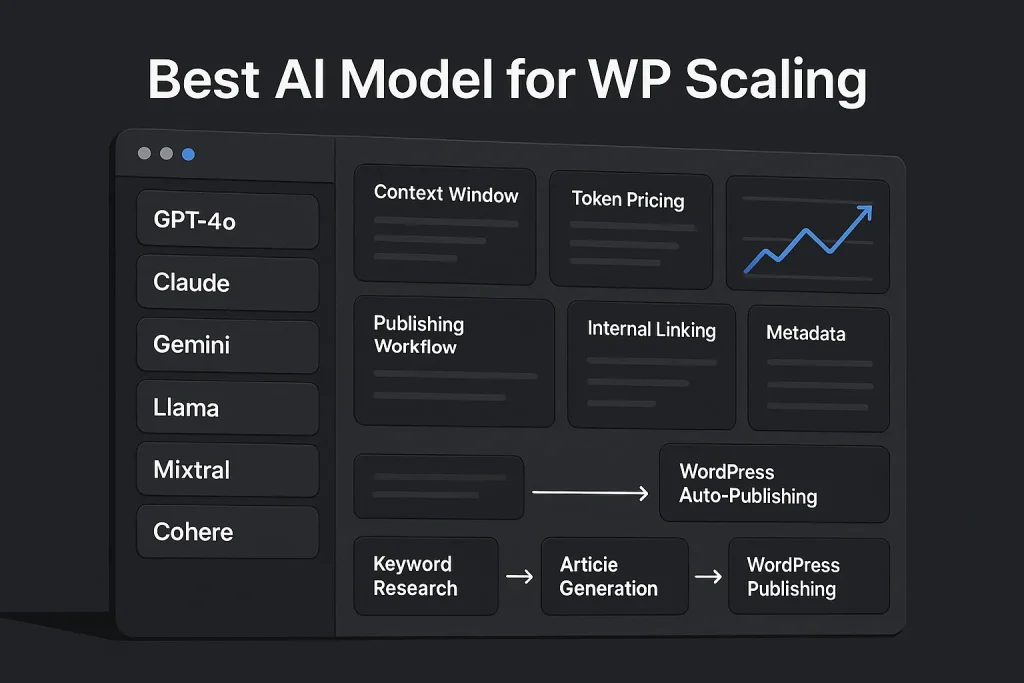
Choosing an ai language model for WordPress content scaling is not a model popularity contest. It is an operations decision. It affects article quality, token spend, editorial control, publishing speed, metadata consistency, and how reliably a team can turn briefs into search-ready pages at scale. A model that looks impressive in a chatbot demo can still break in production when it has to follow heading logic, preserve entity coverage, generate internal links, map fields to WordPress, and do that repeatedly across hundreds of posts.
The market now offers several credible large language models for content generation: OpenAI, Anthropic, Google, Meta, Mistral, and Cohere all come with different trade-offs in context length, reasoning quality, tool use, deployment flexibility, and price. We think the real comparison is not “which model writes best.” It is “which system produces publishable SEO content with the lowest operational friction and the most predictable total cost.” That is the question teams actually pay for.
This distinction matters because raw text generation solves only one layer of the workflow. Real content operations also need semantic planning, structured outlines, section depth, title and meta generation, internal linking rules, citation policy, image prompts, CMS mapping, update logic, and QA checkpoints. That is where many raw APIs underperform, even when the underlying llm ai capability is strong.
Who this guide is for and why LLM choice matters for WordPress scaling
This guide is for SEO teams, content marketers, agencies, publishers, startup operators, and WordPress site owners who need more than occasional AI drafting. It matters most when the goal is to produce long-form SEO articles repeatedly, across topic clusters, without losing editorial structure or operational efficiency.
For a solo blogger publishing four posts per month, minor differences between large language models may be tolerable. For a marketing team publishing 100, 500, or 1,000 posts, those differences become structural. Context windows determine whether the model can ingest a full brief, style guide, research pack, and prior site examples at once. Output pricing changes unit economics. Tool support shapes retrieval and fact-check workflows. Reliability in structured generation decides how much manual cleanup is needed before publishing.
WordPress scaling adds constraints that generic AI comparisons often skip. The model has to produce content that fits a publishing pipeline, not just a text box. That means fields for title tags, meta descriptions, featured image ideas, FAQs, categories, slugs, excerpts, internal anchors, and in some cases schema-related fragments. A strong large language model ai output helps. A strong workflow is what makes it commercially viable. On our view, teams that ignore this distinction usually end up buying extra editing hours later.

There is also a governance angle here. Teams increasingly care about prompt reproducibility, revision control, data handling, brand voice consistency, and failure recovery. Those requirements change the selection criteria fast. The best large language models for one-off ideation are not automatically the best large language models for repeatable WordPress production.
Quick primer: how large language models work and differ
Large language models are transformer-based systems that predict the next token in a sequence. In practice, they operate on tokenized text rather than words, which is why token pricing and token limits matter. According to OpenAI’s token documentation, one token is roughly 4 characters or about 0.75 English words. That rule of thumb is useful when planning article generation cost, context usage, and batch throughput.
At a high level, most transformer models ai differ across six technical dimensions: parameter scale, context window, training mixture, alignment method, tool-use support, and deployment model. Some are closed APIs managed by a vendor. Others are open source large language models or open-weight alternatives that can be self-hosted or adapted more deeply. Some prioritize reasoning depth. Others are tuned for throughput, retrieval, or multilingual business tasks.
For content generation, these differences show up in predictable ways. A longer context window can absorb larger briefs, source packs, brand guides, and content inventories. Better instruction following usually improves adherence to heading hierarchies and formatting constraints. Lower latency affects batch throughput. Stronger tool support makes it easier to combine retrieval, grounding, function calling, and post-processing. Open-weight deployment provides more control over privacy, data residency, and fine tuning large language models for specific editorial needs. We have seen this on real projects: the model matters, but the surrounding constraints matter just as much.
The distinction between model capability and publishing readiness is central. A list of large language models may tell you which systems exist. It does not tell you whether they can enforce a production SEO template without orchestration. That is why we evaluate models inside a workflow, not in isolation.
Key selection criteria for content generation (quality, SEO fit, latency, cost, limits)
The best selection process starts with workload definition. “WordPress content scaling” can mean affiliate article production, B2B thought leadership, location pages, glossary expansion, knowledge base enrichment, or programmatic cluster publishing. Each of these asks different things from an ai language model.
1. Output quality under constraint
Raw fluency is not enough. The model has to maintain section relevance, avoid repetition, preserve logical heading depth, and sustain coherence over long outputs. For SEO use, quality also includes semantic completeness: does the draft cover the right subtopics, entities, and search angles without drifting into filler. On our experience, this is where many flashy demos fall apart.
2. SEO structure compliance
Many large language models examples look strong until you ask for strict structural behavior. A production-ready model should support consistent heading hierarchy, clean intro logic, FAQ formatting, metadata generation, and controlled use of keywords. If the system regularly breaks formatting instructions or overuses phrases, editing overhead rises quickly.
3. Context window and prompt packing
Long context matters when a team wants to include search intent notes, semantic clusters, competitor headings, style guidelines, product positioning, internal link inventory, and citations in one generation pass. According to the OpenAI GPT-4o model page, GPT-4o has a 128,000-token context window and a 16,384-token max output. According to the Gemini 1.5 Pro documentation, Gemini supports up to 2,097,152 input tokens, which materially changes how much source material can be included in a single request.
4. Cost per finished article
API pricing is rarely just “cost per post.” In production, one article may involve topic interpretation, outline generation, first draft, rewrite, metadata, schema-related formatting, and QA passes. That means the orchestration layer may consume more tokens than the final article itself. Teams that compare only final output cost usually underestimate total cost of ownership.
5. Throughput and latency
High-quality models with slow turnarounds can become bottlenecks in batch publishing. Throughput matters for agencies and content teams that queue dozens of articles daily. It also matters for refresh workflows where many existing posts need updates, title rewrites, or FAQ enrichment in short windows.
6. Tool use and retrieval support
Modern content systems increasingly rely on retrieval, function calling, structured outputs, and grounding. Google and Cohere both emphasize these capabilities in their model pages, reflecting a broader shift from single-prompt generation toward orchestrated systems. This matters because raw generation without retrieval is weaker at factual discipline and source-aware drafting. We consider this one of the biggest dividing lines between hobby use and production use.
7. Deployment model and control
Open source large language models and open-weight systems such as Llama create different operational possibilities than closed APIs. They can help with privacy requirements, infrastructure control, regional hosting, and model adaptation. The trade-off is usually more engineering complexity, more evaluation work, and sometimes lower out-of-the-box instruction quality.

Model comparison for long-form SEO content (GPT-4/4o, Claude 3.x, Llama 3.x, Mixtral, Gemini 1.5, Cohere)
No universal winner exists across all publishing scenarios. The right answer depends on whether the team values long context, strong instruction following, open deployment, lower cost, or retrieval-oriented architecture.
The table below summarizes the practical differences that matter most for SEO article production.
| Model family | Context / scale signal | Operational strength | Primary limitation |
|---|---|---|---|
| GPT-4o | 128k context, 16,384 max output | Balanced quality, cost, tooling, broad ecosystem | Still requires chunking or multi-pass workflows for very long outputs |
| Claude Opus 4.7 | Premium pricing tier | High-end reasoning for difficult editorial tasks | Significantly higher output cost for scale publishing |
| Gemini 1.5 Pro | Up to 2,097,152 input tokens | Excellent for huge briefs, source packs, and retrieval-heavy workflows | Pricing shifts with larger prompts; overkill for simple article jobs |
| Llama 3 / 3.1 | 8B, 70B, 405B options; 128k context for 3.1 405B | Control, hosting flexibility, adaptation potential | More engineering work and evaluation burden |
| Mixtral 8x7B | 32k context; sparse MoE activation | Efficient inference profile for controlled tasks | Tighter context for large SEO workflows |
| Cohere Command R+ | 128k context; enterprise RAG emphasis | Strong fit for grounded enterprise content systems | Less default mindshare in mainstream blog workflows |
The comparison gets clearer when mapped against real WordPress publishing needs rather than abstract rankings.
GPT-4o
GPT-4o is one of the most balanced options for long-form SEO production. OpenAI documents 128k context and API pricing of $2.50 per 1 million input tokens and $10 per 1 million output tokens on the GPT-4o model documentation. For many teams, that creates an efficient middle ground between quality and cost. It is well suited to orchestrated workflows where separate steps handle outline creation, drafting, metadata, and QA.
Claude
Claude is often attractive for nuanced writing and reasoning-heavy tasks, but cost becomes a serious factor at scale. Anthropic’s May 27, 2026 price sheet shows standard pricing for Claude Opus 4.7 at $5 per 1 million input tokens and $25 per 1 million output tokens, according to the Anthropic pricing document. That premium may be justified for high-stakes editorial passes, but it is less comfortable for commodity-scale article output.
Gemini 1.5 Pro
Gemini is particularly relevant for workflows that rely on large prompt packs, retrieval, or complex structured generation. Google’s pricing page documents text input at $1.25 per 1 million tokens below 200,000 input tokens and $2.50 above that threshold, with text output at $5.50 below 200,000 tokens and higher above that threshold, according to Google Vertex AI pricing. The very large input ceiling can reduce prompt fragmentation when a team needs to combine style guides, source material, and semantic inventories in one call. If you are evaluating a google ai model for content ops, this is the practical reason it stays in the conversation.
Llama 3 and 3.1
For teams evaluating open source large language models or open-weight deployments, Meta’s Llama family is strategically important. Meta states that Llama 3 shipped in 8B and 70B sizes, while Llama 3.1 added a 405B model with a 128k context window, as described in Meta’s Llama 3.1 release announcement. This matters when a team prioritizes control, data residency, customization, or private deployment over convenience. If meta ai and llama ai are on your shortlist, the real question is whether your team can support the extra engineering load.
Mixtral
Mixtral is useful in discussions about efficiency because mixture-of-experts architectures can lower active compute per token. Mistral documents Mixtral 8x7B with 46.7B total parameters but only 12.9B active per token, and a 32k context window, according to the Mixtral 8x7B model documentation. For article production, that may be enough for constrained tasks, but it is noticeably tighter than 128k or 2M-class options for broad SEO workflows.
Cohere Command R+
Cohere deserves attention when the workflow depends on grounding, retrieval, citations, and tool use. Its pricing is close to GPT-4o at list level, and its positioning is strongly enterprise-oriented. That makes it relevant for teams building retrieval-backed content pipelines rather than simple blog drafting loops.

The practical takeaway is simple. Large language models llm should be matched to workload classes. Premium reasoning models are not always the best economic choice for repetitive publishing. Open models are not always the cheapest once infrastructure and QA are counted. Ultra-long context models are not always necessary if the system can orchestrate retrieval and multi-step generation efficiently.
Raw LLM APIs vs an agentic SEO system: where results diverge
Raw APIs generate text. Agentic systems generate outcomes. That is the real split.
A raw model call usually accepts a prompt and returns a completion. If the prompt is carefully engineered, the result may be usable. But SEO content operations require repeatable enforcement across multiple article components and multiple production stages. An agentic system coordinates prompts, retrieval, validators, formatting rules, field mapping, and publishing actions around the model.
In practice, the divergence appears in five places:
- Input preparation: raw APIs depend on one prompt; agentic systems assemble semantic data, brand constraints, page templates, and link inventories automatically.
- Multi-step generation: raw calls often try to do everything at once; agentic systems separate planning, outlining, drafting, metadata, internal links, and QA.
- Validation: raw responses can ignore rules; agentic systems can check heading depth, section coverage, keyword placement, and formatting before publication.
- CMS operations: raw APIs stop at text; agentic systems handle WordPress fields, scheduling, media prompts, and publishing status.
- Recovery and iteration: raw APIs require manual intervention when outputs break; agentic systems can rerun failed steps or revise specific blocks without rebuilding the whole article.
This difference explains why many teams overestimate what a single model can do. The issue is not whether is chatgpt a large language model or whether Claude or Gemini can write. They can. The issue is whether a generic prompt can reliably produce production-grade SEO pages under business constraints. Usually, it cannot. On our view, this is where most “AI content automation” promises become expensive cleanup projects.
That is also why reading Why Manual AI Writing Tools Are Obsolete: The Case for Full SEO Autopilot is useful in parallel with model selection. It frames the operational gap between writing assistance and content infrastructure.
Failure points of raw models for SEO structure (entities, outlines, internal links, citations)
The main weakness of raw large language models applications in SEO is not sentence generation. It is structural discipline under repetition. A model can sound authoritative while still failing the rules that matter for search-oriented content production.
Heading hierarchy instability
Long prompts often ask for H2 and H3 logic, but raw models may collapse levels, overproduce subheadings, or shift tone between sections. This creates inconsistent editorial architecture and increases cleanup time.
Weak entity coverage
SEO articles need topical completeness, not just keyword insertion. Raw models often mention the headline term while missing adjacent concepts, competing solutions, operational constraints, or important product entities. This is a common failure when prompts do not include a semantic map.
Poor internal linking logic
Internal links are usually not a text-generation problem. They are an inventory and relevance problem. A raw model does not know which URLs exist, which anchor variants are acceptable, or where links should be distributed. Without orchestration, internal links are either invented, omitted, or inserted awkwardly.
Citation inconsistency
Many content teams want references for factual claims, especially in technical B2B topics. Raw models may summarize knowledge plausibly but without source discipline. When grounded workflows or retrieval are not added, factual statements become harder to verify systematically.
Metadata and field mapping gaps
WordPress publishing requires more than body copy. Teams also need slugs, title tags, meta descriptions, excerpts, featured image prompts, and often taxonomies. Raw APIs do not manage that automatically unless the application layer structures and validates each field.
Keyword control and anti-spam behavior
Prompt-only workflows often swing between underuse and overuse of target terms. An ai language model can be instructed to include a focus keyword, but without validators it may place the phrase unnaturally, miss crucial placements, or repeat it excessively. We have noticed that this gets worse as volume rises, because small formatting failures compound into a real editorial burden.

These are not edge cases. They are the normal reasons supposedly automated pipelines still need manual editing. Teams that want reliable results need a system that decomposes the task and validates each step.
Evaluation framework and benchmarks for blog-scale testing
Model selection should be evidence-based. A useful benchmark for WordPress content scaling does not try to identify the smartest model in the abstract. It measures which configuration produces the best operational outcome for the intended content class.
Recommended test design
Build a test set of 20 to 30 representative topics across multiple difficulty levels: straightforward commercial topics, comparison pages, technical explainers, and update-style articles. Use the same brief structure for each model family and compare results under a controlled workflow.
The benchmark should score outputs on these dimensions:
- Outline compliance
- Semantic completeness
- Readability and redundancy control
- Keyword placement quality
- Internal link insertion accuracy
- Metadata usefulness
- Factual caution and unsupported claims
- Latency per article
- Total tokens consumed across all passes
- Manual editing time to publish
The most important metric is usually editor minutes per publishable article. A more expensive model may still be cheaper overall if it materially reduces human editing. Conversely, a cheaper model may become expensive if it fails structure and requires repeated rewrites. On the practical side, this is why a list of large language models or an openai model list is never enough for procurement.
The table below provides a practical benchmark framework for teams comparing large language models examples in production.
| Benchmark area | What to measure | Why it matters |
|---|---|---|
| Draft quality | Coherence, section relevance, repetition | Determines how much rewriting is needed |
| SEO fit | Entities, heading logic, keyword placement | Determines search-oriented usefulness |
| Operational efficiency | Latency, retries, throughput | Impacts publishing velocity and queue stability |
| Token economics | Input, output, enrichment, QA passes | Reveals real unit cost, not list price illusion |
| Publishability | Minutes to final WordPress-ready asset | Best proxy for business value |
A model benchmark without editing-time data is incomplete, because publishing economics depend on the total workflow, not the draft alone.
Context length alone does not decide the winner, but it strongly affects how much planning and source material can be packed into one generation pass.
Cost and throughput math: TCO per 100, 500, and 1,000 posts
Cost discussions around large language model ai systems are often distorted by focusing only on the final draft output. Real pipelines consume tokens across several stages. Still, output math is a useful baseline for rough planning.
Using OpenAI’s rule of thumb, a 2,000-word article is roughly 2,667 output tokens. At GPT-4o pricing of $10 per 1 million output tokens, output alone costs about $0.0267 per article. At Claude Opus 4.7 pricing of $25 per 1 million output tokens, the same output length costs about $0.0667 per article. These are only output charges; input, retrieval, rewrites, metadata generation, and QA are additional.
| Publishing volume | Approx. output tokens | GPT-4o output cost | Claude Opus 4.7 output cost |
|---|---|---|---|
| 100 posts | 266,700 | About $2.67 | About $6.67 |
| 500 posts | 1,333,500 | About $13.34 | About $33.34 |
| 1,000 posts | 2,667,000 | About $26.67 | About $66.68 |
These numbers look small because they exclude the rest of the pipeline. That omission is exactly why naive cost estimates fail. Once prompts include outline generation, entity extraction, internal links, metadata, revisions, and fact-check passes, token usage can multiply.
For total cost of ownership, treat the final draft as one stage in a longer pipeline. If the system uses three or four additional passes, a cheaper model with higher retry rates may no longer be cheaper.
In many real pipelines, the non-draft stages account for a large share of consumption. That is one reason raw API comparisons often mislead procurement decisions.

WordPress integration requirements (REST API, media, metadata, schedules, updates)
Even excellent large language models fail operationally if the WordPress integration layer is weak. Production publishing requires predictable field mapping, update paths, and media handling.
Core publishing requirements
A mature integration should support the WordPress REST API or equivalent application layer, authentication management, category and tag assignment, slug creation, featured image workflow, post status handling, and scheduling. It also needs error handling for draft failures, duplicate slugs, broken media uploads, and partial publish states.
Metadata mapping
At minimum, the system should map body HTML, SEO title, meta description, excerpt, FAQ blocks, and image metadata. Stronger implementations also handle custom fields, schema helpers, author assignment, and update rules for existing posts.
Media generation and enrichment
Content scaling is rarely text-only. Teams need image prompts, alt text, captions, and descriptions. They may also need stock search queries, asset replacement logic, and featured image assignment. Without that layer, editors still perform repetitive post-processing.
Content updates and refreshes
Publishing is only part of lifecycle management. A scalable system should also update existing posts, enrich FAQs, revise metadata, insert new internal links, and republish refreshed versions without rewriting every page from scratch. On our side, we would treat this as a core requirement, not a nice extra.
These requirements are easier to understand through workflow examples. The article How to Turn an AI Writer Into a Fully Automated WordPress Content Engine for SEO Teams is particularly relevant for teams designing an end-to-end CMS pipeline rather than a writing-only stack.
Decision matrix: which model for which workload
The most practical way to choose among large language models is to align model families with workload classes.
If the team values balanced cost and broad ecosystem support, GPT-4o is usually a strong baseline. If the team needs premium reasoning for difficult editorial transformation, Claude can be justified for selected stages rather than full-volume drafting. If the team needs to pack massive briefs or retrieval contexts into single requests, Gemini 1.5 Pro becomes strategically attractive. If the organization requires private hosting, control, or regional deployment, Llama-based stacks deserve serious evaluation. If the workflow is constrained and cost-sensitive, Mixtral can be useful for narrower steps. If grounding and enterprise retrieval are central, Cohere is relevant.
A useful buying principle is to separate base model selection from workflow architecture. The base model handles language generation. The workflow architecture determines whether the output becomes a publishable asset. This is where many “best model” discussions miss the decisive variable. If you are comparing the best large language models or even the largest language models, remember that size alone rarely fixes workflow design.

Implementation checklist and risk controls (guardrails, fact-checking, E-E-A-T)
A strong implementation reduces the risk that model output creates low-quality, repetitive, or unsupported content. The best large language models still require guardrails.
Guardrail design
Use structured prompts, schema-validated outputs where possible, section-level generation for long content, and post-generation validators for headings, keyword placement, formatting, and required fields. Avoid “one giant prompt” architectures for production SEO.
Fact-check workflow
For technical and commercial claims, use retrieval or source-bound generation, not memory-only drafting. If claims require documentation, the generation pipeline should either cite verified sources or flag unsupported assertions for review. This is particularly important in B2B content where credibility losses are expensive.
E-E-A-T alignment
AI-generated content should still reflect editorial standards around expertise, specificity, and trust. That means practical examples, product context, transparent claims, and clear distinction between documented facts and interpretation. Generic fluency without source discipline is not enough. We would go further: what is llm in generative ai matters less to a business than whether the output can be trusted after publication.
Versioning and rollback
Track prompt versions, model versions, and workflow changes. Model upgrades can change output characteristics even when application logic remains stable. Cohere, for example, has documented throughput and latency improvements across releases, showing that model family evolution can materially change operating conditions without a full system redesign.
Teams building a more mature content ops stack should also review How an AI Assistant Automates SEO Content Ops From Semantic Clustering to Auto-Publishing in WordPress. It is a useful reference point for understanding how generation, semantic planning, and CMS execution fit together.
How Autopilot SEO orchestrates LLMs, retrieval, and one-click publishing
The most important conclusion is that the best ai language model for WordPress scaling is rarely a raw model used directly. It is usually a model embedded inside a system that enforces SEO structure, orchestrates generation stages, validates outputs, and publishes cleanly into WordPress.
That is the operational gap addressed by SEO Autopilot. Instead of relying on a single prompt to do everything, the platform is designed around the full SEO content workflow: semantic generation, structure planning, article drafting, image prompt creation, internal linking logic, metadata preparation, and direct WordPress publishing. The result is closer to a production pipeline than a chatbot wrapper.
For teams comparing raw APIs with a deployment-ready content engine, the key advantage is consistency. A custom agentic layer can decide how to use large language models, when to split tasks, how to preserve formatting, how to map fields into WordPress, and how to reduce manual touchpoints. That matters more than choosing a frontier model in isolation. If your team is also reviewing free large language models, keep the same standard: cheap access is not the same thing as operational readiness.
If your team needs a practical system rather than a prompt experiment, review the SEO Autopilot platform. It is built for agencies, publishers, and site owners who want to move from topic idea to SEO-ready WordPress publication with far less manual coordination.

We believe the market is moving away from single-model obsession and toward workflow reliability. The teams that win will not necessarily use the flashiest model; they will use the system that consistently turns briefs into publishable assets with fewer errors, lower editing time, and cleaner WordPress execution. On a practical level, the smartest buying decision is usually the one that reduces coordination cost, not the one that wins benchmark arguments. The risk to watch is simple: businesses that optimize only for model price or hype will often pay for that shortcut in QA, revisions, and missed publishing velocity.
Our forecast is fairly straightforward. More stacks will become multi-model, with one model for planning, another for drafting, and another for validation or retrieval-heavy tasks. We also expect open source large language models and open-weight options to gain ground in privacy-sensitive environments, while closed vendors keep the edge in convenience and tooling. The next wave of advantage will come from orchestration quality, not from a longer list of large language models alone.
FAQ
Which AI language model is best for long form SEO content?
There is no single universal winner. For many teams, GPT-4o is a strong baseline because it balances quality, tooling, and token economics, while Gemini 1.5 Pro is attractive for extremely large briefs and source-heavy workflows. The better question is which ai language model works best inside your SEO pipeline with the least editing and the best WordPress fit.
GPT-4 vs Claude for blog writing: which is better?
GPT-4-class models are often the safer default for broad content operations because ecosystem support and cost structure are easier to manage at scale. Claude can be very strong for nuanced writing and reasoning-heavy passes, but premium output pricing makes it harder to justify for high-volume blog generation unless the quality lift clearly reduces editing time.
Are open source large language models good enough for WordPress content?
They can be, but the answer depends on your engineering capacity and quality threshold. Open source large language models or open-weight options like Llama can work well when control, private hosting, or customization matter, but they typically require more workflow design, evaluation, and QA than managed closed APIs.
How much does it cost per 1000 words with different LLMs?
The answer depends on token pricing and how many generation passes your workflow uses. Using OpenAI’s token approximation, 1,000 English words are roughly 1,333 output tokens, which makes output-only cost on GPT-4o about $0.0133 and output-only cost on Claude Opus 4.7 about $0.0333. Real production cost is higher because outlines, rewrites, metadata, retrieval, and internal linking steps also consume tokens.
How can I auto publish LLM generated articles to WordPress?
You need more than an LLM endpoint. A reliable workflow should generate structured fields, validate SEO formatting, prepare media metadata, and send the final content through the WordPress REST API or a connected publishing layer. SaaS systems built for SEO content automation are usually more dependable than direct prompt-to-post scripts because they handle orchestration, validation, and post metadata together.