
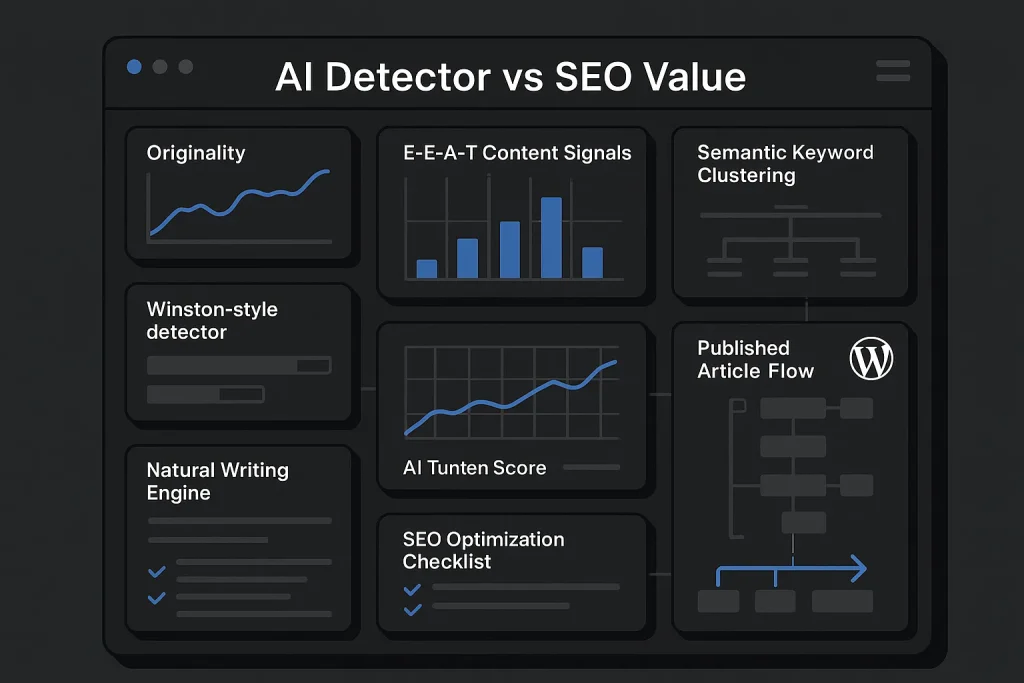
Passing an ai text detector is rarely about outsmarting a machine with a cute rewrite. In practice, it is about removing the fingerprints of generic, over-smoothed, statistically predictable copy while keeping what actually makes a page rank: specificity, source discipline, topical depth, and clean editorial structure. We consider that the core distinction. Detector scores are not proof of authorship, and SEO value does not improve just because text has been paraphrased into looking less machine-like.
For publishers, agencies, and in-house teams, the risk is pretty simple. A page can underperform because it is thin, repetitive, or unhelpful. The same page can also get flagged by an ai writing detector because the prose feels formulaic. Those issues overlap, but they are not the same thing. On our side, we would not treat post-generation “humanization” as the fix. The better move is stronger content from the start: grounded examples, useful distinctions, natural variation in sentence shape, and topic-specific insight that supports E-E-A-T.
That is why we treat detector outputs as secondary diagnostic signals, not the main quality standard. Tools such as Originality, Winston AI, and the turnitin ai detector can surface patterns worth reviewing, but they cannot tell you whether an article is credible, commercially useful, or likely to perform in Google.
What AI Text Detectors Actually Do (and Don’t)
An ai generated text detector does not inspect authorship the way a forensic examiner would inspect a document trail. It estimates whether a passage statistically resembles text patterns associated with machine-generated writing. In practice, these systems analyze distributions: token predictability, syntactic regularity, repetition, burstiness, phrasing templates, and other model-derived features. The output is a probability estimate or confidence score, not a courtroom-grade finding.
That limitation is not hidden. It is stated in vendor documentation and research. OpenAI’s own guidance says detectors cannot reliably determine authorship, and the company previously acknowledged false positives on clearly human texts. Turnitin’s AI writing report documentation also warns that its model can misidentify human-written, AI-generated, and AI-paraphrased text. So the score should never be the sole basis for serious decisions.
For SEO teams, the implication is blunt. A low score is not proof of quality. A high score is not proof of bad intent. A polished landing page written by a human can look statistically uniform. A heavily paraphrased AI draft can look irregular enough to satisfy one ai detector for text while still being shallow, vague, and strategically weak.
The practical model is simple: detectors observe style patterns, while search performance depends on usefulness, relevance, topical coverage, clarity, and trust signals. There is overlap, yes. But these metrics are not interchangeable. On our experience, teams get into trouble the moment they confuse them.

How Popular Detectors Work: Signals, Models, and Thresholds
Most detector products rely on some mix of language-model classification, perplexity-style estimates, and pattern matching against known machine-writing traits. They are not identical systems. That is exactly why the same article can produce different outputs across tools. For us, that alone is enough reason to avoid treating one score as decisive.
Some widely used tools also publish constraints that materially change how you should read the result. Turnitin separates its AI score from its similarity score, so a document can have low plagiarism similarity and still receive a higher AI estimate. Turnitin also says it only generates reports for documents with at least 300 words of prose and under 30,000 words, and that it does not reliably analyze formats such as poetry, code, bullet-heavy layouts, tables, or annotated bibliographies. Winston AI publicly claims high performance, but it also notes that no detector reaches 100% accuracy and that longer text usually provides more reliable signal than short passages. Originality.ai makes a similar point: detector performance varies across datasets and tests rather than staying stable across all use cases.
The operational takeaway is straightforward. If your team is comparing the best ai text detector, the criteria should include more than vendor claims. Look at document-length sensitivity, formatting sensitivity, supported languages, false-positive behavior, and consistency across content types such as product pages, blog posts, and tutorials.
The table below summarizes the constraints that matter most for editors and SEO managers.
| Tool or source | What it says | Editorial takeaway |
|---|---|---|
| OpenAI guidance | Detectors cannot reliably determine authorship; small edits can evade detection. | Do not use detector pass/fail as a proxy for quality. |
| Turnitin | AI score is separate from similarity score; 300-word minimum; limitations on non-prose formats. | Context and document type matter as much as the score. |
| Originality.ai | Performance varies across tests and datasets. | Compare outputs across multiple content samples, not one article. |
| Winston AI | Claims high accuracy but acknowledges no tool is perfect; long-form text is easier to analyze. | Short pages need more human review than tool confidence. |
The only safe conclusion is that no single chatgpt text detector or open ai detector should define editorial policy on its own.
Several published facts from vendor documentation and research are easier to grasp visually.
Length and format sensitivity explain why one ai text detection tool can swing sharply across the same site depending on page type. We have seen this happen often on mixed-content sites with short product pages and long educational guides.
Vendors themselves acknowledge that detector confidence changes with text length. That is one more reason single-score comparisons are unstable.

Why False Positives Happen on Human‑Written SEO Content
False positives happen when human writing shares statistical traits with machine-generated prose. In SEO environments, this is more common than many teams assume. Writers are trained to be clear, concise, and structurally consistent. Brand guidelines push similar sentence rhythms across pages. Content briefs often enforce repeated entities, tightly scoped keyword sets, and standard heading logic. All of that can make a legitimate article look highly patterned.
This gets sharper in international content operations. Stanford researchers reported that several detectors labeled 61.22% of TOEFL essays by non-native English writers as AI-generated, even though those texts were written by humans. The Stanford HAI analysis matters for SEO because multilingual teams, outsourced editorial pipelines, and global B2B brands often rely on writers whose English is polished but stylistically regular. Detector bias can punish that regularity. On our view, this is one of the most under-discussed risks in enterprise content ops.
Formatting is another issue. Turnitin explicitly says its model is less reliable on non-prose structures such as code, tables, scripts, and bullet lists. That matters for documentation sites, product pages, SaaS comparison pages, and technical tutorials where useful formatting is part of the value. A detector may simply have less usable signal, while the content itself may be exactly what users need.
OpenAI’s guidance adds another uncomfortable point: small edits can materially change detector outcomes. So a false positive can often be “fixed” without improving truthfulness, expertise, or usefulness. In plain terms, the detector is reacting to surface structure more than underlying informational quality.
The chart below shows a concrete fairness and reliability problem reflected in the sources cited for this article.
The first figure comes from Stanford’s reporting on detector bias; the second reflects the Wikipedia summary of research indicating that only five of 14 tools exceeded 70% accuracy in a 2023 study, based on the literature overview collected on Wikipedia. The larger point is inconsistency, not precision.
SEO teams should be especially careful when reviewing content from freelance networks, non-native English contributors, or highly templated commercial pages. A written by ai detector may be flagging regularity rather than automation. That is a meaningful distinction, and we think too many review workflows ignore it.

Humanizers vs. Writing Naturally: What Really Lowers AI Scores
Third-party “humanizer” tools are popular because they promise a shortcut. Paste text, click rewrite, reduce detector probability. Sometimes that works against a specific tool. It does not solve the larger content problem.
A humanizer typically perturbs wording, swaps syntax, introduces variation, and changes rhythm. That can lower the confidence of one gpt detection model because the predictable statistical pattern has been disrupted. But the side effects are familiar: diluted terminology, weaker factual precision, awkward transitions, accidental meaning shifts, and loss of brand consistency.
The academic literature supports the basic vulnerability behind these tools. A 2023 University of Maryland paper found that recursive paraphrasing could sharply reduce detector hit rates while only slightly reducing text quality, which shows how fragile many systems are under adversarial rewriting. You can review that result in the arXiv paper on evasive paraphrasing. The nuance matters. “Slightly reducing text quality” is not a business win. At scale, slight damage becomes real damage to clarity, trust, and conversion.
There is also a strategic flaw here. If the content starts generic, humanizing it afterward only rearranges generic material. It does not add first-hand examples, commercial context, implementation detail, or stronger topical coverage. In SEO terms, it may reduce one detector score while leaving the page thin in the ways that actually matter for rankings and users.
A better approach is to write naturally from the beginning. That means using an engine or workflow that creates variation through substance rather than noise. Good examples include scenario-based explanations, distinctions between page types, explicit trade-offs, and concrete editorial judgments instead of filler.
The difference is not subtle. On our practice side, natural drafting beats mechanical rewriting almost every time once you measure the full business outcome.
| Approach | What it changes | SEO impact | Detector impact |
|---|---|---|---|
| Third-party humanizer | Surface phrasing, syntax variation, word swaps | Often neutral to negative if terminology and clarity degrade | May reduce one tool’s score temporarily |
| Natural E-E-A-T-first drafting | Depth, examples, framing, specificity, source use | Usually positive because usefulness and differentiation improve | Often lowers flags more durably by removing generic patterns |
| Manual editor pass | Precision, coherence, factual framing, conversion logic | Strong when the editor adds real subject-matter judgment | Helpful when it changes substance, not just cosmetics |
For deeper context on editorially sound rewriting, see why humanizing AI text matters for E-E-A-T at scale. The key point remains the same: humanize ai is useful only when it means improving the article, not hiding its origin.

An E‑E‑A‑T‑First Writing Workflow That Passes Detectors by Design
The most stable way to reduce detector risk is to structure the drafting process around E-E-A-T from the start. This is not a slogan. It is an engineering choice for content operations.
An E-E-A-T-first workflow tends to generate text that is less statistically generic because it includes decisions generic models often skip: what matters for this audience, what trade-off applies in this scenario, what implementation detail changes the outcome, what common mistake distorts interpretation, and what evidence or source anchors the claim. Those signals naturally diversify prose.
For teams producing at scale, the workflow usually looks like this:
- Semantic scoping before drafting: Build the article around intent clusters, entity coverage, and page purpose rather than around a single keyword string.
- Scenario-led framing: Draft for a concrete reader situation such as an agency reviewing detector flags before publication, not for an abstract generic audience.
- Claim discipline: Use direct assertions only where the source or reasoning is clear. Avoid inflated promises and invented numbers.
- Topic-specific detail: Add distinctions by format, funnel stage, CMS workflow, or content type.
- Editorial normalization: Review terminology consistency, remove robotic transitions, and tighten unsupported generalizations.
This is also why purpose-built systems outperform generic rewrite chains. Instead of drafting with one model, rewriting with another, then forcing the result through a free ai detector or gltr ai checker, a better content engine writes with natural variance, source-aware framing, and SEO structure from the beginning.
That is the real line between a native writing engine and a patchwork process. A patchwork process treats detector avoidance as the goal. A native workflow treats useful content as the goal and gets lower detector risk as a side effect. We think that is the only scalable approach that does not quietly erode quality.
If you are designing the workflow end to end, the model described in a writer-human AI content pipeline for WordPress is much closer to what sustainable SEO teams need than detector-first rewriting.

On‑Page SEO You Should Not Sacrifice to Reduce AI Probability
One of the biggest mistakes in detector avoidance is weakening the page’s SEO foundation. Teams remove keywords, flatten headings, delete internal links, shorten explanatory passages, and strip away structured comparisons because they fear those patterns will trigger an ai text detector free tool or a premium checker. That is the wrong trade.
You should not sacrifice:
- Clear search-intent alignment. The article still needs a defined query target and coherent information architecture.
- Topic coverage. Removing subtopics to make prose look less systematic often harms completeness.
- Exact-match keyword placement in strategic positions. Natural use in the title, opening paragraph, headings where relevant, and core body sections remains valuable.
- Internal links. Contextual links improve crawl paths, topical clustering, and user journeys.
- Examples and comparisons. They reduce genericness and improve usefulness at the same time.
The better tactic is to keep the SEO spine intact while improving the language around it. Instead of deleting the focus term, vary the supporting context. Instead of flattening headings, make each section do real work. Instead of removing internal links, make them tighter and more relevant.
For example, a sentence like “AI detectors are changing content strategy and businesses must adapt accordingly” is broad, generic, and detector-prone. A stronger SEO-friendly version is more specific: “For SaaS blogs publishing at scale, detector scores matter less than whether the draft includes product-specific examples, source-backed claims, and internal links that place the article inside a coherent topic cluster.” The second version is simply better. It is more informative, and it is usually less statistically bland.
Teams scaling editorial production should also review how to scale AI content creation without sacrificing SEO quality. The principle is the same here: optimization and naturalness are not opposites when the content architecture is sound.

Testing Protocol: Cross‑Checking Detectors vs. Editorial Quality Signals
Teams that need a repeatable review process should separate detector analysis from editorial QA, then compare them. This avoids the common failure mode where a high detector score automatically triggers heavy paraphrasing.
A practical protocol has four stages:
- Run the draft through one or two detectors only after the article is structurally complete. Checking too early creates noise because unfinished sections are often more repetitive.
- Review the flagged areas manually. Look for generic transitions, repetitive clause openings, overused summary language, or missing specifics.
- Score the article on editorial usefulness separately. Measure clarity, topical depth, evidence quality, funnel relevance, internal linking, and factual precision.
- Revise substance first, wording second. Add scenario detail, examples, distinctions, and clearer logic before making stylistic tweaks.
This method keeps the team focused on business outcomes. A low score in a best ai detector does not matter if the page underperforms in rankings, engagement, and conversions. On the other hand, a moderate detector score may be perfectly acceptable if the article is strong, original in framing, and commercially useful.
The chart below organizes the editorial priority order.
A detector score belongs at the bottom of the hierarchy, not the top. It is a diagnostic hint, not the definition of quality.
Case Examples: Detector Outcomes Across Blog Posts, Guides, and Product Pages
Different page types create different detector behavior because they operate under different rhetorical constraints.
Blog posts often contain explanatory prose, transitions, and summary framing. If written generically, they can trigger a detecting ai writing pattern because they resemble the polished middle-ground style many models produce. The fix is usually more concrete examples, differentiated subpoints, and tighter evidence.
Long-form guides usually perform better in detectors when they include step logic, scenario branching, and explicit trade-offs. Their length also gives tools more signal, which means both false positives and true model-pattern detections can appear more confidently. The editorial response should stay focused on section-level substance.
Product pages are tricky because commercial messaging often repeats the same nouns and claims. That repetition can look synthetic. Stronger product pages reduce that risk by tying benefits to use cases, workflow stages, and implementation details instead of repeating generic value statements.
The table below shows where detector scores and SEO value often diverge.
| Page type | Why detectors react | Best revision move |
|---|---|---|
| Blog post | Generic explanatory transitions and repetitive summary language | Add examples, opinions with rationale, and more specific scenario framing |
| Guide | High consistency across long sections makes patterns easier to model | Introduce trade-offs, implementation detail, and richer examples |
| Product page | Repeated benefit statements and templated sections | Tie features to operational use cases and buyer context |
| Technical documentation | Non-prose formatting gives detectors less stable signal | Judge by accuracy and usefulness first, detector output second |
The better your page-type model, the less likely you are to misread a detector result as a universal quality verdict. We would call that a recurring editorial mistake.

Implementation in WordPress: One‑Click Publishing with Internal Links and Media
Detector-safe content operations get much easier when drafting, optimization, linking, and publishing happen in one system. Fragmented workflows create more chances for shallow rewrites and rushed edits that weaken both readability and SEO.
In WordPress environments, the best implementation pattern is to generate content with semantic coverage, insert contextual internal links, attach relevant images, and publish after an editorial pass rather than after a detector-only pass. That keeps the page aligned with search intent and site architecture.
Internal links matter a lot here because they reinforce topical context. A page about detector-safe AI content should sit near related pages on human review, scaling AI content, semantic clustering, and WordPress automation. That improves user navigation and helps search engines understand the cluster.
For example, a team building a scalable pipeline can learn from an AI assistant for SEO content ops and WordPress auto-publishing. The operational advantage is not just speed. It is consistency across content briefs, entities, links, media, and final publication states.
Media handling matters too. Useful screenshots, diagrams, and explanatory visuals often make the article less generic because they force more specific captions and surrounding context. That improves readability and content differentiation at the same time. A bare wall of text tends to stay abstract. If your workflow also touches visual verification, an ai image detector may be relevant in adjacent review processes, though it solves a different problem than an ai text detector.
Compliance and Ethics: Passing Detectors Without Deception
The ethical line is clearer than the market sometimes suggests. It is legitimate to use AI-assisted workflows to draft, structure, optimize, and accelerate content production. It is not legitimate to treat detectors like a game where the only goal is disguising low-value text.
Passing detectors without deception means improving the article until it is genuinely useful, accurate, and context-aware. If the detector score drops because the content now includes real examples, better logic, and cleaner source framing, that is a healthy byproduct. If the score drops because a tool mechanically scrambled phrasing while preserving weak substance, the page is still weak.
This matters even more for enterprise and agency teams. Compliance risk does not come only from whether content was AI-assisted. It comes from whether claims are supportable, whether sources are represented honestly, whether regulated topics are reviewed properly, and whether the published page meets editorial standards. No ai writing detector can solve those requirements.
Used correctly, detector checks can support governance by identifying passages that deserve extra review. Used badly, they encourage cosmetic manipulation and warped incentives. Our position is simple: governance should reward usefulness, not theater.
Tooling Guide: When to Sanity‑Check with Turnitin, Originality.ai, and Winston AI
There is a reasonable place for detector tools in a content operation. The key is scope control.
Use Turnitin when you are operating in educational, compliance-heavy, or formal review contexts where its workflow is already part of the process and the prose-length requirements are satisfied. Use Originality.ai when you need a publisher-oriented secondary opinion and want to compare results over batches of web content. Use winston ai when you need another perspective on longer-form text and want to test whether detector conclusions are stable across vendors.
Do not use any one of them as the sole gatekeeper. The source material behind this article points in the same direction. Originality.ai’s discussion of AI detector accuracy highlights variability across tests. Winston AI’s own explanation says that no detector reaches 100% accuracy and that interpretation should include context.
If you still want a practical rule, use detectors for sanity checks in these situations:
- Before publishing a large batch of similarly structured pages.
- After major model or prompt changes in your content pipeline.
- When a draft sounds unusually generic or over-smoothed.
- When a compliance stakeholder requires documented review steps.
Outside those scenarios, editorial review and content performance data deserve higher priority than cycling drafts through every available best ai detector. And if you are still testing an ai text detector free option for quick screening, treat it as a rough filter, not a verdict.
Metrics That Matter: Traffic, Engagement, and Rankings vs. AI Scores
Content teams can waste a surprising amount of time chasing lower detector percentages that do not improve search performance. A more useful scorecard starts with outcomes:
Organic traffic quality. Are the right queries landing on the page, and are those visits relevant to the business?
Engagement depth. Do users scroll, click internal links, and continue the session?
Ranking stability. Does the page maintain visibility after indexation and over successive crawls?
Conversion contribution. Does the article assist demos, signups, qualified leads, or product discovery?
Editorial efficiency. How much time is spent rewriting for detector optics versus strengthening substance?
An ai text detector score can sit on the dashboard, but it should remain a secondary control metric. If the page has strong rankings, healthy engagement, clean structure, good internal-link participation, and clear topical fit, then the detector result has already been put in its proper place.
For teams trying to reduce friction around detecting ai generated text, the stronger path is to stop treating AI detection as a bypass challenge and start treating it as a signal that generic writing patterns need correction. On our view, that mindset shift is where the real gains happen.
Commercial Fit: Why SEO Autopilot Is Better Than a Humanizer Stack
Most content pipelines break because they solve the wrong step first. They generate a draft, run it through a paraphraser, test it in a detector, and only then think about topical coverage, internal links, image context, or publishing logic. That sequence creates extra work and weaker pages.
SEO Autopilot is built for the opposite sequence: semantics first, structure second, natural drafting with E-E-A-T-aware framing, then media, internal linking, and WordPress publishing. Instead of relying on an external humanizer to manipulate surface phrasing after the fact, the platform aims to write naturally from the beginning so the content is more useful and less statistically generic. We think that is a much stronger operational model for agencies, publishers, and in-house teams that care about both scale and quality.
Teams evaluating a production-grade workflow can review the official SEO Autopilot site to see how the platform handles SEO article generation, semantic structure, images, and one-click publication in WordPress. In commercial terms, the advantage is not “beating” any single detector. It is reducing the need for detector-driven cleanup while preserving the elements that actually support search performance.
We believe the practical lesson is clear. The best ai text detector strategy is not a bag of rewrites, but a better content system. Over the next year, we expect more teams to move away from cosmetic post-processing and toward workflows that combine semantic planning, editorial judgment, and publishing automation. The tools will keep changing. The value of useful, differentiated content will not.
FAQ
Do AI text detectors like Turnitin or Originality.ai reliably detect ChatGPT content?
Not reliably enough to treat the result as proof. A detector can estimate whether a passage resembles machine-generated prose, but vendor documentation and published research show false positives, formatting limits, and inconsistent performance across tools and datasets.
How can I lower an AI detector score without hurting SEO performance?
Improve substance before style. Add specific examples, expert framing, clearer transitions, stronger topical detail, and better source use while keeping your keyword targeting, internal links, headings, and search-intent alignment intact. If you want to humanize ai content, do it by making it better, not just stranger.
Why do AI detectors flag human-written, well-cited articles?
Because polished human writing can still look statistically predictable. Templated structure, repeated entities, formal tone, and highly regular sentence patterns can trigger an ai generated text detector even when the article is written or heavily edited by a human.
Is it ethical to use AI content that passes detectors?
Yes, if the content is accurate, useful, properly reviewed, and not deceptive about claims or sourcing. Ethical use depends on editorial integrity and quality control, not on whether the draft was produced with AI assistance.
Should SEO teams rely on AI detectors for content QA?
No. Detector tools can help as secondary checks, but primary QA should focus on intent match, E-E-A-T signals, factual accuracy, internal linking, readability, and business relevance. Those are the signals that decide whether content performs, regardless of what a free ai detector or paid checker says.