
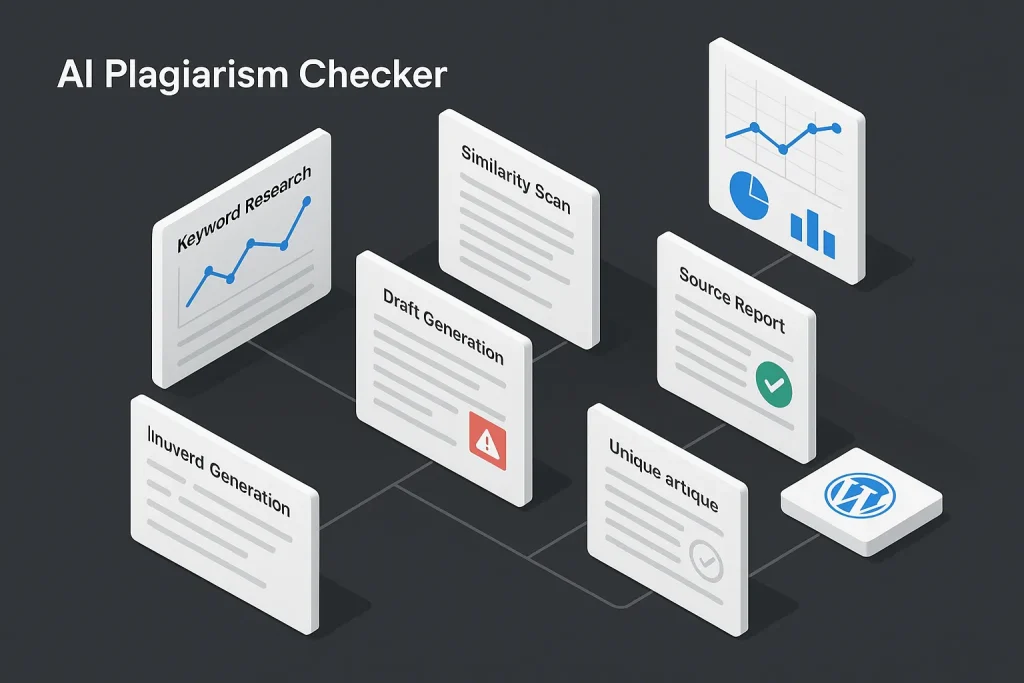
High-volume AI publishing has changed how SEO teams manage risk. The real issue is no longer whether a team can produce enough content, but whether every draft is original enough, useful enough, and distinct enough before it hits an indexable page. An ai plagiarism checker is now a basic control layer for serious content operations, because repetitive phrasing, cross-site overlap, template reuse, and thin derivative pages can quietly drag performance down long before anyone spots the pattern in Google Search Console or in client feedback.
The market often reduces this to a duplicate content penalty conversation. We think that framing is too shallow. Google has long said duplicate content is not usually grounds for action unless it is deceptive or manipulative, and in many cases its systems simply choose one version and filter the rest. But Google’s guidance on helpful, people-first content makes something else clear: original information, reporting, research, or analysis still matters. In practice, originality is not a cosmetic SEO preference. It is a quality requirement. For teams using AI at scale, the risk is operational. Too many drafts can look fine at first glance while still being structurally repetitive, source-light, or overly derivative once you review them properly.
That distinction matters because AI volume is already mainstream across business workflows. McKinsey’s 2025 global survey reported that 71% of respondents use generative AI regularly in at least one business function, and Pew found that 21% of U.S. workers said at least some of their work was done with AI in its September 2025 survey. When multiple writers, agencies, and tools generate content from similar briefs, duplication stops being an isolated editorial mistake. It becomes a system failure. We have seen this firsthand in content pipelines: the problem usually starts upstream, not in the final edit.
The practical conclusion is simple: a plagiarism checker ai workflow should review external overlap, internal duplication, and source-level evidence before content enters the CMS. Anything less turns SEO publishing into cleanup after the damage is done.

AI content surge and the hidden risk of duplication
AI-assisted drafting removes production bottlenecks, but it also compresses judgment. Briefs get reused. Competitor outlines get pasted into prompts. Content plans chase the same keyword clusters across multiple sites. Editors fall back on standard intros, standard logic, and standard definitions because that is the fastest way to keep output moving. The result may pass a quick reading test, yet still carry serious duplication risk in substance, sequence, phrasing, or informational value.
This is why an ai plagiarism problem is rarely just about blatant copy-paste. In B2B SEO operations, duplication usually shows up in softer, more dangerous forms:
- multiple pages targeting near-identical search intent with only minor wording changes,
- vendor-produced drafts that overlap with public web sources or previous client content,
- site-wide reuse of boilerplate sections that overwhelm the unique value of the page,
- AI-generated paragraphs that paraphrase common web language without adding original analysis,
- cross-domain duplication where one team republishes lightly revised assets across several owned properties.
Google’s public position helps here. According to Google’s duplicate content explanation, duplicate content is usually handled through canonical selection and filtering rather than automatic punishment. That does not make duplication harmless. It simply means the damage is often indirect: weaker ranking differentiation, filtered pages, diluted crawl attention, and lower perceived originality.
Google’s people-first content guidance raises the bar further by asking whether a page offers original information, reporting, research, or analysis. That standard matters even more in AI-heavy workflows, because generated content can be clean on the surface while adding very little that is distinct. A free ai plagiarism checker may reveal some overlap, but a team-grade system has to answer a harder question: does this page genuinely add value? On our view, that is the real editorial threshold.
The scale issue matters just as much. Content teams do not publish risk one article at a time. They publish it in batches. One weak brief can produce 20 mediocre variants. One template can spread repeated claims across an entire category cluster. One outsourced workflow can create hidden duplication across multiple clients. That is why a plagiarism checker artificial intelligence workflow belongs inside the production system, not on the sidelines as an optional editorial step.
As AI usage expands, duplication risk becomes a workflow issue rather than a writing issue.
Plagiarism in SEO vs. academia: what teams actually need to detect
Academic plagiarism frameworks focus on attribution, citation norms, and textual borrowing from published or submitted work. SEO teams work under a different set of pressures. They need to protect rankings, preserve brand trust, satisfy client approvals, and avoid publishing pages that are too close to external or internal assets. So the review model has to be broader.
In SEO, the real questions are practical:
- Does the draft overlap materially with external pages already indexed on the web?
- Does it duplicate or cannibalize content already published on our own site or related domains?
- Is the article mostly assembled from generic web-common language without enough original framing, examples, or synthesis?
- Can the team produce a report that explains the overlap and supports an editorial decision?
Turnitin makes a useful distinction here. Its documentation explains that a Similarity Report shows how much text matches material in its databases, but it does not itself determine whether a document is plagiarized. It also states that AI writing percentage is a separate measure, independent of similarity. That separation is critical for content operations because a plagiarism and ai checker is not one metric. It is a dual-control system with different signals and different decisions attached to each. We consider this one of the biggest gaps in how teams buy and use these tools.
For SEO teams, plagiarism review should include several overlap types:
| Overlap type | Why it matters in SEO | What teams should do |
|---|---|---|
| External web matches | Can signal derivative drafting and reduce perceived originality | Review matched passages and rewrite for unique value, not synonym swaps |
| Internal site duplication | Creates cannibalization, weak differentiation, and crawl inefficiency | Compare against published library and merge, redirect, or reposition pages |
| Cross-domain reuse | Owned network sites may compete with each other in search | Track content lineage and define reuse rules by domain purpose |
| Boilerplate-heavy templates | May drown out page-specific substance across large site sections | Separate reusable blocks from unique editorial body content |
SEO-oriented originality review is broader than academic similarity scoring because it has to protect performance, structure, and content distinctiveness across a living site.
A plagiarism checker for ai content therefore needs to do more than paint passages red. It should help reviewers decide whether the draft is safe to publish, needs revision, or should be rejected because the brief itself produced a derivative article. On our experience, that last case is more common than teams want to admit.

How duplicate content impacts rankings, E-E-A-T, and legal exposure
Duplicate or derivative content creates three separate classes of risk: search performance risk, quality-evaluation risk, and governance risk.
Search performance risk
When multiple versions of similar content exist, search engines often choose a preferred version and de-emphasize the rest. That means not every page in a cluster gets a fair shot at ranking. Teams often misread the result as a backlink problem or an indexing problem when the real issue is weak differentiation. We see this constantly in local SEO templates, SaaS comparison pages, and informational clusters built from lightly varied prompts.
Google’s spam policies matter too. The company explicitly warns that scaled content abuse includes generating many pages primarily to manipulate search rankings instead of helping users. In AI-heavy operations, that line is crossed not only by bad intent but by bad process. If the workflow rewards volume over substance, the site accumulates pages that are technically different in wording yet functionally repetitive in value.
That is why teams that care about rankings should read why AI writing detectors are flawed and what actually keeps Google happy alongside any detector comparison. Search systems do not reward content because a tool labels it human. They reward pages that earn their place.
E-E-A-T and usefulness risk
Originality supports the broader signals readers and reviewers associate with expertise, experience, authority, and trust. A draft filled with recycled definitions and generic paragraphs may not be plagiarized in the strict sense, yet it still fails the usefulness test because it adds little insight. For B2B audiences, this shows up fast. Decision-makers can spot generic content almost immediately when every section reads like a compressed summary of the public web.
An ai text plagiarism checker cannot create expertise, but it can stop low-value overlap from entering the publication queue. That matters because originality in SEO is usually about contribution, not novelty for novelty’s sake. A strong page can cite known facts, but it still needs to connect them to a distinct scenario, framework, workflow, or evaluation model. We think this is where many AI-first teams still underperform.
Legal and ownership risk
Legal exposure around AI content is unsettled enough to justify caution. The U.S. Copyright Office’s AI guidance shows that copyrightability, human authorship, and the use of copyrighted materials in AI-related contexts remain active governance questions. For content teams, that does not mean all AI content is legally unsafe. It means editorial traceability matters more: what sources informed the draft, how much human revision was added, and whether the final piece can be defended as original authored work.
The ownership issue gets very practical in enterprise publishing. If two agencies use similar prompts, similar source sets, and similar revision habits, the outputs can converge more than anyone expects. A gpt plagiarism checker or similar review layer helps surface that overlap before it turns into a client dispute or a publication hold.
Originality failures rarely stay confined to one KPI; they spread across rankings, review quality, and governance.
AI detectors are not plagiarism checkers: key differences and failure modes
One of the costliest mistakes content teams make is using an AI detector as if it were a plagiarism checker, or using a similarity score as if it measured usefulness. These tools do different jobs.
Turnitin’s guidance is explicit: AI writing percentage and similarity score are separate signals. A document can show low similarity and still appear heavily AI-assisted. It can also show notable similarity because of quotations, templates, or references while remaining legitimate. That is why a plagiarism checker ai review process needs interpretation rules, not raw thresholds alone. On our view, teams that chase a single score usually end up optimizing for the wrong thing.
What AI detectors do
AI detectors estimate whether text resembles machine-generated patterns. Their outputs are probabilistic. They do not prove plagiarism, ownership, or low quality. They also do not show where the text overlaps with published sources.
What plagiarism checkers do
Plagiarism checkers compare text against databases or indexed sources to identify matching passages. They help teams locate overlap and inspect evidence. They do not decide on their own whether the final piece is acceptable, deceptive, or valuable.
Common failure modes when teams confuse them
Failure mode one is rejecting good original content because an AI detector labeled it likely machine-written. Failure mode two is approving derivative content because a detector said it looked human. Failure mode three is treating a low similarity score as proof of uniqueness even when the article is little more than a generic paraphrase of public-web ideas. Failure mode four is focusing on tool outputs while ignoring internal duplication across your own site library. That last one is especially expensive, and we think it is still widely underestimated.
If your team is trying to navigate AI-origin concerns without losing ranking value, the adjacent discussion on how to pass AI text detectors without sacrificing SEO value is useful because it reframes the issue around real editorial quality rather than score-chasing.
The most reliable workflow is dual-layer review:
| Control layer | Question answered | What it cannot answer |
|---|---|---|
| AI detector | Does the text resemble common AI writing patterns? | Whether the text overlaps with sources or is plagiarized |
| Plagiarism checker | Where does the text match existing sources or archives? | Whether the writing is useful, expert, or sufficiently original in insight |
| Editorial review | Is the page worth publishing for users and search? | Cannot scale alone without automation support |
A team that collapses these layers into one score usually ships avoidable mistakes.

What a team-grade AI plagiarism checker must do (beyond ‘similarity %’)
Enterprise content workflows need more than a similarity meter. A useful ai and plagiarism checker should support editorial decisions, process automation, and defensible reporting.
1. Check external overlap with evidence
The tool should identify matching passages and reveal source-level context. Reviewers need to see whether the overlap comes from a generic phrase, a quoted sentence, a template section, or a materially copied paragraph. Raw percentages without source inspection are weak governance.
2. Check internal duplication
Many teams focus only on the public web and ignore their own archives. That is a major blind spot. Cross-posted service pages, overlapping blog clusters, and syndicated assets can create internal cannibalization long before anyone notices. A strong ai checker plagiarism workflow compares new drafts to the company’s own published content as well as external sources. We consider internal duplication the quieter threat, because it often looks harmless until rankings flatten.
3. Support automation at scale
Copyscape’s Premium positioning illustrates what scale requirements look like: API access, batch processing for up to 10,000 pages, WordPress integration, and private indexing for checks against a company’s own content. Those capabilities matter because originality QA becomes an operating system, not a one-off check.
Its pricing also shows why process efficiency matters. Copyscape publishes a rate of 3 cents per search for up to 200 words plus 1 cent for each additional 100 words or part thereof. At enterprise publishing volume, even straightforward originality checks become a recurring cost center. Originality.ai likewise positions plagiarism and AI detection as separate but combined workflow checks, with pricing tied to word volume. The implication is clear: if your workflow generates too many avoidable revisions, your QA bill rises with it. This is where a free ai plagiarism checker or plagiarism checker free ai option may help for spot checks, but serious teams usually outgrow lightweight setups quickly.
Even simple per-search pricing becomes significant when originality QA is attached to every draft, revision, and republish cycle.
4. Produce shareable reports
Reviewers, editors, legal teams, and clients may all need visibility. Turnitin highlights downloadable and shareable similarity reporting with overall similarity, top source types, and integrity flags. B2B content teams should expect the same principle: reviewable evidence that can be attached to approval workflows.
5. Fit the CMS publishing gate
The best tool is not the most sophisticated standalone scanner. It is the one that stops bad drafts before publication. A plagiarism checker using ai should sit between draft completion and CMS push, ideally as a required status gate rather than a manual courtesy step. If you rely on memory or goodwill here, the process will break under deadline pressure.

Workflow to prevent duplication before WordPress publishing
The most effective originality process starts before writing. If teams wait until a finished draft enters a free ai plagiarism checker or another scanner, they are solving the problem too late. Good systems reduce duplication risk at four stages: planning, generation, review, and publishing.
Stage 1: planning controls
Every article brief should define the exact search intent, the target angle, exclusions, and the source strategy. This prevents three common causes of duplication: overlapping cluster assignments, vague prompts, and competitor-summary writing. A content calendar without intent differentiation creates duplicate assets before a single sentence is written.
Stage 2: generation controls
Prompting should instruct the model to avoid generic web-summary language, repeat competitor structures, and reuse prior site phrasing unless explicitly requested. Generated content should be required to include original framing, proprietary examples, or clearly differentiated synthesis. If your team is still treating AI as a standalone writing tool instead of part of a system, the perspective in AI writing assistant or a content pipeline for SEO growth is relevant because workflow design shapes outcome quality.
Stage 3: originality review
This is the formal plagiarismchecker ai step. The draft is checked against public sources and internal content libraries. Reviewers inspect matched passages, remove unnecessary overlap, and verify that any quotations or reused template elements are justified.
Stage 4: pre-publish gate
No draft should be sent to WordPress until it passes originality rules. This gate should be binary: pass, revise, or reject. Soft warnings are easy to ignore under deadline pressure. A good team-grade workflow records the report, reviewer decision, and rationale. On our experience, binary gates save more time than they cost.
A simple operating sequence looks like this:
- brief approved with unique intent and differentiation notes,
- draft generated and editor-reviewed for usefulness,
- ai plagiarism checker free or paid check run as part of QA stack,
- matched passages triaged by source type and severity,
- revision completed with source-aware rewrites,
- final report archived,
- WordPress publication enabled only after pass status.
That sequence moves duplication prevention upstream, where it belongs.

Setting thresholds, sources, and reports: measuring originality at scale
Threshold design is where many teams become either too strict or too careless. There is no universal acceptable similarity percentage for SEO content because legitimate overlap depends on topic, citation density, templates, product names, and standardized language. Turnitin notes that 0% similarity is possible and is more common in shorter or creative pieces. That matters because teams should not assume every good article must show a small but nonzero match rate, and they should not assume a low number automatically means quality.
Instead of forcing one blanket rule, define thresholds by content type:
| Content type | Typical overlap tolerance | Review focus | Decision rule |
|---|---|---|---|
| Thought leadership | Very low | Distinct analysis and unique examples | Reject generic public-web paraphrase |
| Product documentation | Moderate | Template language and fixed terminology | Review long matched blocks, ignore standard labels |
| Service pages | Low to moderate | Cross-page differentiation and local details | Merge or reposition near-duplicates |
| News summaries | Context dependent | Proper quotes, citations, and added interpretation | Require original commentary around sourced facts |
Thresholds only become useful when they are tied to source categories, content types, and explicit reviewer actions.
Report design should also separate these dimensions:
A strong report is not just scanner output. It is an audit artifact. And if you are using a plagiarism checker ai free setup, this is often the first limitation you run into: weak reporting and weak traceability.
Handling citations, quotes, syndication, and internal duplication safely
Not all matching text is bad. Some overlap is expected and legitimate. The role of a turnitin ai checker or any similar tool in a professional SEO workflow is to make that overlap visible and reviewable.
Quotes and citations
Quoted language should remain minimal, clearly attributed, and surrounded by original analysis. If the article cites policy language, legal wording, or exact product descriptions, reviewers should accept those matches as intentional rather than forcing unnatural rewrites. The key is proportion and context.
Templates and recurring blocks
Navigation labels, disclaimers, product names, and standard process descriptions will naturally recur. Teams should isolate these reusable blocks from the editorial body when assessing originality. Otherwise, similarity scores become noisy and misleading.
Syndication and republishing
If content is intentionally republished across domains, establish rules in advance. Decide which domain is primary, whether canonical tags are used, and whether the republished version includes meaningful adaptation. Do not let syndication drift into quiet duplication through habit.
Internal duplication
This is the most underestimated issue in content operations. A company may publish ten pages on adjacent subtopics, each with different target keywords, but if the middle 70% of the article repeats standard definitions and advice, the pages still compete conceptually. An anti plagiarism ai process should include internal comparisons by cluster, not only exact text matches. A true ai and plagiarism checker setup has to account for this, otherwise teams only catch the obvious cases.
When overlap is found, the response should match the cause. Some pages need rewrites. Some should be consolidated. Some require intent repositioning. And some need stronger differentiation in examples, use cases, or audience framing. If the original draft leans too heavily on generic AI output, the editorial discipline described in how to rewrite AI content to improve user engagement and rankings becomes part of originality control, not just style improvement. We think this is a healthier approach than relying on any so-called ai plagiarism remover after the fact.

How Autopilot SEO guarantees 100% unique drafts with integrated checks
For teams that publish at scale, the highest-friction failure point is not writing the draft. It is catching duplication before the draft reaches approval loops, client review, or WordPress publication. That is where SEO Autopilot is operationally different. The platform is built for end-to-end SEO article production, and its originality control is integrated into the content workflow rather than treated as an external add-on.
In practical terms, SEO Autopilot generates SEO articles with semantic structure, content planning, and publishing flow aligned in one system. It also guarantees 100% unique drafts with integrated checks before content reaches WordPress. That matters because the cost of a duplicated draft rises sharply once it has entered approval chains, internal linking logic, CMS staging, and indexable publication.
Teams evaluating workflow solutions should review the official SEO Autopilot site with one question in mind: does the platform prevent originality failures upstream, or does it simply help detect them after the draft already exists? In a high-volume SEO operation, the first model is materially safer. On our view, prevention beats remediation every time.
The commercial advantage is process compression without lowering control standards. Instead of stitching together ideation tools, external scanners, editors, and WordPress handoff, the platform helps centralize generation, optimization, uniqueness validation, and publishing readiness in one content pipeline.
Implementation checklist: rolling out originality QA across your content pipeline
Adopting a plagiarism checker ai free tool for ad hoc review is easy. Rolling out a durable originality program across a content team takes governance. The sequence below is the practical version.
- Define originality policy. Separate AI-origin review, plagiarism review, and editorial usefulness standards. Each should have a distinct owner.
- Map content types. Establish different review rules for blog posts, landing pages, product content, and republished assets.
- Connect internal libraries. Your checker must compare against your own published estate, not just the public web.
- Create pass/revise/reject statuses. Avoid ambiguous warnings that writers can ignore.
- Archive reports. Store similarity evidence, reviewer notes, and final decisions.
- Add a WordPress gate. Publishing should require originality clearance.
- Train editors on exceptions. Quotes, citations, and boilerplate need consistent treatment.
- Audit by cluster. Review not only page-level overlap but repeated patterns across topic groups.
This checklist matters because originality problems are usually process leaks, not isolated writing failures. If a plagiarism checker free ai tool is the only control you have, the system is still fragile.
KPIs and governance: auditing results and continuous improvement
Originality QA should be measured as an operational discipline. The goal is not merely to lower similarity scores. The goal is to reduce downstream rework, improve page distinctiveness, and keep duplicate or derivative content from reaching production.
Useful KPIs include:
- draft pass rate on first originality review,
- average number of flagged passages per article,
- share of drafts rejected due to internal duplication,
- time added by originality review per article,
- republish or consolidation rate within topic clusters,
- percentage of pages with archived originality reports.
These indicators should be reviewed by content type and by source. If one writer, one prompt template, or one external vendor consistently triggers overlap, the solution is not stricter editing alone. It is changing the input conditions.
Continuous improvement usually comes from four interventions: better brief differentiation, stronger source policies, tighter prompt design, and earlier automated checks. That is also where a mature ai plagiarism remover mindset can become counterproductive if it focuses only on rewriting matched sentences. Sentence-level cleanup does not fix a derivative strategy. The real objective is to publish content that is structurally distinct and genuinely useful. We have also noticed that teams searching for a plagiarism ai checker often want a shortcut, but the better answer is usually a stronger workflow.
Content teams that treat originality as a governance layer tend to make better decisions across the entire pipeline. They brief more precisely, generate more responsibly, and publish with stronger control over risk. That is the difference between content velocity and content discipline.
We think the core lesson is straightforward: originality control works best when it starts before drafting and ends only at the publishing gate. The teams that get this right do not rely on one score or one tool. They combine editorial judgment, internal comparison, and a reliable ai plagiarism checker workflow. That approach is simply more resilient.
Our прогноз is fairly practical. As AI-assisted publishing expands, more businesses will move from occasional checks to formal originality QA across the whole pipeline. We also expect the gap to widen between teams using a basic scanner and teams using a real plagiarism checker for ai content with internal libraries, reporting, and CMS gating. In SEO, that gap will show up in fewer content collisions, cleaner site architecture, and better long-term trust signals.
FAQ
What’s the difference between an AI detector and a plagiarism checker?
An AI detector estimates whether text resembles machine-generated writing patterns. An ai plagiarism checker compares the draft against existing sources to identify matching text and overlap. They solve different problems and should not be used as substitutes.
How much similarity is acceptable for SEO content without risking rankings?
There is no universal acceptable percentage. What matters is the type of overlap, the role of citations or templates, and whether the page adds original analysis, examples, or value beyond matched text. For SEO, reviewers should inspect source-level matches instead of relying on one threshold.
Does Google penalize AI content if it’s original and well-cited?
Google focuses on content quality, usefulness, and whether pages help users. Original AI-assisted content is not automatically a problem, but scaled low-value content created mainly to manipulate rankings is a risk under Google’s spam policies. The key is originality, relevance, and editorial quality.
How should plagiarism checkers treat quotes, citations, and templates?
They should flag them for review, not automatically fail the draft. Legitimate quotations, citations, and standard boilerplate need contextual handling, while long uncredited copied passages or excessive template dependence should trigger revision or rejection.
Can cross-domain or cross-site duplication hurt my content strategy?
Yes. Even when you control both domains, similar pages can compete for the same intent and dilute differentiation. Cross-site duplication should be governed with clear reuse rules, canonicals where appropriate, and distinct positioning for each published asset.