
The term google image generator no longer points to one simple tool. In 2026, it means a layered product stack: consumer chat interfaces, Labs experiments, enterprise apps, and the image models underneath them. For publishers, marketers, and SEO teams, that distinction is not academic. It affects image quality, output size, pricing, usage limits, and whether the tool actually fits a commercial workflow.
That is why blog-graphic production is no longer about hunting for one magic button. It is about choosing the right route: Gemini for fast generation in a familiar interface, ImageFX for experimentation, or Imagen-powered business environments for more structured production. On our reading, that is the real story behind Google’s visual push. The question is not whether Google can generate images. It is whether the current stack is reliable enough for featured images, blog headers, branded illustrations, infographics, and repeatable WordPress publishing.
For content operations, this is a meaningful shift. Earlier tools were often great at visual variation and weak at typography, aspect-ratio control, and export quality. Google is now pushing stronger text rendering, higher output resolution, local edits, and cleaner business use cases. That makes the current google image generator ecosystem relevant not just for testing, but for production-oriented blog graphics.
What the “Google Image Generator” Actually Refers To in 2026
Search demand around google ai image generator, google image creator, and google image generator from text is driven as much by naming confusion as by product interest. Google has several image-generation entry points, and users constantly mix up the interface, the model, and the subscription plan. From an editorial and operational standpoint, those are different layers.
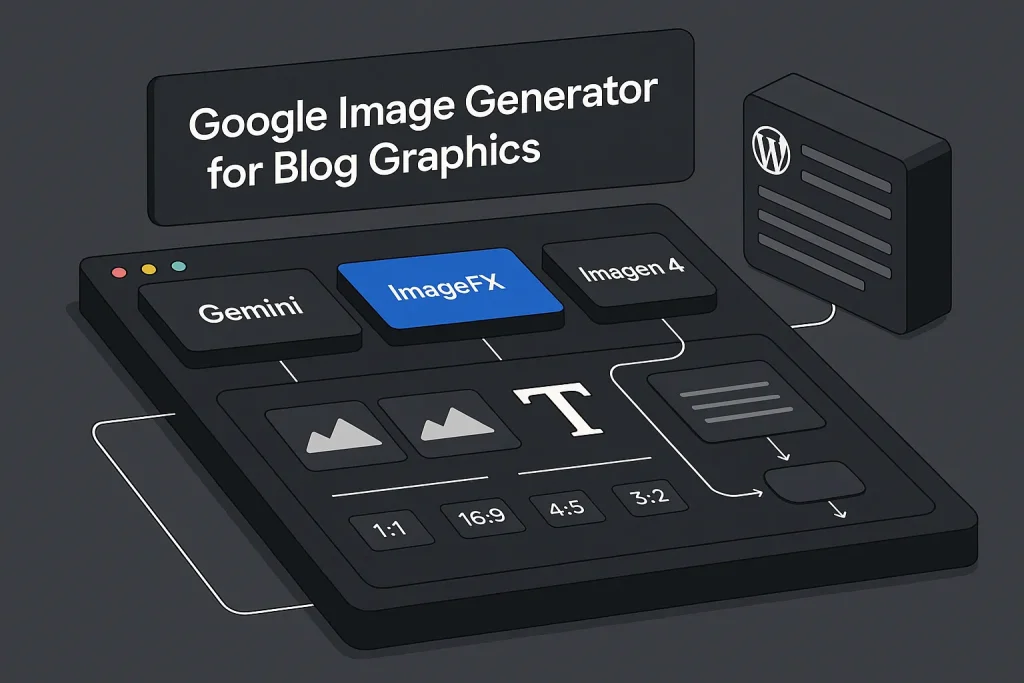
At a high level, three references dominate. First, there is image generation inside Gemini, where many users first encounter a google ai image workflow in conversational form. Second, there is ImageFX, an official Google Labs product built more like a dedicated image environment. Third, there is the Imagen model family, which powers multiple Google products and enterprise surfaces instead of acting only as a standalone destination.
For publishers, that means the phrase google images generator may refer to a front-end tool, a model, or a capability embedded elsewhere. This matters when teams compare screenshots, pricing pages, prompt outcomes, or tutorials. One user may be testing Gemini free downloads at 1K resolution, while another is working inside a paid plan or Workspace environment with different controls and higher-resolution output. Those are not the same scenario.
Google also keeps separating product positioning by audience. Labs products are framed as experiments. Gemini is the mainstream consumer-facing entry point. Workspace and Vertex AI sit on the operational, business-facing layer. In other words, the same broad google image generation story shows up across very different levels of product maturity.

For content teams, the better approach is to define the use case first:
- Fast blog cover drafts: Gemini is often the most direct route.
- Experimental prompting and visual exploration: ImageFX is more appropriate.
- Business workflow integration: Imagen-powered Workspace or Vertex AI surfaces are more relevant.
- Automation inside a publishing pipeline: external workflow tools may still be needed to make the process operational end to end.
This naming ambiguity is one reason many reviews of google’s ai image generator sound contradictory. In many cases, they are reviewing different products under one keyword. We have seen this repeatedly in SEO content too: authors compare outputs without ever clarifying which Google surface they used. That makes the conclusion weaker than it looks.
Product Landscape: Gemini image generation, ImageFX, and Imagen 4
The product landscape became clearer after Google positioned Imagen 4 as its newest flagship image model in May 2025. According to the Google announcement for Imagen 4, the model arrived with stronger detail rendering, improved typography, support for multiple aspect ratios, and output up to 2K resolution. For blog graphics, those are not cosmetic upgrades. They directly affect cover readability, text overlays, and the practical ability to ship presentation-ready assets.
At the consumer layer, Google’s Gemini help documentation states that image generation in Gemini currently uses Nano Banana 2, while paid subscribers can use Nano Banana Pro for additional detail, particularly useful in text-heavy and infographic-style outputs, as described in Gemini Help. This matters because many users searching for a gemini ai image generator free experience are not actually testing the same mode as paid users.
ImageFX, by contrast, remains Google’s dedicated Labs image product. Google’s own ImageFX page confirms that it is a standalone official tool within Google Labs. From a workflow perspective, that tells us two things. First, ImageFX is real and actively maintained. Second, it still belongs to an experimental portfolio rather than the most stable mass-market application layer.
The result is a three-part structure:
| Layer | What it is | Best use for blog graphics | Main limitation |
|---|---|---|---|
| Gemini | Chat-based image generation inside a consumer app | Quick cover drafts, simple edits, ideation | Plan-dependent output quality and throughput |
| ImageFX | Dedicated Google Labs image-generation experiment | Prompt exploration and style testing | Experimental positioning, less operational certainty |
| Imagen family | Underlying model layer available across multiple Google products | Business workflows, higher-quality production, structured usage | Access depends on product, plan, and environment |
The practical takeaway is simple: if users compare a new google ai image generator result against Midjourney or DALL·E, they need to specify the Google surface first. Otherwise the comparison is too fuzzy to be useful.
Google also highlighted that Imagen 4 would be available across Gemini, Whisk, Vertex AI, and Workspace. That cross-product availability matters because it narrows the gap between consumer experimentation and business deployment. The same engine can influence consumer prompts, office-product graphics, and structured enterprise workflows without forcing a complete tool change.
The timeline shows why older reviews age badly. Google’s image stack has changed across tools, models, and pricing in a fairly short window. On our view, that is one of the biggest reasons published comparisons go stale so fast.
Access, Availability, and Pricing: Labs, Workspace, and regional limits
One of the least understood parts of the google ai photo generator ecosystem is access. Availability is not universal, and pricing is not fixed. Users often assume that if Google announced a feature, it is equally available to every account type in every region. It is not.
Gemini image generation requires sign-in. Google also states that image generation requires personal account users to be at least 13 years old, while image editing requires users to be 18 or older. Availability depends on supported countries and languages, so feature access varies even when the product exists in the interface. For global publishing teams, that means distributed staff may not all have identical access to the same workflow.
Google further distinguishes free and paid output. According to Gemini Help, free users can download generated images at 1K resolution, while users with a Google AI plan can download at 2K resolution. For a casual social visual, 1K may be enough. For WordPress featured images, blog headers, and assets that may be cropped across templates, 2K is materially better. We would not overcomplicate this point: resolution still matters in real publishing.
Pricing has already shifted over time. Google introduced AI Ultra in the U.S. at $249.99 per month in May 2025, then later announced a new $100 per month AI Ultra tier in 2026, as outlined on Google’s AI subscriptions update. That tells marketers something important: packaging is still evolving, so cost modeling should not assume long-term stability.
Google also replaced simple daily prompt caps with compute-based usage limits that refresh every five hours until a weekly limit is reached. In practice, throughput now depends less on a visible “prompts per day” number and more on prompt complexity, feature type, and plan behavior. For teams producing high volumes of blog covers or variants, that creates planning uncertainty. We have seen this become a hidden bottleneck in content ops more than once.
Enterprise usage adds another layer. Google Workspace’s AI Expanded Access add-on includes advanced image generation with Nano Banana Pro in products such as Slides, NotebookLM, and Gemini. The same Workspace documentation notes that each licensed user receives 2,000 Google Flow credits per month through July 7, 2026, according to Workspace AI access details. That is useful context for teams comparing the economics of image and video generation inside office-product workflows.
ImageFX availability also expanded geographically. Google reported in late 2024 that ImageFX was rolling out to more than 100 countries with the latest Imagen 3 at the time, as described in the Google Labs update. That makes it clear that country rollout is part of the product strategy, not a trivial footnote.
For content teams evaluating access, the most realistic framework is this:
These figures do not tell the whole throughput story, but they define the operational baseline. That is usually enough to separate a hobby workflow from a production one.
Image Quality for Blog Graphics: photo-realism, illustration, typography, branding
For blog graphics, image quality is not just about artistic realism. It is about whether the tool can create a visual that survives CMS cropping, communicates the article topic quickly, fits brand tone, and does not fall apart when text elements are introduced. This is where the current google imagen ai generator story becomes more relevant than older AI art comparisons.
Google has explicitly emphasized stronger typography and more accurate diagram or infographic creation. That is a significant point for publishers. Many generators can produce a dramatic scene. Far fewer can reliably create clean title-space compositions, presentation-style layouts, or simple explanatory diagrams that are close enough to final production to save editing time.
For blog operations, quality should be judged across five practical dimensions:
Composition: Does the model leave usable negative space for headline overlays or featured-image cropping?
Typography behavior: If prompt-based text is attempted, is the output legible enough to be useful, even if not final?
Style consistency: Can a site keep a recognizable visual system across multiple posts?
Brand neutrality: Does the output work for B2B editorial design rather than looking like fantasy art or stock-photo parody?
Editability: Can the team refine local details without restarting from zero?
Google’s recent positioning suggests improvement in all five areas, especially around typography and structured graphics. That does not mean every generated image is publish-ready. It means the average distance between first draft and usable asset is probably shorter than with more art-first models. On our experience, that is the metric that actually matters to content teams.
In practice, Google performs best for blog use when prompts aim for one of three visual modes:
- Editorial illustration: abstract enough to avoid uncanny details, concrete enough to support the topic.
- UI-inspired mockup scenes: useful for SaaS, SEO, analytics, and automation themes.
- Clean concept visuals: objects, dashboards, diagrams, documents, and workflows rather than human drama.
It is less reliable when users expect perfect branding lock-in from prompt alone. If your design system uses exact colors, highly specific icon libraries, or strict illustration geometry, manual post-editing or template-based generation is still the safer route.
| Quality factor | Why it matters for blogs | What Google currently highlights |
|---|---|---|
| Typography | Blog covers often require text-friendly layouts or close-to-usable wording | Improved text rendering and better support for presentation-ready outputs |
| Aspect ratios | WordPress themes crop images differently across archive, hero, and social previews | Multiple aspect-ratio support with Imagen 4 |
| Local edits | Saves time when only one area needs correction | Google documentation highlights local editing capabilities |
| Resolution | Improves reuse across blog, email, and social surfaces | 1K for free Gemini downloads, 2K for paid plans |
For most B2B content teams, the strongest Google use case is not cinematic art. It is dependable article-support imagery with decent typographic behavior and less cleanup. That may sound less glamorous, but for publishing teams it is the more valuable outcome.

Teams that want stronger prompt control can also benefit from structured prompt libraries. A related approach is covered in AI image generator from text tips, especially when consistency across many articles matters more than artistic variety.
Prompting for Blog Covers: styles, aspect ratios, negative prompts, safety hints
A good google text to image generator workflow starts with prompt discipline, not model switching. Most weak blog-cover outputs come from vague requests, mixed visual goals, or prompts that ask for too much narrative detail and too little layout structure.
For blog covers, prompts should define four layers clearly: subject, visual style, composition, and intended use. That reduces randomness and increases the chance of a reusable output.
A practical prompt structure looks like this:
Topic object: “SEO dashboard”, “AI content workflow”, “WordPress publishing pipeline”, “search analytics illustration”.
Visual mode: “minimalist editorial illustration”, “clean isometric SaaS scene”, “flat vector business graphic”, “presentation-ready concept art”.
Layout instruction: “leave empty space on the top-left for a title”, “wide composition for blog header”, “centered focal element with uncluttered background”.
Style constraint: “neutral colors with blue accents”, “no photorealistic people”, “no excessive text”, “clean corporate design”.
That structure works particularly well for a google image generator ai free testing workflow in Gemini because it reduces wasted generations. It also transfers well across ImageFX and competing systems. If you are evaluating a google image ai text to image workflow seriously, prompt structure usually matters more than tool loyalty.
Aspect ratio is another major variable. For WordPress, common use cases include 16:9 for featured images, wider banners for hero sections, and square or near-square crops for social sharing. Since Google now emphasizes multiple aspect-ratio support, teams should bake ratio intent into prompts rather than trying to fix everything in post-processing.
Negative prompting remains useful, though not every interface exposes it the same way. Instead of only saying what you want, state what must be excluded:
“No watermark, no cluttered text, no extra hands, no photo-realistic office workers, no logos, no busy background, no low-contrast title area.”
Safety hints also matter. Google states that outputs may be removed when prompts appear to violate its terms or prohibited-use rules. For production work, the practical implication is simple: avoid ambiguous or risky prompt framing when a neutral editorial description will do the job. It lowers friction. On our side, we would treat that as basic process hygiene.
The chart reflects a workflow truth rather than a published benchmark: better prompt structure usually increases the odds of getting a cover-ready image in fewer iterations.
If your team compares Google against Microsoft’s stack, it helps to read the separate guide to Bing Image Creator for blog covers and test the same prompt framework across both systems. That creates a fairer comparison than changing tools and prompts at the same time.
Rights, Safety, and Compliance: SynthID watermarks, licensing, and commercial use
Commercial use is where many reviews get too casual. Image quality is not enough. A production workflow for blogs needs a clear stance on provenance, account eligibility, content restrictions, and human review.
Google’s current image ecosystem includes a growing transparency layer. Google announced SynthID Detector on May 20, 2025, and stated that it can scan uploaded image, audio, video, or text content created with Google AI tools for embedded SynthID watermarks, according to the SynthID Detector announcement. Google later expanded this verification theme in 2026 across image, video, and audio in Gemini. The strategic point is clear: provenance is now part of the stack, not just a research concept.
For publishers, that helps in three ways. First, it gives teams a more concrete way to think about internal governance around AI-made assets. Second, it reduces ambiguity when organizations want to track generated media sources. Third, it signals that Google expects generated-content provenance to matter in professional environments.
That said, provenance is not a substitute for editorial judgment. Google also warns users not to rely on generated outputs without judgment. This matters most for diagrams, pseudo-screenshots, maps, charts, and any image that could imply factual precision. A generated visual can be directionally useful and still be unsuitable as a factual representation. We think this is one of the easiest mistakes for teams to underestimate.
Commercial blog use therefore needs a minimum compliance checklist:
Review the current product terms: access and permitted use may vary by product surface and subscription.
Check for accidental brand conflicts: remove unintended logos, UI similarities, or misleading labels.
Validate text inside the image: AI typography can improve, but still fail in subtle ways.
Keep a provenance note: useful for enterprise documentation and editorial policy.
Avoid regulated or deceptive use cases: especially visuals that look like evidence, certificates, or official documents.

The practical answer for marketers is cautious but usable. Google-generated images can be appropriate for commercial blogs, but they should be treated as created assets that require policy review, not as automatic stock-photo replacements.
Exporting for WordPress: header sizes, compression, alt text, and file naming
Even strong image generation fails as a publishing workflow if export handling is weak. For WordPress, the asset needs to match theme behavior, performance constraints, and SEO conventions. This is where many teams quietly lose the time they thought AI would save.
For most WordPress sites, blog-cover export should be standardized around a few approved sizes rather than generated ad hoc every time. Common patterns include 1200×630 for social compatibility, 1600×900 or 1920×1080 for wide featured images, and occasionally 2048px-based variants when a theme aggressively crops hero media. If your plan allows 2K output, that gives more flexibility for resizing without immediate quality loss.
Compression matters because AI images often carry visual detail that is not especially useful on the final page. A clean editorial illustration can usually be compressed more aggressively than a detailed textured scene without obvious degradation. For blog headers, the right target is not maximum fidelity. It is acceptable sharpness at practical page weight.
Alt text should describe the visible content and support topical relevance naturally. It should not become a keyword dumping field. If the image is a conceptual illustration for an article on a google generate image from text workflow, good alt text should explain that scene directly. The same principle applies to file naming. Use human-readable names that reflect the topic and article context.
A structured export standard can look like this:
| Element | Recommended practice | Why it helps |
|---|---|---|
| Header size | Use a predefined wide ratio such as 16:9 for consistency | Reduces crop surprises across templates |
| Compression | Optimize before upload based on visual complexity | Improves page speed without needless quality loss |
| Alt text | Describe the image honestly and include topic relevance naturally | Supports accessibility and image-context clarity |
| File naming | Use concise, descriptive, hyphenated names | Keeps the media library organized and readable |
When this process is standardized, google image generation stops being a novelty step and becomes part of a stable publishing pipeline. That is the point where the tool starts creating leverage instead of extra cleanup.

SEO teams trying to remove manual friction from the broader article workflow should think beyond just images. The larger case for integrating generation, optimization, and publishing is outlined in the article on the full SEO autopilot case.
Benchmark Comparison: Google vs Bing Image Creator vs Midjourney vs DALL·E
A useful benchmark for blog graphics should ignore hype and focus on editorial production criteria. The main variables are layout discipline, typography behavior, speed to first usable draft, consistency, and ease of integration into a content workflow.
Google’s current advantage is its explicit emphasis on stronger typography, presentation-ready resolutions, and broad integration across consumer and business surfaces. That is directly relevant to blog covers, infographics, and explanatory graphics. Bing Image Creator remains attractive for accessible experimentation and broad user familiarity. Midjourney still has strong stylistic power and visual polish, especially for artistic compositions, but it often requires more design management to fit clean B2B editorial systems. DALL·E remains strong for general-purpose concept generation and integrated chat workflows, though results vary by use case and platform context.
For blog operations, the decision often comes down to this:
Choose Google when typography, clean editorial output, and growing workspace integration matter.
Choose Bing when ease of casual generation and Microsoft ecosystem familiarity are priorities.
Choose Midjourney when distinctive visual style matters more than fast CMS-ready business graphics.
Choose DALL·E when general ideation and conversational image creation are the core use case.
This is an editorial comparison framework, not a universal scoring system. Actual results depend on prompts, plan levels, and post-processing discipline. Still, on our view, Google is now more competitive for business blog graphics than many marketers assume.
Workflow Automation: One-click blog covers inside SEO Autopilot
The real operational gap is not image generation itself. It is the distance between prompt, approved cover, article metadata, and final WordPress publication. That is where many teams still waste time on copy-paste work, manual downloading, renaming files, adding alt text, and matching visuals to article structure.
SEO Autopilot addresses that workflow problem by integrating standard image models into a broader content production pipeline. Instead of treating visuals as an isolated creative task, the platform connects topic generation, semantic planning, article creation, image generation, and publishing flow into one system. For teams producing content at scale, this matters more than testing image models one by one in separate tabs.
In practice, the value is straightforward. A content team can move from a target keyword and article outline to a generated blog cover without leaving the production flow. That reduces friction in three places: prompt handoff, asset organization, and CMS publishing. It also makes visual generation more consistent because image instructions can be tied to article type, brand style, and publishing templates.
That is especially relevant when comparing Google’s tools as image engines versus full publishing operations. Gemini, ImageFX, and Imagen can help create the asset. They do not, by themselves, solve the operational layer around metadata, asset naming, article matching, internal linking, and scheduled WordPress posting. This is where an ai image generator google test often looks impressive in isolation but less impressive inside a real content pipeline.
For agencies, bloggers, and in-house teams that need repeatability, the more practical model is to use image generation as one module inside a controlled pipeline. A fast way to evaluate that approach is to review the official SEO Autopilot website and check how one-click cover creation fits into the broader article automation stack. The business case is not that AI replaces review. It is that repetitive production steps stop consuming senior team time.
Setup Checklist: From prompt templates to WordPress publishing
Teams that want stable output should document a repeatable setup rather than rely on ad hoc prompting. The strongest workflows use templates by article type. A how-to post, SaaS comparison, technical explainer, and category landing article do not need the same kind of cover image.
A practical setup sequence looks like this:
- Define visual categories. Separate editorial illustrations, product-style mockups, diagram-like headers, and brand-neutral concept art.
- Create prompt templates. Include subject pattern, composition rule, color rule, and exclusion list.
- Set aspect-ratio defaults. Match the WordPress theme and social-sharing requirements.
- Define metadata rules. Standardize alt text, title, caption, and file naming patterns.
- Assign review thresholds. Decide what can publish immediately and what needs design approval.
- Automate upload and mapping. Connect the selected image to the correct article draft and publishing slot.
- Track failures. Note prompt types that repeatedly produce weak typography, awkward compositions, or policy friction.
This kind of checklist turns a google generate image from text habit into a managed content operation. It also makes cross-tool testing easier. If the same template is applied across Google, Bing, or another model, comparisons become operationally meaningful. We have found that teams usually improve faster from better templates than from endlessly switching tools.
Limits and Trade-offs: content restrictions, biases, and when to choose another model
No review of google image artificial intelligence tools is complete without the trade-offs. Google’s strengths in typography, presentation-oriented output, and ecosystem reach do not remove the usual limitations of generative imagery.
First, policy restrictions are real. A prompt that looks harmless from a creative standpoint may still run into product constraints depending on how it is framed. Second, generated visuals can still show bias, stereotyping, or visual shortcuts. Third, factual-looking graphics remain risky. If the image resembles a chart, UI screenshot, scientific diagram, or official document, human validation is mandatory.
There are also model-fit issues. If the goal is highly stylized art direction, another model may produce a more distinctive result. If the goal is pixel-precise brand consistency, a design template system may outperform prompt-based generation entirely. If a team needs exact throughput predictability, compute-based usage controls may be less convenient than simpler quota systems.
Another limitation is that Google has not published one universal quota table covering every image feature and tier. That means operational planning has to account for ambiguity. A team cannot assume that one documented limit applies identically across Gemini, Workspace, and all account types. The same caution applies when someone searches for a google ai picture generator and expects one simple answer. The stack is broader than that.
In short, Google’s image stack is increasingly production-relevant, but it is not a frictionless universal replacement for design systems, stock libraries, or specialist models. Our position is fairly simple: use it where it creates leverage, not where it introduces avoidable risk.
Key Takeaways and Next Steps
The phrase google image generator now describes an ecosystem, not a single product. Gemini is the most accessible consumer entry point. ImageFX is a dedicated Labs surface for experimentation. Imagen 4 is the flagship model layer that gives Google a stronger position in typography, aspect-ratio support, and presentation-ready outputs.
For blog graphics, Google is now more competitive where it matters operationally: cleaner layouts, improved text behavior, local edits, and stronger resolution options for publishing workflows. The main caveats remain access variability, evolving pricing, compute-based limits, and the need for editorial review.
The most effective use of Google’s tools is not isolated prompting. It is integration into a repeatable content system with prompt templates, WordPress export standards, metadata rules, and automation around publishing. That is exactly where content teams can turn a google ai image generator test into real production efficiency rather than occasional novelty.
If your workflow depends on producing many SEO articles and matching each one with a usable visual, Google’s tools are worth testing. If your workflow depends on publishing those assets at scale with minimal manual handling, the stronger move is to combine image generation with a system built for SEO content operations end to end.
We think the practical takeaway is clear: Google is no longer just catching up in AI visuals. It is building a usable, if still uneven, production stack for publishers. The strongest results will come from teams that treat the google image generator as part of a workflow, not as a standalone novelty. The biggest near-term risk is not weak output quality, but messy operations around access, quotas, review, and publishing standards.
Our прогноз is fairly restrained. Google will likely keep tightening the link between consumer prompting, Workspace production, and enterprise deployment. That should make google text to image generator workflows easier to operationalize for content teams, but it will not remove the need for human review, brand control, and sensible automation choices.
FAQ
Is Google’s AI image generator free to use?
Partly. Google offers image generation in Gemini, and free users can download generated images at 1K resolution according to Google’s help documentation. Paid plans unlock higher-resolution downloads and, in some cases, more advanced image capabilities. So yes, there is a free entry point, but it is not the full production version many teams expect from a google image generator ai free search.
Which Google tool should I use for blog covers: Gemini, ImageFX, or Imagen?
Use Gemini for fast day-to-day cover creation, ImageFX for prompt experimentation, and Imagen-powered business surfaces when workflow structure matters more than casual generation. On our view, Gemini is the easiest starting point, while google imagen text to image use cases make more sense when you care about the model layer and production quality.
Can I use Google AI–generated images commercially on my blog?
In many cases, yes, but only with policy review and editorial judgment. You should verify current terms for the specific Google product you use, review outputs for misleading details or brand conflicts, and treat AI-generated graphics as publishable assets that still require human approval. That applies whether you call it a google ai image generator or a google image creator.
What image size and aspect ratio work best for WordPress blog headers?
A consistent wide ratio such as 16:9 is usually the safest baseline for WordPress featured images. In practice, many teams work with 1200×630 for sharing compatibility or larger wide formats such as 1600×900 or 1920×1080 for cleaner theme rendering. If you use a google image generator from text workflow, define the ratio in the prompt early rather than fixing it later.
How does SEO Autopilot integrate with Google’s image tools for one-click covers?
SEO Autopilot integrates standard image models into a larger SEO content workflow, so blog-cover generation can happen alongside article creation, metadata handling, and WordPress publishing. The advantage is not only image creation itself, but reducing manual steps between generated asset and published post. That is the difference between testing a google ai picture generator and running a scalable publishing system.