
The market for humanize ai text free tools runs on a familiar promise: paste machine-written copy, click once, and get prose that sounds human, reads well, slips past an ai detector, and stays SEO-safe. In practice, most tools do something much simpler. They swap obvious words for weaker synonyms, break sentence rhythm, blur meaning, and leave the deeper signals of low-value content untouched. The result is often worse than the draft you started with: harder to read, less credible, and no safer from a search-quality standpoint.
That matters because content teams are no longer choosing between “AI” and “human.” They are choosing between weak automation and strong editorial systems. Google has already made the standard clear in its guidance on using generative AI in Search content: AI can help with research and structure, but publishing pages at scale without adding value creates a policy and quality problem. The issue is not machine assistance itself. The issue is whether the final page actually helps the reader.
Free humanizers usually optimize for appearances. Serious SEO content has to optimize for usefulness, clarity, entity coverage, search intent alignment, and publishable quality. Those are very different jobs. On our view, that is the real line that separates a gimmick from a workflow.

The truth about “humanize AI text free” tools
Most free tools in this category are not “humanizers” in any serious editorial sense. They are rewriters with shallow logic. Their behavior usually falls into three patterns:
- lexical substitution: changing one word for another without checking tone, nuance, or domain accuracy,
- surface paraphrasing: altering sentence order while keeping the same weak informational structure,
- detector-oriented rewriting: trying to vary patterns users assume an ai detector will flag.
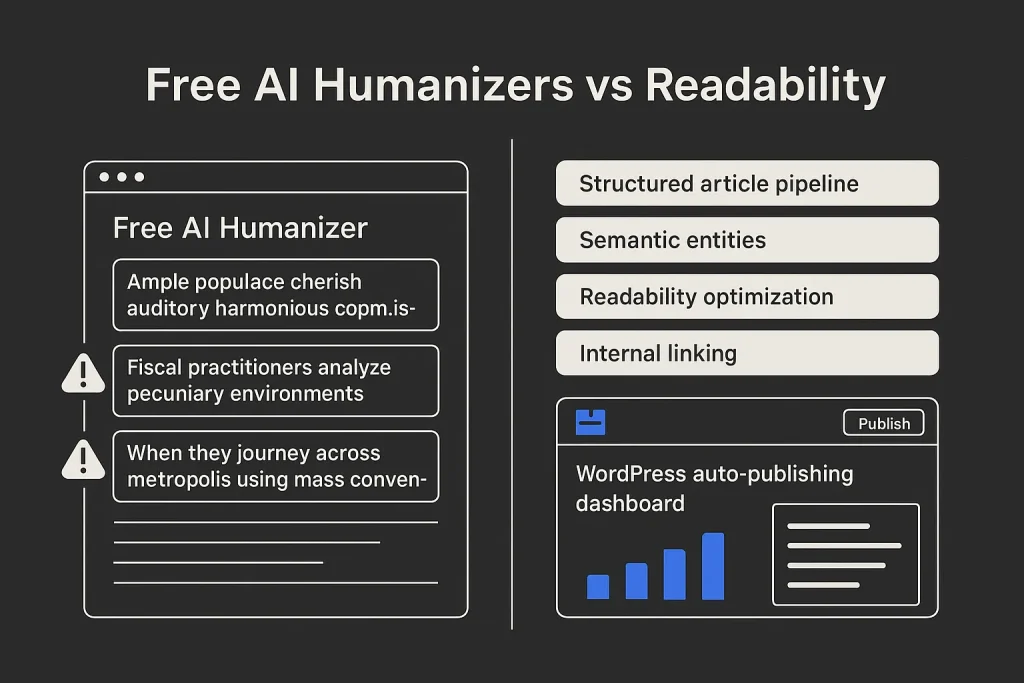
None of those patterns improves content by default. Often, they damage it. If a paragraph originally says, “This workflow improves content consistency across product pages,” a poor rewriter may turn it into something like, “This process elevates narrative regularity throughout merchandise destinations.” The wording changes. The meaning gets worse. The sentence becomes less readable, less credible, and less useful for a business audience.
There is also a bigger misunderstanding behind the category. A tool can rewrite text and still fail every test that matters in publishing: it can stay generic, miss key entities, misstate facts, ignore search intent, and add no original value. Under Google’s spam policies, scaled content abuse is about producing many pages mainly to manipulate rankings rather than help users. Whether the text came from a language model, a spinner, or a human outsourcing chain does not change that principle.
That is why “humanize text from ChatGPT” is the wrong brief if you treat it like a one-click task. The better brief is simpler and more demanding: improve the draft so it reads naturally, covers the topic clearly, matches search intent, and gives the reader decision-grade value. We think that distinction gets missed far too often in this market.
For a deeper view of why surface-level rewriting fails, see how a modern AI rewriter maintains search intent. The gap between spinning and editorial rewriting is not cosmetic. It decides whether content survives quality review.
These limits matter because many landing pages promising humanize ai text free 1000 words or humanize ai text free 1500 words imply neat thresholds that do not reflect how detector systems actually behave across formats and word counts.
Why synonym swapping destroys readability and credibility
Readability is not the same as simplification, and simplification is not the same as random substitution. Good readability comes from clear syntax, stable meaning, predictable transitions, and vocabulary that fits the reader’s context. Bad humanizers attack the easiest layer of text—the visible words—while ignoring the structure that makes writing understandable.
The U.S. Environmental Protection Agency says public-facing material generally should not exceed a 7th- to 8th-grade reading level, and 4th- to 6th-grade can be better for critical information, according to EPA readability guidance. That does not mean every B2B page should sound simplistic. It means clarity has a ceiling, and inflated complexity works against comprehension. Free synonym engines often move in the opposite direction by replacing common words with rarer, clumsier alternatives.
Here is what usually happens when a free tool tries to make text sound “less AI”:
- short, direct words become formal but less natural alternatives,
- useful repetition of a core concept gets replaced with inconsistent terminology,
- sentence rhythm turns uneven because the tool has no discourse-level judgment,
- technical precision drops because near-synonyms are not true equivalents in context.
That last point does real damage in SEO and conversion content. In editorial work, “keyword clustering,” “search intent,” “entity coverage,” and “internal linking” are not decorative phrases. They mean specific things. If a rewriter starts replacing them just to sound fresh, it can erase the precision both readers and search engines need. On our experience, this is one of the fastest ways to make competent content sound amateur.
The National Institutes of Health makes another useful distinction in its Clear & Simple communication guide: readability formulas mostly measure sentence length and vocabulary, not true comprehension. NIH also warns that over-shortening can make text choppy and less clear. That is exactly where many free humanizers fail from both sides. Some bloat text with awkward synonyms. Others compress it into clipped, mechanical sentences that do not connect.
Credibility tends to fall with readability. A business reader does not need literary flourishes, but they do need signs of control: consistent terminology, accurate claims, stable tone, and examples that make operational sense. Poorly humanized content loses that control fast.
The practical comparison below shows how different rewriting approaches affect quality.
| Approach | What It Changes | Main Risk | Editorial Outcome |
|---|---|---|---|
| Synonym swapping | Words and short phrases | Awkward language, meaning drift | Lower readability and trust |
| Sentence reshuffling | Order and syntax | Choppy flow, weaker logic | Superficial variation only |
| Structure-first revision | Argument, hierarchy, transitions | Requires judgment, not one-click automation | Better clarity and stronger SEO utility |
| Fact and entity enrichment | Specificity and topical coverage | Needs source discipline | Higher usefulness and stronger search fit |
The editorial gain comes from changing the information architecture, not merely the words. That is the part free tools rarely handle well.
AI detection vs plagiarism vs policy compliance: key differences
One of the biggest problems in this market is category confusion. Users often treat three separate tests as if they were one:
- AI detection: whether a detector thinks a passage may have been generated or heavily rewritten by AI.
- Plagiarism detection: whether text overlaps with existing sources.
- Policy compliance: whether the content violates platform or search policies, especially when published at scale.
These are not interchangeable. A passage can be fully original and still appear AI-written to a detector. A human-edited article can still be thin and low-value under search policy. A non-plagiarized post can still be useless to readers.
Turnitin states in its AI writing report documentation that its system is designed to identify text that could be generated by AI, AI paraphrasers, or bypasser tools. That alone undercuts a common claim from many free rewriters: that one pass through a humanizer automatically makes text undetectable. It does not. Detector vendors already know paraphrasing and bypass workflows exist.
Format matters too. Turnitin notes that non-prose formats such as code, poetry, scripts, bullet points, tables, and annotated bibliographies are not reliably detected. So detector outputs are highly format-sensitive. A score or label is not a universal truth about content quality. It is a model output under specific conditions.
Copyleaks, meanwhile, markets its detector with over 99% accuracy and says the chance of human text being mislabeled as AI is 0.03%, according to Copyleaks’ detector documentation. Whether you accept every vendor claim or not, the strategic takeaway is straightforward: detector systems are moving fast, and shallow rewriting is not a stable long-term answer. We would not build a publishing process around trying to outguess them with surface tricks.

For search teams, the distinction is operational:
- plagiarism control protects originality,
- AI detection risk management protects against institutional workflow issues,
- SEO quality control protects rankings by making sure the page is useful, original in value, and aligned with intent.
If a team optimizes only for detector scores, it can still publish pages that do not rank, do not convert, and do not survive editorial review. That is why detector anxiety is a weak strategy on its own.
For a more direct breakdown, this analysis of AI writing detectors and what actually keeps Google happy is worth reading alongside policy documents.
Detector thresholds and caution ranges show why simplistic promises around 100 humanize ai text success rates are marketing language, not a serious editorial standard.
Can you pass AI detectors without hurting readability?
Sometimes yes. Often no. It depends entirely on how the text is revised.
If the method is word spinning, readability usually gets worse before any detector outcome changes in a meaningful way. If the method is serious editing—improving examples, sharpening claims, restructuring paragraphs, removing generic filler, fixing transitions, and adding specific entities—then readability can improve while the text also becomes less mechanically uniform.
That distinction matters because detector systems do not respond only to individual words. They can react to broader patterns of predictability, phrasing behavior, and rewriting signatures. Copyleaks notes that basic grammar correction is typically not flagged, while AI-based rewriting features may trigger detection. That supports something many teams already see in practice: deep paraphrasing can create its own detectable signals, especially when the underlying content stays generic.
In other words, detector evasion and quality writing are not the same workflow. They overlap only when the revision genuinely improves the content. On our view, that is the only overlap worth pursuing.
The safer editorial model looks like this:
- keep the valid structure if it already matches intent,
- rewrite weak passages for clarity rather than novelty,
- replace generic statements with concrete business detail,
- maintain consistent terminology around the topic,
- add examples, comparisons, and useful distinctions missing from the original draft.
That is how teams can humanize text from ChatGPT without turning it into unreadable pseudo-human prose. The final text becomes more editorially distinctive because it contains better reasoning, not because it uses more exotic vocabulary.
If detector pressure is part of your workflow, this guide on passing AI text detectors without sacrificing SEO value is much closer to real publishing constraints than one-click “undetectable” claims.
Benchmark criteria: readability, style, entities, and SEO value
To evaluate any humanizer, use criteria that reflect real publishing quality. A tool is not good because the output looks different from the input. It is good only if the revised page performs better on the dimensions that matter to readers and search systems.
The four most important benchmarks are readability, style control, entity coverage, and SEO value.
Readability
Readability means the text can be processed quickly without losing precision. That includes sentence flow, familiar terminology, stable transitions, and proportionate complexity. In B2B SEO, the goal is not childish language. The goal is efficient comprehension.
Style control
A useful rewriter preserves tone. A bad one drifts between conversational filler, academic inflation, and awkward formality. If a piece starts as an expert B2B article, the revision should still sound like an expert B2B article.
Entity coverage
High-performing SEO pages usually cover the topic through the right entities, subtopics, scenarios, and distinctions. A weak humanizer often deletes or dilutes those anchors while chasing novelty. That hurts topical completeness.
SEO value
SEO value is larger than keyword presence. It includes search intent match, completeness, internal linking opportunities, scannability, examples, heading logic, and post-publication usefulness. A text that merely “looks less AI” but still says very little has low SEO value. We have seen teams confuse visible change with substantive improvement, and it is usually an expensive mistake.

The comparison below is a practical evaluation model for teams reviewing rewrites at scale.
| Benchmark | Weak Free Humanizer | High-Quality Editorial Rewrite |
|---|---|---|
| Readability | Often worsens through awkward synonyms | Improves clarity, pacing, and transitions |
| Tone consistency | Unstable, often overly formal or unnatural | Aligned with brand and audience |
| Entities and specifics | May dilute or remove topical precision | Strengthens topical coverage and examples |
| SEO usefulness | Surface variation without added value | Better intent match and user utility |
Teams that use this kind of benchmark stop confusing paraphrase volume with content quality. That is a healthy shift.
These benchmarks do not mean every page should sound elementary. They show that comprehension remains a hard limit, and bloated synonym substitution is a direct threat to retention.
Free humanizers vs Autopilot SEO: side-by-side comparison
The core difference is not that one uses AI and the other does not. The core difference is whether the system is built around publishable content quality.
Free humanizers usually start with a narrow premise: alter enough wording that the output appears different. Autopilot SEO starts from a broader operational goal: produce content that is structurally sound, semantically relevant, readable, useful, and ready for a real publishing workflow.
That affects every stage of the output:
- topic interpretation,
- search intent alignment,
- section hierarchy,
- keyword integration,
- entity and subtopic coverage,
- internal linking logic,
- WordPress publishing readiness.
When users search ai detector free or ai detector, they are often trying to manage risk after the text already exists. That is a reactive workflow. Better systems reduce that risk earlier by producing stronger drafts in the first place. High-quality output usually needs less cosmetic “humanization” because it already reads naturally.
A practical comparison is below.
| Dimension | Typical Free Humanizer | Autopilot SEO Approach | Business Impact |
|---|---|---|---|
| Primary method | Surface rewriting | Structured content generation and optimization | Lower rework load |
| Readability handling | Often degrades flow | Built for natural editorial output | Higher engagement potential |
| SEO structure | Rarely intent-aware | Semantics, headings, links, publishing workflow | Stronger ranking foundation |
| Operational fit | One-off salvage tool | End-to-end content system | Scale with governance |
The strategic lesson is simple: if the original generation process is weak, post-generation humanizing becomes a cleanup tax. If the original generation process is strong, editing becomes focused quality control. We consider that the more useful comparison than “tool A vs tool B.”
For a narrower look at one humanizer-style product, this honest review of Phrasly AI shows how these promises should be tested in a real SEO context.
A responsible workflow to humanize AI text (without word spinning)
The responsible workflow is not complicated, but it is disciplined. It treats AI output as a draft that must be refined against editorial and SEO criteria, not as raw material to be aggressively disguised.
1. Validate the intent before touching the wording
If the draft targets the wrong search intent, no amount of humanizing will fix it. A comparison page should not read like a definition post. A transactional page should not read like a college essay. Start by confirming the user need the page is supposed to satisfy.
2. Audit structural quality
Check whether the article has a logical opening, useful section order, clear topic progression, and clean transitions. Weak AI drafts often sound repetitive because the structure is repetitive. Fixing structure usually improves perceived naturalness more than changing vocabulary.
3. Replace generic claims with concrete business detail
“This tool helps users save time” is generic. “This workflow removes manual handoff between keyword planning, draft generation, and WordPress publication” is concrete. Specificity is one of the fastest ways to make AI-assisted writing sound less generic and more publishable.
4. Normalize terminology
Do not let a rewriter invent five labels for one concept. If the page is about entity coverage, keep that phrase stable. Consistent terminology improves both clarity and topical authority.
5. Edit for rhythm and compression
AI drafts often over-explain. Humanizers often over-distort. The right move is selective compression: cut filler, combine overlapping sentences, and keep the strongest wording. This is where real editing happens. On our view, this step does more for readability than any so-called magic bypass feature.
6. Review detector risk as a secondary check, not the primary goal
If your environment uses detector systems, review the output after quality improvements. Do not design the entire article around detector appeasement. That produces content that sounds anxious rather than useful.

This workflow is much closer to editorial reality than a single-click tool that promises to humanize ai text free 1000 words instantly. Volume is not the challenge. Judgment is.
If your process depends on AI output, this guide on rewriting AI content to improve engagement and rankings follows the same logic: improve utility first, then refine presentation.
The rising line reflects editorial leverage. The later you leave real quality work, the more tempting superficial rewriting becomes.
Checklist for evaluating any humanizer or rewriter
Most teams test rewriters too casually. They paste a paragraph, compare wording changes, and decide from surface impressions. That misses the real failure modes. Use this checklist instead:
- Meaning retention: does the rewritten paragraph preserve the exact business meaning of the original?
- Terminology stability: are important SEO and product terms kept consistent?
- Sentence naturalness: would an expert editor sign off on the paragraph without manual repair?
- Readability direction: did the text become easier to process or merely more different?
- Entity preservation: were critical names, concepts, and subtopics retained correctly?
- Intent alignment: does the revised text still serve the page’s search goal?
- Formatting integrity: does the output behave well across headings, bullets, tables, and prose blocks?
- Revision efficiency: how much human cleanup is still required after the rewrite?
This checklist matters because detector-facing text often fails on the first, second, and fifth criteria even when it “looks human” to a casual reviewer. That is a false win. If the tool creates more editorial repair work than it saves, it is not a productivity asset.

Publishing at scale: WordPress automation, QA, and governance
The quality problem gets much larger when content is published at scale. One awkward paragraph is an inconvenience. Hundreds of awkward pages become a site-wide liability. This is where many teams misread the promise of automation. They assume scale removes the need for editorial governance. In reality, scale raises the cost of weak controls.
Google’s concern with scaled content abuse is fundamentally a governance concern: many pages, low incremental value, ranking-first motivation, and too little user benefit. The fix is not to slow content production for the sake of it. The fix is to build a workflow where scale is paired with quality gates.
For WordPress-based operations, that means treating publication as the last stage of QA, not the first moment content becomes visible. Teams need controls around:
- topic selection and search intent mapping,
- semantic completeness,
- readability review,
- internal linking rules,
- fact checking and source attribution where needed,
- template consistency across categories and page types,
- final approval before auto-publication.
Automation is powerful when it removes repetitive manual work around clustering, drafting, formatting, image handling, and WordPress posting. It becomes risky when it removes judgment instead of friction. Good systems automate the pipeline but preserve standards. We have seen this play out repeatedly: scale without QA looks efficient right up until rankings or trust start slipping.
The commercial difference becomes obvious here. A free rewriter helps with paragraph variation in isolation. A content platform helps teams manage the full lifecycle from idea to published page with semantic and operational consistency.

For teams handling volume, SEO Autopilot is built around that lifecycle. It is not a word-spinner wrapped in better branding. The platform automates semantic planning, article generation, structure, imagery, and WordPress publication with a process designed for SEO content operations. If your workflow currently depends on cleaning up weak drafts from free “humanizers,” review the official SEO Autopilot website to see how a native content pipeline reduces revision overhead and produces stronger pages from the start.
When to rewrite from scratch vs use a rewriter
Not every draft deserves rescue. Knowing when to start over is a useful productivity skill.
Use a rewriter when:
the draft has the right topic, the right search intent, usable structure, and mostly correct information, but needs compression, tone control, and clearer phrasing. In those cases, a good editorial rewrite can save time.
Rewrite from scratch when:
the draft is generic, structurally repetitive, thin on examples, confused about intent, or weighed down by so many awkward substitutions that repairing it takes longer than rebuilding it. This happens often with free “detector bypass” outputs. They may look transformed, but the informational value is still low.
A practical decision rule
If more than three core sections require substantive rebuilding of argument, examples, and terminology, starting from scratch is usually faster. If the skeleton is sound and the problems are local, a rewrite pass is efficient.
This is also where teams should be honest about the opportunity cost of “free.” A tool that consumes twenty minutes of cleanup per article is not free in any operational sense. It simply hides the cost in editorial labor.
The better your generation system, the fewer times you face that rebuild decision. That is why serious teams invest in output quality upstream instead of relying on downstream humanizer patches.
We think the real takeaway is straightforward: readability survives when editing improves meaning, structure, and specificity. It usually suffers when “humanization” means disguise. Over the next year, we expect more teams to stop chasing one-click bypass claims and put more weight on governed, publishable workflows instead. That shift is healthy for SEO, and frankly overdue. Businesses that treat AI output as a draft to refine—not a shortcut to hide—will have a more stable content operation.
FAQ
How do I humanize ChatGPT text without ruining readability?
Start with structure and specificity, not synonym swaps. The safest way to humanize ChatGPT text is to improve intent alignment, replace generic claims with concrete detail, normalize terminology, and edit for flow. That improves readability because it makes the content more useful, not just more different.
Do free AI humanizers really help pass AI detectors?
Sometimes they change detector outcomes, but they do not guarantee success. Turnitin explicitly says AI writing detection can identify text that could come from AI paraphrasers or bypasser tools, which means free rewriters are already part of the detection landscape. Many tools also hurt readability while leaving broader quality signals unchanged.
Is using an AI humanizer the same as avoiding plagiarism checks?
No. AI detection and plagiarism detection are separate tests. A passage can be original and still appear AI-written, or be human-edited and still fail to add value under search-quality standards. Policy compliance is a third issue, especially when content is published at scale.
What’s the best way to humanize 1000–1500 words of AI text quickly?
The fastest reliable method is a structured editorial pass: verify intent, fix the outline, remove filler, add missing specifics, and smooth transitions. That is more effective than relying on a free tool marketed for humanize ai text free 1500 words or humanize ai text free 1000 words, because those tools usually optimize for visible change rather than usable quality.
Can AI detectors reliably identify high-quality AI-assisted content?
They can sometimes flag it, but reliability depends on the detector, format, and type of revision. High-quality AI-assisted content can still trigger AI detection, and low-quality human-edited content can still violate search spam guidance if it is mass-produced without value. Detector output is best treated as one workflow signal, not the final definition of quality.