
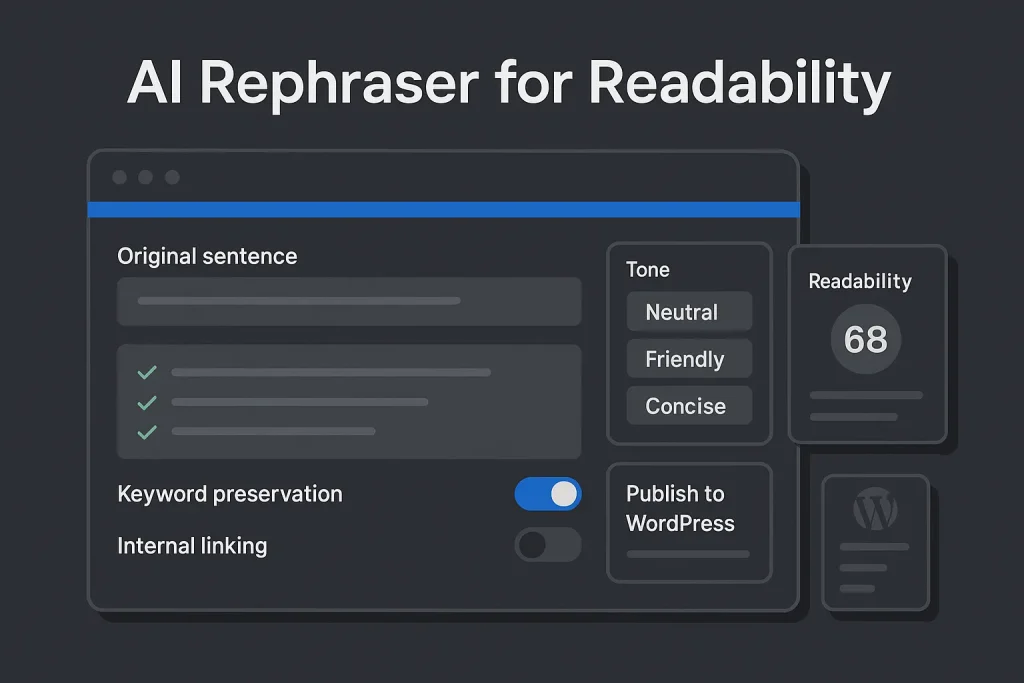
Readable content performs better because it removes friction where readers feel it first: inside the sentence. An ai rephraser is useful when it improves flow, trims filler, and aligns tone without weakening meaning, entities, or search intent. For SEO teams, that line matters. Better readability supports people-first content; careless automation produces pages that feel processed, vague, or padded.
We see this distinction constantly in production workflows. Rephrasing is not a loophole, and it is not a cosmetic trick. Google’s public guidance on helpful, reliable, people-first content makes the standard plain: usefulness to readers comes first. Google also explains that generative AI content can be used on websites, but scaled pages created without adding value can drift into spam territory. On our reading, rephrasing only works as an editing layer when it adds clarity the draft did not have before.
Those benchmarks do not replace editorial judgment, but they are useful targets. Microsoft’s readability guidance confirms both the Flesch Reading Ease and Flesch-Kincaid Grade Level metrics in current Word versions, along with the common target ranges for general documents in Microsoft readability documentation. NIH also stresses that plain language means clear, grammatically correct writing with accurate word usage, not simplified thinking. That point is explicit in NIH plain language guidance.

Why Readability Matters for SEO and User Experience
Readability is not a finishing touch you sprinkle on after SEO. It shapes whether a visitor can process a paragraph quickly, understand what a section promises, and keep reading without effort. In real content operations, weak readability usually comes from three familiar problems: sentences carrying too many ideas at once, vague wording that hides the point, and transitions so thin that readers have to rebuild the logic on their own.
Search performance and user experience meet here. A page can target the right keyword and still underperform if the copy feels heavy, repetitive, or synthetically stretched. Long-winded wording delays the answer instead of delivering it. We consider this one of the most common failure points in scaled content production.
An ai paraphrasing tool becomes valuable when it shortens the distance between user intent and comprehension. It should remove friction, not add fresh ambiguity. A capable ai sentence rewriter does not just swap synonyms. It improves sentence shape, sequencing, and emphasis while keeping the original claim intact.
NIH also notes in its plain-language training material that readability formulas do not measure every factor that affects understanding, which is a useful constraint for any editor. The score is a signal, not the goal. That nuance appears in the NIH plain language PDF. On our side, we would add one practical point: clean logic still beats a pretty score every time.
The chart is a practical reminder that readability targets are manageable. Sentence length and word complexity are variables we can control directly, and both shift the moment we rephrase with intent.
What an AI Rephraser Does (and Doesn’t)
An ai rephraser rewrites existing text at the sentence or paragraph level to improve readability, tone, concision, or stylistic consistency. In an editorial workflow, that means changing how a point is expressed without changing what the point means. The tool may split long sentences, compress repeated wording, replace stiff phrasing, or smooth transitions across adjacent lines.
What it should not do is invent unsupported facts, alter named entities, weaken commercial intent, or detach the copy from the target query. This is where the gap between a real workflow and a generic paraphrasing tool online free experience becomes obvious. Free tools can be fine for isolated variation. Production SEO content needs guardrails.
A strong rephrase ai workflow usually supports four editorial objectives:
- improve comprehension by reducing unnecessary complexity,
- match the intended tone for the audience,
- preserve topical relevance and search intent,
- maintain consistency across long-form documents.
It also helps to separate rephrasing from paraphrasing in practice. A broad ai paraphrase process may substantially restructure wording across multiple sentences. Rephrasing is usually narrower and more controlled. For SEO teams, narrower control is often safer, especially around headings, factual claims, product details, and keyword-bearing lines. We think this is the difference between useful automation and avoidable mess.

Core Readability Principles: Flow, Tone, and Concision
Most sentence improvement work falls into three buckets: flow, tone, and concision. These are also the areas where an ai paraphrase generator can either help a lot or quietly damage the copy if the instructions are weak.
Flow
Flow is the ease with which one idea leads into the next. Good flow depends on sentence order, internal rhythm, and transitions between claims. It breaks when every sentence starts the same way, when ideas are packed into one oversized clause, or when the paragraph jumps between points without connective logic.
AI can improve flow by splitting overgrown sentences, merging fragments that belong together, and adding explicit transitions where the relationship between ideas is not obvious. The goal is not decorative prose. The goal is an efficient reading path.
Tone
Tone is the attitude of the text. In B2B SEO writing, the most common tone problems are accidental informality, hedging, exaggerated confidence, and inconsistent voice across sections produced at different times. Grammarly’s tone detector describes tone analysis as a function of word choice, phrasing, punctuation, and capitalization. That supports a common editing pattern: change delivery without changing the core claim.
A reliable ai paraphrasing tool should let editors move the same sentence toward formal, neutral, or direct business language. That matters when one block sounds conversational and the next sounds procedural. On our experience, tone inconsistency is one of the fastest ways to make a page feel machine-assembled.
Concision
Concision is often the highest-leverage improvement. Many weak drafts do not need new wording; they need less wording. Nielsen Norman Group’s user-experience research has long supported what editors already know: long-winded messages create friction because they take too long to read. In SEO content, filler usually shows up as stacked qualifiers, repetitive framing, and obvious statements that delay the answer.
A capable ai sentence rewriter free or premium editor should therefore prioritize deletion as much as substitution. Replacing bloated text with different bloated text is not progress.
The table below shows how those three principles map to concrete editing actions.
| Principle | What it fixes | Typical AI action | Editorial risk |
|---|---|---|---|
| Flow | Jumps, awkward sequencing, overloaded sentences | Split, merge, reorder, add transitions | Can over-smooth and flatten emphasis |
| Tone | Mismatch with audience or brand voice | Adjust diction, punctuation, confidence level | May introduce overclaiming or casual phrasing |
| Concision | Filler, repetition, delays before the point | Cut phrases, compress clauses, remove redundancy | Can remove nuance if constraints are weak |
For long-form SEO content, the best sequence is usually simple: preserve meaning first, improve flow second, tighten wording third.
When to Rephrase vs. Rewrite vs. Delete
Editors lose time when they use the wrong operation on the wrong sentence. Rephrasing is not always the answer. Some lines need a full rewrite because the logic is broken. Others should disappear because they add nothing.
Use rephrasing when the idea is correct but the delivery is weak
Example: the sentence contains the right fact, but it is too long, too formal, or awkwardly sequenced. Here, a sentence rephraser online free or premium tool can help fast, as long as the instruction is narrow and the sentence is constrained.
Use rewriting when the idea itself is incomplete or structurally wrong
If the sentence blends multiple claims, confuses cause and effect, or uses a vague subject such as “this” or “it” without a clear referent, rephrasing alone may only polish the confusion. That is a rewriting task.
Use deletion when the sentence adds no informational value
Many intros, transition lines, and generic statements can be removed entirely. This is especially true in AI-assisted drafts where the system may produce obvious bridge sentences such as “It is important to note that content quality matters.” If the surrounding section already proves that point, deletion is the cleaner edit.
Teams that lean too heavily on an online paraphrasing tool often miss the delete option. The result is copy that sounds changed but not better. We would argue that deletion is the most underrated readability tool in the stack.

Step-by-Step: Rephrasing a Paragraph with AI
A reliable workflow for sentence refinement should be repeatable. OpenAI’s prompting guidance presents prompts as reusable instructions that can be tested and refined over time, with high-level behavior placed in stable instructions and task-level details provided per request in OpenAI prompting documentation. That maps neatly to editorial rephrasing systems.
Use the following process when working with an best ai paraphrasing tool or a built-in content editor.
- Lock the meaning. Identify the factual payload of the paragraph: what must not change, including entities, numbers, product names, and intent.
- Define the editing goal. Pick one dominant goal per pass: clearer flow, stronger concision, more formal tone, or easier reading level.
- Constrain the output. Tell the model what to preserve and what to modify. For example: keep all entities, do not add facts, shorten by 15–20%, use direct B2B language.
- Review sentence by sentence. Check whether any claim became weaker, broader, or less specific.
- Validate keyword alignment. Make sure the target phrase or semantic equivalent still appears naturally where needed.
- Run final readability and style checks. Measure readability, then inspect manually for rhythm, tone, and transitions.
Prompt caching can also matter in production workflows that use repeated instruction prefixes for inline rewriting. OpenAI documents that prompt caching can reduce latency by up to 80% and input token costs by up to 90% when prompts share exact prefixes, according to OpenAI prompt caching guidance. For large editorial pipelines, that is not a small detail. It affects speed, cost, and how realistic it is to run a disciplined free ai paraphrasing tool process at scale.
For inline sentence refinement at scale, reusable prompts are not just a modeling preference. They improve consistency, speed, and cost control.
Inline Rephrasing in Autopilot SEO: How It Works
Most teams know standalone rewriting tools. Far fewer have rephrasing built directly into the article generation flow. That difference matters because editing quality usually improves when sentence refinement happens in context, not as an afterthought.
In SEO Autopilot, inline rephrasing is positioned as part of the generation process rather than an isolated cleanup step. Instead of exporting a draft to a separate ai rewriter free online utility, the system can refine weak lines while preserving the surrounding section structure, SEO intent, and publication workflow. We see four reasons this is operationally stronger.
Context is preserved
When a sentence is rephrased inside the article generation environment, the model has access to the section goal, adjacent sentences, target topic, and on-page SEO signals. That reduces the risk of producing a polished sentence that no longer fits the paragraph.
Keyword handling is more controlled
Generic tools often over-edit key phrases. Inline rephrasing inside an SEO system can be constrained to preserve the focus keyword, semantic variants, and intent-bearing terminology. That is especially important when working with phrases such as ai rephraser, ai sentence rewriter, or best ai paraphrasing tool that need to stay natural and discoverable.
Revision loops are shorter
The longer the editorial chain, the easier it is to lose formatting, links, and structural consistency. Inline refinement shortens the loop between generation, review, optimization, and publication.
Publishing is connected to the full pipeline
Once the text is improved, it can move through internal linking, metadata, and WordPress publication without copy-paste fragmentation. That is simply more efficient than pushing separate drafts through disconnected apps.
For related editing strategy, the article How to Rewrite AI Content to Improve User Engagement and Rankings is a useful companion to sentence-level refinement. It extends the same principle from individual lines to broader on-page performance.

Controls to Set: Tone, Formality, Length, and Variants
AI rewriting quality depends less on the model label and more on the control layer. Editors should not ask for “make this better” and expect stable results. Good outputs come from precise constraints.
The most important controls are tone, formality, length, and number of variants. A disciplined free ai paraphrasing tool prompt can still produce usable results if those variables are explicit. Without them, the model tends to generalize too aggressively.
The table below shows how to think about these controls in production.
| Control | Best practice | What to avoid |
|---|---|---|
| Tone | Specify neutral, formal, direct, or educational | Vague requests such as “sound better” |
| Formality | Match the audience and brand voice | Mixing casual and procedural voice in one page |
| Length | Give a target such as shorten by 15% | Open-ended compression that removes nuance |
| Variants | Request 2–3 distinct options for difficult lines | Generating many near-duplicates |
The best operational pattern is straightforward: keep one fixed system-level instruction for style and one variable user-level instruction for the current line or paragraph. In our experience, that structure improves consistency across teams and batches far more than endlessly tweaking ad hoc prompts.
Techniques to Improve Flow: Splits, Merges, and Transitions
Sentence flow is mechanical enough to optimize systematically. In practice, most flow problems can be solved through three operations.
Split long sentences when they hold multiple decisions
A long sentence is not automatically bad. It becomes a problem when it contains separate claims, conditions, and outcomes that force rereading. Splitting is often the fastest readability win in any rephrase sentence online free workflow.
Weak: “Because the team wanted to publish faster while also making sure the article matched the target keyword cluster and maintained a professional tone across sections, they used an AI tool to revise the draft before it was uploaded.”
Better: “The team wanted to publish faster without losing SEO control. They used AI to revise the draft, align it with the target keyword cluster, and keep the tone consistent before upload.”
Merge fragments when the paragraph feels choppy
Some AI-generated drafts overcorrect in the other direction and produce too many short, isolated lines. That hurts flow because the paragraph reads like notes rather than prose. Merging related fragments can restore rhythm.
Add transitions only where the logical relationship is unclear
Useful transitions name the relationship between claims: cause, contrast, sequence, or conclusion. They should not be sprayed into every sentence. Over-signaling slows the writing down.
For a broader explanation of semantic preservation during rewriting, Beyond Word Spinning: How a Modern AI Rewriter Maintains Search Intent is directly relevant. It addresses the main risk in flow editing: cleaner language that drifts away from the original search purpose.
Techniques to Boost Clarity: Active Voice and Simpler Words
Clarity improves when the subject, action, and object are visible without extra decoding. Two methods do most of the work here: active voice and simpler wording.
Use active voice when responsibility matters
Passive voice is not wrong. It is often weaker because it hides the actor. In product, SEO, and operational writing, hidden actors reduce clarity. “The article was optimized” says less than “The editor optimized the article for the target cluster.”
Prefer simpler words when precision is unchanged
The Flesch model in Microsoft Word is based on sentence length and syllables per word. Shorter sentences and simpler wording therefore tend to improve scores. That does not mean replacing technical terms that are genuinely necessary. It means removing inflated alternatives when plain wording says the same thing more clearly.
For example:
Instead of: “utilize” use “use.”
Instead of: “facilitate” use “help” when the nuance is the same.
Instead of: “in the event that” use “if.”
Instead of: “with regard to” use “for” or “about.”
This is where many quillbot paraphrasing tool, quill bot paraphrasing tool, or quill bot paraphrasing-style outputs start to look artificial. They often replace short, plain words with longer synonyms in the name of variation. That usually hurts readability. Strong rephrasing does the opposite. The same criticism often applies to a generic quillbot paraphraser workflow or even to how teams use quillbot’s paraphraser without enough editorial control.
Even modest sentence-level changes can move content closer to mainstream readability targets. The point is not to force every page into the same grade level. It is to remove unnecessary complexity where it serves no user or business purpose.
Preserving Meaning, Entities, and Search Intent
The biggest risk in AI sentence rewriting is semantic drift. A sentence can sound smoother while becoming less precise. For SEO, that usually happens in four places: entities, qualifiers, intent terms, and claim boundaries.
Entities
Named products, brands, tools, organizations, and standards must remain stable unless you intentionally change them. An ai paraphrase pass should never turn a specific platform workflow into a generic “tool” if that reduces accuracy.
Qualifiers
Words such as “can,” “may,” “typically,” and “often” matter. Removing them can turn a reasonable statement into an overclaim. SEO content is especially vulnerable here because models often prefer smoother certainty. Editors should push back on that instinct.
Intent terms
If the paragraph targets a commercial query, the wording should still signal evaluation, comparison, workflow, or selection intent after rephrasing. If it targets an informational query, the revision should not suddenly sound like a sales pitch.
Claim boundaries
When a sentence contains one fact and one interpretation, rephrasing can accidentally merge them into a single stronger claim. That is a subtle but common failure mode in an ai paraphrasing tool or a rushed ai paraphrase generator workflow.
Teams working with AI-written drafts should also review how detectors and downstream quality checks fit into the process. On that topic, How to Pass Any AI Text Detector Without Sacrificing SEO Value is most useful when read as a workflow-control guide rather than a shortcut. Our position is simple: the goal is not to game systems; it is to improve naturalness without damaging the page.

Quality Checks: Grammar, Sources, Plagiarism, and AI Detectors
Sentence rephrasing is only one layer of editorial quality control. A clean workflow checks four things before publication: grammar, factual grounding, duplication risk, and machine-like phrasing patterns.
Grammar
Grammar correction is basic but necessary. Rephrasing can introduce agreement errors, punctuation changes, or broken references when a sentence is split. Every refined section should still pass a standard language review.
Sources
If the source sentence contains a claim tied to a reference, the revised sentence must preserve that claim faithfully. Rephrasing must not intensify or broaden sourced material. This matters even more on SEO pages that compare tools, cite platform policies, or describe workflow capabilities.
Plagiarism and duplication
Using an ai paraphrase generator does not automatically create original content in a legal or editorial sense. It may still produce language that is too close to the source or that mirrors common phrasing patterns. Teams should validate originality with a proper review process, whether they use a paraphrase generator free online option or a paid stack.
For production environments, Why You Need an AI Plagiarism Checker for Your Content Team is a relevant operational reference because it frames duplication control as a process issue, not a last-minute check.
AI detectors
Detection tools are imperfect and should not be treated as truth engines. Still, they can reveal repetitive syntax, predictable phrasing, and low-variation rhythm that often correlate with weak readability. In that sense, they are useful as secondary signals.
A mature workflow uses multiple gates: readability metrics, human review, source checks, originality checks, and live-page QA. On our side, we have found that no single checker catches the real problem alone. The pattern matters more than the score.
Before/After Examples with Explanations
Examples show what good rephrasing actually changes. The goal is not cosmetic variation. The goal is stronger delivery under constraints.
Example 1: Cutting filler
Before: “It is important to note that businesses that are looking to improve the readability of their content can potentially benefit from using an AI tool that is able to rephrase sentences.”
After: “Businesses can use AI to rephrase sentences and improve readability.”
Why it works: The revision removes framing filler, keeps the actor visible, and moves directly to the claim.
Example 2: Improving flow
Before: “The article was created quickly, however there were some areas in which the language was repetitive and because of that the editorial team decided that changes would need to be made before publishing.”
After: “The article was created quickly, but some sections were repetitive. The editorial team revised those lines before publishing.”
Why it works: The revision separates cause and action into two cleaner units.
Example 3: Preserving meaning while adjusting tone
Before: “Our tool kind of helps you get the wording into better shape so it sounds more polished.”
After: “The tool refines wording to improve clarity and produce a more polished final draft.”
Why it works: The revision removes conversational hedge language and aligns with a professional B2B tone.
Example 4: Avoiding synonym inflation
Before: “Users can utilize the application to facilitate the optimization of article readability.”
After: “Users can use the application to improve article readability.”
Why it works: Shorter, plainer words improve clarity without reducing meaning.
These edits look simple because they solve the right problem. Strong rephrasing is often conservative. It fixes sentence mechanics instead of trying too hard to sound impressive. That is also why a flashy ai sentence rewriter free demo can look good in isolation but disappoint in a full article.

Publishing Workflow: From Draft to WordPress with Internal Links
Sentence refinement should not live in isolation from publishing. For SEO teams, the efficient workflow moves from draft generation to revision, internal linking, metadata completion, and final publishing without scattering the process across too many tools.
A practical workflow looks like this: generate the draft, run inline rephrasing on weak sections, validate search intent, add internal links, review title and meta description, then publish to WordPress. This is where integrated systems outperform disconnected copy-paste stacks.
Internal links should also be reviewed after rephrasing. Sentence changes can create better anchor opportunities or remove weak ones. The key is to keep links contextually relevant and editorially natural rather than forcing exact-match repetition into every paragraph.
The table below shows the operational difference between isolated rephrasing and an integrated pipeline.
| Stage | Standalone tool workflow | Integrated SEO workflow |
|---|---|---|
| Draft editing | Manual export into separate editor | Inline refinement inside the article workflow |
| Keyword control | Easy to over-edit target phrases | Better preservation of SEO terms and intent |
| Links and metadata | Handled later in separate tools | Connected to final on-page optimization |
| Publishing | Copy-paste into CMS | Direct WordPress-ready workflow |
The integrated model is better for scale because it reduces editorial handoffs and lowers the risk of quality loss between steps. We have seen this repeatedly: the more tools involved, the more likely the final page is to lose consistency.
Metrics to Track: Readability Scores and Engagement
Readability improvements should be measured with restraint. There is no universal benchmark proving a fixed ranking or conversion gain from AI rephrasing alone, so teams should avoid simplistic ROI claims. Still, there are useful indicators.
Start with sentence-level and document-level readability metrics. Microsoft Word’s Flesch Reading Ease and Flesch-Kincaid Grade Level are practical baseline signals. Then track on-page behavior that reflects reduced friction: scroll depth, time on page, CTA progression, and paragraph-level exit patterns if your analytics stack supports them.
Do not treat readability scores as absolute truth. Use them alongside editorial review and intent validation. A lower grade level is not automatically better for every page. Technical documentation, legal wording, or enterprise evaluation content may need more precise terminology than consumer-facing pages. The same goes for any rephrase sentence online free or sentence rephraser online free workflow: a cleaner score means little if the page loses precision.
For teams managing large content volumes, the most useful measurement pattern is comparative. Track draft versus revised readability, then compare engagement and editorial acceptance over time. That gives you process feedback you can actually use, without pretending one metric explains the whole outcome.
Commercial Fit: Using SEO Autopilot for Readability-Safe Content Production
Teams that publish at scale need more than a standalone online paraphrasing tool. They need a system that keeps readability improvements connected to structure, keywords, internal linking, and publishing. That is where SEO Autopilot is operationally stronger than isolated rewriting utilities.
The platform combines article generation, semantic planning, refinement, image workflow, and WordPress publishing in one process. Its inline rephrasing capability is especially useful when drafts need sentence-level cleanup during generation rather than after export. For marketing teams, agencies, and site owners who want cleaner output with less manual rewriting, the official SEO Autopilot website is the best place to review the workflow in context.
The practical advantage is not “more AI.” It is tighter editorial control across the full content pipeline.
We think the real takeaway is straightforward. An ai rephraser is most useful when it works inside a disciplined editorial system, not as a one-click substitute for judgment. The strongest gains come from preserving meaning, cutting friction, and keeping search intent stable while improving readability. Businesses that treat rephrasing as controlled editing tend to get cleaner pages; businesses that treat it as mass variation usually get noise.
Our forecast is modest but clear. Rephrasing tools will keep improving, especially in context-aware workflows tied to publishing and SEO controls. But the gap between a generic free ai paraphrasing tool and a production-safe best ai paraphrasing tool will likely widen, not shrink, because scale makes precision more important, not less.
FAQ
How does an AI rephraser improve readability without changing meaning?
An ai rephraser improves readability by changing sentence structure, cutting filler, and simplifying wording while preserving the original claim. The safest setup locks entities, facts, and search intent before any rewriting starts. On our view, that is the only reliable way to use an ai rephraser in SEO content without inviting semantic drift.
What settings should I use to make sentences more concise and clear?
Set one clear objective per pass: shorten by a defined percentage, keep tone neutral or formal, preserve all entities, and do not add facts. This works better than vague prompts because the model knows what must stay fixed and what it can optimize. If needed, ask for 2–3 variants instead of one and compare them manually.
Will using an AI paraphrasing tool cause plagiarism issues?
It can, if teams assume rewording automatically makes content original. An ai paraphrasing tool should be followed by originality checks, source review, and manual inspection, especially when the draft is based on competitor pages, source documents, or existing internal copy. That applies whether you use a premium editor or a paraphrase generator free online option.
When should I rephrase a sentence versus rewrite or delete it?
Rephrase when the idea is correct but the wording is awkward. Rewrite when the logic is broken or incomplete. Delete when the sentence adds no informational value and only slows the reader down. In practice, strong editors delete more often than most tools recommend.
How can I keep tone consistent when rephrasing long-form content?
Use one stable style instruction for the whole document, then apply local sentence edits under that rule. In long-form SEO content, consistency improves when tone, formality, and keyword constraints are defined before generation and preserved during inline refinement. That matters whether you use an ai rewriter free online, a structured ai paraphrase workflow, or a full platform-based editing system.