
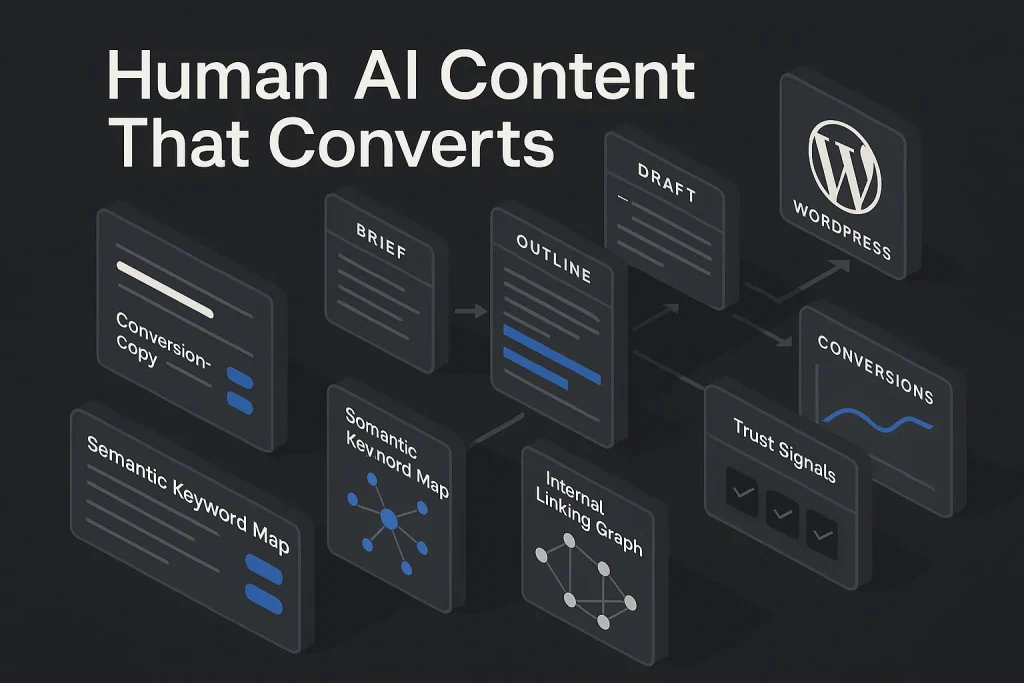
Search visibility without persuasive, readable copy is an expensive half-win. Teams that write human ai content well do not stop at getting indexed or even ranking; they turn traffic into signups, demos, and revenue by making AI-assisted pages sound specific, credible, and easy to act on. We see this constantly: the real gap is not between AI and human writing, but between pages that merely exist and pages that actually move a visitor forward.
Google’s own guidance is explicit: ranking systems aim to reward helpful, reliable, people-first content built for users, not pages produced mainly to manipulate rankings. That principle is clear in Google’s people-first content guidance, and it aligns with the company’s broader emphasis on E-E-A-T. Google has also stated in its guidance on AI-generated content that automation itself is not against policy; low-value output is the problem. For marketers, the real question is no longer “Can AI rank?” It is “Can this page satisfy intent strongly enough to earn trust and convert?”
The market context points the same way. According to HubSpot’s State of Blogging, 46% of marketers who maintain blogs track conversion rate as a primary metric. That matters. Content is being judged less by pageviews alone and more by business outcomes. At the same time, Semrush found in its traffic channel mix study that organic search remains enormous, generating more than 1 trillion visits in 2025, yet organic growth is not universal across industries.
On our reading, that changes the operating model. Rankings still matter, obviously. But when traffic is harder to grow, conversion efficiency becomes the lever that separates decent content programs from profitable ones.
If AI-assisted content is now normal, generic AI phrasing becomes easier for readers to spot, not just software. Pew Research reported that 49% of U.S. adults use AI chatbots in 2026, up from 33% in 2024. As familiarity rises, bland wording, recycled abstractions, and unsupported claims stand out faster. That is why a page can be technically optimized and still underperform commercially.

Why ‘human-sounding’ isn’t enough: conversions over detector scores
Many teams still treat AI content quality like a disguise problem. They want text that sounds less robotic, passes an ai detector, or resembles a best humanizer output. That framing is too shallow. A paragraph can sound conversational and still fail because it does not answer the real buying-stage question, reduce risk, or explain why the offer matters now.
The costliest mistake in AI workflows is optimizing for the wrong proxy metric. There is no authoritative public benchmark showing that an AI detector score predicts conversion performance. Yet teams keep spending hours trying to make copy appear less machine-generated while ignoring message hierarchy, proof, and CTA clarity. On the ground, detector-chasing usually creates awkward edits, diluted terminology, and a voice that feels stitched together.
We think this is where many content teams lose the plot. Search success gets the click. Commercial success earns the next step. If a page ranks for a problem-aware query but the body copy stays generic, the visitor leaves with no stronger conviction than they had before landing.
Three failure modes show up again and again in AI-assisted articles:
- Surface fluency without specificity: the text reads smoothly but says little that could only be true for this audience, use case, or problem.
- SEO coverage without persuasion: keywords are present, yet the copy never turns features into outcomes or objections into reassurance.
- Formatting without decision support: the page has headings and bullets, but no clear path from pain point to action.
So the more useful target is not “Does this sound human?” It is “Does this page help a real buyer make a confident next step?” If the answer is no, even natural write ai output is still under-optimized.
A detailed breakdown of this problem appears in Why Every AI Writing Detector Is Flawed and What Actually Keeps Google Happy, where the practical standard shifts from detector compliance to user value.
What makes AI content feel human: intent, specificity, voice, and proof
Human-feeling content rarely comes from sprinkling contractions or casual phrases into a draft. Readers read “human” through signals of relevance and judgment. They notice whether the page understands their context, whether the technical depth is right, and whether it offers evidence instead of polished vagueness.
Four elements shape that perception.
Intent match
Every query contains an implied task. Someone searching for a tactical SEO workflow does not want a philosophical essay on AI. Someone comparing solutions needs evaluation criteria, not a glossary. The fastest way to make AI text feel fake is to answer a different question than the one the user actually brought to the page.
For example, a post targeting marketers evaluating content automation should address workflow friction, semantic coverage, review steps, publishing speed, and quality control. It should not spend half the article trying to impress an ai detector or explaining definitions an experienced buyer already knows.
Specificity
Specificity is one of the strongest anti-generic signals. Specific copy uses concrete scenarios, constraints, examples, and trade-offs. Instead of saying “AI can improve productivity,” strong copy says “AI can turn a topic brief into a structured article draft, but conversion quality depends on how well the draft handles search intent, proof points, and CTA placement.”
Specificity also means naming the operational realities: revision loops, stakeholder approval, CMS formatting, internal linking, semantic entities, and trust elements. These details make the content usable. On our experience, this is also the point where average AI drafts separate from pages that genuinely convert.
Voice discipline
Brand voice is not decorative tone. In B2B content, it is a consistency system for how claims are framed, how risk is handled, and how confidently the page recommends action. A strict, expert voice avoids inflated promises. It uses clear wording, controlled emphasis, and precise transitions. That is harder to get from generic humanizer tools because they often overwrite domain language in pursuit of “naturalness.”
Proof and trust
Proof closes the gap between readable copy and believable copy. It includes citations, examples, product screenshots, process details, first-hand observations, and transparent limitations. Readers trust pages that demonstrate judgment, not just phrasing. That trust matters even more as AI-generated language becomes familiar to wider audiences.
Before revising an AI draft, it helps to pressure-test the page through a simple editorial lens:
| Signal | Weak AI Draft | Human-First Version |
|---|---|---|
| Intent | Broad, mixed, unfocused answer | Clear answer for one stage of the buyer journey |
| Specificity | Generic benefits and filler transitions | Examples, constraints, and concrete outcomes |
| Voice | Overly polished, interchangeable tone | Controlled editorial voice aligned with audience |
| Proof | Claims without support | Sources, process detail, and transparent limitations |
If a draft is weak across these four signals, no clever ai humanizer will solve the underlying conversion problem.

A practical conversion framework for AI drafts (JTBD, PAS, benefits-first)
AI drafts convert better when they are built inside a persuasion framework. Without one, the model tends to produce balanced but indecisive prose. The structure may look coherent, yet the message does not create urgency or confidence. A framework gives the draft direction before line editing even starts.
JTBD: write for the job the reader is hiring the page to do
Jobs to Be Done is useful because it forces clarity around user motivation. A visitor is not searching for “AI content” in the abstract. They are hiring a page to solve a problem such as:
- reduce the time needed to publish SEO articles without sacrificing quality
- improve blog conversions from existing organic traffic
- make AI-assisted pages sound credible to decision-makers
- scale WordPress publishing with tighter editorial control
When the job is clear, the angle sharpens immediately. Instead of writing “AI helps with content creation,” the draft can say “If your team is already getting traffic but landing pages still underconvert, the problem is usually not keyword coverage. It is weak message hierarchy, generic claims, and poor proof.”
PAS: problem, agitation, solution
PAS still works for conversion-oriented educational content because it mirrors decision pressure. First define the practical problem. Then show its cost. Then present the solution in concrete terms.
For this topic, the sequence is straightforward:
Problem: ranked pages read like polished templates and fail to persuade.
Agitation: traffic arrives, bounces, or stalls because the copy does not answer objections or establish trust.
Solution: use AI for speed, but enforce semantic accuracy, buyer-stage messaging, proof, and formatting discipline.
Benefits-first writing
AI drafts often list features before benefits. That is backward for conversion. Readers care about what changes for them. If the article or product has semantic analysis, the business benefit is stronger topic coverage and fewer shallow pages. If it has WordPress publishing, the benefit is a shorter path from brief to live article. If it supports internal links, the benefit is a stronger content graph and easier user movement across related pages.
A useful rewrite pattern is simple: translate every feature into an operational gain, and every operational gain into a commercial effect. That is what turns static description into persuasive relevance. We consider this one of the most reliable fixes for AI copy that ranks but does not sell.
Teams that need a systematic editing process can borrow from the approach outlined in How to Rewrite AI Content to Improve User Engagement and Rankings, especially when the first draft already covers the right topic but lacks commercial sharpness.
Research and semantic coverage: entities, questions, and topical depth
Conversion-focused content still depends on strong SEO infrastructure. Pages do not convert if they never attract qualified readers. That is why semantic coverage matters. The goal is not just to repeat the primary phrase write human ai, but to build a complete context around the user’s need.
Semantic depth comes from three layers.
Entities and concepts
A strong page on this topic should naturally cover related concepts such as AI-generated content, E-E-A-T, conversion rate optimization, internal linking, readability, search intent, trust signals, CTA placement, editorial workflow, and WordPress publishing. These entities help search engines interpret topical completeness while helping readers find the details they actually need.
Real user questions
Many high-volume results around this topic lean heavily on tools like ai detector, write human ai free utilities, or named services such as walter writes ai, walter writes ai humanizer, and other best humanizer comparisons. Those queries matter because they reveal user anxiety. People worry that AI text will look generic, get flagged, or simply fail to perform. A better article addresses that concern directly, then redirects attention to what actually improves outcomes: useful structure, proof, and intent match.
Topical depth without bloat
Depth is not the same as length. It means covering decision-critical subtopics while stripping out filler. Google can evaluate relevance, but human readers evaluate effort. If they have to dig through repetitive phrasing to find one practical answer, trust drops fast.
The market-level data reinforces the need for quality over volume. Semrush reported 66.02% year-over-year growth in AI traffic, but AI referrals still represented less than 0.15% of total web visits. Organic search remains the core acquisition channel for most brands, yet Semrush also found organic declines in 13 of 17 industries analyzed. The practical implication is clear: content teams need pages that do more with the traffic they already earn.
The graph makes the point quickly: big growth rates in AI-related traffic do not remove the need for high-performing pages. On our view, this is exactly why semantic quality beats cosmetic rewriting.
Semantic coverage is also where many free humanizer workflows fail. A tool may make the wording feel more casual, but it can strip technical precision, remove useful entities, or flatten nuance. If that weakens intent alignment, the page becomes less useful even if it sounds less machine-like.

Formatting that converts: hooks, subheads, scannability, CTAs, and internal links
Formatting is not decoration. It is part of how the argument lands. Nielsen Norman Group’s web usability research has long argued that people read less on screens and benefit from concise writing and layered headings. That guidance from NNGroup’s writing for the web research matters even more for AI drafts because language models naturally produce long, smooth paragraphs that bury the point.
The structural goal is simple: help a scanning visitor find the promise, the proof, and the next step with minimal friction.
Hooks that state the commercial problem
The opening section should not take its time. It should identify the exact issue the reader faces. For this topic, a strong hook says that rankings are fragile if the page reads like a robot, lacks proof, and gives the visitor no reason to act.
Subheads that do real work
Weak AI subheads summarize the obvious. Strong subheads move the reader through a decision path: what the problem is, why it matters, what good looks like, how to implement it, what to avoid, and how to measure success. The structure should feel like guided thinking, not a pile of loosely related sections.
Paragraph compression
Most AI drafts improve when paragraphs are shortened by 20% to 40%, especially in explanatory sections. Dense text reduces clarity and slows pattern recognition. We have seen plenty of cases where editing for scannability improved conversion more than adding extra copy.
CTAs with context
A CTA should follow resolved tension. If the page has just explained the cost of generic AI output and shown a practical framework for fixing it, the CTA can logically invite the visitor to test a workflow, request a demo, or review a product that operationalizes the process. Random CTAs dropped between paragraphs weaken trust because they feel disconnected from the reader’s current level of belief.
Internal links as decision support
Internal links should move the reader deeper into the topic graph. On a site covering AI SEO workflows, the best internal links are the ones that solve adjacent questions during evaluation. For readers wrestling with the trade-off between free rewrites and content quality, Can You Humanize AI Text Free Without Hurting Your Readability? extends the discussion usefully. For those focused on detector anxiety, How to Pass Any AI Text Detector Without Sacrificing SEO Value helps reposition the issue around SEO value rather than cosmetic edits.
A concise comparison makes the formatting difference easier to apply:
| Element | Ranking-Oriented Draft | Conversion-Oriented Draft |
|---|---|---|
| Opening | Defines topic broadly | Names the business problem immediately |
| Subheads | Topic labels | Decision-guiding claims |
| Body copy | Long explanatory blocks | Compressed paragraphs with proof and examples |
| CTA | Generic invitation | Action tied to solved concern |
When teams say they need a natural write ai result, they often really need stronger editorial structure. Formatting is one of the fastest ways to improve both readability and business performance.

E-E-A-T you can show: first-hand details, citations, author creds, and transparency
E-E-A-T is often discussed too abstractly. In practice, it becomes visible through what the page includes. Experience shows up in first-hand observations, implementation details, and practical constraints. Expertise shows up in accurate terminology, sound recommendations, and coherent trade-offs. Authoritativeness grows when the site consistently publishes useful material in the same cluster. Trust comes from transparency, citations, and claims that can survive scrutiny.
For AI-assisted content, this matters because the default model style leans toward plausible generalization. The fix is not pretending the content was written with no automation. The fix is making the page more accountable and more useful.
First-hand details
Add process observations that generic web summaries often miss. For example: AI drafts usually overuse abstract transitions, under-specify examples, and present weak CTA logic unless the prompt explicitly defines audience stage and desired action. That kind of detail signals operational familiarity. We have found that even two or three concrete observations can change how credible a page feels.
Citations that support key claims
If the article references search guidance, usability standards, or market adoption, cite them where they matter. This is not just an SEO move. It improves perceived trust. Public sentiment on transparency around AI reinforces that expectation, and it aligns with buyer caution in B2B environments.
Clear authorship and review standards
On-site author bios, editorial notes, and review policies are still underused in AI-assisted publishing. For brands investing in content at scale, they are valuable trust infrastructure. They tell the reader the page was produced under standards, not simply generated.
Disclosure without self-sabotage
If AI assistance is part of the workflow, the goal is not theatrical disclosure. The goal is credibility. Editorially reviewed, source-supported, user-focused content remains strong whether the first draft came from a model or a human writer.
These figures underline something simple: AI content quality has to be measured against business outcomes, not drafting speed or detector scores.

Prompting workflow: brief → outline → draft → critique → refine → publish
Most AI content quality problems start before the draft exists. If the system receives a vague prompt, it returns a generic article. If the workflow lacks critique and refinement stages, that generic draft goes live with minor edits. The real fix is process design.
A high-performing workflow typically follows six stages.
1. Brief
Define audience, search intent, business goal, product relevance, target action, and exclusions. This is where the team decides whether the page is educational, comparative, bottom-funnel, or mixed. A conversion-focused brief also states the tension to resolve: trust, differentiation, complexity, cost, speed, or proof.
2. Outline
Build the article around user decisions, not just keywords. The outline should sequence information logically: problem, implications, criteria, method, pitfalls, measurement, product fit. This is also where semantic subtopics and internal link opportunities get mapped.
3. Draft
Generate a first draft that covers the structure thoroughly. At this stage, volume matters less than completeness. The draft should answer all major sub-questions and include relevant entities.
4. Critique
Run a structured review against a checklist: intent match, specificity, proof, readability, brand voice, CTA clarity, semantic completeness, and factual caution. This stage is what separates scalable quality from scalable mediocrity. In our view, skipping critique is the fastest route to publishing content that looks finished but performs weakly.
5. Refine
Rewrite weak sections, compress verbose passages, improve examples, add citations, strengthen transitions, and align the CTA with user readiness. This is where teams often do manual write human ai free style rewrites when the draft is already close, but in production environments the better answer is a system that encodes these requirements upstream.
6. Publish
Publishing should not be an afterthought. Title tags, meta descriptions, internal links, images, alt text, schema where relevant, and WordPress formatting all affect performance. A polished draft can still lose impact if the final page is poorly structured in the CMS.
HubSpot’s broader statistics page notes that 56% of marketers believe improving conversion rates is much easier now than it was ten years ago. Better tooling explains part of that. The other part is process maturity: teams now have clearer workflows for testing, revision, and operational consistency.
As users become more familiar with chatbot language, brand-safe editing and stronger proof matter more, not less.

When to avoid AI humanizers and detector-chasing (readability and drift risks)
Humanizer tools are not automatically harmful. They become harmful when they replace editorial judgment. Many of them are optimized around superficial variation: swapping sentence shapes, adding conversational markers, or changing words that detectors may weigh heavily. That creates three serious risks.
Readability drift
The output may become less clear than the original draft. Sentences gain unnecessary flourishes. Technical precision gets softened. The result is text that sounds more “humanized” in theory but communicates less efficiently in practice.
Semantic drift
Important terminology can be changed into weaker variants. In SEO and B2B software content, that is a real cost. If the page starts replacing precise concepts with casual approximations, the article loses both search relevance and decision value.
Voice drift
Brand tone often becomes inconsistent after multiple humanizer passes. A strict, expert style may turn chatty or generic. That inconsistency can be subtle, but on commercial pages it weakens authority.
This is why named tools, whether positioned as the best humanizer or associated with phrases like walter writes ai and walter writes ai humanizer, should be treated as optional utilities rather than strategic solutions. They can help with localized smoothing in some workflows, but they cannot replace a strong brief, a conversion-aware outline, or a disciplined editorial review.
If the main reason for using a humanizer is fear of detection, that is usually a sign the workflow is chasing the wrong outcome. The safer route is to improve usefulness, trust, and specificity directly. We consider that a much more durable strategy than trying to outplay every ai detector on the market.

Metrics that matter: engagement, intent match, and conversion KPIs over detector scores
Teams need a performance model that matches business value. Detector scores are not business metrics. The more useful stack combines search performance with engagement and conversion evidence.
At minimum, evaluate AI-assisted content across five layers.
1. Intent match
Does the page satisfy the searcher’s likely task? This can be reviewed qualitatively through SERP comparison, on-page clarity, and stakeholder review.
2. Engagement quality
Look at scroll behavior, time on page, return-to-SERP signals where available indirectly, CTA interaction, and whether users continue into related pages. Engagement is not a vanity metric when it shows whether the message is actually being processed.
3. Conversion behavior
Track form submissions, demo requests, trial starts, assisted conversions, and CTA click-through rates. This is where educational content proves its commercial value.
4. Content efficiency
Measure production speed, revision load, publish frequency, and update effort. AI should reduce operational cost, but only if the correction burden stays controlled.
5. Long-term trust indicators
Monitor branded search lift, repeat sessions, backlink quality, and assisted journey behavior. Human-first content compounds through credibility, not just rankings.
One more data point matters here. HubSpot’s 2026 coverage says 28% of marketers name increasing conversion rates as a primary objective. That is a better north star for AI content evaluation than any detector benchmark.
These numbers support a practical conclusion: SEO still earns the visit, but conversion-focused content determines the return on that visit.
How Autopilot SEO operationalizes human-first content (semantics, structure, images, QA, WordPress)
Most teams do not fail because they lack AI access. They fail because their workflow stops at generation. The advantage comes from turning AI into a controlled publishing system that enforces semantic coverage, useful structure, and execution discipline at scale.
That is where SEO Autopilot fits. Rather than treating AI as a raw text spigot, the platform is designed around the full path from topic to published article: semantic planning, structured outlines, article generation, image support, internal linking logic, and WordPress publishing. For teams that need to write human ai content consistently, this matters far more than simply producing large volumes of first drafts.
Its value is practical. A content team can reduce manual coordination across keyword research, article structuring, on-page optimization, formatting, and publishing. That shortens production cycles without forcing the team to sacrifice user value. It also supports a better editorial standard because the workflow starts with SEO semantics and structure, not with isolated copy generation.
In commercial terms, that means less time spent fixing avoidable AI weaknesses and more time refining the parts that actually move conversion performance: audience fit, proof, CTA logic, and trust signals. For agencies, lean internal teams, and site owners scaling content in WordPress, that kind of system-level control is more valuable than chasing outputs from disconnected humanizer tools.
We think the takeaway is fairly clear. Content that converts is not the content that sounds the most “human” in a vacuum; it is the content that is most useful, specific, and commercially aligned. Teams that win with AI usually do three things well: they build stronger briefs, keep semantic depth intact, and edit for proof and decision support instead of cosmetic polish. The biggest risk is not using AI. The bigger risk is publishing fast, generic pages that look finished but do not earn trust.
Our forecast is pragmatic. Over the next cycle, more brands will use AI by default, which means generic output will become even easier for readers to spot. The advantage will shift toward teams with tighter editorial systems, clearer positioning, and better conversion measurement. In other words, the winners will not be the ones who automate the most. They will be the ones who operationalize quality.
FAQ
How do I make AI writing sound human without hurting SEO?
Start with intent match, specificity, and structure, not cosmetic rewrites. On our experience, the safest way to make AI writing feel human is to add concrete examples, tighten headings, improve proof, and preserve core semantic terms instead of over-editing for detector scores.
Do I need to pass AI detectors to rank in Google?
No. Google does not require content to pass third-party AI detectors. What matters is whether the page is original, helpful, reliable, and satisfying for users, with strong E-E-A-T signals where relevant.
What’s the best way to format AI content for conversions?
Use a strong opening that names the user’s business problem, clear subheads, shorter paragraphs, visible proof, and CTAs placed after the page resolves a key concern. Scannability is part of persuasion, especially for B2B readers evaluating software or services.
Is using an AI humanizer safe for my brand voice and E-E-A-T?
Only in limited cases. Humanizers can introduce readability drift, semantic drift, and voice inconsistency. If you use one, review the output carefully to make sure terminology, claims, and tone still support trust and expertise.
How can Autopilot SEO help me publish conversion-focused AI content?
Autopilot SEO helps by combining semantic planning, structure generation, article creation, image support, internal linking, and WordPress publishing in one workflow. That makes it easier to produce AI-assisted SEO content that is not only optimized for rankings but also easier to refine for trust, readability, and conversion.