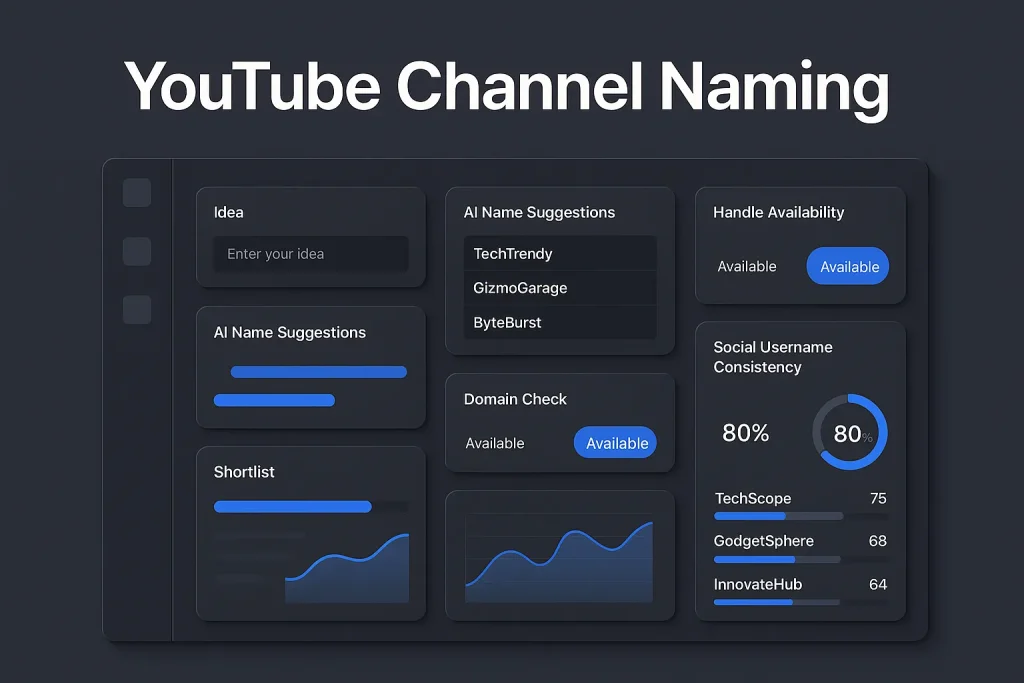
The difference between a forgettable channel and a durable creator brand often starts with naming discipline. A strong youtube name generator does more than spit out random ideas. It compresses brainstorming, filters weak combinations, and helps creators move from a vague concept to a name that can work as a channel title, a handle, a social username, and eventually a business asset.
That matters because YouTube is not a small playground anymore. According to Pew’s 2025 data on Americans and YouTube, 85% of U.S. adults use YouTube. Among teens ages 13 to 17, 90% use it, 73% use it daily, and 15% say they are on it almost constantly. On a platform at that scale, naming stops being a casual creative exercise. It becomes a positioning decision inside a very crowded discovery environment.
A naming workflow now has to account for memorability, spoken clarity, searchability, handle constraints, and legal risk. That is why many creators start with a youtube channel name generator, a youtube username generator, or a youtube handle generator early in the process instead of waiting until the end and discovering that every decent option is already gone.

What Makes a Great YouTube Channel Name
A great channel name is not just creative. It is usable under pressure. It has to survive search, recommendations, word of mouth, cross-platform sharing, and future monetization. The best names usually do four jobs at once.
First, they are easy to remember. If someone hears your name once in a video intro or podcast mention, they should be able to type it later without guessing. Second, they are easy to say. Spoken recall matters because many channels grow through collaboration, interviews, and recommendations. Third, they are visually clean. On thumbnails, channel pages, mobile screens, and profile badges, cluttered names lose force fast. Fourth, they are extensible. A name that fits your first ten videos but blocks your next three years is expensive to outgrow.
YouTube itself separates channel names from handles. As explained in YouTube Help on handles, each channel can have only one handle, it becomes a personalized @ URL, and it follows specific formatting rules. So naming is no longer just about what looks good on a banner. It has to hold up as a unique public identifier.
On our view, this is where many creators underestimate the job. They think they are picking a label, but they are really choosing infrastructure. A weak name creates friction everywhere later.
In practical terms, a best name for youtube channel process should evaluate whether the name works across these layers:
- Channel title: readable, attractive, and niche-relevant.
- Handle: short enough to fit YouTube’s structure and easy to type.
- Search phrase: understandable when entered into YouTube or Google.
- Brand asset: usable later for products, newsletters, courses, sponsorships, or a website.
The strongest youtube channel name ideas often feel obvious in hindsight. That is rarely luck. More often, it is the result of testing many combinations and cutting anything too generic, too long, too trendy, or too hard to spell.
Naming Criteria and Checklist (memorable, pronounceable, short, future-proof)
Most creators benefit from a formal checklist because naming quality is easy to overestimate in the moment. A clever phrase can sound brilliant in your head and fail instantly in real use. The criteria below are more reliable than intuition alone.
Memorable
A memorable name usually has one clear shape. It may be short, rhythmical, alliterative, or built around a strong noun. It does not need punctuation tricks or odd spelling to stand out. If people have to ask how to spell it, that friction compounds over time.
Pronounceable
If a collaborator says your channel name in a live stream, can listeners type it correctly on the first try? If not, discovery drops. This is where many creative name for youtube channel ideas fall apart. They optimize for visual uniqueness but ignore spoken usability.
Short enough for handles and branding
YouTube states that handles must generally be 3 to 30 characters long in most scripts and can include letters, numbers, underscores, hyphens, periods, and Latin middle dots, with restrictions on where some symbols can appear. Shorter is not always better, but shorter names usually travel better across bios, overlays, email signatures, podcast shout-outs, and social profiles.
Niche-relevant without being boxed in
A tech educator may benefit from including a signal like “lab,” “build,” “byte,” or “systems.” But “iPhoneTips2025Daily” is too narrow and too temporary. The goal is relevance without expiry. Good name ideas for a youtube channel suggest a category while leaving room for growth.
Distinct enough to own
Generic terms are easy to think of and hard to own. “Finance Zone” or “Gaming Central” may sound serviceable, but they are weak brands. Distinctive combinations give you a better shot at consistent handles, domains, and trademark clearance.
Future-proof
Future-proofing means asking whether the name still works if your content expands. A creator starting with tutorial shorts may later sell templates, launch a newsletter, or host workshops. A narrow name can become a structural constraint.
We have seen this repeatedly in content marketing and SaaS branding: the name that feels “specific” on day one often becomes dead weight by month six. On our practice, flexibility beats cleverness more often than creators expect.
The checklist below turns these ideas into a practical scoring model.
| Criterion | What to test | Red flag | Better direction |
|---|---|---|---|
| Memorability | Can someone recall it after one exposure | Generic phrase with no hook | Distinctive two-word construction |
| Pronunciation | Can people say and spell it easily | Ambiguous spelling or symbols | Plain words with clear sound |
| Length | Does it fit cleanly as a handle and social username | Over 20 characters with weak payoff | Compact, brandable structure |
| Future-proofing | Will it still fit if the content expands | Too tied to one format or year | Broader niche signal with room to grow |
| Originality | Does it avoid obvious clones | Looks like a variation of an existing creator | Unique wording or novel compound |
A checklist does not kill creativity. It stops you from mistaking novelty for quality.
How YouTube Name Generators Work (AI vs rule-based ideas)
Not every youtube name creator works the same way. Most tools fall into two broad categories: rule-based generators and AI-assisted generators. If you know the difference, you will use them better.
Rule-based generators
A rule-based yt channel name generator usually combines preset word lists, templates, prefixes, suffixes, and category signals. You enter a keyword such as “fitness,” “gaming,” or “budget travel,” and the system returns combinations like “FitCircuit,” “BudgetRoamer,” or “PixelArena.”
These tools are fast and useful for volume. They are especially helpful when you need raw ideation, naming patterns, or a youtube channel name ideas list to react to. Their weakness is predictability. Because they pull from limited logic sets, outputs can feel repetitive, generic, or uncomfortably close to names already in circulation.
AI-assisted generators
An AI-assisted youtube account name generator can interpret context more flexibly. Instead of simply stitching words together, it can respond to prompts about tone, audience, content style, positioning, or long-term brand plans. You can ask for names that sound premium, playful, educational, minimal, or technical. You can also request specific constraints such as “two words only,” “easy to pronounce,” or “must work as a short handle.”
This is similar to how modern content platforms streamline ideation. In SEO and editorial operations, structured generators reduce blank-page friction by turning broad inputs into usable variations quickly. The same logic applies to naming. Algorithms do not replace judgment, but they dramatically speed up the option-generation phase.
We think this distinction matters more than people admit. Rule-based tools are good for breadth. AI tools are better for fit. Confusing one for the other is why many creators end up with names that are technically usable but strategically flat.
If you already work with content systems, the principle is familiar. The value is not magic. The value is throughput with constraints. That is why teams interested in scalable content workflows often also care about better naming systems, title generation, and idea expansion. The same efficiency logic appears in processes like how an AI reader speeds up content sourcing and research at SEO scale, where structured automation reduces manual drag without removing editorial control.
Below is a practical comparison of the two approaches.
| Generator type | Strength | Limitation | Best use case |
|---|---|---|---|
| Rule-based | Fast, simple, high-volume output | Can produce generic combinations | First-pass brainstorming |
| AI-assisted | Context-aware, tonal control, richer variations | Needs stronger prompts and filtering | Brand-oriented naming and refinement |
In practice, the best workflow combines both. Use rule-based tools for breadth, then use AI for sharper refinement and better fit.
The scale argument is straightforward. Naming on a platform this large requires volume, speed, and filtering. In the UK, Ofcom’s Online Nation 2025 report notes that Alphabet reached 99% of online adults in May 2025, reinforcing how mainstream YouTube-linked brand visibility has become. On crowded platforms, faster idea generation is not a luxury. It is operationally useful.
The chart above gives context for why discoverability and memorability on YouTube deserve more attention than they did a few years ago.
Step-by-Step: Use a YouTube Name Generator to Find a Brandable Handle
A good process matters more than any single tool. Whether you use a youtube name generator free tool, an AI workspace, or your own spreadsheet, the workflow below is the safest route to a strong result.
1. Start with positioning inputs, not words
Do not begin by typing “cool” nouns into a generator. Start with four inputs: niche, audience, tone, and future direction. For example:
Niche: personal finance for freelancers
Audience: early-career creatives
Tone: practical, direct, non-preachy
Future direction: courses, templates, newsletter
This gives the generator enough structure to produce names with strategic fit instead of empty novelty.
2. Generate in batches
Run several short sessions instead of one long prompt. Batch by style. One pass can focus on authority-driven names. Another can focus on creator-led names. Another can target concise modern compounds. This is where a random youtube name generator can be surprisingly useful as a contrast tool, even if most random outputs are weak.
3. Remove weak patterns early
Discard names that are too long, too literal, too trend-bound, too similar to established channels, or too dependent on numbers and punctuation. Early subtraction saves time later.
4. Convert titles into handle candidates
A channel title may work while the matching handle fails. Translate every promising name into a likely @handle version and inspect what happens when spaces disappear. “The Quiet Ledger” may still work as @quietledger. “Smart Budget for Beginners” becomes unwieldy.
5. Score the survivors
Use a simple 1–5 scale for memorability, handle fit, distinctiveness, niche fit, and future-proofing. The score is not the decision. It shows where each option is strong and where it is fragile.
6. Check availability before attachment
Do not fall in love with a name until you test handle availability, domain options, social consistency, and trademark risk. A disciplined naming process assumes constraints early.
7. Test aloud and in context
Put the name in a mock channel banner, say it aloud in an intro, type it into a message, and imagine someone hearing it in a podcast. Many names die at this stage for good reasons.
We would add one practical note here. The fastest path is not to find one “perfect” option. It is to get to 10 workable options quickly, then pressure-test them hard. That is where a name for youtube generator or even a rough generator youtube name workflow earns its keep.
Prompt Templates and Naming Formulas that Actually Work
The quality of output from a generator youtube name workflow depends heavily on the prompt. Vague prompts produce vague names. Structured prompts produce better material for evaluation.
Prompt template for authority-based channels
“Generate 25 YouTube channel names for a creator who teaches [topic] to [audience]. Tone should be [tone]. Keep names under 16 characters when possible. Avoid clichés, numbers, and forced spellings. Prioritize names that are easy to pronounce and likely to work as short handles.”
Prompt template for personality-led channels
“Generate 30 YouTube channel name ideas for a creator focused on [topic], with a voice that feels [adjectives]. Mix branded compounds, modern two-word names, and subtle niche signals. Avoid exact-match keyword stuffing. Make them sound credible enough for future products and sponsorships.”
Prompt template for niche expansion
“Create a list of 20 brandable YouTube names for a channel starting in [niche] but likely to expand into [adjacent areas]. Names should feel broad enough for growth while still signaling the core category.”
Naming formulas that consistently produce better results
Some formulas work better than others because they balance distinctiveness and clarity. These patterns tend to outperform generic naming.
- Descriptor + Noun: Quiet Ledger, Bright Circuit, Sharp Habitat
- Action + Object: Build Mode, Scale Notes, Track Wealth
- Niche cue + metaphor: Pixel Forge, Syntax Garden, Beauty Ledger
- Founder cue + category: Dana Builds, Omar Explains, Maya Markets
- System cue + topic: Creator Stack, Budget Framework, Study Engine
Weak formulas usually lean on filler words like “hub,” “world,” “central,” or “official” without adding any identity. They may function, but they rarely become memorable brands.
On our experience, the best prompts do two things at once: they narrow the tone and widen the variation. That balance is what turns a basic youtube name creator into something actually useful.
If you also create written content around your channel, the same naming discipline improves adjacent assets such as video titles, blog categories, and landing page themes. That is one reason structured ideation matters beyond YouTube alone. The logic overlaps with editorial systems that aim to produce stronger outputs from better prompts, similar to the principles behind how to write human AI content that actually converts visitors.
Niche Examples and Idea Starters (Gaming, Vlog, Tech, Education, Beauty, Finance)
Most creators do not need a final name handed to them. They need better pattern recognition. The examples below show what strong directions look like by niche.
Gaming
Gaming names benefit from pace, sound, and recognizability. Strong patterns often use short compounds or clean action cues.
Examples: Pixel Raid, Loadout Lab, Frost Spawn, Quest Thread, Frame Rush
Weak pattern: names overloaded with “pro,” “gamer,” random digits, or references that may age quickly with one title or trend.
Vlog
Vlog channels often work best when the name leaves room for personality and life changes. Too-specific names can create identity friction later.
Examples: Northbound Notes, Dayframe, City Margin, Slow Weekend, Eva Outside
Weak pattern: naming around one city, year, or life phase unless that is the long-term brand itself.
Tech
Tech naming usually benefits from precision and restraint. It should sound informed, not inflated.
Examples: Build Surface, Byte Method, Stack Clarity, Circuit Manual, Kernel House
Weak pattern: overusing “AI,” “labs,” and “future” without a distinctive angle.
Education
Educational channels need trust. The strongest names imply clarity, frameworks, or understanding.
Examples: Clear Concept, Study Grid, Lesson Foundry, Learn in Layers, Proof Table
Weak pattern: names that sound too childish for serious subject matter.
Beauty
Beauty branding often succeeds when it feels polished and verbal rather than decorative alone.
Examples: Soft Theory, Finish Room, Blend Ritual, Shade Method, Daily Texture
Weak pattern: overloaded glamour terms that reduce distinctiveness.
Finance
Finance channels should sound stable, credible, and useful. Flashy names often undermine trust.
Examples: Quiet Ledger, Cash Method, Found Money Lab, Margin Habit, Worth Signal
Weak pattern: hype-driven wording that implies easy money or risky promises.
These are not guaranteed available names. They are directional models for generating a unique name for youtube channel choice that matches category expectations without collapsing into generic phrasing.
Creators also search for cool names for youtube channel ideas here, but “cool” is usually the wrong filter. Clear beats cool. Distinct beats trendy. And a youtube channel name ideas list only helps if you can tell which patterns are durable and which ones are just noise.

High daily usage increases the value of names that are short, recognizable, and quick to retrieve from memory.
Check Availability: YouTube Handle, Domain, Socials, and Trademarks
This is where many promising names fail. Availability should not be the final check. It should be built into the naming process from the start.
YouTube handle
Handle rules matter because the handle now functions as your personalized public identifier. As YouTube explains, handles are unique, tied to one channel, and visible as @ URLs. In a separate help document on YouTube channel URLs, the platform also notes that new custom URLs can no longer be set up or changed in the old way, which increases the practical importance of the handle in discovery and sharing.
Domain availability
Even if you do not need a site on day one, check domain availability. A creator name often becomes a newsletter, portfolio, community, or course platform later. A clean domain is a flexibility asset.
Social username consistency
If your YouTube name is available but the corresponding Instagram, TikTok, X, LinkedIn, or newsletter identity is fragmented, your brand cohesion weakens. Consistency reduces confusion and improves recall.
Trademark conflict risk
This is the most ignored part of the process and one of the most expensive to neglect. The USPTO trademark basics explain that trademarks identify the source of goods or services. For creators, that becomes relevant earlier than many expect, especially once a channel expands into products, education, consulting, or sponsorship-backed assets.
The USPTO also recommends, in its guidance on searching for similar trademarks, checking for conflicts before filing or building too much around a name. At an international level, WIPO trademark resources note that the Global Brand Database gives access to more than 28 million trademark records, making cross-market checks far easier than manual searching alone.
We consider this non-negotiable. If a name cannot survive handle, domain, socials, and trademark checks, it is not a strong name. It is just an attractive draft.
A modern naming workflow should therefore test four layers in parallel: handle, domain, socials, and trademark proximity. Treating originality as an early-stage filter is much more efficient than reworking brand assets after launch.
| Layer to check | Why it matters | Minimum pass condition |
|---|---|---|
| YouTube handle | Core public identifier and @ URL | Clean, short, no awkward modifiers |
| Domain | Supports future website, newsletter, products | Reasonable exact or close-match domain |
| Social usernames | Cross-platform consistency | Same or near-identical name across priority platforms |
| Trademark risk | Reduces future legal and brand conflict | No obvious confusingly similar mark in relevant category |
This check prevents a common failure mode: selecting a name that sounds perfect but is impossible to unify across the public brand stack.

Score, Shortlist, and A/B Test Your Final 3–5 Options
Once you have 15 to 30 decent candidates, the problem changes. You are no longer brainstorming. You are selecting. This stage should be analytical.
Build a shortlist matrix
Use weighted criteria, not instinct alone. For example:
Memorability 25%, handle cleanliness 20%, niche fit 20%, originality 15%, future-proofing 10%, social/domain consistency 10%.
Weights can change by creator type. A personal brand may weight spoken clarity more heavily. A media-format brand may weight flexibility and category breadth.
Test in realistic use
Create simple mockups with the name in these contexts: YouTube banner, channel icon, mobile profile, end card, email signature, and a one-line intro script. A name that looks good only in a list is not ready.
Run small audience checks
Ask a limited group to answer three direct prompts: Which name do you remember after five minutes? Which sounds most credible? Which seems easiest to search? Avoid open-ended focus-group chaos. Narrow questions produce usable feedback.
Compare exact and modified handle versions
If your preferred title needs a slightly altered handle, compare whether the mismatch is acceptable. Minor compression may be fine. Major divergence usually is not.
A shortlist becomes easier to manage when constraints are visible. Most naming mistakes happen when creators compare names emotionally instead of operationally.
We have found that the winning option is rarely the flashiest one. More often, it is the name that keeps scoring well across every boring test. That is exactly what you want.
SEO and Discoverability: Using Keywords in a Channel Name Without Stuffing
Keyword relevance can help, but stuffing is a weak branding strategy. A channel name that reads like a search query may gain topical clarity and lose almost everything else: trust, memorability, flexibility, and distinctiveness.
That does not mean keywords have no role. They do. If your category is competitive or educational, a subtle niche signal can improve immediate comprehension. For example, “Budget Method” communicates more than a purely abstract brand. “Tech With Lena” may be more discoverable than a disconnected phrase. The point is balance.
When keywords help
Keywords are useful when your audience needs immediate category recognition, your brand is new, and the keyword integrates naturally into a clean phrase.
When keywords hurt
They hurt when the name becomes awkward, generic, or obviously designed only for search. “BestPersonalFinanceTipsChannel” is not a brand. It is metadata wearing a nametag.
Better approach
Use one niche cue at most, then let other branding layers do the rest. Your description, banner, video titles, playlist structure, about page, and consistent publishing will do more for channel clarity than cramming exact terms into the name.
This is where creators confuse YouTube search optimization with brand identity. Search systems can read many signals. Human memory is much less forgiving. The strongest good youtube name ideas usually integrate relevance lightly and let distinction carry the rest.
We would be careful here with terms like youtube channel name generator or youtube name generator inside the brand itself. Those phrases make sense for search intent, not for a real creator identity. On our view, a youtube handle generator or youtube username generator should help you discover a brandable phrase, not tempt you into keyword-heavy naming.
Common Naming Mistakes to Avoid
Most bad channel names fail in predictable ways. Avoiding these mistakes is often more valuable than chasing extreme originality.
Being too descriptive
Names that describe every topic or format usually become long and weak. Description belongs in supporting elements, not the full brand name.
Copying category patterns too closely
If your name feels like a slight variation of a larger creator, trust erodes. Similarity may also create platform confusion and legal friction.
Using numbers and punctuation as rescue tools
Adding “TV,” “Official,” “24,” or random underscores because your preferred handle is taken is usually a sign that the base name is too generic. It is better to rethink the name.
Overcommitting to trends
Trend-driven words can age fast. A name tied to one meme, format, or year can feel stale before the channel reaches maturity.
Ignoring cross-platform consistency
A workable YouTube title with fragmented social identity creates unnecessary friction in discovery and recall.
Skipping legal screening
Creators often assume trademark checks are only for large companies. In reality, early diligence is cheaper than late conflict. This matters even more when the name could later appear on products, websites, or paid offers.
One more mistake deserves mention: trusting the first output from a youtube name generator free tool just because it feels convenient. Convenience is useful. Blind trust is not. The same goes for any random youtube name generator or youtube account name generator that produces volume without judgment.
Next Steps: Lock Your Visual Identity and Consistency After You Pick a Name
Once you choose a name, stop reopening the naming debate. Shift into implementation. A brand becomes real through repetition, not endless reconsideration.
Secure the essentials immediately
Register the handle, claim matching social usernames where relevant, secure the domain, and store approved spelling conventions in one place. Decide on capitalization style, spacing rules, and whether abbreviations are acceptable.
Align verbal and visual identity
Your logo, channel art, color system, thumbnail template, intro phrasing, and about-page copy should all reinforce the same tone. A serious finance name with chaotic neon branding creates cognitive conflict. A playful creator name with sterile enterprise visuals can feel equally mismatched.
Build content around the brand promise
The name creates expectation. Your first ten videos should confirm it. If the channel is named around clarity, the content should feel clear. If the name signals systems, the content should feel structured. Branding fails when naming and delivery diverge.
Use systems, not guesswork, in future creative work
The same structured thinking that improves channel naming also improves titles, outlines, content clusters, and publishing workflows. For teams and creators who want to scale content production, that matters. Tools that turn broad inputs into usable outputs with constraints save time not because they are automatic, but because they reduce avoidable manual friction.
We think this is the real dividing line. Strong creators do not just pick a name. They build a repeatable system around it. That is what makes the brand feel coherent instead of improvised.

How algorithmic ideation helps beyond naming
A nickname generator youtube workflow is most useful when it sits inside a broader content system. Naming, title generation, topic expansion, content planning, and publishing all benefit from the same operational principle: generate a wide set of constrained options quickly, then apply editorial judgment.
That is the practical lesson behind modern SaaS content tools. The best systems do not replace brand thinking. They accelerate the expensive middle: the time between a vague idea and a shortlist worth evaluating.
We have also seen creators search odd variations like name for youtube generator or even generator youtube name when they are really looking for one thing: faster, better ideation. The tool label matters less than the workflow quality.
Where SEO Autopilot fits for content teams and creator-led brands
For businesses, agencies, and creator-led sites that want this kind of structured ideation across more than naming, workflow matters. Moving from idea generation to keyword planning, article structuring, drafting, visual support, and WordPress publishing is where most manual bottlenecks appear.
That is where SEO Autopilot becomes relevant. The platform is built to automate SEO content operations end to end: from semantic planning and structure generation to article creation, image support, and WordPress publishing. For teams already thinking systematically about naming, discoverability, and scalable content production, the official client site offers a practical extension of the same logic into full editorial execution.
A disciplined channel name improves brand entry. A disciplined content system improves everything that follows.
We think the main takeaway is simple: a youtube name generator is useful, but only when paired with judgment, availability checks, and a clear brand direction. The strongest youtube channel name ideas are not the cleverest on paper. They are the ones that survive real-world constraints and still sound like something worth building on. For most creators, that means choosing clarity, distinctiveness, and flexibility over novelty for novelty’s sake.
Looking ahead, we expect naming to become even more operational. Handles, cross-platform identity, and trademark friction will matter more as creator brands expand into products, newsletters, and owned media. In our view, the creators who treat naming as part of a broader SEO and brand system will have a quieter but very real advantage over those who treat it as a one-off creative task.
FAQ
How long should a YouTube channel name be?
Shorter is usually better, but the sweet spot is whatever stays memorable, pronounceable, and handle-friendly. In practice, many strong names land between 1 and 3 words and compress cleanly into a handle.
Should I put keywords in my YouTube channel name?
Yes, but lightly and naturally. A niche cue can help discoverability, but stuffing keywords into the name usually weakens memorability and brand quality.
Can I change my YouTube channel name without losing my handle or verification?
You can change a channel name, but handle and verification implications depend on your current setup and YouTube policies at the time of change. Review your channel details carefully before renaming, because the channel name and handle are separate elements.
How do I check if a YouTube handle is available?
Try setting or editing the handle inside your YouTube channel settings and verify whether the exact format is accepted. We also recommend checking matching versions across your domain and priority social platforms before making a final decision.
Are YouTube name generator ideas unique or can others get the same name?
They are not automatically unique. A youtube name generator can produce strong combinations quickly, but other users can receive similar outputs or register the name first. That is why availability and trademark screening still matter.