
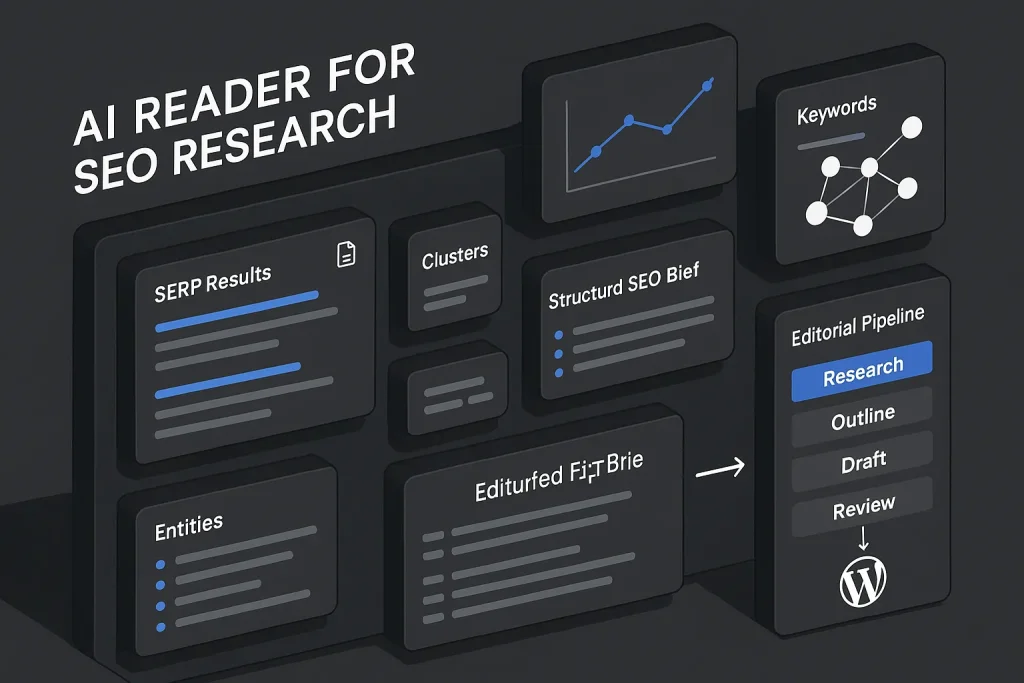
Content sourcing usually breaks before writing does. A modern ai reader matters because the real SEO bottleneck is not drafting one more paragraph. It is reading, filtering, comparing, and consolidating enough source material to build a brief that is actually useful. Once a team moves past a few articles per month, manual review of SERPs, reports, subpages, PDFs, and duplicate coverage becomes the slowest part of the workflow.
That pressure shows up fast in SEO. A writer is expected to understand topical coverage, search intent, repeated entities, source freshness, and competitor framing before the first line is written. Even a modest keyword can force a review of top organic results, the pages behind those results, and extra references buried in studies, docs, and product pages. An ai reader cuts that load by processing many inputs in parallel and returning structured notes instead of a pile of reading debt.
The distinction is practical, not semantic. Many tools sold as ai readers are still just summarizers or a recycled text to speech layer. A research-grade system behaves more like an information pipeline: it fetches pages, parses content, extracts claims and entities, groups overlaps, preserves citations, and prepares the material for drafting. In SEO, that difference decides whether the tool saves a few minutes or removes an entire pre-writing stage.

The content sourcing bottleneck: why manual reading doesn’t scale
Manual content sourcing looks fine only at low volume. One topic, one writer, ten blue links, a few tabs. Then the system cracks. Every new article needs its own SERP review, source validation, note-taking, and duplicate filtering. Across a real content calendar, the waste compounds: the same reference pages get reopened, the same claims get rechecked, and different people repeat the same research from scratch.
At process level, manual reading fails for three simple reasons. First, it is linear. A person reads one page at a time, and switching between sources adds friction. Second, it is lossy. Notes depend on memory, attention, and discipline. Third, it is inconsistent. Two researchers can review the same SERP and still produce different source sets, different summaries, and different conclusions.
There is also a scale problem hidden inside basic SERP analysis. Reviewing page one may sound like ten results. In reality, serious research expands almost immediately into documentation, studies, comparison pages, PDFs, help centers, category pages, and cited references. Suddenly the input is not ten URLs but dozens or hundreds. At that point, reading stops being an editorial task and becomes an operational one.
For agencies, this creates cost drag. For in-house teams, it slows publishing velocity. For publishers and affiliate sites, it shrinks topic coverage because only part of the planned backlog survives the research queue. On our side, this is the blunt truth: if sourcing is slow, the whole content engine is slow.
Microsoft reported in its Work Trend Index that 75% of global knowledge workers were already using generative AI in 2024. That matters because research and source handling are among the most repetitive tasks in content operations. The opportunity here is not vague automation. It is a direct cut in repetitive reading work inside the pipeline.
The takeaway is straightforward: a research process built on manual reading alone will not scale with modern SEO demand.
What we mean by an AI reader for research (not TTS)
Here, an ai reader is not a voice utility and not an accessibility product built around playback. That category includes ai voice reader, ai text to speech, and other listening-first tools. They have valid use cases, but they do not solve the sourcing problem. They convert text into audio or help with consumption. They do not crawl the web, extract structured claims, compare sources, or turn SERP evidence into a research brief.
A research-oriented ai text reader does four jobs. It acquires source material, converts it into machine-readable text, identifies what matters inside that text, and outputs the result in a structure that supports drafting. The tool may appear as an ai reader online, an ai reading tool, or an embedded engine inside a broader platform. The wrapper matters less than the workflow depth.
That is why market language gets messy. A so-called ai reader free product may only summarize pasted text. An ai pdf reader may handle reports well but fail at live SERP expansion. An ai word reader may work for uploaded documents and still ignore web discovery. On our view, the best ai reader for SEO research is the one that combines discovery, parsing, extraction, deduplication, and source attribution in one pipeline.
OpenAI documents that its deep research systems can find, analyze, and synthesize hundreds of sources, and return citation-backed outputs with source metadata in minutes rather than days through its deep research documentation and research solutions page. That benchmark is useful because it defines the category correctly. A real AI reader goes beyond summarization and into multi-source analysis.
For SEO teams, we think the category should be judged by blunt questions. Does the system pre-read top-ranking pages before drafting starts? Can it process PDFs and linked references? Does it preserve citations? Does it detect overlap between near-duplicate articles? Can it turn source material into a structured brief with headings, entities, and evidence points? If not, it is probably a helper, not a research engine.

How an AI reader works: crawling, parsing, and SERP pre-reading
The speed advantage comes from parallel machine steps. Instead of consuming one page at a time, the system can fetch multiple relevant URLs, parse readable text from HTML and PDF, and normalize that content into one analysis layer. This matters because most delays in sourcing are mechanical, not intellectual. People spend time opening pages, waiting for loads, skipping navigation, stripping boilerplate, and copying notes. Machines can remove a lot of that drag.
Crawling the relevant source set
The first step is acquisition. A capable ai reader text workflow starts with a query, target topic, or SERP. It collects visible ranking pages and, depending on the system, may expand into cited references, linked documents, supporting pages, FAQs, and downloadable assets. In SEO, this is far more useful than asking a chatbot to answer from memory because the input is grounded in live or recently fetched pages.
Parsing readable content from HTML and PDF
The second step is parsing. Raw web pages are full of menus, scripts, ads, footers, repeated UI text, and decorative elements that add nothing to research. An ai text reader free tool often struggles here because it treats everything as flat text. A stronger parser identifies article bodies, headings, tables, metadata, lists, and quoted claims. For an ai pdf reader, the equivalent task is converting report layouts, pages, and blocks into readable text while preserving section hierarchy where possible.
Google’s documentation on robots and crawling behavior matters directly here because robots.txt can govern crawling for HTML, PDF, and other non-media formats that a crawler can read. So any professional AI reading workflow should account for both page access and file-type access before fetching content.
Pre-reading the SERP before drafting
Pre-reading is the critical SEO layer. Instead of generating first and validating later, the system reads ranking evidence first. It identifies recurring subtopics, content gaps, repeated entities, and the dominant framing of search intent. That shifts drafting from speculative writing to evidence-backed assembly.
This is especially valuable in competitive niches where top results overlap heavily but differ in detail. A human researcher can miss subtle differences between pages. An automated pre-reader can map them consistently, then surface patterns such as repeated H2 themes, named tools, implementation steps, and caveats. We have seen this become one of the clearest advantages of a serious ai reading app over generic chat workflows.
The core gain is simple: crawling, parsing, and extraction can happen concurrently, turning raw sources into a usable research layer before a writer begins.
Core capabilities that speed up research (entities, topics, citations, deduplication)
Not every reading feature creates real time savings. The features that matter are the ones that reduce repeated human review and improve the quality of what comes next.
Entity extraction
An AI reader should identify named entities such as products, platforms, standards, organizations, methods, and file types. In SEO writing, this helps both coverage and accuracy. If the ranking set repeatedly references robots.txt, precision, recall, citation metadata, and WordPress publishing, those items should show up in the brief as structured entities, not disappear inside prose.
Topic and subtopic clustering
Good research is not only about facts. It is also about pattern recognition. Topic clustering groups repeated ideas across sources and helps define the final article structure. This saves writers from manually rediscovering the same subheadings across ten tabs. It also reveals what is common versus what is differentiating. On our experience, this is where many lightweight ai readers start to fail: they summarize, but they do not organize.
Citation capture
Citations are no longer a premium extra. They are baseline quality control. When a claim is extracted, the system should preserve the source URL, page context, and enough metadata to support verification later. Citation-backed research is easier to review, safer to reuse, and stronger in editorial workflows where claims need checking.
Deduplication and overlap reduction
SERP results often include near-duplicate interpretations of the same original source, especially in software topics and B2B marketing. An AI reader that clusters overlaps reduces repeated reading of syndicated or derivative pages. That saving is bigger than it sounds because duplicate exposure is one of the least visible forms of research waste.
The table below separates the highest-value capabilities from convenience features that sound useful but usually do not move production speed very much.
| Capability | What it does | Why it matters for SEO research |
|---|---|---|
| SERP pre-reading | Reads ranking pages before drafting starts | Grounds article structure in live search evidence rather than generic model output |
| HTML and PDF parsing | Extracts readable content from pages and documents | Expands research beyond blog posts into reports, help docs, and attachments |
| Citation support | Preserves source URLs and claim context | Improves fact review, reduces hallucination risk, and supports editorial checks |
| Deduplication | Groups overlapping or derivative sources | Cuts repeated reading and keeps briefs cleaner |
| Entity extraction | Pulls named items, standards, and recurring concepts | Improves coverage planning and on-topic drafting |
A tool that combines these features behaves like a research system, not just an ai reading app with a summary box.

Workflow: from query and SERP to a structured brief in minutes
The most useful way to understand an AI reader is as a sequence, not as a chat box. The workflow below reflects how efficient SEO content research actually works.
- Start with the query and target intent. The system takes the primary keyword, topic, or cluster, then identifies the live ranking environment and the likely intent mix around that query.
- Fetch the top SERP and related source pages. Instead of stopping at visible results, the engine expands into relevant support pages and documents where needed.
- Parse, clean, and normalize content. Boilerplate is reduced, the main text is extracted, and headings or sections are preserved where possible.
- Extract entities, repeated claims, and missing angles. The system identifies what appears consistently across sources and what is under-covered.
- Attach citations and de-duplicate overlap. Each material point is tied back to its source while repetitive pages are grouped or down-weighted.
- Output a structured brief. The result is not just a summary. It is a draft-ready research artifact with headings, source notes, and direction for writing.
What changes in practice is not only speed but handoff quality. A writer no longer starts with a raw pile of tabs. They start with an ordered brief that separates must-cover points, support evidence, optional examples, and risk areas that need careful wording.
That is the difference between using ai that reads text and using a content-sourcing machine. One reduces reading friction. The other changes the production model. We would not treat those as the same category.
The bigger the source graph becomes, the wider the gap between manual expansion and automated pre-reading.
Generic AI text readers vs Autopilot SEO’s built-in scraping engine
Most generic tools treat research as an afterthought. They work only after the user supplies text. That helps with summarization, but discovery, source selection, and SERP interpretation stay in human hands. In SEO, that is exactly the expensive part.
Autopilot SEO stands out because it does not stop at generation. Its built-in scraping engine is designed to read the top SERP before drafting, extract a usable research layer, and turn those findings into an article workflow that continues into optimization and publication. This is a far more practical model for content teams than an isolated ai reader free online utility or a single-purpose free ai reader aimed at one document at a time.
In generic tools, the researcher still has to decide which pages matter, open them manually, and move cleaned notes into a separate writing system. In Autopilot SEO, the research stage is integrated with semantic planning, article structure, generation, images, internal linking, and WordPress publishing. That integration removes handoff loss. On our side, this is where the real business value appears.
A related point is pipeline maturity. Teams relying on disconnected tools often run into research drift, where the brief, the draft, and the published page no longer match. A full system avoids that by keeping extracted SERP intelligence inside the same production environment. For a broader view of why isolated tools underperform compared with connected workflows, see this piece on a content pipeline for SEO growth.
The comparison below highlights the difference in terms that matter operationally.
| Dimension | Generic AI reader | Autopilot SEO scraping engine |
|---|---|---|
| Input model | Usually pasted text or uploaded document | Live SERP plus expanded web sources before drafting |
| SEO relevance | Indirect | Directly tied to ranking-page evidence and article structure |
| Deduplication | Often limited or absent | Built around overlapping SERP sources and research consolidation |
| Output | Summary or notes | Structured SEO brief ready for drafting and publishing workflow |
| Workflow continuity | Separate tools and manual handoff | Connected to generation, internal linking, and WordPress publishing |
The highest ROI does not come from the reading function alone. It comes from embedding reading inside the full SEO production chain. That is the same logic behind full SEO autopilot platforms that remove manual transitions between tools.

Quality and governance: accuracy, hallucination control, and source attribution
Speed without quality control is a liability. An AI reader is useful only if it retrieves relevant evidence, preserves enough context for review, and limits unsupported synthesis. In information retrieval, the two core metrics are precision and recall. Precision measures how much of the retrieved material is relevant. Recall measures how much of the relevant material was actually found. These are not academic details. They describe the exact failure modes of bad research automation.
Low precision creates noisy briefs packed with marginal sources, duplicated explanations, and generic filler. Low recall creates confident gaps: the brief looks complete, but important evidence never entered the system. SEO teams need both metrics in balance. Overly broad retrieval wastes editorial time. Overly narrow retrieval misses key subtopics, objections, and examples.
Source attribution is the next control layer. A brief should not merely state that “sources say” a point is true. It should preserve where the point came from, ideally with the exact page or document context. OpenAI explicitly documents inline citations and source metadata in its deep research outputs, which is a strong signal for where market expectations are heading. Citation-backed extraction gives editors an audit trail and makes it easier to separate source-grounded material from model-generated glue language.
Human review still matters. The role changes, though. Instead of reading everything from scratch, editors validate the research set, review sensitive claims, and refine framing. That is a much better use of human time than repetitive skimming. We consider this one of the most underrated governance benefits of a serious ai reading tool.
A fast system is only an asset when it stays auditable and specific under editorial scrutiny.
Legal and technical safety: robots.txt, rate limits, and copyright
AI reading at scale needs governance at the crawling layer, not only at the writing layer. Before a system fetches pages, it should check robots policies and apply tool-level safeguards. The Robots Exclusion Protocol was standardized as RFC 9309 in 2022, so there is now a clear baseline for how modern crawlers should interpret robots.txt behavior.
One operational nuance is often missed by teams building their own scraping workflows. Google notes in its robots.txt reference that unsupported fields such as crawl-delay are ignored by Google. The implication for AI reading systems is important: polite crawling cannot rely on every possible directive being honored automatically. Rate limiting has to be enforced by the tool itself.
That leads to a practical safety model:
- Check robots.txt before fetching supported content types.
- Apply conservative concurrency and rate limits even where explicit directives are absent.
- Respect site availability and avoid burst behavior that creates unnecessary server pressure.
- Preserve source attribution and keep human review in the loop for sensitive or legally constrained material.
There is also a copyright dimension. Research extraction is not the same as unrestricted content reuse. Teams should treat AI reading as a sourcing and synthesis layer, not a permission waiver. Structured citation, rights awareness, and conservative editorial review are necessary when working with protected materials, especially if any source language might be quoted or closely paraphrased.
From a risk perspective, the safest systems are the ones that gather evidence, summarize responsibly, and maintain clear provenance for what they extracted. That matters whether you use an enterprise workflow or a lightweight ai reader free online setup.

Metrics to prove ROI (time saved, coverage, recall/precision)
AI reading should be measured as an operational improvement, not as a novelty feature. The relevant ROI indicators are time-to-brief, source coverage, editorial rework, precision, recall, and output throughput. These metrics make it possible to compare a manual workflow with an automated sourcing workflow using the same team and topic set.
Pew reported in October 2025 that 21% of U.S. workers use AI on the job, according to its latest short read on workplace AI use. Adoption is growing, but the more useful question for content teams is not who uses AI in general. It is which tasks show measurable leverage. Research, synthesis, and source consolidation are among the clearest candidates because they consume large amounts of repeatable effort.
McKinsey has estimated that generative AI could automate up to 30% of business activities across occupations by 2030 and create trillions of dollars in annual economic value. Even without turning those estimates into article-specific projections, the direction is clear: document handling, search, summarization, and drafting are high-priority automation targets precisely because they are process-heavy and information-dense.
The chart below uses the published adoption figures in the topic research to show where the market stands today. The point is not to claim a direct content KPI from broad adoption data, but to frame AI-assisted reading as part of mainstream knowledge work rather than a niche experiment.
To measure internal ROI, teams should track their own workflow before and after implementation rather than leaning on broad industry claims.
The most useful scorecard usually looks like this:
| Metric | What to measure | Why it matters |
|---|---|---|
| Time to brief | Minutes or hours from keyword selection to usable brief | Direct indicator of research efficiency |
| Source coverage | How many relevant page types and references enter the brief | Shows whether the system expands beyond superficial SERP reading |
| Precision/recall | Editorial relevance and completeness of retrieved material | Controls noise and missed evidence |
| Revision load | How much human correction the draft needs after research | Reveals actual quality, not just speed |
| Output throughput | Published articles per month with stable quality control | Connects research automation to business capacity |
When these metrics improve together, the AI reader is not just saving clicks. It is improving the economics of the content operation.
WordPress auto-publishing and internal linking with Autopilot SEO
Research speed matters most when it shortens the full path to publication. This is where many standalone tools fail. They can summarize material, but they stop before execution. Autopilot SEO extends the workflow from SERP reading to article generation and then into WordPress publishing, which means the brief does not need to be exported into a fragmented stack.
That matters because publishing delays often come from transitions: researcher to writer, writer to editor, editor to CMS manager, CMS manager to SEO reviewer. If the source intelligence already exists inside the same platform that drafts, links, and publishes, the number of manual touchpoints drops sharply.
Internal linking is part of this execution layer. Once the article is generated from a structured brief, the platform can place it into a wider content graph rather than treating it as a standalone page. In practical SEO terms, this improves discoverability, strengthens topical clustering, and reduces post-publication cleanup. Teams exploring this broader production logic can compare adjacent workflows in this article on an AI assistant for SEO content ops.
There is also a quality angle. When the brief, the draft, and the publishing target live in one system, it is easier to preserve the original topic framing and semantic coverage. That reduces the drift that often appears when notes are copied between tools or reformatted by different people.
For teams using WordPress as the final destination, the advantage is operational simplicity: one pipeline from query to live page, with less re-entry and fewer formatting bottlenecks. If your workflow still separates short-form output from long-form publishing decisions, it helps to review the distinction discussed in AI paragraph writer vs long-form AI systems.

Implementation checklist and recommended settings
Rolling out an AI reading workflow is less about one prompt and more about setting boundaries, defaults, and review rules. The goal is predictable research output that writers trust.
- Define the source scope. Decide whether the system should read only top SERP pages, also include linked references, or also ingest PDFs and documentation.
- Separate retrieval from drafting. First build the source set and structured notes, then generate the article. This reduces unsupported synthesis.
- Enable citation retention by default. Research notes without provenance create review friction later.
- Use deduplication on overlapping SERP results. This cuts repeated explanations and makes briefs more compact.
- Set crawl politeness inside the tool. Do not assume every site directive will control fetch behavior for you.
- Review high-risk claims manually. Legal, medical, financial, or policy-sensitive material still requires stronger editorial oversight.
- Measure precision and recall on a sample set. Before scaling, validate that the system is finding the right material and not omitting key sources.
- Connect output to publishing. The highest efficiency appears when the brief flows directly into article production and CMS delivery.
Recommended defaults for SEO teams are conservative rather than aggressive. Fetch enough sources to represent the SERP properly, but prioritize relevance over volume. Expand into documents where they add evidence. Keep citations attached. Require a human pass before publication on claims that matter. These settings do not reduce automation value. They make the automation reliable.
One more practical note: if a tool markets itself as an ai reader free download, an ai reader voice solution, or an ai text reader free shortcut, check whether it actually supports sourcing depth. We have seen plenty of tools that sound impressive and still stop at pasted text.
Examples and use cases for agencies, product teams, and blogs
Agencies. Agencies benefit from consistent pre-reading across many clients and verticals. An AI reader can normalize how briefs are built so strategist quality does not depend entirely on who had time to open more tabs that day. This is especially useful in high-volume deliverables where margin depends on process efficiency.
Product marketing teams. Product teams often need pages that combine SERP expectations with feature positioning and source-backed explanation. A reading engine helps them understand how competitors frame the topic before deciding how to differentiate.
Publisher and blog operations. Editorial sites gain from broader coverage. When research stops being the bottleneck, more cluster pages can move from backlog to publication without lowering the standard of source review.
Technical content teams. Teams working in software, infrastructure, analytics, or developer education often depend on documentation and PDFs in addition to standard articles. For them, an ai pdf reader and a web-capable ai text reader are more valuable together than either one alone.
Across all of these cases, the strongest fit is not a standalone ai reader free download utility. It is a system that integrates research with article creation, on-page structure, linking, and CMS publishing. In other words, the useful category is not just ai that reads text; it is AI that reads, organizes, and operationalizes.

Commercial fit: where SEO Autopilot adds more than a generic AI reader
A generic AI reader can save time inside one narrow task. The business value gets much higher when research becomes part of a production system that also handles structure, drafting, optimization, internal linking, and publication. That is where SEO Autopilot is positioned most clearly.
Instead of asking teams to stitch together separate scraping, note-taking, writing, and CMS tools, the platform uses a built-in SERP-aware workflow that reads source material before drafting and carries the result forward into publishing. More details are available on the official SEO Autopilot website. For agencies, marketers, and site owners trying to increase output without multiplying manual research time, that integrated model is materially more efficient than using an isolated ai reader online tool alone.
On our reading, this is the real dividing line in the market. A generic free ai reader may help with one document. A connected system changes throughput, consistency, and publishing speed across the whole operation.
We believe the practical lesson is clear: the value of an ai reader in SEO is not in sounding futuristic, but in removing the slowest and least scalable part of content production. The tools that matter are the ones that pre-read SERPs, parse documents, preserve citations, and feed clean research directly into drafting and publishing. For most teams, the biggest gains will not come from another isolated helper, but from a pipeline that connects sourcing, structure, and execution. The main risk is adopting a tool that reads text but does not truly manage research depth, overlap, or attribution.
Looking ahead, we expect the gap between simple summarizers and full research systems to widen. More teams will treat source retrieval, deduplication, and citation control as standard infrastructure, not optional extras. And as content velocity keeps rising, the best ai reader will increasingly be the one that disappears into the workflow and quietly removes hours of manual work.
FAQ
How does an AI reader extract structured data from web pages?
An ai reader typically fetches the page, removes boilerplate, parses the main readable text, and then extracts entities, claims, headings, and repeated themes into structured notes. In stronger SEO workflows, it also preserves citations and groups overlapping pages so teams do not waste time rereading the same material in different wrappers.
Can an AI reader process PDFs and long reports for summaries?
Yes. A capable ai pdf reader can parse long reports and convert them into machine-readable sections for summarization and extraction. The real question is whether the tool only summarizes one uploaded file or connects those findings to broader SERP research and article planning.
What’s the difference between an AI text reader and text-to-speech tools?
An ai text reader for research is built to analyze, extract, and structure information from pages or documents. Text to speech tools, including many ai voice reader products, are designed to read content aloud and support listening, not source discovery or SEO brief creation.
Is it legal and safe to use an AI reader for SERP and site scraping?
It can be, if the workflow checks robots.txt, applies conservative rate limits, preserves source attribution, and keeps human review in place for sensitive reuse decisions. The safest model treats AI reading as evidence gathering and synthesis, not as unrestricted copying of protected content.
How do I connect an AI reader to WordPress for publishing?
The efficient path is to use a platform where research, drafting, and publishing already share one workflow. In an SEO-focused stack such as Autopilot SEO, the research layer can feed directly into article generation, internal linking, and WordPress auto-publishing without manual copy-paste between tools.