
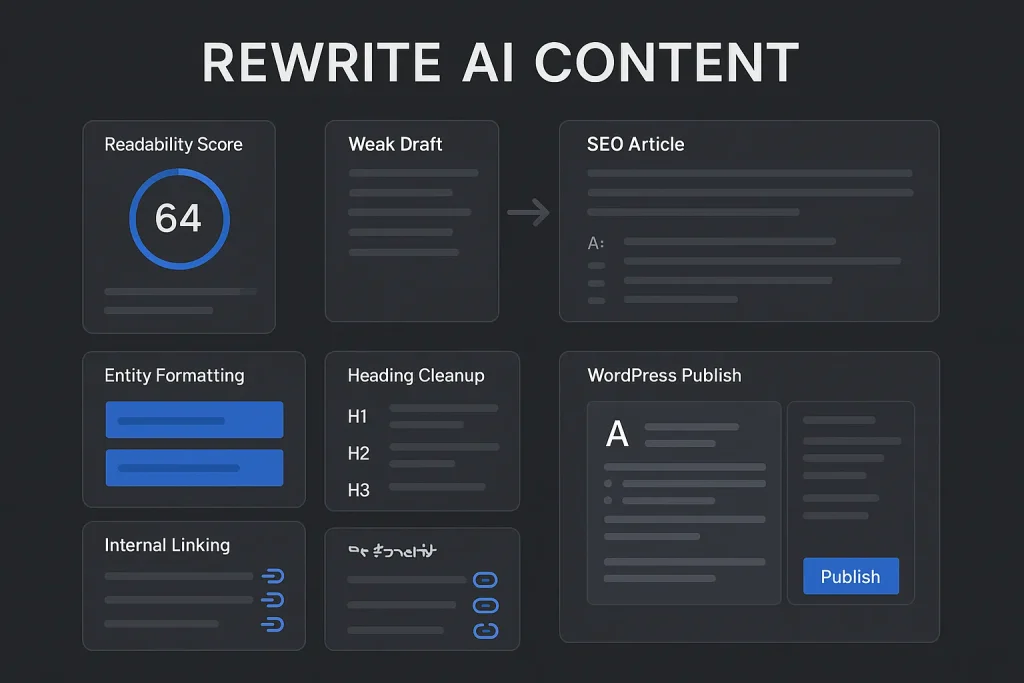
Teams that publish large volumes of AI-assisted content usually do not lose performance because they used automation. They lose performance because the draft stays generic, bloated, poorly structured, and weak on intent satisfaction. To rewrite ai content well, the job is not to disguise machine wording. The job is to turn a loose draft into a useful page that helps a reader complete a task, trust the source, and take the next step.
That distinction matters even more in 2026. Google’s guidance is centered on helpful, reliable, people-first content, and the real issue is value, not whether AI was involved. An ai rewrite that improves clarity, task completion, structure, examples, and authorship signals is strategically different from shallow synonym swapping. In our view, this is where many teams still get it wrong: they treat rewriting as camouflage when it should be editorial reconstruction.
Bad AI drafts fail in familiar ways. They over-explain basics, under-explain decisions, flatten nuance, and repeat phrases without adding depth. They also miss entity precision, bury commercial relevance, and waste the opening lines on vague setup. For B2B teams, that usually means weaker engagement, softer conversion paths, and lower confidence from both readers and search systems.

The strongest workflow combines human editorial judgment with automation. Human editors protect intent, examples, positioning, and expertise. Automation handles readability cleanup, formatting consistency, entity normalization, and scalable revision throughput. That is the model we recommend: first diagnose why a draft fails, then rebuild it with a repeatable framework, then decide when manual editing or auto-rewriting is the smarter move.
Why AI Drafts Fail: Signals That Hurt Engagement and SEO
Most weak AI articles are not technically broken. They are strategically under-edited. At a glance, they look finished. In practice, they do not satisfy the user’s real job. That gap shows up in short dwell time, weak scroll depth, low conversion intent, and very little differentiation from competing pages.
Google’s helpful content guidance pushes teams to evaluate content through a simple lens: who created it, how it was produced, and why it exists. That matters directly when rewriting ai drafts because it shifts the goal from “make it sound less robotic” to “make it more useful, more attributable, and more trustworthy.” The underlying guidance is documented by Google Search Central’s helpful content documentation.
Common failure patterns show up across industries:
- Intent dilution: the article targets a keyword but not the real need behind the query.
- Template sameness: every section has the same rhythm, sentence shape, and content density.
- Low informational gain: paragraphs rephrase common knowledge instead of adding examples, trade-offs, or steps.
- Weak entities: products, authors, frameworks, tools, and standards are mentioned inconsistently or vaguely.
- Unscannable formatting: long walls of text reduce comprehension on desktop and mobile.
- Poor intros: the highest-CTR and highest-attention area fails to establish relevance fast.
- No conversion bridge: the content educates in theory but does not connect insight to next action.
These issues affect both engagement and rankings because search performance is not only about retrieval. It is also about whether the page deserves to keep attention after the click. Google also notes that readers should leave the page feeling they learned enough to achieve their goal. On our reading, that standard is much closer to editorial usefulness than to paraphrasing quality.
The engagement side is measurable. Semrush cites Databox data showing a median bounce rate of 44.04% across industries, while also noting that in GA4 bounce rate represents the share of unengaged sessions. That makes rewrites easier to evaluate in operational terms: measure engagement after the rewrite instead of treating rankings as the only signal. See the underlying explanation in Semrush’s bounce rate analysis.
For editorial teams, the lesson is blunt: if the draft does not improve the post-click experience, the fact that it includes the target keyword is not enough.
Rewrite vs Humanize vs Spin: What Actually Works in 2026
These terms get blurred together all the time. They should not.
Spinning is mechanical substitution. It swaps words without improving meaning. Usually, it preserves the original weakness and can easily make the text worse. We do not consider spinning a serious B2B content strategy.
Humanizing usually means reducing robotic tone and making phrasing sound more natural. That can help. But by itself, it is incomplete. A page can sound more human and still be thin, vague, or misaligned with search intent.
Rewriting is the stronger model. It changes wording where needed, but it also reorganizes sections, compresses filler, improves examples, clarifies entities, upgrades intros, tightens headings, and aligns the page with the user’s actual objective. When teams use an ai rewriter properly, they are not just paraphrasing. They are redesigning the information flow.
That is why a serious ai rewriting tool should be judged on more than sentence variation. The useful questions are simple:
- Does it preserve intent?
- Does it improve scannability?
- Does it normalize formatting and heading hierarchy?
- Does it strengthen entity clarity?
- Does it reduce repetition without flattening meaning?
- Does it support a publish-ready workflow instead of isolated sentence tweaks?
If the output only helps you rewrite text with ai at sentence level, it solves too small a part of the problem. Modern SEO editing happens at page level and workflow level. That is the difference between a toy and a system.
There is also a practical gap between an ai paraphrasing tool, an ai sentence rewriter, and an ai paragraph rewriter. Sentence-level tools are fine for local cleanup. Paragraph-level tools help fix density and rhythm. Full-page rewriting is what moves rankings and engagement because searchers consume documents, not isolated lines.

For a broader perspective on intent preservation during rewriting, see this guide on a modern AI rewriter that maintains search intent. It aligns with the core principle that the page should better satisfy the query after revision, not merely look different to a detector.
A Practical Framework for Rewriting AI Drafts into Rankable Content
The most reliable rewriting process follows five layers. Edit only one, and you usually get cosmetic improvement without real SEO lift.
Layer 1: Intent correction. Define the exact job behind the query. For “How to Rewrite AI Content to Improve User Engagement and Rankings,” the reader does not want abstract commentary on AI. They want a process that turns weak drafts into better-performing pages. Every section should serve that job.
Layer 2: Information hierarchy. Move from diagnosis to method to implementation to measurement. Bad drafts scatter related ideas across the page. Rewriting should consolidate and sequence them. On our projects, this single change often does more than any line edit.
Layer 3: Evidence and specificity. Add examples, workflows, editorial checks, and implementation constraints. Generic advice like “make content more engaging” should become observable action, such as “replace a 120-word abstract introduction with a 35-word problem-led lead and one concrete outcome.”
Layer 4: Readability and formatting. Microsoft’s guidance on web writing recommends short sections, consistent formatting, and paragraphs that are easier to scan online. That is directly useful when breaking up large AI blocks and standardizing visual rhythm. The recommendation is summarized in Microsoft’s scannable content guidance.
Layer 5: Trust and entity reinforcement. Rewritten pages should clearly communicate who authored the piece, how the content was produced when relevant, and what entities are central to the page. On article markup, Google’s structured data documentation recommends author properties such as name and URL, which supports cleaner authorship signals. See Google’s Article structured-data documentation.
The framework below separates shallow editing from real content improvement.
| Rewrite layer | What changes | SEO impact | Typical mistake |
|---|---|---|---|
| Intent | Refocus the article on the exact user job | Better relevance and task completion | Keeping a broad generic angle |
| Structure | Reorder sections and compress repetition | Higher scannability and lower abandonment | Only editing sentences in place |
| Specificity | Add examples, constraints, and decisions | Improved perceived expertise | Replacing one generic phrase with another |
| Readability | Shorter paragraphs, cleaner headings, parallel lists | Better engagement and easier scanning | Leaving dense text untouched |
| Trust signals | Clarify authorship, method, sources, entities | Stronger E-E-A-T and entity understanding | Treating trust as optional metadata |
Rewrites that move across all five layers tend to produce measurable gains. Rewrites that stay at the wording layer usually do not. We have seen this pattern too many times to call it optional.
Step-by-Step Manual Rewriting Workflow (with examples and checklist)
Manual rewriting remains the best option for high-value pages where nuance, industry context, and conversion alignment matter. It is slower. It is also where the best pages are usually made, because the editor decides what the page should do, not just how it should sound.
Step 1: Diagnose the draft. Highlight sections that are repetitive, generic, off-intent, overlong, or under-evidenced. Mark weak openings, vague transitions, and claims without implementation detail.
Step 2: Rebuild the outline before editing sentences. Editors often waste hours line-editing content that should be deleted or merged. Start with a tighter H2/H3 structure that mirrors the user journey.
Step 3: Rewrite the introduction last or near-last. Intros should reflect the final shape of the article. A strong intro names the practical problem, the stakes, and the payoff quickly.
Step 4: Replace filler with function. Every paragraph should either explain a concept, compare approaches, prove a claim, or move the workflow forward. If it does none of those, cut it.
Step 5: Add specificity. Add examples, edge cases, implementation notes, and language that shows editorial ownership. This is where you move beyond an ai re writer output and into an authoritative document.
Step 6: Tighten sentence rhythm. Use short declarative lines around dense ideas. Break oversized paragraphs. Standardize list logic. Reduce stacked qualifiers.
Step 7: Optimize entities and links. Make sure products, methods, sources, authors, and referenced standards are named consistently and placed where they support comprehension.
Step 8: Add conversion pathways. If the page supports a product or service, connect the educational content to the operational solution without damaging trust.
Here is a compact before-and-after model:
| Draft problem | Weak AI version | Rewritten version |
|---|---|---|
| Vague intro | AI content is becoming more popular and many people want to improve it. | AI-assisted articles often lose engagement because they publish fast but underperform on specificity, structure, and trust. |
| Thin advice | Make the text more human and readable. | Split 8-line blocks into 3- to 5-line paragraphs, add one concrete example per major section, and remove repeated definitions. |
| No business bridge | Use tools to help with rewriting. | Use automation for readability cleanup and formatting consistency, then reserve manual editing for claims, examples, and conversion logic. |
The improvement comes from precision, not from sounding “more human” in the abstract. That distinction matters.

A useful checklist for manual rewriting includes the following controls:
- Does the first screen communicate the problem and the payoff?
- Is each section answering one clear subtask?
- Have repeated definitions been removed?
- Have generic claims been converted into examples or steps?
- Are headings specific enough to earn a skim-reader’s attention?
- Are there enough internal transitions to keep momentum?
- Is the author, method, or source context clear where relevant?
- Does the content lead naturally to a business action?
For teams focused on entity quality and trust depth, this piece on humanizing AI text for E-E-A-T at scale is useful as a companion framework.
One-Click Alternative: Autopilot SEO’s Auto‑Rewriting Module
Manual editing is powerful, but it gets expensive when content volume rises. Agencies, content teams, and multi-site operators need a system that can clean weak drafts without creating a second full-time editorial bottleneck. That is where an automated rewriting layer becomes genuinely useful.
Autopilot SEO’s auto-rewriting module is built for page-level improvement rather than superficial synonym replacement. The practical advantage is not simply that it can rewrite ai generated text quickly. The advantage is that it can standardize the repeatable parts of content refinement: readability cleanup, formatting normalization, section balance, and cleaner entity presentation.
In a typical workflow, the system sits after initial generation and before final approval or direct publication. That gives teams a middle layer between raw generation and human QA. Instead of asking an editor to manually repair every long paragraph and repetitive section, the platform handles first-pass remediation so the editor can focus on expertise, compliance, examples, and commercial fit.
This is where a serious ai rewrite function differs from a standalone ai rephrase widget. It works in context with the article, metadata, links, and publishing pipeline. That matters because a page can be perfectly rewritten at paragraph level and still fail operationally if headings, schema, internal links, and WordPress output stay inconsistent.
For teams comparing fragmented tools with integrated workflow, the case for full SEO Autopilot explains why end-to-end automation is often more efficient than stacking isolated utilities.
On our side, the best use case for auto-rewriting is not replacing editorial judgment. It is removing repetitive low-value editing work and making quality standards easier to apply at scale.

Teams that currently use an ai to rewrite text only as a drafting shortcut often miss the larger ROI. Rewriting becomes far more valuable when connected to production throughput, QA consistency, and publish-ready formatting.
Entity and Topic Optimization: Preserving Intent and Strengthening E-E-A-T
One of the biggest weaknesses in AI-generated drafts is entity blur. The article refers to a concept, tool, author, standard, or product, but does so inconsistently. That weakens user understanding and can also reduce semantic clarity.
Rewriting should improve entity precision in a few direct ways. First, use the same canonical naming for tools, brands, frameworks, and authors throughout the piece. Second, add supporting context where a mention would otherwise be ambiguous. Third, make sure the page clearly signals who is speaking and what expertise or experience stands behind the advice.
Google’s helpful content guidance explicitly points editors toward the “Who, How, and Why” framework. For rewritten AI-assisted articles, that means clarifying authorship where appropriate, explaining the production method when it helps users, and making sure the article exists to help readers rather than to capture clicks. On the markup side, author properties in article schema reinforce authorship consistency.
From a topic modeling standpoint, entity optimization also helps preserve search intent. If the page is about improving engagement and rankings after rewriting, it should consistently connect editing actions with concepts such as readability, search intent, E-E-A-T, CTR, bounce rate, internal linking, and WordPress implementation. That is much stronger than producing a loose essay about AI writing in general. We consider this one of the clearest differences between rankable content and merely acceptable content.
This is also where teams should be careful with prompts like rewrite ai to human or rewrite ai text to human text. Those requests optimize for surface style, not for topical completeness. A page can sound natural and still lack entity clarity, source grounding, or decision logic.
If you use schema on editorial pages, make sure visible authorship and structured authorship do not contradict each other. The rewrite should not only improve prose but also align on-page signals and technical signals.
Readability and UX Tweaks That Boost Dwell Time and CTR
Readability is often treated as cosmetic. In practice, it is a delivery mechanism for meaning. If readers cannot quickly parse the page, the quality of the underlying advice stops mattering.
Microsoft recommends online paragraphs of about three to seven lines and consistent section formatting. That is directly useful when cleaning up AI text because generated drafts often produce overlong blocks that are syntactically correct but visually exhausting. Cleaner paragraph rhythm improves scanability, especially on mobile. We have seen pages improve simply because the reading friction dropped.
CTR also depends on how the page presents itself before the click. Backlinko’s CTR study of 4 million search results found that the top organic result gets an average CTR of 27.6%, and that the first result is 10 times more likely to get a click than position ten. That study is a reminder that sharper titles, introductions, and topical framing can improve traffic yield even before rank changes fully materialize. The data is summarized in Backlinko’s CTR research.
The chart below summarizes two directional click metrics that matter when rewriting intros and metadata.
Editorially, the takeaway is straightforward: rewriting the introduction, title logic, and first few subheadings can change click behavior and page retention without changing the article’s core topic.
Key readability and UX edits that usually matter most include:
- Reduce paragraph length in dense explanatory sections.
- Use parallel structure in lists and subheads.
- Remove throat-clearing intros and generic transitional filler.
- Put the concrete action before the abstract explanation.
- Surface examples earlier instead of hiding them later in the article.
- Add meaningful internal links that extend the task, not random link stuffing.
If teams are fixated on whether they can use ai to rewrite text faster, they should also ask whether the rewritten output becomes easier to consume across devices. That is where engagement gains often begin.

Avoid Detector Theater: Optimize for Users, Not AI Scores
Many teams still frame rewriting around one objective: make the text “pass” an AI detector. That is a poor editorial target. Detector scores are unstable, method-dependent, and disconnected from the reader’s actual experience.
A rewrite designed only to evade detection tends to introduce awkward variation, forced contractions, unnecessary idioms, or unnatural sentence fragmentation. Those changes may alter the detector output, but they do not necessarily improve usefulness, trust, or rankability. In our view, detector theater is one of the biggest time sinks in modern content ops.
Google’s position is clear enough for strategic purposes: using AI is not inherently a problem; using content primarily to manipulate rankings without adding value is the problem. That means a page should be rewritten to become more useful, more credible, and easier to consume. A detector score is, at best, a secondary artifact.
Originality.ai’s ongoing tracking shows that AI-authored pages are present in Google search results at non-trivial levels. Their reported measured levels reached 19.10% in January 2025 and 16.57% in May 2025, with earlier points such as 18.07% in November 2024 and 17.96% in October 2024. The exact percentage should be treated as directional because methodologies differ, but the strategic message is solid: AI content is common enough that differentiation matters more than concealment. See the source data in Originality.ai’s study of AI content in Google results.
A more productive goal than “rewriteai for detectors” is this: make the page clearly better than the draft that came before it.
For teams still under pressure to address detector concerns, this guide on passing AI text detectors without sacrificing SEO value is useful mainly as a corrective: detector performance should never override user value and search intent.
Quality Assurance: How to Test Improvements (engagement, conversions, rankings)
Rewriting is only strategic if it is measurable. Otherwise, teams end up arguing about tone instead of performance.
The most useful QA model tests three levels: engagement, conversion behavior, and search outcomes. Engagement should be checked first because it usually shifts sooner than rankings. If users do not engage better after the rewrite, the page probably did not improve in a meaningful way.
A practical QA set includes:
- Engagement metrics: engaged sessions, bounce rate, average engagement time, scroll depth if available.
- Behavioral content checks: clicks to internal links, CTA interactions, assisted conversion paths.
- Search indicators: CTR, average position, impressions, query mix, landing-page traffic trend.
- Editorial controls: heading clarity, entity consistency, visible authorship, formatting quality, link placement.
Ahrefs defines content decay as a gradual decline in organic traffic and rankings over time. That concept is useful when deciding whether an older AI-assisted page needs a rewrite rather than replacement. Ahrefs also documented an example where a substantial article overhaul was followed by a traffic increase of more than 3,000 visits per month. The exact outcome will vary, but the editorial principle is important: substantive revision can outperform superficial updates. See Ahrefs on content changes and article overhauls.
| Metric group | What to compare | Why it matters after a rewrite |
|---|---|---|
| Engagement | Bounce rate, engaged sessions, time on page | Shows whether readers found the rewritten page easier to use |
| Search visibility | Impressions, average position, CTR | Separates ranking shifts from snippet and title improvements |
| Business performance | CTA clicks, demo requests, lead assists | Confirms that better content quality produces better commercial outcomes |
| Editorial quality | Entity consistency, authorship, formatting, internal links | Prevents false positives where traffic shifts but page quality remains weak |
Testing should be done against a stable pre-rewrite baseline. Otherwise, teams confuse seasonality, indexing lag, and SERP volatility with rewrite quality.
The chart is conceptual rather than statistical, but it reflects the sequence teams should expect: page quality improvements often appear in engagement signals before they fully appear in rankings and conversions.

When to Choose Manual Editing vs Auto‑Rewriting
The right choice depends on page value, content volume, editorial complexity, and turnaround time.
Choose manual editing when the page supports high-intent commercial traffic, requires nuanced industry expertise, includes legal or technical sensitivity, or needs a strong original point of view. Manual work is also preferable when the draft structure itself is fundamentally wrong.
Choose auto-rewriting when the base draft is directionally correct but weak on readability, repetition, formatting, or section balance. It is also ideal when the bottleneck is volume rather than strategy.
Choose a hybrid workflow for most scalable B2B programs. Let automation clean the repeatable surface and mid-layer problems. Then let editors refine the parts that directly affect trust, differentiation, and conversion.
This distinction helps teams avoid a false binary. You do not need to overtrust raw AI output, and you do not need to rebuild every page by hand either.
The best operational question is not “Can an artificial intelligence rewrite text?” It can. The better question is: which layer of the rewrite should be automated, and which layer must remain editorial?
WordPress Implementation: Drafting, Versioning, and Auto‑Publishing
Rewriting quality loses value if the publishing layer is chaotic. WordPress workflows should preserve version control, metadata integrity, internal links, and review checkpoints.
A practical implementation sequence looks like this:
- Generate or import the draft into the editorial pipeline.
- Run auto-rewriting for readability, section cleanup, and formatting normalization.
- Apply manual review for examples, claims, product mentions, and compliance.
- Confirm title logic, meta description, slug, internal links, and schema fields.
- Preview in WordPress on desktop and mobile.
- Publish directly or queue for scheduled release.
Versioning matters because rewrite quality is easiest to improve when teams can compare pre- and post-rewrite structures. Keep at least one prior version of the page and annotate major editorial changes. That makes post-publication analysis more credible and helps teams learn which rewrite patterns consistently improve performance.
If the workflow includes internal linking, place links where they extend the user’s next task. For example, a reader working through rewriting strategy may reasonably want more detail on intent preservation or detector pressure, but not a random category page or generic homepage link.

For SEO teams using WordPress at scale, the advantage of an integrated platform is that the rewrite is not isolated from publication. It becomes part of the same system that handles structure, media, and deployment.
Common Pitfalls to Avoid When Rewriting AI Content
Most rewrite failures come from chasing the wrong target or stopping too early.
Pitfall 1: Treating paraphrasing as a full rewrite. A sentence-level free ai sentence rewriter can remove duplication, but it cannot redesign a weak page architecture.
Pitfall 2: Over-editing for “humanness.” Forced colloquialisms, exaggerated storytelling, and unnecessary personality markers often reduce authority in B2B contexts.
Pitfall 3: Preserving broken structure. If the H2 logic is wrong, line editing is wasted effort.
Pitfall 4: Ignoring entity formatting. Inconsistent product names, author references, or framework labels make the page less coherent.
Pitfall 5: Optimizing for detectors instead of outcomes. This usually produces text that is different, but not better.
Pitfall 6: Measuring too early or too narrowly. A rewrite should be assessed through engagement and behavior as well as rankings.
Pitfall 7: Forgetting the commercial bridge. Strong educational content can still underperform if it never connects the problem to a relevant operational solution.
One practical way to avoid these problems is to separate the rewrite into layers: intent, structure, specificity, readability, trust, and publishing. Teams that collapse all of this into a single prompt tend to get inconsistent results. We have also noticed that many teams lean too hard on a single quill bot paraphrasing workflow and then wonder why the page still feels generic. That is not a tooling problem alone. It is a process problem.
Where SEO Autopilot Fits in a Scalable Rewrite Workflow
For teams publishing at scale, rewriting should not remain a manual rescue operation attached to every article. It should become a managed stage in the content pipeline. That is the practical role of SEO Autopilot: standardize the repeatable parts of article improvement while preserving room for human review where expertise and business nuance matter.
The platform is especially relevant when your process includes AI generation, semantic planning, formatting cleanup, internal linking, and WordPress publishing in one workflow. Instead of moving drafts between disconnected tools, teams can use SEO Autopilot’s official site to evaluate a system that automates content production and supports cleaner rewrite operations before publication. In business terms, that reduces editorial friction, shortens time to publish, and improves consistency across large content sets.
For agencies, bloggers, and in-house SEO teams, the operational value is not just speed. It is the ability to apply the same quality baseline across hundreds of articles without forcing editors to spend their best time fixing the same readability and formatting problems repeatedly. If your current stack relies on a lightweight ai rewriter, an ai paraphrasing tool, and a separate CMS workflow, the fragmentation itself may be the bottleneck.
On our reading, the market is moving away from isolated utilities and toward connected systems. That does not mean every team needs full automation tomorrow. It does mean the old model of using a small rewriteai helper for sentence swaps is getting harder to justify on scale, especially when teams need to rewrite ai text to human text without losing intent, structure, or business relevance.
We believe the real takeaway is simple: the best teams do not use tools to cosmetically rewrite ai drafts. They use process, editorial judgment, and automation together to improve intent match, readability, trust, and conversion paths. Manual editing still wins on nuance, but auto-rewriting wins on throughput when the workflow is built well. The risk for businesses is not AI itself. The risk is publishing under-edited content and mistaking variation for quality.
Our прогноз is fairly practical. Over the next cycle, teams that can use ai to rewrite text inside a controlled editorial system will outperform teams that rely on scattered tools and detector chasing. We also expect more businesses to shift from simple ai rephrase and ai sentence rewriter use cases toward integrated page-level rewriting, because that is where measurable SEO gains actually show up.
FAQ
How do I rewrite AI-generated text without losing search intent?
Start with the user’s exact task, not with the wording of the original draft. Preserve the core query, align sections to the intent behind that query, and rewrite structure before rewriting sentences. A good rewrite ai process removes filler and repetition while keeping the page focused on the same search outcome.
Will rewriting AI content help pass AI detectors?
It may change detector output, but that should not be the main goal. The better objective is to improve usefulness, readability, examples, entity clarity, and trust signals. If you only rewrite ai generated text to influence a score, you are solving the wrong problem.
What’s the difference between paraphrasing and humanizing AI content?
Paraphrasing changes wording. Humanizing changes tone and flow. Neither is enough on its own if the article still has weak structure, vague claims, or poor intent alignment. A complete rewrite improves content architecture, specificity, and SEO relevance, not just style. That is why an ai paragraph rewriter or ai sentence rewriter can help locally, but not replace full editorial rewriting.
How can I measure if rewritten content actually improves rankings?
Measure engagement first, then search outcomes. Compare bounce rate, engaged sessions, average engagement time, CTR, impressions, average position, and conversion actions before and after the rewrite. Rankings alone can lag or fluctuate, so they are not the only valid signal.
When should I use an AI rewriter vs. edit manually?
Use an AI rewriter when the draft is broadly correct but needs readability cleanup, section balancing, and formatting consistency. Edit manually when the page needs stronger expertise, examples, product positioning, compliance review, or a structural overhaul. In most B2B SEO workflows, the best model is hybrid. If you want to rewrite text with ai efficiently, let the tool handle repeatable cleanup and keep the strategic decisions with the editor.