
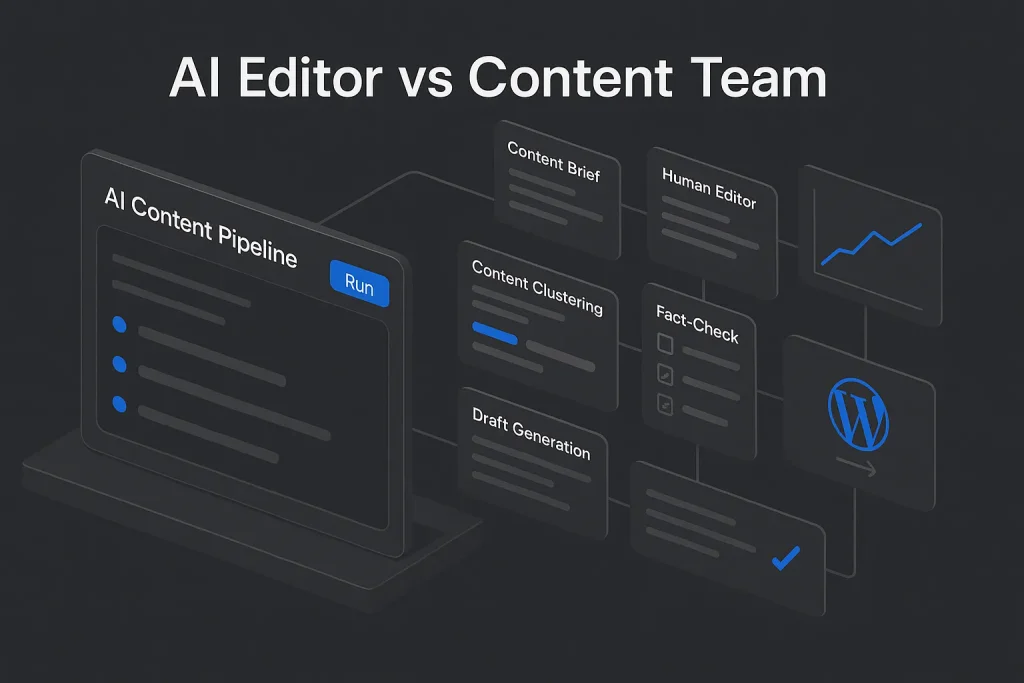
An ai editor is unlikely to replace a serious content team outright. What it can replace is a big share of repetitive editorial labor: first-pass cleanup, structural normalization, tone alignment, SEO checklist enforcement, draft expansion, and production coordination across dozens or hundreds of pages. That distinction matters. In modern content operations, the real question is not whether artificial intelligence editing exists, but whether the team knows which decisions can be automated safely and which still need accountable human judgment.
Executive summary: Will an AI editor replace your content team?
The short answer is no. The more useful answer is that it will absolutely change the team’s composition, operating model, and economics. A capable ai editor can process more pages, faster, with more consistency than a fully manual workflow. It can also support ai text editing at scale, generate rewrite options, flag weak transitions, surface structural gaps, and apply style rules across large content sets. In SEO, that matters because throughput and consistency often shape outcomes almost as much as sentence-level polish.
But the limits matter just as much. Editorial quality is not grammar alone. It includes truthfulness, audience fit, search intent alignment, brand risk, legal and compliance sensitivity, source quality, internal linking logic, citation accuracy, and the ability to notice when a draft sounds right but is substantively wrong. AI editing tools do not own accountability. Humans do.
Recent adoption data supports a middle-ground view, not the usual extremes. According to U.S. Census data on AI use in businesses, reported usage among American businesses sat roughly between 17% and 20% during the measured period, with much higher adoption in firms with 250 or more employees. That is meaningful penetration, but it is not evidence that editorial roles are obsolete. It tells us something simpler: businesses are adopting automation unevenly, and operational maturity still trails enthusiasm.
For content teams, the practical implication is straightforward: use AI for heavy lifting, keep human review where judgment affects performance, trust, and downside risk. On our view, that is the only model that scales without quietly degrading quality.
Those three figures describe the market pretty well: AI-assisted publishing is common, enterprise-scale implementation is uneven, and governance now matters more than novelty. We think that is the real story.
The market has already moved from experimentation to mainstream use in content production, but the gap between using AI and governing it well is still wide. On practice, that gap is where most teams either win or create expensive cleanup later.

What editors actually do: strategy, voice, fact-checking, and accountability
Teams often underestimate editorial work because they reduce it to line edits. In reality, an editor sits at the intersection of quality, business strategy, and publishing risk. A copy editor may improve clarity, coherence, consistency, and correctness. A managing editor may control briefs, workflow, deadlines, and publishing standards. An editor-in-chief usually owns policy, approval standards, and reputational accountability. None of those responsibilities disappear because an ai editor online can suggest cleaner sentences.
Editorial work in SEO content has at least six layers. First, there is intent calibration: deciding what search problem the page should solve and for whom. Second, there is structural design: making sure the article covers the topic with enough breadth and logic to satisfy both users and search engines. Third, there is voice and positioning: ensuring the content sounds like the brand rather than generic model output. Fourth, there is verification: checking claims, examples, references, dates, comparisons, and product statements. Fifth, there is internal ecosystem fit: linking to relevant pages, avoiding cannibalization, and preserving taxonomy logic. Sixth, there is release accountability: someone approves the final published asset and accepts the consequences if it is wrong.
This is why human editors remain central in B2B content environments. A SaaS buyer, agency client, or technical evaluator does not judge a page only by grammar. They judge whether it reflects competence. If the article confuses concepts, overstates capabilities, cites nonexistent evidence, or mismatches the buyer’s stage, the page fails even if the syntax is clean.
Editorial accountability becomes even more important in AI-assisted production because automated systems scale errors as efficiently as they scale drafts. A weak manual process may produce ten mediocre articles per month. A weak automated process can produce hundreds. That changes the cost profile of mistakes fast. We have seen this pattern repeatedly: the more aggressive the automation, the more rigorous the approval gates need to be.
For teams weighing whether to move from isolated writing tools to a broader operating model, the better question is whether they need an AI powered writing assistant or a content pipeline for SEO growth. That distinction matters because editing is not one task. It is a control layer across the whole pipeline.
Why strategy remains human-heavy
Strategic editing depends on prioritization under uncertainty. An editor decides when to consolidate pages, when to expand a topic cluster, when to shift messaging for a higher-intent audience, and when a brand should not publish on a subject despite search demand. AI can recommend, summarize, cluster, and draft. It does not bear the business consequences of the decision. On our view, that is the dividing line between assistance and ownership.
Why fact-checking is not optional
Fact-checking remains a distinct control, not a side effect of good writing. OpenAI’s own documentation notes that ChatGPT may produce incorrect or misleading outputs and may fabricate facts, quotes, or citations, as stated in the OpenAI help guidance on output accuracy. That warning should be treated as a workflow requirement, not a disclaimer to scroll past. Any team publishing serious commercial or SEO content needs explicit review steps for factual claims, not just readability.
Why accountability stays with humans
Search engines, customers, and internal stakeholders do not hold a model accountable. They hold the publisher accountable. If content creates legal exposure, brand damage, or conversion friction, the human organization owns the result. That is the strongest reason an best ai editor remains an assistant rather than a replacement.

What an AI editor can do today: grammar, style, structure, and checklists
The case for an ai editing software stack is strong because many editorial tasks are pattern-based. AI works well when the job involves rewriting for brevity, enforcing formatting rules, cleaning transitions, simplifying syntax, normalizing headings, extracting key points, comparing against a brief, and checking for omissions against a predefined rubric.
In practical SEO workflows, editing with AI can improve throughput in several ways:
- first-pass line editing for grammar, punctuation, and syntax cleanup
- headline and subheading refinement for clarity and consistency
- brief-to-draft alignment checks against required sections and key entities
- tone calibration based on style instructions and approved examples
- passive voice reduction, redundancy removal, and sentence compression
- meta description and title variant generation
- internal linking suggestions based on target topics
- FAQ expansion from search intent patterns
- template enforcement across category pages, glossaries, and cluster articles
- pre-publication checklist automation for links, formatting, image fields, and schema inputs
This is where ai editor online free and free ai editor tools often create the wrong expectations. They can handle local edits, but most teams do not struggle with isolated sentence corrections. They struggle with workflow coordination, consistency across assets, and publishing velocity. The real leverage appears when AI is embedded inside the content system rather than treated as a one-off editor app.
According to Pew Research’s 2025 survey on workers and AI chatbots, about one in ten U.S. workers report using AI chatbots at work at least a few times a month, and research, drafting, and editing are among the more common use cases. That fits editorial reality well. The operational value of AI is currently strongest in support tasks, not autonomous decision-making.
The difference between an ai editor website and a content automation platform is operational depth. A standalone editor rewrites text. A workflow platform orchestrates briefs, keywords, structure, draft generation, internal linking, optimization, media fields, and WordPress publishing. For SEO teams, the second model is usually more useful because it removes process friction rather than merely polishing sentences.
A helpful framing is the one discussed in where Grammarly AI Writer stops and full-funnel SEO content automation begins. Sentence-level assistance is useful. The larger gains usually come from controlling the entire production chain. We think many teams underestimate that difference for far too long.
It is also worth separating text tools from adjacent creative tools. An ai photo editor, ai photoshop editor, ai image editor, or ai photo generator can speed up visual production, and ai photography editing or ai photoediting can help with supporting assets. But those tools solve a different problem than ai text editing. They are useful in the stack, just not a substitute for editorial judgment. Even odd search variants like iai photo editing usually point to the same broader demand: faster asset production with human review still in place.
| Editorial task | AI strength today | Human role |
|---|---|---|
| Grammar and syntax cleanup | High | Spot-check edge cases and preserve intended meaning |
| Structure and outline compliance | High | Confirm relevance and section logic |
| Brand voice consistency | Medium | Approve nuance, positioning, and tone boundaries |
| Fact-checking and citation accuracy | Low to medium | Verify claims against trusted sources |
| Search intent fit | Medium | Decide angle, audience, and conversion context |
| Final publication approval | Low | Own release decision and risk acceptance |
The main pattern is clear: the more rule-based the task, the stronger the automation opportunity. The more judgment-heavy the task, the less a tool can safely own it.
Where AI still falls short: originality, E-E-A-T, nuance, and risk control
AI is still weak where content quality depends on lived experience, proprietary context, genuine judgment, and the ability to catch subtle errors with real consequences. That matters directly for search visibility and brand trust.
Google’s position is more nuanced than many content teams assume. In Google’s guidance on AI-generated content, automation is not inherently against policy. The problem is content produced primarily to manipulate rankings. In the broader Google helpful content documentation, the emphasis stays on helpful, reliable, people-first content. That shifts the editorial burden from “Was AI used?” to “Is the page genuinely useful and responsibly produced?”
The addition of Experience in E-E-A-T is especially relevant. Models can imitate expertise patterns, but they do not possess first-hand operational experience. They cannot actually run a campaign, debug a broken WordPress publishing flow, or own a failed SEO migration. They can summarize likely practices. That is not the same thing as demonstrating experience in a way sophisticated readers and search systems often reward.
Originality is another weak point. AI can combine, paraphrase, and reorganize existing patterns quickly. It is much less reliable at producing non-obvious insight derived from proprietary data, unusual workflows, or accumulated field judgment. In competitive SERPs where many pages now use similar AI-assisted scaffolding, originality often comes from humans adding examples, tradeoffs, screenshots, postmortems, and nuanced recommendations.
Risk control is the final major gap. An ai editor app or best free ai editor may improve style, but it can also strengthen bad content by making falsehoods sound polished. That is dangerous in B2B environments. Confidently wrong copy can pass surface-level quality checks and still damage credibility, procurement trust, or compliance requirements. On our view, this is the most underrated risk in the whole AI editing conversation.
Ahrefs estimated in an 2025 study of newly created pages that 74.2% of pages contained some AI-generated content. The practical implication is not that AI content is automatically weak. It is that surface fluency is no longer a moat. If everyone can generate decent drafts, differentiation shifts to insight quality, editorial discipline, and trust signals.
Data summarized from McKinsey’s 2025 survey show that experimentation exceeds scaled operational impact. That is exactly why editorial governance matters more than tool adoption alone. We would go further: many teams are not under-automated, they are under-governed.

Human-in-the-loop vs AI-in-the-loop: which workflow fits your team
There are two common operating models in AI-assisted content. In a human-in-the-loop model, AI produces or transforms content, but humans review at critical stages before publication. In an AI-in-the-loop model, humans define rules and exceptions while the system executes most routine tasks automatically. Neither model is universally better. The right choice depends on content risk, team maturity, topic sensitivity, and scale requirements.
Human-in-the-loop works best when content quality variance is expensive. That includes B2B pages targeting qualified traffic, high-consideration SaaS buyers, regulated industries, executive thought leadership, and technical documentation that could mislead users if wrong. Here, AI functions as production support and acceleration. Editors still intervene early and often.
AI-in-the-loop works better when the content set is large, templated, and process-driven. That includes glossary pages, category expansions, location variants with strong validation rules, routine blog support content, internal linking sweeps, metadata refreshes, and update cycles where most decisions can be made by policy rather than case-by-case judgment.
A mature content organization often uses both models at once. High-risk pages get deeper human review. Lower-risk pages move through automated generation, cleanup, formatting, and publishing with selective sampling. On practice, hybrid beats ideology almost every time.
When human-in-the-loop is the right default
Choose this model if your team publishes expert-driven content, if your brand sells trust, if claims need source validation, or if your editors spend more time correcting conceptual errors than fixing grammar. In those environments, AI should reduce labor but not narrow review depth.
When AI-in-the-loop becomes efficient
Choose this model once your prompts, templates, citation policies, formatting rules, internal linking logic, and publishing workflows are stable enough to encode. The point is not to remove editors. The point is to redeploy them away from repetitive cleanup and toward exception handling and strategic review.
| Workflow model | Best fit | Main risk | Operational outcome |
|---|---|---|---|
| Manual-first editing | Small teams, high-risk pages, bespoke thought leadership | Low velocity and inconsistent throughput | High control, limited scale |
| Human-in-the-loop AI | Most B2B SEO teams | Bottlenecks if review gates are unclear | Balanced scale and quality |
| AI-in-the-loop with editor oversight | Large content inventories and repeatable page types | Scaled errors if governance is weak | High velocity with controlled exceptions |
Most teams should not jump directly from manual publishing to near-autonomous workflows without first standardizing review logic. Skip that step, and the speed gains rarely hold.
Quality control framework: datasets, prompts, fact-checking, citations, and bias mitigation
If a team wants an ai editor online or broader ai editing tools to improve output rather than simply increase volume, quality control has to be designed explicitly. Good prompts are not enough. Teams need controlled inputs, verification rules, and escalation logic.
A robust framework usually contains five layers. The first is source discipline. AI outputs should be grounded in trusted source sets, internal documentation, product notes, approved claims, and topic-specific references. The second is prompt engineering with constraints, including audience, tone, prohibited claims, required sections, and citation instructions. The third is validation, covering factual checks, date accuracy, entity consistency, cross-link checks, and title-meta-body alignment. The fourth is editorial adjudication, where a human resolves ambiguity or flags content that should not publish. The fifth is post-publication monitoring, where rankings, engagement, corrections, and revision patterns feed back into the system.
Bias mitigation also belongs in editorial quality control. Models reflect patterns in training and prompting. That can produce narrow assumptions, overconfident framing, or blind spots in examples. In B2B content, bias often shows up as simplistic recommendations, generic buyer assumptions, or uneven treatment of edge cases. Editors catch this by asking a blunt question: would this still sound credible to a knowledgeable practitioner?
Content teams that rely on automation should define what must be checked every time and what can be sampled. For example, every page may require verification of product claims, external references, and internal links, while only a sample may need deeper style audits if the templates are stable.
Operationally, this moves the team from “trust the model” to “trust the system.” On our view, that is a much stronger position and a much more durable one.

A practical review stack for AI-assisted editing
A review framework becomes more effective when each layer has a clear owner. Strategists own topic intent and business fit. AI operators or content managers own prompt and workflow configuration. Editors own readability, coherence, and approval quality. Subject experts or product owners validate claims in high-stakes areas. SEO leads monitor SERP fit, entity coverage, and cannibalization risk.
For teams building repeatable process, the workflow described in automates SEO content ops from semantic clustering to auto-publishing in WordPress is useful because it frames editing as one control layer in a larger system rather than as an isolated end-stage activity.
SEO implications: intent fit, entity coverage, and how AI impacts rankings
From an SEO perspective, the wrong debate is whether Google can detect AI prose in the abstract. The better question is whether the page solves the query better than competing alternatives. An ai editor can help with structural completeness, entity inclusion, readability, and publishing speed. It cannot guarantee ranking outcomes if the page misses intent, repeats commodity phrasing, or lacks genuine usefulness.
AI affects rankings indirectly through operations. It lets teams publish faster, update more often, maintain more consistent on-page formatting, build larger topic clusters, and enforce internal linking more reliably. Those are real advantages. At the same time, AI can lower average quality if the workflow rewards volume over validation. We have seen both outcomes, and the difference usually comes down to process discipline rather than model choice.
Three SEO dimensions matter most here.
Intent fit. The page must answer the real user need behind the query. A draft may be clean and comprehensive yet still fail if it addresses the wrong audience stage or format expectation.
Entity coverage. AI can help ensure the article mentions the essential concepts, tools, processes, and subtopics related to the topic. This is one of the strongest use cases for ai text editing in SEO because omissions are often pattern-detectable.
Trust and evidence. As more pages become AI-assisted, credibility signals grow in importance. Examples, source transparency, practical specifics, and first-hand details help differentiate content from generic synthesis.
McKinsey’s 2025 State of AI reporting found that 88% of respondents said their organizations regularly use AI in at least one business function, but nearly two-thirds had not yet scaled AI across the enterprise. That gap mirrors SEO operations well. Many teams use AI for fragments of the workflow. Fewer have built a reliable end-to-end content system with measurable quality control.
That is why content teams should think in terms of pipelines rather than prompts. A single free ai editor can improve local output. A system improves ranking operations. On our view, that is the practical difference between experimentation and actual SEO leverage.
The operational lesson for SEO is simple: adoption by itself is not the advantage. The advantage comes from turning AI use into repeatable, measurable publishing quality.
Team design: roles for strategists, editors, subject experts, and AI operators
Once an organization adopts AI-assisted content production, role clarity becomes more important, not less. Teams that fail here usually create duplication: writers edit what AI already fixed, editors rewrite strategy decisions that should have been solved in the brief, and SEO managers become bottlenecks because no one else owns validation logic.
A durable team design usually includes four distinct roles.
Content strategist or SEO lead. Owns topic selection, keyword clustering, SERP intent, content briefs, and business prioritization.
Editor. Owns quality, readability, consistency, risk review, and final polish. This is where most human value concentrates once AI handles the first draft and mechanical cleanup.
Subject expert or product owner. Validates claims, examples, workflows, and edge-case accuracy in sensitive or technical topics.
AI operator or content systems manager. Owns prompt libraries, workflow automation, templates, QA rules, and integrations such as CMS publishing and internal link mapping.
In smaller teams, one person may cover multiple roles. The principle stays the same: separate generation, validation, strategy, and approval.
This shift also changes hiring logic. Instead of hiring only for writing speed, teams benefit more from people who can define standards, judge content quality, and improve systems. The highest-leverage editorial talent becomes better at governing machines and resolving exceptions than at manually polishing every sentence.
For organizations trying to scale without diluting standards, the better path is usually not removing editors. It is raising the level of editorial work they perform. We think that is the healthiest reframing for content leaders right now.

Tooling blueprint: using Autopilot SEO for heavy lifting and human editors for final polish
For most B2B teams, the ideal setup is not a standalone ai editor website that edits text after the fact. It is a system that handles the upstream and downstream work around the article: semantic planning, content structure, drafting, optimization, image fields, internal links, and publishing preparation. That is where the time savings compound.
SEO Autopilot fits this model well because it is designed as a collaborative production layer rather than a replacement for editorial accountability. The platform can take on the heavy lifting: generating semantic direction, building article structure, producing draft content, preparing images and metadata, and pushing material toward publication in WordPress. Human editors then focus on what they do best: validating claims, adjusting nuance, protecting brand voice, and approving the final asset.
This division of labor is economically cleaner than full manual production and safer than blind autopublishing. It also aligns with how most successful teams already use AI: not as an autonomous content department, but as infrastructure for speed and consistency.
Teams evaluating process modernization can review the workflow on the official SEO Autopilot site. The practical advantage is not only that drafts are produced faster. It is that editorial capacity is reserved for the tasks where human review changes outcomes.
This is also the difference between general-purpose ai editing software and a content operations platform. One improves isolated text. The other reduces end-to-end production friction.
A related perspective appears in the case for full SEO autopilot and in the broader guidance on how to scale your blog without sacrificing SEO quality. The common principle is consistent: automate the pipeline, not just the paragraph. On our view, that is where the best ai editor conversation becomes much more interesting than a simple tool comparison.
Governance and KPIs: approval gates, error budgets, revision rates, and velocity
Once AI enters the editorial workflow, teams need metrics that reflect quality control, not output volume alone. A good governance model does two things at once: it prevents scaled errors, and it makes automation measurable.
The most useful KPIs usually include:
- draft-to-publish cycle time
- average number of human revision rounds per article
- share of articles approved without major structural rewrite
- fact correction rate after editorial review
- post-publication correction rate
- internal linking completeness
- metadata completion accuracy
- search intent match score from editorial QA
- organic performance by content cohort
- cost per published article and cost per updated article
Error budgets are especially useful. Instead of assuming AI must be perfect, define tolerable thresholds for specific error classes. For example, zero tolerance for fabricated citations, low tolerance for product claim errors, moderate tolerance for minor phrasing edits, and higher tolerance for stylistic cleanup needs in low-risk articles. This gives teams a rational basis for deciding which content can flow faster and which needs heavier review.
Governance also needs clear approval gates. A common model is: brief approval, draft QA, factual validation for sensitive claims, editorial polish, SEO checklist signoff, then publication. Lower-risk pages may merge some gates. Higher-risk pages may add legal or subject-matter review.
Without these controls, near-autonomous publishing tends to look efficient until the first serious quality incident reveals that no one defined ownership. We have seen that story before, and it is never as cheap as the initial time savings suggest.
These figures reinforce a practical point: teams should measure whether automation creates business value, not merely whether it exists in the workflow.
ROI comparison: manual team vs AI-assisted pipeline vs near-autopilot with editor oversight
The ROI case for AI-assisted editing is usually compelling, but only when evaluated at the process level. Comparing a human editor to an AI tool one-for-one misses the economics. A better comparison is between operating models.
Manual team. Highest direct labor per article, strongest bespoke control, slowest throughput, and frequent bottlenecks in drafting and routine editing. Suitable when volume is low and stakes per page are high.
AI-assisted pipeline. Lower direct labor per article, better consistency, faster updates, scalable template use, and more editorial capacity available for final judgment. This is the strongest default model for most SEO teams.
Near-autopilot with editor oversight. Best for large content programs with clear rules, repeatable page types, and strong QA systems. Highest throughput, but only sustainable if governance is mature and exception handling is disciplined.
The ROI inflection point usually appears when editors stop spending time on low-value cleanup. If a team still asks senior editors to normalize headings, tighten intros, insert basic FAQs, or repair repetitive metadata by hand, it is wasting expensive judgment capacity on machine-suitable work.
The caution is simple: automation ROI collapses when poor drafts require deep rewrites or when publishing errors force retractions and reputational cleanup. That is why the best AI workflows are not the ones with the fewest humans. They are the ones where human time is applied at the highest-value checkpoints. On our view, this is the most pragmatic way to think about ai editor ROI.
| Operating model | Cost profile | Quality profile | Best use case |
|---|---|---|---|
| Manual editorial workflow | Highest labor per asset | Strong custom control, variable throughput | Low volume, high sensitivity content |
| AI-assisted pipeline | Lower labor through automation of repetitive work | Best balance of speed and review quality | Most B2B SEO programs |
| Near-autopilot with editor oversight | Lowest marginal production cost at scale | Strong if QA is mature, risky if not | Large repeatable content inventories |
For most organizations, the middle option produces the best mix of ROI, reliability, and editorial sanity. It is not the flashiest answer, but it is usually the correct one.
Implementation checklist: policies, prompts, brand voice, escalation paths, and training
A realistic AI editing rollout should be operational, not ideological. Teams move faster when they document standards early and reduce discretionary chaos. The checklist below is the most practical way to launch without creating hidden risk.
- Define approved use cases. Specify where AI can draft, rewrite, summarize, optimize, or auto-publish, and where human-only handling is required.
- Create prompt templates by page type. Separate workflows for blog posts, landing pages, glossaries, updates, product education, and comparison content.
- Build a brand voice guide. Include vocabulary rules, sentence preferences, prohibited phrases, evidence standards, and audience assumptions.
- Set claim-validation rules. Product features, pricing, legal points, and external statistics should have explicit review requirements.
- Establish citation policy. Define when sources are required, what types are acceptable, and how editors should verify them.
- Map escalation paths. Decide who reviews technical ambiguity, compliance concerns, uncertain facts, or tone conflicts.
- Instrument KPIs. Track revision rate, cycle time, correction rate, publication velocity, and content performance by workflow type.
- Train editors on system use. Editors should know how prompts shape output, where failure patterns recur, and how to annotate useful corrections.
- Separate low-risk from high-risk content. Not every page deserves the same review depth.
- Review outcomes quarterly. Update prompts, templates, and QA rules based on actual failures and wins.
The most important implementation principle is to avoid treating AI as a magic layer on top of an undefined process. If the editorial system is messy, AI accelerates the mess. If the system is disciplined, AI compounds its strengths. We consider that the core implementation truth, and it applies whether the team uses an ai editor app, an ai editor online free tool, or a larger ai editing software stack.
We think the realistic takeaway is simple: an ai editor is not a replacement for a serious content team, but it is already replacing a lot of low-value editorial labor. The winning teams are not the ones chasing full autonomy at any cost. They are the ones that automate repeatable work, preserve human judgment where it matters, and measure quality as carefully as they measure speed.
On our view, the best approach is a controlled middle path: strong briefs, clear QA rules, automation for production, and human ownership for claims, positioning, and final approval. That model is less glamorous than “AI replaces editors,” but it is much more durable. It also aligns better with how SEO performance actually compounds over time.
Looking ahead, we expect the gap between basic tool users and system-level operators to widen. More teams will adopt ai editing tools, ai editor online workflows, and even best free ai editor options, but only a smaller group will turn that adoption into reliable ranking gains. The next advantage will not come from using AI at all. It will come from governing it better than competitors do.
FAQ
Will an AI editor replace human editors?
No. An ai editor can replace a large amount of repetitive editorial labor, but not the human responsibilities tied to judgment, accountability, brand voice, risk control, and factual approval. The strongest model is AI-assisted production with human final review.
What tasks can an AI editor handle in a content workflow?
AI editing tools are effective for grammar cleanup, structural formatting, tone normalization, draft expansion, metadata generation, checklist enforcement, and some internal linking suggestions. They work best on rule-based tasks where consistency and speed matter more than deep judgment.
How should human editors work with AI to improve content quality?
Human editors should review strategy fit, factual accuracy, citations, nuanced claims, and final polish while AI handles first-pass drafting and cleanup. In practice, this lets editors spend less time on mechanics and more time on the quality controls that affect SEO and trust.
Is AI editing safe for SEO and E-E-A-T?
Yes, if the workflow is governed well. Google focuses on helpful, reliable content rather than the production method, so AI editing is compatible with SEO when the final page satisfies search intent, includes trustworthy information, and reflects accountable oversight.
What KPIs prove that AI-assisted editing is working?
The best KPIs include cycle time, revision rounds, correction rates, structural compliance, internal linking completeness, and performance by content cohort. If output rises but factual corrections and rewrites also rise, the system is automating the wrong parts of the workflow.