
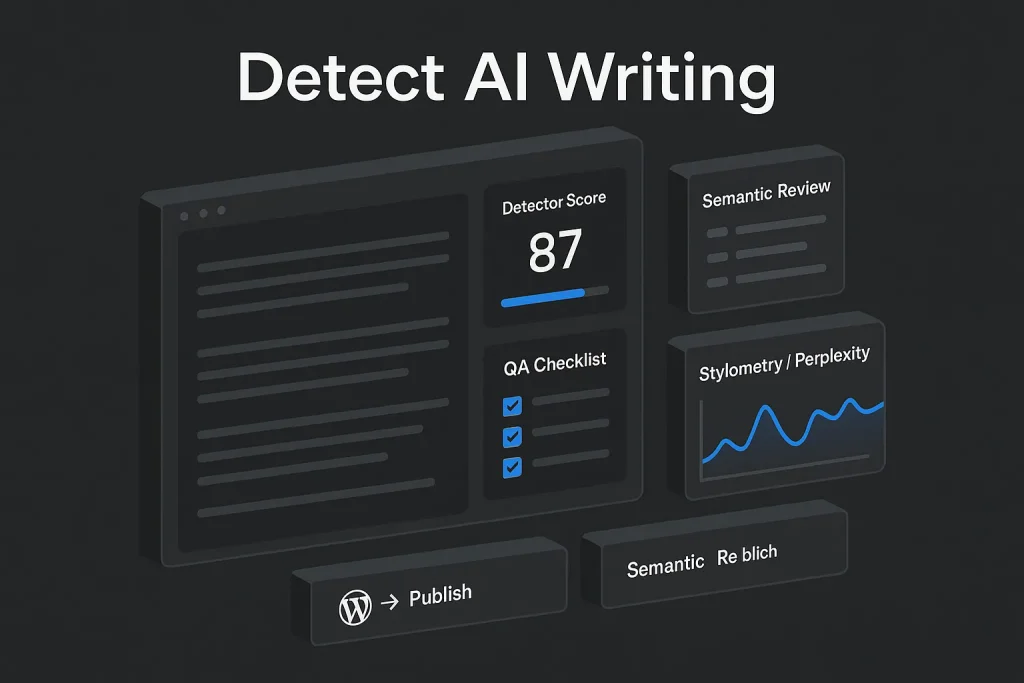
Publishing teams no longer have a content problem. They have a verification problem. As AI-assisted drafting becomes routine, the real operational challenge is how to detect ai writing without mistaking probability for proof, slowing production, or unfairly penalizing solid work from freelancers, guest authors, and non-native English writers.
For bloggers, the stakes are practical. A detector score can tell you which draft deserves a closer look, but it cannot replace editorial judgment, fact-checking, voice control, and SEO QA. Google’s position matters here: quality, originality, usefulness, and compliance matter more than whether a text was produced with AI assistance. On our view, that means an ai writing detector belongs inside the workflow, not above it.
The most reliable model is threshold-based triage. Use an ai detector for writing to surface suspicious patterns, then review the article manually for unsupported claims, repetitive phrasing, thin originality, awkward entity usage, and weak search intent alignment. Treat the tool as a screening layer, not a verdict engine. That distinction saves a lot of bad decisions.

What AI writing detection means for bloggers
In a blogging operation, detection usually serves three jobs. First, it helps identify content that may have been drafted too fast and barely revised. Second, it supports editorial consistency when multiple contributors work in noticeably different styles. Third, it reduces risk when you accept guest posts, outsource content, or run a scaled publishing program.
That said, detect ai writing should never be framed as a moral filter. AI-assisted writing is not automatically weak, and human-written content is not automatically good. We see this constantly in practice. Some AI-assisted posts are deeply researched, heavily edited, and genuinely useful. Some fully human posts are vague, repetitive, and not worth publishing. The standard has to stay editorial value.
For a blogger or content lead, the real question is not “Was AI used?” but “Does this article meet our standards for accuracy, originality, clarity, and usefulness?” That difference matters because many teams misuse a program to detect ai writing as if it were plagiarism software. It is not. Plagiarism tools compare overlap. AI detectors usually estimate probability from language patterns.
Google’s own guidance supports this approach. According to Google Search Central guidance on generative AI content, the ranking issue is not whether content is AI-generated but whether it is helpful, original, and compliant with Search Essentials and spam policies. Google also warns against scaled content abuse when many pages are published with little added value. For bloggers, that means QA has to focus on substance, not just source.
In real workflows, detection is useful for:
- screening guest posts before line editing starts
- checking outsourced drafts that feel overly generic
- flagging posts with improbable consistency, low specificity, or templated sections
- building documentation around editorial review decisions
- protecting site quality when scaling output in WordPress
The operational value is highest when your team knows exactly what happens after a draft is flagged. A red score with no reviewer playbook just creates noise. A detector paired with revision rules creates a repeatable system. We consider that the difference between useful QA and performative QA.
How AI detectors work: perplexity, burstiness, stylometry, watermarking
Most tools sold as an ai writing detection tool do not actually “know” whether AI wrote a text. They infer likelihood from statistical regularities. If you understand those signals, you are far less likely to overtrust the score.
Perplexity
Perplexity measures how predictable a sequence of words is to a language model. Text that is highly predictable may score as more machine-like because many generative systems produce smooth, probable continuations. But predictability is not unique to AI. Clear business writing, educational copy, and beginner-friendly blog posts can also look highly predictable.
Burstiness
Burstiness refers to variation in sentence length, structure, and information density. Human writing often has uneven pacing: short lines, longer explanations, abrupt turns, and local stylistic shifts. AI-generated text can look more evenly distributed. Still, edited AI copy can become more varied, and disciplined human writers can look less bursty than expected. So burstiness is a clue, not a conclusion.
Stylometry
Stylometry looks at style markers: sentence rhythm, punctuation habits, lexical diversity, repetition, and related features. A sophisticated software to detect ai writing may combine stylometric analysis with classifier outputs. That can help in editorial settings where you know the expected author voice. It is less reliable when contributors vary widely or when a draft has already gone through several rounds of revision.
Classifier-based scoring
Some systems train models on examples of AI-generated and human-written text, then score new samples by similarity. This can work reasonably well in controlled datasets. It tends to weaken in open publishing environments. A classifier trained on one generation style may struggle with another. It may also perform poorly on niche formats such as product explainers, technical guides, or lightly edited multilingual content.
Watermarking
Watermarking is a different category. Instead of analyzing finished text for likely patterns, it embeds a detectable signal during generation. A widely discussed 2023 University of Maryland paper on LLM text watermarking proposed a method that can be detected statistically with negligible impact on output quality. In follow-up work on watermark reliability after paraphrasing, the same research line reported detectability on average after about 800 tokens under strong human paraphrasing at a 1e-5 false-positive rate.
For bloggers, the takeaway is simple. Watermarking tries to survive transformations that can weaken ordinary detectors. But most public blog workflows still rely on post-hoc tools rather than watermark-aware platforms. On our reading, that means the market is still operating with imperfect signals and a lot of confidence theater.
Below is a practical comparison of the main detection approaches.
| Method | What it looks for | Best use case | Main limitation |
|---|---|---|---|
| Perplexity | Predictability of word sequences | Initial draft triage | Predictable human writing can look AI-like |
| Burstiness | Variation in sentence rhythm and density | Spotting overly uniform drafts | Editing can quickly change the signal |
| Stylometry | Lexical and stylistic regularities | Known author or brand voice checks | Mixed editing reduces reliability |
| Classifier scoring | Similarity to trained AI/human examples | Tool-level probability screening | Dataset drift across models and genres |
| Watermarking | Embedded generation-time signal | Controlled generation environments | Not available across all public content sources |
No single detection family is strong enough to make publication decisions on its own.

Where detection fits in a blogging workflow (from ideation to publish)
Detection works best when it is built into the content lifecycle rather than bolted on at the end. Bloggers who only check if ai wrote this after formatting and optimization usually waste time, because a flagged draft often needs structural revision, not cosmetic polishing.
Stage 1: Brief and source design
Strong editorial inputs reduce the need for aggressive detection later. A detailed brief should define target query, audience, claims that require sourcing, brand voice requirements, internal links, and prohibited filler patterns. If the brief is weak, even a human writer may produce generic content that resembles low-value AI output.
Stage 2: Draft creation
At this stage, allow AI assistance if your policy permits it, but require source-backed claims and original framing. The real issue is not whether the writer used AI but whether the draft adds synthesis, examples, and editorial intent. Teams that ban AI entirely often still receive poor content. Teams that permit AI with controls often get faster and better first drafts. We have seen that trade-off play out repeatedly.
Stage 3: Detector triage
Run the first screening before heavy editing. That gives you a cleaner signal. If the draft is flagged by one best ai detector candidate, do not reject it on the spot. Mark it for review. If multiple tools identify the same risk and the text also feels generic on manual reading, move it to a revision queue.
Stage 4: Human editorial review
This is the non-negotiable layer. Reviewers should check factual support, search intent match, content originality, authoritativeness of examples, entity accuracy, internal consistency, and stylistic credibility. A detector may suggest risk. A human editor decides whether the piece is publishable.
Stage 5: SEO optimization
Once the draft is substantively sound, optimize metadata, headings, semantic coverage, internal links, image context, schema where relevant, and on-page structure. If you want a process model for quality control around detection, the article How an AI Writing Checker Can Save Your Brand’s Reputation is a useful complement to this workflow.
Stage 6: Publish and post-publish monitoring
After publication, monitor engagement, ranking behavior, and revision needs. Detector scores alone do not predict organic performance. Posts that rank tend to be specific, useful, and tightly aligned with intent, regardless of whether AI helped draft them.
These figures, reported by Pew Research Center in 2025, help explain why blogging teams increasingly need both AI-assisted drafting policies and review systems that can check if text was written by ai when needed.
The operational lesson is straightforward: AI use is expanding, but not evenly, which makes documented editorial review more valuable than blanket assumptions.
Limits of AI detection: accuracy, false positives, and adversarial rewriting
The biggest mistake bloggers make is treating a detector score as objective truth. Detection accuracy varies across tools, datasets, text lengths, genres, and editing states. A paragraph from a polished B2B explainer may look more machine-like than a messy human draft. A heavily edited AI-assisted article may look less machine-like than its origin suggests.
Research literature and product behavior both justify caution. A 2024 peer-reviewed review discussed substantial variability in how well-known tools classified the same texts. That matters because a single app to detect ai writing can overfit its own assumptions, especially when it encounters genres outside its evaluation set.
Bias is the more serious problem. A 2023 Stanford study on bias in GPT detectors against non-native English writers found that human-written TOEFL essays were frequently misclassified as AI-generated. If your blog works with international freelancers, multilingual guest contributors, or early-career writers, this risk is not theoretical. False positives can punish legitimate authors simply because their English is more standardized or less idiomatic. On our view, this is where many detection policies quietly become unfair.
OpenAI’s decision to withdraw its own classifier remains one of the clearest warning signs. As reported by Ars Technica’s coverage of OpenAI discontinuing its AI writing detector, the tool was removed on July 20, 2023 because of low accuracy. If the company behind a leading model could not justify broad public use of its detector, content teams should be very careful with rigid pass-fail rules.
There is also the adversarial rewriting problem. A draft can be paraphrased, reordered, shortened, expanded, or stylistically smoothed in ways that materially change detector output. This is why “humanize ai” services are marketed so aggressively. They exploit the fact that post-hoc detectors are probabilistic and often fragile. For ethical bloggers, the lesson is not to evade detectors for the sake of evasion. It is to understand that detector scores can shift sharply after legitimate editing too.

How to choose an AI writing detector: evaluation criteria and metrics
Bloggers comparing GPTZero, an essay ai detector, or another commercial platform often spend too much time on the homepage interface and too little on operational fit. The right tool is the one that improves editorial decisions with the fewest unnecessary escalations.
Core criteria to evaluate
1. False-positive tolerance. If your site works with guest authors or non-native English contributors, this is critical. A tool that flags too aggressively creates editor workload and damages contributor trust.
2. Minimum text length. Many tools are weak on short samples. If you publish news blurbs, product updates, or short explainers, test the detector on those formats specifically.
3. Genre robustness. A tool may handle essays differently from affiliate content, SaaS explainers, technical tutorials, or list-based blogging content.
4. Score explainability. The best systems do not just output a percentage. They provide sentence-level highlights, confidence framing, or guidance for manual review.
5. Workflow integration. If your team uses WordPress heavily, detector usage should fit into your content pipeline. Manual copy-paste checks can work for a solo blogger. They do not scale well for agencies or editorial teams.
6. Data handling and privacy. Before pasting unpublished drafts into a third-party detector, review its terms and retention model. This matters even more for sponsored content, pre-launch pages, or client work.
7. Multi-tool corroboration. Because accuracy varies, your process should allow comparison. One tool may be your primary screener, but borderline cases should be reviewable in a second tool or by a senior editor.
For teams trying to scale content without losing editorial control, Building Content Machines: The Ultimate Scale Guide for SEO Agencies is useful context for designing workflows that balance throughput with QA.
A concise vendor evaluation matrix removes guesswork. We would also add one practical note: if a tool looks impressive in demos but creates constant reviewer friction, it is not the right tool for your stack.
| Evaluation area | What to test | Why it matters for bloggers |
|---|---|---|
| False positives | Run verified human samples from multiple writers | Prevents unnecessary rejection of valid drafts |
| Edited AI samples | Check raw and revised versions separately | Shows how fast signal weakens after normal editing |
| Short-form reliability | Test snippets, intros, and summary blocks | Many blog components are shorter than full articles |
| Explainability | Review score notes, highlights, and exports | Makes reviewer decisions more consistent |
| Privacy | Check storage, retention, and training clauses | Protects unpublished and client-sensitive drafts |
Choosing a detector is less about brand popularity and more about how the tool behaves on your real content mix. That is why names like gptzero, winston ai, originality ai, or even walter writes ai should be tested against your own samples instead of accepted on reputation alone.
Hands-on testing protocol you can replicate (datasets, thresholds, scoring)
If you want to know whether a free ai writing detector or premium platform is actually useful, build a local evaluation set instead of trusting marketing pages. A practical benchmark for bloggers does not need to be academic. It does need to be controlled.
Build three sample groups
Group A: verified human writing. Use published or private drafts from trusted writers with known provenance. Include native and non-native English contributors, different experience levels, and multiple article types.
Group B: raw AI drafts. Generate drafts from the AI tools your team or contributors are likely to use. Keep prompts realistic. Do not create toy examples.
Group C: edited AI-assisted drafts. Take Group B and revise it to publication standard. Add sourcing, restructure sections, rewrite intros, vary sentence rhythm, add examples, and remove generic filler.
This three-way split matters because many detectors look strong when comparing raw AI against untouched human text, but blog content in the wild is usually hybrid. That is the environment you need to test.
Score with thresholds, not absolutes
Instead of saying “anything above X is banned,” use ranges such as low concern, review recommended, and high concern. This is a better way to detect ai writing in production because it matches editorial triage. For example:
- Low concern: publish if other QA checks pass
- Review recommended: senior editor checks claims, voice, and originality
- High concern: send back for revision before optimization and formatting
These ranges should be set only after testing your own data. A tool that works for student essays may behave very differently on B2B blog posts, product-led content, or technical explainers. This is also where an ai writer detector and an ai generated essay checker can diverge more than vendors admit.
The adoption trend below supports why standardized testing now matters for content teams.
Even broad workforce figures suggest that AI-assisted writing and AI review will increasingly coexist in mainstream publishing operations.
Track reviewer agreement
A detector is only operationally useful if it improves human decisions. For each flagged sample, record whether reviewers agreed with the escalation, what problems they found, and whether revision resolved the issues. Over time, this tells you whether your chosen tool reduces risk or simply adds friction.
Use a lightweight scoring sheet
Your internal sheet can include detector score, sample type, source certainty, reviewer decision, key issues found, revision time, and final publish decision. This becomes a calibration tool. It also helps teams compare tools such as gptzero, winston ai, originality ai, or another software to detect ai writing without overreacting to one-off results.
Interesting point here: once teams start tracking reviewer agreement, they often realize the detector is not catching “AI” so much as catching weak editing. That is still useful. But it is a different job.

Write AI-assisted content that won’t be flagged: ethical, SEO-safe practices
The right goal is not to game detection. It is to produce content that is genuinely useful, well-sourced, clearly structured, and human-reviewed. Once that standard is met, detector outcomes tend to matter less.
AI-assisted content is more likely to be flagged when it is generic, repetitive, low-specificity, overly symmetrical in phrasing, or packed with obvious summary language. It is less likely to create concern when the human editor adds domain framing, evidence, examples, nuance, and stronger rhetorical control.
What high-quality revision actually changes
Good revision does more than swap words. It changes information structure. It adds original comparisons, updates claims, checks product terminology, inserts concrete examples, and removes filler transitions. This is why “humanized” content that is only cosmetically rephrased often remains weak from an SEO and editorial standpoint. In other words, to humanize ai well, you need real editorial work, not a surface-level paraphrase pass.
If your process needs a stronger model for AI-assisted quality, see How to Write Human AI Content That Actually Converts Visitors and Natural Write AI: How to Write SEO Copy That Sounds Like a Human Expert. Both are useful references for building content that reads credibly instead of mechanically.
From an SEO standpoint, the publish-safe standard is simple:
- every key claim should be supportable
- the article should solve a search problem clearly
- examples should be context-specific rather than generic
- sections should add distinct value rather than restating previous text
- the final draft should reflect an editor’s judgment, not raw model output
That is how you reduce the need to constantly check if something was written by ai after the fact. Better inputs and stronger revision create better outputs. We consider this the most SEO-safe path because it improves the page itself, not just the detector score.
WordPress workflow: automate checks and publishing with Autopilot SEO
Most blogging bottlenecks happen between “draft exists” and “post is safely publishable.” Detection is one checkpoint in that path, but the real gains come from reducing manual handoffs across research, structure, writing, SEO optimization, internal linking, image preparation, and WordPress publication.
A mature workflow separates three layers: generation, validation, and publishing. AI can support generation. Detection and QA support validation. WordPress integration supports publishing. When these layers are disconnected, teams end up copy-pasting between tools and losing track of revision state.
That is where a platform like SEO Autopilot becomes commercially relevant. Instead of treating AI as a raw text spout, the platform is designed around the full SEO content pipeline: semantics, structure, article generation, image handling, and direct WordPress publishing. If your team is looking to scale content operations while keeping a documented review stage, the official SEO Autopilot website is the right place to review the product workflow and fit.
For bloggers and agencies, the strategic value is not “replace editors.” It is “reduce manual production overhead while preserving control points.” In practice, that means you can automate repetitive content operations and still insert a detector review or editor approval stage before publication. On our view, that is the only sane way to scale: automate the repetitive work, keep humans on the judgment calls.

Policies and compliance: disclosures, privacy, and Google’s stance on AI
Policy design matters because detection is not only an editorial issue. It affects contributor expectations, privacy handling, and how your site explains AI assistance to readers when relevant.
Google’s stance
Google does not ban content simply because AI helped create it. The central concern is whether the page is useful, accurate, and aligned with Search Essentials. At the same time, scaled publishing of low-value pages can violate spam policies. That is why a blogging team should focus on editorial value and process discipline rather than trying to pass or fail content based on detector output alone.
Disclosure policy
Google also recommends giving readers context about how content was created when that context would be useful. For bloggers, a disclosure policy does not need to be theatrical. It needs to be consistent. For example, you may disclose AI assistance on highly technical explainers, financial comparisons, or medically adjacent topics where process transparency adds trust.
Privacy and draft security
If you use a third-party ai generated essay checker or another detector, confirm whether unpublished content is stored, retained, or reused. This is especially important for client blogs, embargoed launches, and commercially sensitive articles. Privacy review should be part of vendor selection, not an afterthought.
The policy stack should answer four operational questions: when AI assistance is allowed, when detector checks are required, who reviews flagged content, and when disclosure is appropriate.
| Policy area | Recommended rule | Operational benefit |
|---|---|---|
| AI use by writers | Permit with source-backed claims and human revision | Preserves speed without lowering standards |
| Detector usage | Use for triage, not proof | Reduces false-confidence decisions |
| Flagged drafts | Require manual review and documented revisions | Creates auditability and consistency |
| Disclosure | Disclose when creation context adds reader value | Supports transparency without over-disclosing |
| Privacy | Review vendor retention and storage terms | Protects unpublished or client-sensitive content |
Good policy prevents detector misuse long before a dispute with a contributor or client appears. That is not glamorous work, but it is usually where the real risk sits.
What to do if your post is flagged: triage, reviewer steps, and revisions
A flagged post should enter a controlled review path. The fastest way to waste editorial time is to rerun the same draft through multiple tools without changing the content or diagnosing the issue.
Triage sequence
Start by confirming draft status. Is it raw, lightly edited, or near-final? Raw drafts often produce higher-risk outputs than revised drafts. Next, inspect whether the tool flagged the whole article or only specific passages. Then check whether the article contains unsupported claims, flat transitions, repetitive list logic, or weak examples. In other words, review the text itself before reacting to the score.
Reviewer steps
The reviewer should examine:
- claim accuracy and evidence support
- topic specificity and search intent match
- voice consistency with site standards
- section-level originality and synthesis
- signs of repetitive or templated wording
- whether the draft adds real value beyond common summaries
If those checks pass, the post may still be publishable even with a moderate detector score. If they fail, the detector was useful because it surfaced a weak draft that needed intervention. We think that is the healthiest interpretation model: the score starts a review, it does not finish one.
The chart below summarizes the safest editorial interpretation model.
The point is not mathematical precision. It is procedural clarity. A detector score becomes useful only when the next action is predefined.

Editorial checklist for guest posts and freelancers (detection-ready guidelines)
Guest posts and outsourced drafts create the highest detection complexity because provenance is often less visible. A clean editorial checklist improves consistency and reduces unnecessary disputes.
Your contributor guidelines should define whether AI assistance is allowed, what kind of sourcing is required, whether drafts may be run through an ai detector for writing, and how flagged drafts will be handled. Transparency protects both sides.
A strong checklist usually includes authorship declaration, source expectations, prohibited generic filler, acceptable AI use, revision responsibilities, and final editorial authority. This works better than simply saying “no AI” because it targets quality behavior rather than unverifiable intent.
For blogs with multiple contributors, the best process is to normalize review rather than personalize suspicion. Every guest post passes through the same quality gates. Some drafts may also be screened with an ai writing detector. If a score triggers review, editors check evidence, voice, and usefulness before making a decision.
On our view, this is also the fairest way to check if writing is ai generated or check if ai wrote this without turning the process into a credibility trap for contributors. Consistency matters more than suspicion.

We think the practical takeaway is clear: detectors are useful when they sit inside a documented editorial system, and risky when they are treated as truth machines. The strongest teams do not obsess over whether a tool can perfectly detect ai writing. They build briefs, review steps, and revision standards that make weak content easier to spot regardless of origin.
Looking ahead, we expect more hybrid workflows, not fewer. That means more demand for an ai writing detection tool, but also more pressure on teams to validate those tools against their own content rather than vendor claims. The likely winners will be publishers that combine AI speed with human QA discipline, especially as platforms like gptzero, winston ai, and originality ai keep evolving but remain imperfect.
FAQ
How accurate are AI writing detectors for blog content?
They are not reliable enough to serve as proof on their own. Accuracy changes by tool, text length, genre, editing level, and writer profile, so the safest use of an ai writing detection tool is triage first and manual review second.
Will Google penalize my site for AI-written articles?
Not simply because AI was involved. Google cares more about whether the content is helpful, original, accurate, and compliant with Search Essentials and spam policies. The bigger risk is scaled low-value publishing, not AI assistance by itself.
What’s the best free AI detector for bloggers?
There is no universal winner. A free ai writing detector can be useful for initial screening, but bloggers should test it on their own formats and compare false positives before relying on it. The best ai detector for one site may be a poor fit for another.
How can I reduce false positives when checking guest posts?
Use thresholds instead of hard bans, review flagged passages manually, and calibrate your process on verified human writing from multiple contributors, including non-native English writers. That is the most practical way to check if writing is ai generated, check if something was written by ai, or check if text was written by ai without punishing legitimate authors.
Should I disclose AI assistance in my blog content?
Disclose it when the creation context is useful for readers or relevant to trust. For sensitive, technical, or highly regulated topics, disclosure can strengthen credibility, especially when paired with clear editorial review standards.