
Blog teams no longer judge AI output by speed alone. We judge whether an article is publishable, whether it keeps the original intent, stays factually stable, matches brand voice, and gets through editorial QA without creating SEO risk. That is where writesonic’s ai humanizer fits: not as a magic bypass, but as one editing layer inside a broader workflow that still depends on human judgment.
For bloggers, the real question is simple. A humanizer helps when an AI draft is structurally sound but reads flat, too uniform, too synthetic, or too generic to publish. It helps far less when the draft is weak at the source, contains factual errors, misses search intent, or lacks first-hand perspective. In those cases, rewriting just repackages a weak input.
That distinction matters for SEO. Google does not ban AI content by default; the issue is value, originality, usefulness, and whether scaled production is being used mainly to manipulate rankings. On our view, this is the line many teams still miss. A humanized article with no substance is still a weak page. A carefully edited article with expertise, sources, and context can absolutely be publishable.
What Writesonic’s AI Humanizer Is and When Bloggers Should Use It
Writesonic’s AI Text Humanizer is documented as a feature inside the AI Document Editor, not as a standalone public tool. According to the Writesonic documentation, the feature currently supports English only. For multilingual editorial teams, that is not a footnote. It is a real workflow constraint.
In practical terms, a writesonic humanizer workflow works best in four cases:
- an AI draft is accurate but too mechanical in cadence
- sentence structure repeats across paragraphs
- the tone feels generic and lacks editorial nuance
- the text needs readability refinement before human review and publishing
It should not replace subject-matter editing, source checking, or SEO alignment. If the brief was weak, keyword targeting was sloppy, or the article does not answer real search intent, humanization will not fix the core issue.
For bloggers publishing several posts a week, the strongest use case is draft polishing after the structure is already solid. That usually means intros that feel templated, body sections with repetitive transitions, and conclusion blocks that sound machine-made even when they are technically correct. We see this pattern constantly in SaaS and affiliate content.

A useful way to frame it is this: generation creates raw material, humanization improves flow, and editorial review decides whether the page deserves to rank. That order matters.
How the Humanizer Works: Modes, models, and detection signals it targets
Most humanizers try to change writing patterns that detectors and readers often associate with machine-generated prose. That includes uniform sentence length, repetitive transitions, predictable clause structure, low stylistic variance, generic emphasis language, and paragraphs that feel suspiciously clean. The system is not “understanding” intent the way an editor does. It is modifying textual signals.
That is why bloggers need to know what a humanizer is actually optimizing. Usually it paraphrases, adds variation, changes word order, smooths transitions, and adjusts readability. Sometimes that improves the reading experience. Sometimes it introduces semantic drift. On our experience, both outcomes are common.
Writesonic also offers an Enhanced Readability option, but its own docs warn that enabling it may increase the risk of AI detection. That is an important detail because it breaks a popular myth: better readability and lower detector confidence are not always the same thing. A text can become easier to read and still keep patterns that a detector flags as machine-like.
The platform’s broader stack is also model-flexible. On the Writesonic pricing page, the company positions its tools alongside access to multiple AI models, including GPT-4o and Claude 3.7 Sonnet. That does not mean the humanizer itself gives you every model choice in the same way, but it does show that the surrounding writesonic ai workflow is broader than a single rewrite button.
For editorial teams, the implication is practical: judge humanization by output quality, not by vendor language around AI sophistication. We would treat any other approach as wishful thinking.
The table below maps the main signals a humanizer tends to affect and the editorial risk attached to each one.
| Signal area | What the humanizer changes | Potential benefit | Main risk |
|---|---|---|---|
| Sentence rhythm | Varies sentence length and cadence | Less robotic flow | Forced complexity or awkward pacing |
| Lexical variety | Substitutes repeated phrases and common AI wording | More natural phrasing | Terminology drift and weaker precision |
| Readability | Simplifies phrasing and transitions | Faster scanning for readers | May increase detector sensitivity in some cases |
| Structure smoothing | Improves transitions and continuity | Better narrative flow | Can blur sharp distinctions or nuance |
For bloggers, the goal is not maximum rewriting. It is controlled change with semantic retention. That is a much stricter standard.
Setup Checklist: Inputs, brand voice, tone, and safety constraints
Good output starts before the rewrite. A humanizer cannot reliably infer missing brand standards for professional publishing. Bloggers and content teams need to define the source conditions before they run text through the tool.
The minimum setup checklist includes source quality, audience definition, tone controls, factual constraints, protected terminology, linking rules, and prohibited claims. This matters even more for B2B blogs, affiliate content, regulated sectors, and client deliverables, where a casual wording shift can change legal or commercial meaning.
A practical input framework looks like this:
- Validate the draft first. Remove factual errors, duplicated ideas, and unsupported claims before humanization.
- Lock brand language. Define terms that must stay unchanged, such as product names, category terms, and compliance wording.
- Set tone clearly. For example: direct, expert, neutral, low-hype, short paragraphs, no dramatic claims.
- Define acceptable rewrite depth. Decide whether you want light smoothing, medium paraphrasing, or high variation.
- Preserve SEO anchors. Mark focus keyword placements, internal links, entity mentions, and section purpose so the system does not dissolve search intent.
This is also where many teams misuse a simplified ai humanizer or any quick free paraphrase tool. They paste a draft into a generic rewriter with no constraints, then wonder why the result turns vague. On our view, this is one of the most expensive “time-saving” mistakes in content operations. Humanization without guardrails often strips the exact details that help a post rank or convert.

For a stronger editorial base, teams can pair this step with the principles outlined in Natural Write AI: How to Write SEO Copy That Sounds Like a Human Expert, especially when the main problem is unnatural phrasing rather than missing information.
Step-by-Step Workflow: Humanize an AI draft without losing meaning
A disciplined workflow prevents the most common failure mode: text that sounds more varied but becomes less accurate. The safest process is iterative, not one-shot.
Step 1: Build or import a solid draft. The draft should already match the target query, solve the search intent, and have a usable heading structure. If it is a weak article, stop and fix the substance first.
Step 2: Identify high-risk blocks. Mark paragraphs that sound templated, repetitive, inflated, or generic. There is no reason to humanize every line equally. Overprocessing raises drift risk.
Step 3: Humanize section by section. Instead of rewriting the full article in one run, process intros, body explanations, comparison paragraphs, and CTA transitions separately. This gives much better control over meaning retention.
Step 4: Compare against source meaning. Review whether the rewritten version preserved numbers, conditions, exclusions, definitions, and product references. Small language changes can quietly weaken technical accuracy.
Step 5: Restore SEO precision. Reinsert the focus keyword where needed, maintain entity references, and keep search intent explicit. A polished paragraph that loses topical clarity can underperform.
Step 6: Perform manual line editing. Remove filler, flatten exaggerated wording, and sharpen transitions. This is the point where human oversight adds the most value.
Step 7: Run factual and originality QA. Humanized text still needs source validation, citation review, and duplicate-idea checks.
This process works better than treating ai text humanizer for free tools as final-stage publishing systems. Free tools can be useful for testing. They are not a substitute for editorial control. We have yet to see a serious workflow where QA becomes optional just because the rewrite sounded smoother.
The table below shows a safer rewrite workflow for bloggers.
| Stage | Primary goal | What to check |
|---|---|---|
| Draft review | Confirm substance before rewriting | Intent match, factual coverage, outline quality |
| Selective humanization | Improve natural flow | Paragraph rhythm, wording, transitions |
| Semantic comparison | Prevent drift | Numbers, conditions, exclusions, definitions |
| SEO restoration | Keep ranking relevance | Keyword placement, entities, links, headings |
| Editorial QA | Make it publishable | Fact-checking, citation review, tone, CTA clarity |
The strongest results usually come from selective rewriting plus manual tightening, not from maximum paraphrase intensity. That is slower, but it is also how quality survives.
Settings That Matter: Temperature, rewrite depth, style, and paraphrase limits
Writers often talk about humanizers as if one button decides everything. In practice, output quality depends on how aggressively the text is transformed. Even when a tool does not expose every variable transparently, the same editorial principles still apply.
Rewrite depth controls how much the wording changes. Light rewriting is safer for technical content, product explainers, comparison articles, and legal-sensitive posts. Medium rewriting often works for blog intros, thought-leadership sections, and repeated informational blocks. Heavy rewriting should be reserved for highly repetitive drafts, and only with manual comparison afterward.
Style direction changes more than tone. It shifts the balance between directness, complexity, sentence movement, and lexical variety. If you ask for conversational output on a B2B article, the piece may become easier to read but lose authority. If you ask for polished editorial style, the output may get smoother but less distinctive.
Temperature-like variation is another useful concept. Higher variation can reduce monotony, but it also raises the chance of wording drift and invented nuance. Lower variation is safer when definitions must stay intact.
Paraphrase limits are essential. Every team should decide what must not change: product names, quotations, statistics, entity references, legal disclaimers, and core claims. Without those limits, the humanizer may rewrite the exact lines that needed stability most.

For content marketers, the most useful rule is simple: be conservative on critical sections and push variation only where the prose is obviously synthetic. In our experience, that single habit prevents a lot of cleanup later.
Quality Benchmarks: Readability, E-E-A-T, semantics, and factual integrity
A humanized post should never be judged by one metric. Bloggers need a layered quality model that reflects both search performance and editorial credibility.
Readability matters because users scan before they read deeply. Better transitions, shorter syntactic runs, and less repetition usually improve usability. But readability alone is not proof of value.
E-E-A-T alignment matters because useful content needs visible signals of experience, expertise, authoritativeness, and trust. A humanizer can improve phrasing, but it cannot invent real experience. If the article lacks examples, tested advice, clear definitions, or source-backed claims, it still feels thin. We think this is where many AI-assisted blogs plateau.
Semantic integrity is critical for SEO. When a tool swaps precise terms for looser synonyms, the article may become less aligned with the search query and less clear for both readers and search systems. This is especially risky in SaaS, finance, medical, and technical blogging.
Factual integrity is the non-negotiable benchmark. Any rewrite that changes conditions, numbers, timelines, or qualification statements needs manual correction.
Google’s guidance on AI-assisted content is useful here. According to Google Search Central, using generative AI is not inherently against policy. The issue appears when content is produced at scale without adding value. That shifts the benchmark away from detector games and toward usefulness, which is exactly where it should be.
For deeper editorial thinking on conversion-focused phrasing, How to Write Human AI Content That Actually Converts Visitors is a useful companion read, especially when the challenge is not just sounding human but moving readers toward action.
This scorecard is illustrative rather than vendor-based. The main point is straightforward: factual stability should carry more weight than cosmetic variation. We would not compromise that tradeoff.
Detector Reality Check: Does it pass AI detectors? Tests and limitations
This is the most misunderstood part of the category. Bloggers often judge a humanizer by whether it can pass a detector, but detectors themselves are probabilistic systems with false positives and false negatives. They are not ground truth.
Originality.ai cites a RAID benchmark summary in which its system averaged 85% accuracy across 11 AI models and reached 98.2% accuracy on ChatGPT content, according to the RAID study summary. At the same time, Originality.ai also says that no AI detector will ever be 100% perfect. That is the practical baseline blog teams should work from.
A detector-aware workflow is still useful, but only as one QA lens. If a humanized draft triggers a detector, that does not automatically make the article unusable. If it does not trigger, that also does not make it high quality.
What the humanizer can do is reduce some machine-like textual patterns. What it cannot do is guarantee a universal result across detector tools, models, updates, and thresholds. That is why chasing a “pass” score is usually the wrong KPI.
The broader market context explains why this question keeps getting louder. On its About page, Writesonic says that 1.5 billion people use AI search platforms every month, AI search referrals grew 400% in 2026, 89% of B2B buyers use generative AI to choose solutions, and publishers have seen a 33% drop in Google search traffic according to the company’s own positioning on Writesonic About. Those figures are company-published, but they help explain why teams are pushing harder on AI-assisted workflows.
The useful takeaway is not that detector scores define quality. The useful takeaway is that detector variance is now part of the editorial environment, so teams need process discipline rather than tool superstition. That is a less exciting answer, but a more useful one.

For a more systematic review process, Detect AI Writing for Bloggers: Methods, Limits, and a Practical QA Workflow offers a stronger framework than one-pass detector chasing.
Fixing Failure Modes: Over-paraphrasing, style drift, and factual erosion
The biggest mistake with writesonic’s ai humanizer is assuming that more change automatically means better output. In real editorial work, the same failure modes appear again and again.
Over-paraphrasing happens when the rewritten text becomes linguistically busier but semantically weaker. Technical terms get replaced with loose synonyms. Clear sentences become inflated. The article sounds less robotic, but also less trustworthy.
Style drift appears when the tone moves away from the intended publication voice. A strict B2B article can suddenly sound casual. A concise post can become verbose. A sharp opinion piece can turn bland. We have seen this happen even in otherwise decent outputs.
Factual erosion is the most serious risk. Conditions disappear, numbers detach from context, and cautionary wording gets smoothed out. In SEO and SaaS writing, that can turn a careful statement into an inaccurate one very quickly.
To fix these issues, use a simple repair hierarchy. First restore facts, then restore terminology, then restore brand voice, and only after that refine readability. Many editors reverse this order and end up protecting flow over truth. On our view, that is exactly backwards.
Another common problem is the insertion of generic “human-like” fluff. Broad encouragement, motivational filler, and padded transitions may make the piece feel less synthetic at first glance, but they also weaken density and annoy serious readers. Strong human writing is usually more specific, not more padded.
Alternatives and When to Use Them: Clever, Simplified, and other humanizers
The category is crowded, and bloggers often compare Writesonic with alternatives such as clever ai humanizer, simplified ai humanizer, or even adjacent workflows users loosely describe through terms like ahrefs humanizer ai. The real comparison should not focus only on whether a tool changes wording. It should focus on workflow fit.
Writesonic is strongest when the humanizer sits inside a larger content process rather than acting as an isolated rewrite step. That is useful for bloggers who already work inside a broader platform environment and want fewer tool handoffs.
A lighter standalone humanizer may be enough when the task is small: refining outreach emails, smoothing short social posts, or reducing obvious AI cadence in a simple article draft. A more integrated platform is better when the team also needs drafting, SEO support, visibility workflows, and publishing operations.
The comparison below highlights the practical tradeoffs without pretending there is one universal winner. There usually is not.
| Tool type | Best for | Strength | Limitation |
|---|---|---|---|
| Writesonic humanizer inside platform | Bloggers using a connected AI content workflow | Fits into broader drafting and search workflow | Not a substitute for QA or multilingual editing |
| Standalone humanizer tools | Fast cleanup of short drafts | Speed and simplicity | Limited context control and weaker SEO guardrails |
| SEO-first content platforms | Teams balancing generation, optimization, and publishing | Better process integration | Requires clearer workflow design |
The right choice depends less on labels and more on whether you need isolated rewriting or an end-to-end content operation. That is the comparison that actually affects output.

Blogging Workflow: From draft to WordPress with QA and editorial checks
Humanization creates business value only when it connects cleanly to publication. A blog team should define a standard path from draft generation to final upload.
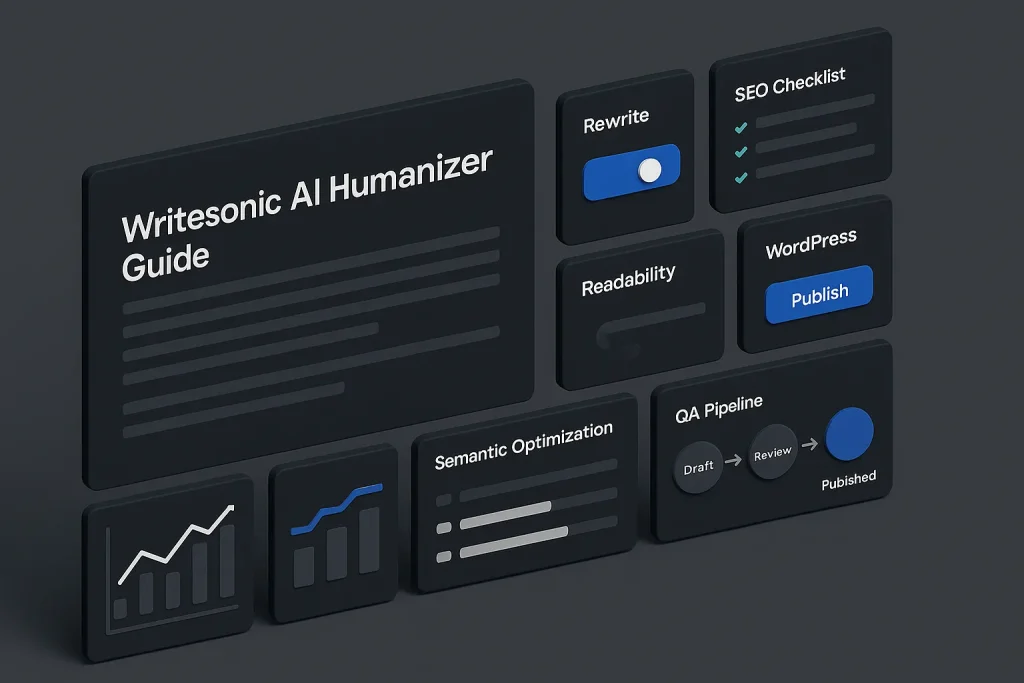
A practical workflow looks like this: brief creation, source collection, draft generation, selective humanization, manual editing, SEO refinement, internal linking, media insertion, CMS formatting, and final QA. If any of those steps are skipped, the team starts using rewriting to hide upstream process gaps.
WordPress adds its own discipline. Headings need a clean hierarchy. Paragraphs must stay scannable. Tables and visuals need contextual captions. Internal links should support navigation rather than exist only for ranking signals. Featured snippets and on-page SEO depend as much on clarity as on keywords.
One reason many AI-assisted blog teams struggle is that they optimize only the drafting stage. The larger gains usually come from standardizing the entire editorial path: who reviews facts, who checks tone, who signs off SEO, and who publishes. Humanization improves one part of that chain, not the whole chain by itself. We think this is where mature teams separate from experimental ones.
Teams worried about low-quality shortcuts should also review Why Using an AI Writer Free Platform Can Lead to Google Penalties. The core issue is not that free tools are automatically bad. It is that weak process often clusters around no-cost experimentation with very little editorial control.
Scaling the Process: Automating briefs, generation, and publishing with Autopilot SEO
Once a team publishes at volume, the limiting factor is no longer a single rewrite feature. It becomes orchestration: keyword discovery, content planning, draft generation, structure quality, internal linking, image workflows, and CMS publishing. This is where the soft boundary appears between a humanizer and a real content operations system.
For teams that want fewer manual handoffs, SEO Autopilot positions itself as a more complete workflow. Instead of treating humanization as the main event, the platform is designed around the broader SEO article pipeline: semantics, structure, text generation, images, and WordPress publishing. You can review the product on the official SEO Autopilot site when the goal is not only to polish wording but to automate repeatable blog production with stronger operational consistency.
This distinction matters for agencies, in-house content teams, and niche site operators. If the bottleneck is “our drafts sound synthetic,” a humanizer may be enough. If the bottleneck is “we cannot consistently move from topic to published article fast enough,” a broader system becomes more valuable.
For agencies in particular, Building Content Machines: The Ultimate Scale Guide for SEO Agencies is the more useful mental model. Scaling content is a pipeline problem long before it becomes a paraphrasing problem.

The operational gain comes from reducing friction between stages, not from over-optimizing one rewriting feature. That is the bigger systems lesson here.
Compliance and Risk: Google guidelines, originality, and attribution
Any discussion of humanizers has to move past detector folklore and into policy reality. Google’s spam rules matter far more than whether a paragraph looks less synthetic.
According to Google spam policies, scaled content abuse includes generating many pages primarily to manipulate rankings rather than help users. That means a humanized article can still be problematic if the whole production system is built around low-value volume.
The safest standard is editorial accountability: check facts, cite sources where needed, disclose limitations when appropriate, and make sure every article adds something useful beyond word count. If an AI draft simply summarizes familiar information, the publisher still needs to add interpretation, framing, context, examples, or tested advice.
Originality in blogging does not always mean inventing a new topic. More often, it means adding a distinctive editorial angle, clearer organization, or stronger real-world application. That is where human oversight matters far more than the rewrite engine itself. On our view, this is also where sustainable SEO still wins.
Attribution is especially important when a humanizer has rephrased sourced information. Rewording does not remove the need for responsible sourcing. If a post relies on official docs, product pages, or public policy sources, the editorial process should preserve that trail.
Pricing, Limits, and Data Privacy Considerations
Pricing matters for workflow design because a humanizer is rarely the only cost in a content stack. According to the Writesonic pricing information, users can start free and no credit card is required to explore the platform. For solo bloggers, that lowers experimentation friction. For teams, the more relevant question is not “is there a free tier” but “what part of the process still stays manual after the free test.”
The absence of product-specific public adoption metrics for the humanizer alone also means teams should evaluate it qualitatively: speed, text quality, semantic retention, review burden, and fit with the existing workflow.
Privacy deserves more attention than most bloggers give it. The Writesonic privacy policy confirms that the company collects and processes personal information across its services. That does not make the tool unusual, but it does mean agencies, client-content teams, and regulated verticals should define what may or may not be uploaded for rewriting.
Useful internal rules include stripping sensitive client notes, avoiding unpublished financial data, removing private personal information, and documenting which team members can process production drafts in external AI tools. On practice, this is basic operational hygiene, not legal drama.

Final Checklist and Reusable Prompts/Templates
The most reliable use of writesonic’s ai humanizer is procedural. Bloggers should stop treating humanization as a binary pass-fail tool and use it as a controlled editorial step with explicit checks.
Pre-humanization checklist: confirm search intent, remove factual issues, lock brand terminology, mark non-editable claims, identify synthetic paragraphs, define rewrite depth, and set tone boundaries.
Post-humanization checklist: compare meaning line by line, restore keyword precision, verify entity mentions, review links and headings, remove filler, check citations, and perform a final human edit for clarity.
Reusable prompt template for light humanization:
Rewrite this section to sound more natural and less repetitive while preserving all facts, numbers, product names, and SEO terms. Keep the tone expert, direct, and concise. Do not add claims, examples, or new information. Vary sentence rhythm moderately and improve transitions only where needed.
Reusable prompt template for medium humanization:
Humanize this draft for a professional blog audience. Preserve meaning, structure, terminology, and factual qualifiers. Reduce generic AI phrasing, vary sentence openings, and improve readability without making the tone casual. Keep key SEO entities intact and avoid dramatic language.
Reusable prompt template for repair after over-paraphrasing:
Compare the rewritten text to the original and restore any lost facts, conditions, technical terminology, or intent. Remove inflated wording and keep the final version specific, accurate, and publication-ready.
For most blogs, that final repair prompt is the one that saves quality. We have seen it rescue more drafts than any “make it sound human” instruction ever does.
We think the real lesson is straightforward: humanization works best as a precision tool, not as a shortcut. The teams getting value from writesonic’s ai humanizer are the ones that already have decent briefs, clear QA, and a publication process that protects facts and intent. The teams expecting one rewrite pass to solve weak strategy, thin content, or sloppy editing will keep getting inconsistent results.
Our forecast is fairly simple. Humanizers will remain useful, but they will matter less as standalone features and more as parts of integrated editorial systems. We also expect detector anxiety to keep fading inside serious teams, while semantic accuracy, brand control, and workflow efficiency become the real buying criteria.
FAQ
Is Writesonic’s AI Humanizer safe to use for SEO?
Yes, if you use it as an editing layer rather than a shortcut for mass low-value publishing. Google’s guidance is centered on usefulness, originality, and value to users, not on whether a draft involved AI assistance.
Can Writesonic’s humanizer reliably pass AI content detectors?
No tool can guarantee that across all detectors. These systems are imperfect, they change over time, and they produce both false positives and false negatives, so the smarter standard is editorial quality first and detector scores second.
What settings produce the most natural, human-like output in Writesonic?
Light to medium rewrite depth is usually the safest for blog content. The best results come from preserving terminology and facts, limiting paraphrase intensity, and manually editing only the sections that sound templated or repetitive.
How does Writesonic’s Humanizer compare to Clever and Simplified?
Writesonic is more useful when you want humanization inside a broader content workflow. Tools like clever ai humanizer or simplified ai humanizer may help with quick rewrites, but workflow fit, QA burden, and SEO control matter more than the label.
Is there a free way to humanize AI text without quality loss?
There are free and low-friction options to test, including entry tiers and simple rewriters, so yes, you can experiment with an ai text humanizer for free. But quality loss is always possible. The deciding factor is not whether the tool is free; it is whether you add fact-checking, source review, and manual editing after the rewrite.