
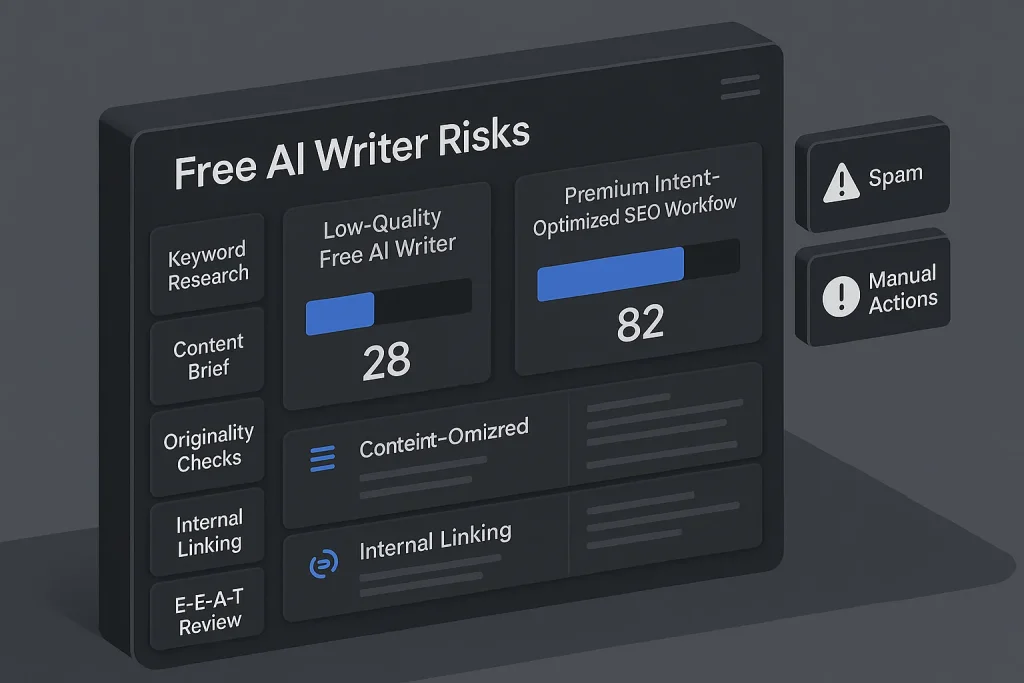
Cheap AI content has changed the cost structure of publishing, but it has also changed the risk structure. An ai writer free workflow often strips out the exact layers that keep SEO content safe: intent matching, originality checks, factual verification, editorial judgment, topical discipline, and post-publication monitoring. That gap matters even more in 2024. Google is not asking whether a page used AI in the abstract; it is asking whether the page looks mass-produced, thin, repetitive, unhelpful, or built mainly to capture search traffic.
For agencies, in-house teams, affiliate publishers, and founders running lean content operations, the appeal of a free ai writer is obvious. One prompt can generate dozens of pages, cut writing costs, and fill a calendar fast. But the operational downside shows up just as quickly once those pages go live at scale: weak briefs create generic copy, generic copy creates overlap, overlap weakens topical focus, and the whole footprint starts to look like search-engine-first publishing instead of audience-first publishing.
The strategic issue is not that every free ai writing tools workflow gets penalized. Google has not published a percentage threshold for AI use. The real issue is simpler: low-tier systems make it much easier to produce the patterns Google explicitly warns against. Mass publication. Little original value. Broad-topic spraying. Summary-only pages. Content created mainly to attract search visits rather than help users finish a task. On our view, that is where most teams misread the risk.
This is why the cost comparison between a free ai writing generator and a premium pipeline is often badly framed. The relevant cost is not the subscription price alone. It is the full cost of remediation, traffic loss, deindexation risk, editorial cleanup, brand dilution, and delayed revenue when an entire content cluster has to be consolidated, rewritten, or removed.
Google stated that the combined effect of its March 2024 search improvements was producing 45% less low-quality, unoriginal content in search results after rollout completion on April 19, 2024. That is the environment in which any ai blog writer free or free ai article writer workflow now competes.

The Real Cost of “Free AI Writer” Tools
A free tool looks inexpensive because the invoice is tiny or non-existent. The hidden cost shows up in the workflow. Most free ai writing tools optimize for instant text generation, not for search intent, content differentiation, entity coverage, source quality, or editorial consistency. In SEO operations, those layers are not optional. They are the infrastructure that makes publication defensible.
At a process level, the typical ai writing assistant free experience has five structural limitations. First, the model gets a shallow prompt instead of a SERP-informed brief. Second, it writes from generalized language patterns rather than topic-specific evidence. Third, it has no reliable way to enforce unique positioning across multiple pages in the same cluster. Fourth, it often produces repetitive intros, stock phrasing, and list-heavy filler. Fifth, users publish too early because the tool is sold as instant content rather than draft material that still needs governance.
For a business team, that creates a false economy. What looked like savings at the creation stage becomes cost transfer to later stages: revision, pruning, fact-checking, plagiarism review, UX fixes, internal linking repair, and traffic recovery. A free ai content generator does not automatically reduce total content cost. In many cases, it front-loads speed and back-loads risk. We have seen this pattern often enough that it is no longer an edge case. It is the default failure mode.
The contrast is easiest to see when comparing what is free versus what is controlled.
| Workflow layer | Typical free setup | SEO consequence | Premium controlled setup |
|---|---|---|---|
| Topic planning | Broad prompt, little SERP context | Weak intent match | Keyword clustering and intent mapping |
| Draft generation | Template-heavy generic output | Similarity across URLs | Intent-aware structure and differentiated angles |
| Originality control | Rarely enforced | Paraphrase and patchwork risk | Plagiarism and overlap review before publish |
| Editorial QA | Skipped or minimal | Thin, repetitive, inaccurate pages | Human review with factual and structural gates |
| Publishing | Bulk push to CMS | Scaled abuse footprint | Guardrailed publication with monitoring |
The core business lesson is simple: free generation lowers friction, and lower friction raises the odds of publishing pages that should still be drafts.
Teams that treat an artificial intelligence writer free tool as a final content engine usually discover the quality debt too late. The damage rarely appears page by page. It appears cluster by cluster: cannibalized topics, decaying CTR, weak engagement, low linkability, and declining trust in an entire section of the site.
How Google Evaluates Mass-Generated AI Content Today
Google’s public guidance is more precise than many publishers assume. The company does not say AI use is inherently disallowed. It says content is evaluated by quality, usefulness, originality, and intent. That distinction matters because enforcement has shifted away from authorship mechanics and toward publication patterns.
According to Google’s spam policies, scaled content abuse means producing many pages mainly to manipulate search rankings rather than help users, and the rule applies whether content is generated by automation, humans, or a mix of both. This matters directly for publishers using a free ai writer online or ai writer free no sign up tool to create large batches of content. The risk is not the free plan itself. The risk is what the free plan encourages: volume without enough control.
Google’s people-first guidance also asks whether content provides original information, research, or analysis and whether it demonstrates first-hand expertise. That standard presses directly on the weak spots of a free ai content writer workflow. Commodity outputs tend to summarize what already ranks. They rarely add tested examples, first-hand observations, proprietary analysis, or detailed process knowledge unless a capable editor adds that layer manually. On our view, this is the dividing line between AI-assisted publishing and AI-led clutter.

Google also lists warning signs of search-engine-first publishing, including content created mainly to attract search-engine visits, lots of content on many topics in hopes that some will perform well, and extensive automation. Those signs map neatly onto the common operating model behind many best free ai writing tools experiments: publish broadly, cover every keyword variation, and trust volume to create wins. That is exactly the pattern modern quality systems are built to discount.
One additional point gets overlooked by teams relying on a free ai article writer. Google’s enforcement is not limited to algorithmic suppression. The documentation says violations may be detected through automated systems and, when needed, human review. That means repetitive footprints can surface to multiple layers of evaluation, especially when a site shows obvious scaling patterns.
The March 2024 context reinforces this direction. Google’s public update summary said the combined effect of its search improvements was yielding 45% less low-quality, unoriginal content in results. For content operators, the message is not philosophical. It is operational: low-value pages have become a more expensive SEO asset class to maintain.
That directional reduction does not prove that every low-grade page will receive a manual action. It does show that the search environment is actively less tolerant of industrialized low-value publishing.
Free-AI Footprints That Trigger Filters and Manual Reviews
Low-tier AI content is rarely exposed by one sentence alone. It is exposed by patterns. A single article with flat phrasing may still survive if it satisfies intent and adds useful substance. A site with dozens or hundreds of pages sharing the same structural habits is a different story. That is where an ai writer generator leaves recognizable footprints.
Common footprints include interchangeable introductions, predictable subheading formulas, repeated sentence rhythm, generic transitions, padded definitions, low entity depth, and weak examples detached from real execution. Another footprint is semantic overreach: one site suddenly publishes across unrelated verticals because a free ai writing assistant made output cheap enough to chase every long-tail term without topical discipline.
Google’s people-first checklist asks whether a site has a primary purpose or focus. That matters because many sites damaged by bulk AI publication did not just create mediocre content. They weakened their own topical coherence. A software company that suddenly publishes travel tips, wellness summaries, or legal explainers through a free ai writing pipeline creates a site-wide signal problem, not just a page-level quality problem. We consider that one of the most underestimated risks in AI-led publishing.
Manual review risk rises when these footprints combine with scale. Search Console documentation states that a manual action can cause some or all of a site to disappear from Google Search results. For publishers, that is the key economic fact. Cleanup is not just an editorial inconvenience. It is a revenue and discoverability issue.
Below is a practical way to think about footprint severity.
The practical implication is that filters often respond to aggregate behavior. If your entire output system is optimized for rapid publishing through an ai writer free platform, the footprints become operational, not accidental.
Teams running large editorial calendars should also review how an AI writing checker can save your brand’s reputation because repetitive drafting is easier to detect internally than after rankings drop.

Thin, Repetitive, or Paraphrased: When AI Content Becomes Spam
Not every weak page is spam, but the line gets thin when repetition and manipulation become the main publishing logic. Google’s spam documentation defines scaled content abuse around intent: many pages produced mainly to manipulate rankings rather than help users. So the decisive question is not whether text was generated by a machine. It is whether the page materially serves a user better than what already exists.
A free ai writer output becomes structurally dangerous when it does one or more of the following:
- Rephrases what is already on page one without adding original information or analysis.
- Targets keyword variants with separate pages that offer nearly the same answer.
- Uses long introductions and shallow subheadings to imitate depth without delivering it.
- Inflates article count across loosely related topics to capture any residual search demand.
- Publishes “SEO pages” whose primary value is phrase coverage rather than task completion.
These patterns are especially common in free ai content generator environments because users are pushed toward volume: ten blog posts, twenty listicles, fifty FAQ pages, one page per keyword. The result may look productive in a CMS but thin in search quality terms.
Google’s helpful-content guidance asks whether a visitor leaves the page feeling they learned enough to achieve their goal. Thin AI copy usually fails that test for a practical reason: it often explains what a topic is, but not how to apply it. For example, a weak page about internal linking may define internal links, list generic benefits, and stop there. A stronger page would explain link depth, anchor distribution, navigational versus contextual use, orphan-page recovery, and measurement criteria. Free tools tend to produce the first kind of page unless tightly managed. On our experience, this is exactly why many AI-heavy clusters get impressions but struggle to hold rankings.
This is also where content overlap becomes expensive. A site using a free ai article writer may create separate posts for “best free ai writing tools,” “free ai writing assistant,” “free ai content writer,” and “ai writer free online,” each with nearly identical body copy. The publisher sees keyword coverage. Google may see duplicated intent with low marginal value.
A useful internal benchmark is editorial substitutability. If one article can replace five others with little loss of information, the cluster is a consolidation candidate. Thin AI ecosystems often contain a surprising number of such substitutable pages.
The more your production model depends on substitutable pages, the easier it is for quality systems to treat the section as redundant.
E-E-A-T, Citations, and Attribution Risks with Free Generators
E-E-A-T is often discussed in abstract terms, but the operational risk with low-tier AI is concrete. Free generation tools frequently produce statements without sourcing discipline, summarize consensus without attribution, and flatten expert nuance into generic paragraphs. For SEO teams, that creates three linked vulnerabilities: unverifiable claims, absent evidence, and weak trust signals.
Google’s people-first guidance emphasizes original information, research, or analysis and also asks whether content demonstrates first-hand expertise. A page generated from a broad prompt using a free ai writing workflow usually does not contain first-hand observations unless the publisher adds them later. That means even a factually acceptable article may still underperform because it adds little beyond what is already searchable.
Attribution problems matter even more in YMYL-adjacent and credibility-sensitive verticals. Even if the topic is not medical or financial, readers and search systems still reward pages that show where claims come from, how the process was tested, and why the publisher is qualified to explain it. Free tools often produce confident prose without evidence. That mismatch is dangerous because it looks complete while remaining editorially underbuilt. We think this is one of the most deceptive traits of low-cost AI copy: it sounds finished long before it is trustworthy.
One practical fix is to redesign the brief. Instead of prompting a free ai writer online with “write a blog post about keyword clustering,” instruct the system with intent, audience, angle, must-cover subtopics, required examples, internal data placeholders, competitor gaps, citation requirements, and explicit exclusions. In other words, you reduce reliance on model improvisation and increase reliance on editorial design. The problem is that most free tools are not built around that kind of pipeline control.
Content teams that want higher-quality AI-assisted drafting should study how an AI reader speeds up content sourcing and research at SEO scale. Research structure is often the difference between useful AI assistance and generic AI filler.

There is another subtle E-E-A-T issue with a free ai writing generator: it tends to homogenize voice across different subject areas. That makes a brand sound less like a specialist and more like an aggregator. Over time, brand-level trust weakens because no page feels like it came from real operational knowledge.
Plagiarism and “Humanizer” Tools: Why They Don’t Protect You
Many publishers assume they can neutralize the risks of an ai writer free workflow by running text through a paraphraser or “humanizer.” That assumption is weak on both editorial and detection grounds.
In February 2024, Copyleaks reported that 59.7% of GPT-3.5 outputs in its analysis contained some form of plagiarism. This does not mean every generated sentence is copied verbatim. It does mean that claims of a plagiarism free ai writer should be treated cautiously, especially when the tool is optimized for free mass output rather than original synthesis.
Originality.ai’s detector page states up to 99.5% accuracy for global plagiarism detection, 41% for paraphrase plagiarism, and up to 67.5% for patchwork plagiarism. The same source also says text run through paraphrasing tools such as QuillBot is identified as AI-generated 95% of the time, and it cites a 2024 Frontiers in Education study summarized there with an F1 score of 0.92 for human-versus-AI classification and 0.80 for disguised AI text. Exact tool performance can vary, but the strategic conclusion is still clear: paraphrasing is not a dependable shield.
That matters because many users of a free ai content writer adopt a two-step workaround. Step one: generate commodity copy. Step two: humanize it. The result often remains structurally weak even if the wording changes. It still mirrors existing SERP language, still lacks first-hand evidence, and still behaves like a derivative page. Detection risk is only one part of the problem; value deficiency is the larger one. On our view, “generate then disguise” is one of the weakest content strategies on the market.
The table below summarizes what these numbers mean operationally.
| Signal | Reported figure | Practical implication |
|---|---|---|
| GPT-3.5 outputs with some plagiarism in Copyleaks analysis | 59.7% | Free generation claims need verification before publication. |
| Paraphrased AI text identified as AI-generated | 95% | “Humanizer” tools do not reliably erase AI footprints. |
| Global plagiarism detection accuracy claim | Up to 99.5% | Direct copying is easier to detect than many teams assume. |
| Paraphrase plagiarism detection accuracy claim | 41% | Paraphrase abuse is harder to catch perfectly, but still measurable. |
| Patchwork plagiarism detection accuracy claim | Up to 67.5% | Mixed-source remixing still creates detectable risk. |
The safest conclusion is not that detectors are perfect. It is that derivative content leaves enough signals to justify preventive controls.
Teams working with AI drafts at scale should add an AI plagiarism checker for your content team before any WordPress publish step. Detection after indexing is late control, not real control.
For teams considering rewrite tools, the limitations are also clear in practice. You can read more about whether you can humanize AI text free without hurting readability, but from an SEO risk perspective the bigger question is not readability alone. It is whether the rewritten page now has original value.
The commercial takeaway is straightforward: “generate then disguise” is not a durable SEO system.

Quality Gates: How to Audit Existing AI Content for Risk
If a site has already used a free ai writer at scale, the first priority is not rewriting everything at once. The first priority is classification. Without classification, teams waste time polishing pages that should be merged or removed.
Google recommends auditing drops by page type and query type for sites saturated with low-value AI pages. That is a practical framework because it shifts analysis away from isolated anecdotes and toward pattern diagnosis. Start by grouping URLs into clusters: informational guides, comparison pages, glossary pages, location pages, supporting blog posts, and template-driven posts. Then review how each group behaves in impressions, clicks, average position, and indexation status.
Search Console is the baseline tool here. Google describes Search Console as a free service for monitoring search traffic, indexing, and spam issues. Every publisher experimenting with a ai writer free no sign up workflow should already be using it. Without Search Console, cleanup decisions get slower and much less accurate.
A strong audit should score each URL against several dimensions:
- Intent fit: Does the page satisfy the actual query better than competing results?
- Original contribution: Does it add examples, analysis, data, or process detail not already common in the SERP?
- Overlap: Does another URL on the site answer substantially the same user need?
- Evidence quality: Are sources, citations, or first-hand observations present where needed?
- Topical alignment: Does the article support the site’s core subject area or dilute it?
- Performance trend: Is the page losing impressions, stuck with no engagement, or still valuable enough to justify repair?
Use those inputs to classify pages into four buckets: keep, refresh, consolidate, remove. The most common mistake is overcommitting to refresh. A weak page with no clear role in the cluster and no original angle is often better removed or merged into a stronger asset. We have seen many teams spend months rewriting URLs that should have been retired in week one.
| Audit bucket | When to use it | Action standard |
|---|---|---|
| Keep | Strong intent match, unique value, stable performance | Minor edits only, preserve ranking signals |
| Refresh | Relevant topic but shallow or outdated execution | Rewrite with examples, evidence, structure, and internal links |
| Consolidate | Multiple URLs serve near-identical intent | Merge into one canonical page and redirect duplicates |
| Remove | Low relevance, no value, no recovery case | Deindex or retire based on site architecture needs |
An audit is only useful if it ends in decisive action. Content inventories fail when every page becomes a sentimental rewrite candidate.

Safe Automation Framework: Guardrails, Human Review, and Testing
The alternative to unsafe free generation is not manual writing of every sentence. It is controlled automation. Mature SEO teams use AI well when they treat it as one layer in a governed content system rather than as an autonomous publishing engine.
A safe framework starts before drafting. Topic selection should come from semantic research and cluster logic, not from a random list of easy keywords. Brief creation should define search intent, reader stage, required entities, differentiators, primary questions, exclusions, and linking targets. Draft generation should then follow that brief. After drafting, editorial review should verify factual grounding, originality, overlap risk, clarity, and conversion alignment. Only then should content enter formatting and WordPress publication.
This is where many free ai writing setups break down. The model may be capable, but the operating environment is not. There is no built-in enforcement for intent, no structured link strategy, no originality checkpoint, and no publication gate. Output becomes a production artifact instead of a search asset.
A reliable process usually includes these guardrails:
- Semantic boundaries: publish only within defined topic clusters tied to the site’s purpose.
- Intent templates: separate workflows for informational, commercial, comparison, and problem-solving pages.
- Originality review: compare against existing site URLs and likely SERP overlap before publishing.
- Human revision: add examples, experience, brand context, and expert nuance the model cannot infer.
- Internal linking standards: connect every new page to parent topics, adjacent subtopics, and conversion pages.
- Staged rollout: publish in controlled batches and monitor performance before scaling the pattern.
Publishers who want a stronger drafting standard should review how to write human AI content that actually converts visitors. Conversion quality often works as a proxy for content usefulness because pages built for real readers tend to be less generic.
Testing also matters. If a team wants to use an ai letter writer free tool, a book writing ai free tool, or a best ai writing tools stack for non-SEO tasks, that can be separated from indexable publishing. Not every AI use case carries the same search risk. Internal drafts, customer support ideas, outreach templates, and ideation documents are one category. Search-indexed landing pages and blog posts are another. Governance should reflect that difference. On our view, this separation is one of the easiest wins for teams that want AI speed without SEO fallout.

A Better Path: Intent-Optimized Pipeline with Autopilot SEO
The strongest argument against relying on a free ai writer is not fear. It is workflow design. When AI is integrated into a premium, intent-optimized pipeline, the economics improve because the system is built to reduce avoidable SEO debt rather than simply accelerate word production.
That is the difference between basic text generation and a content operations platform. A premium workflow can connect semantic planning, structure generation, draft production, internal linking, optimization logic, image generation, and WordPress publishing into one governed process. Instead of asking a free ai content generator to improvise a publish-ready article, the system builds the article from a strategic framework.
For teams scaling SEO content, SEO Autopilot on the official site is positioned around that infrastructure approach. It helps automate the path from semantic research to structured article creation and WordPress publication while keeping the workflow oriented around search intent and content operations rather than isolated prompts. That matters for B2B teams, agencies, and site owners because the unit of value is not one draft. It is a repeatable pipeline that can scale without producing a footprint of low-value pages.
In practice, the long-term payoff comes from fewer avoidable rewrites, better cluster consistency, stronger internal linking, and more disciplined publishing. Premium systems do not remove the need for quality review, but they do reduce the odds of shipping pages that look like generic output from an ai writer free platform.
The commercial logic is straightforward. If a tool only saves money at the drafting step but increases risk at the ranking step, it is not cheaper. It is simply underpriced relative to the remediation work it creates.
Migration Plan: Consolidate, Refresh, or Remove Low-Value AI Pages
Once a team accepts that part of its existing content base is low-value, migration has to be methodical. Random rewriting creates mixed signals and prolongs quality debt. A proper migration plan works at the cluster level.
Start with pages that meet three conditions: low originality, high overlap, and weak business relevance. Those are the cleanest removal or consolidation candidates. Next, identify pages targeting strategic keywords that still deserve a place on the site. Those become refresh priorities. Finally, isolate any pages that are structurally useful but topically off-brand. Those are often retirement candidates because even a good rewrite may not fix the topical coherence problem.
A practical migration sequence looks like this:
Phase 1: Export all AI-affected URLs and map them by topic cluster, template type, and performance trend.
Phase 2: Mark exact and near-duplicate intents. Decide canonical winners at cluster level.
Phase 3: Rewrite only pages with strategic relevance and clear potential to become materially better than current SERP alternatives.
Phase 4: Merge overlapping pages and set redirects where appropriate.
Phase 5: Remove or deindex pages that dilute topical focus or add no meaningful value.
Phase 6: Rebuild internal links around the surviving pages so the cluster reflects a cleaner architecture.
Phase 7: Monitor Search Console and crawl health after each batch rather than waiting until the end.
This migration logic is especially important for sites that published many pages from a free ai article writer or ai blog writer free system in a short period. Bulk publication usually means bulk remediation. The main objective is not to preserve every URL. It is to preserve and strengthen the sections that deserve to rank.
KPIs to Track After Cleanup and Workflow Upgrade
Cleanup without measurement becomes narrative, not operations. After replacing a risky free ai writing workflow with a controlled system, teams should watch a focused KPI set that reflects both search health and content quality.
The first KPI is indexed URL quality, not raw URL count. If total published pages fall while the proportion of useful, ranking, and conversion-supporting pages rises, that is often a healthy outcome. The second KPI is query concentration: fewer irrelevant impressions and stronger visibility on core thematic terms. The third KPI is content overlap reduction, measured through cannibalization checks and cluster-level performance clarity. The fourth KPI is editorial efficiency: time from brief to approved publication under the new workflow. The fifth KPI is recovery traction in Search Console, especially by page type and query type.
Those numbers are not universal thresholds. They are directionally useful evidence that quality-control failures are not theoretical.
Track these business outcomes after the upgrade:
- Index coverage of refreshed versus removed pages.
- Impression share by core cluster instead of site-wide vanity growth.
- Average position trends for consolidated canonical pages.
- CTR changes after title and intent alignment improvements.
- Time on page and downstream conversions for rewritten assets.
- Rate of manual action, spam alert, or indexing anomalies in Search Console.
If those KPIs improve while content volume becomes more disciplined, the new system is doing its job. Strong SEO operations do not measure success by how many pages an artificial intelligence writer free tool can output in an hour. They measure success by how many pages remain useful, differentiated, indexable, and commercially relevant over time.
The strategic conclusion is not that AI should be avoided. It is that free, low-control generation is a poor foundation for search-scale publishing. In an environment where Google evaluates originality, user benefit, topical focus, and scaled abuse patterns, the safer path is a governed content pipeline built around intent, evidence, review, and controlled publication. That is the difference between producing text and building durable search assets.
We think the real takeaway is straightforward: the problem is not AI itself, and it is not even automation at scale. The problem is publishing low-discipline output as if it were finished content. Teams that win with AI are usually the ones that slow down at the right moments: briefing, review, consolidation, and measurement.
Looking ahead, we expect Google to keep getting better at discounting derivative pages while rewarding tighter topical authority and clearer editorial fingerprints. That does not mean every ai writer free workflow will fail, but it does mean the gap between governed AI content and disposable AI content will keep widening. For businesses, the practical move is clear: invest in systems that create fewer pages, but better ones.
FAQ
Can Google penalize sites for using free AI writers?
Yes. A site can lose visibility if content made with a free AI writer breaks spam policies or repeatedly fails quality standards. Google does not ban AI by default, but it can lower rankings or apply manual actions when pages are mass-produced, unoriginal, or created mainly to manipulate search results.
How does Google detect low-quality or repetitive AI content?
Google says violations can be identified through automated systems and, when necessary, human review. In practice, the obvious signals are repetitive structure, scaled publication, weak originality, broad-topic spraying, and thin value. One page may slip through; a pattern across a whole section is much harder to hide.
What is the difference between a Google penalty and algorithmic demotion?
A manual action is a direct enforcement step taken by Google reviewers and can affect part or all of a site in search. An algorithmic demotion happens when ranking systems evaluate pages as lower quality or less helpful, even without a formal manual notice. The outcome can look similar in traffic, but the mechanism is different.
Are AI humanizer or paraphrasing tools safe for SEO?
No, not on their own. Paraphrasing may change wording, but it does not automatically add originality, expertise, citations, better structure, or stronger intent match. In many cases, the page stays derivative even if it sounds more natural.
How can I fix pages created with free AI writers without losing traffic?
Start with an audit. Group URLs by page type, query type, overlap, and business value. Then refresh strategic pages, consolidate duplicate-intent pages, remove weak low-value content, rebuild internal linking, and move future publishing into a controlled SEO workflow with semantic planning and human review.