
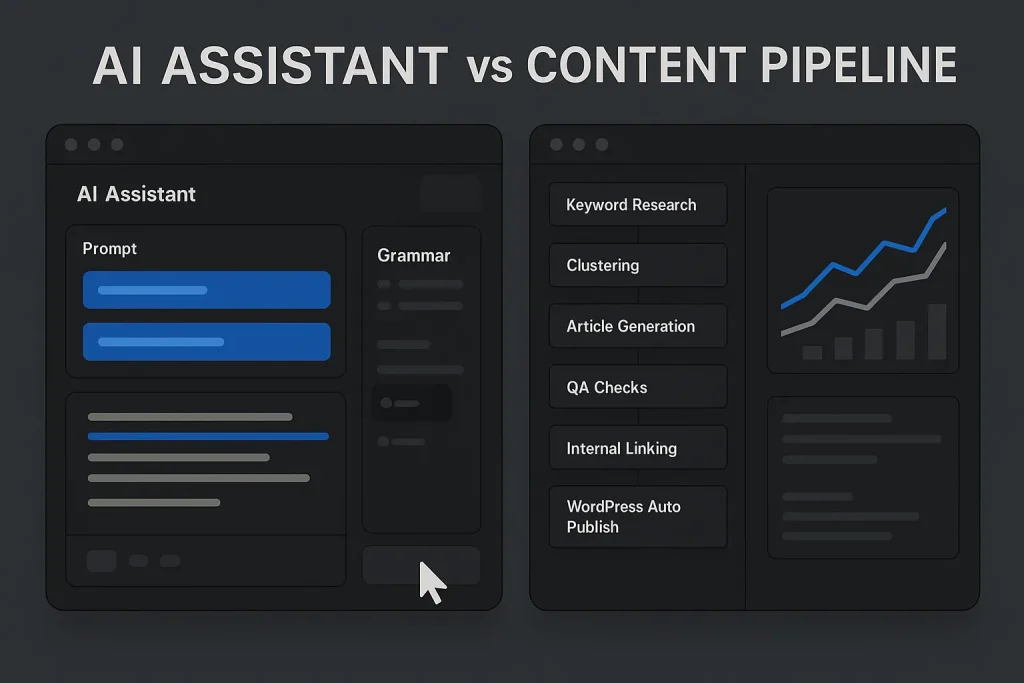
An ai powered writing assistant can clean up a sentence, tighten a paragraph, or help a stalled draft move again. What it cannot do on its own is run a scalable SEO operation. We think that distinction gets blurred far too often. Most teams are not really choosing between two writing tools; they are choosing between a seat-based helper for individual writers and a throughput-based system for planning, producing, reviewing, publishing, and refreshing content at scale.
For a marketer writing emails, proposals, and the occasional blog post, an assistant may be enough. For an SEO team trying to expand topical coverage, maintain internal linking, push content into WordPress, and keep QA consistent across dozens or hundreds of URLs, the bottleneck sits somewhere else. It is usually the workflow. On our side, we keep seeing the same pattern: when a business treats an assistant like a publishing engine, it ends up with fragmented drafts, manual handoffs, and quality that swings from article to article.
The practical choice is straightforward. If your pain is sentence-level friction, buy assistance. If your pain is content throughput, coordination, and repeatability, build or adopt a pipeline. That is the real line between interactive help and autonomous execution.
What Is an AI-Powered Writing Assistant?
An AI-powered writing assistant is an interactive tool that helps a user write better in the moment. It usually lives inside a document editor, a browser extension, or a chat interface. The user still controls each step: prompting, selecting outputs, revising drafts, and deciding what survives.
That model is collaborative, not autonomous. The software suggests; the human decides. In business terms, it removes micro-friction inside a single writing session, but it does not independently run a multi-step content system.
Typical use cases include:
- rewriting awkward sentences
- fixing grammar and tone
- drafting a first version of an email or memo
- expanding bullet points into prose
- helping with ai for english writing when the writer needs fluency support
- creating one-off article intros, outlines, or summaries
That is why terms like free writing assistant, ai writing assistant free online, and best free ai writing assistant online usually point to user-facing apps rather than publishing infrastructure. They promise faster drafting and cleaner copy. They do not promise end-to-end SEO execution.
Grammarly’s AI writing assistant makes that positioning pretty clear: support from blank page to final draft, with 100 prompts per month on the free plan. Useful? Yes. But on our view, a prompt-limited assistant is built for guided user sessions, not for autonomous content throughput across a serious SEO program.

Microsoft follows the same pattern. Copilot in Word can start a draft, pull from an existing file, email, or meeting context, and add content inside a document. That is genuinely useful for document production. It is still human-in-the-loop writing support inside Word, with access shaped by licensing and admin settings.
A writing assistant, then, has three defining traits. First, it is interactive. Second, it is user-steered. Third, it solves local writing problems better than systemic publishing problems. We would argue the third point is the one buyers miss most often.
Why businesses adopt assistants first
Assistants are easy to buy, easy to test, and easy to explain internally. A manager can frame them as productivity software. A user opens a document and feels the value right away. No CMS integration. No workflow redesign. No QA framework to build first.
That simplicity is exactly why adoption happens fast. It is also why a ceiling appears fast. One writer may produce a cleaner draft sooner, but the team still has to handle topic selection, keyword mapping, editorial review, publishing, refresh cycles, and performance feedback outside the tool.
What assistants are not built to do
An assistant does not inherently cluster keywords, assign search intent, build internal links across a content hub, publish to WordPress automatically, or maintain a queue of articles moving through statuses. Those are process functions. They belong to infrastructure.
That is why even a strong grammarly ai powered writing assistant or ai writing assistant for word should be treated as one component in a content operation, not the operation itself. We consider that a healthy way to buy the category: as support, not as strategy.
What Is a Content Pipeline for SEO?
A content pipeline for SEO is a structured system that moves content from opportunity discovery to publication and maintenance. Instead of helping one person write one document at a time, it coordinates a repeatable workflow across many topics and URLs.
In a mature pipeline, writing is only one stage. The full process usually includes topic research, keyword clustering, search intent alignment, content brief generation, drafting, optimization, fact-checking, internal linking, CMS formatting, publishing, and later refreshes.
That shift changes everything. You stop asking, “Can this tool write a paragraph?” and start asking, “Can this system run the workflow?”
The pattern in those numbers matters. Workplace AI adoption often begins with editing and drafting, while operational scale depends on the publishing environment. According to Pew Research Center’s workplace AI survey and W3Techs’ WordPress market share data, businesses need more than drafting help if the goal is sustained organic growth across a CMS ecosystem dominated by WordPress.
A content pipeline is built around throughput and control. It can standardize how topics are approved, how briefs are assembled, how drafts are generated, how links are inserted, and how completed pieces move into WordPress. In practice, it reduces coordination cost more than it reduces typing effort. That is an important distinction.
In SEO, the pipeline has to do four jobs that assistants usually do not handle well on their own:
- Translate business goals into topic coverage and keyword targets.
- Maintain consistent article structure and optimization rules across many pages.
- Connect content to the CMS and site architecture, including categories, formatting, and internal linking.
- Apply quality gates before publication so scale does not erode trust.
That is why a pipeline is not simply “a better writer.” It is an execution layer for content operations. On our side, we see this as the more strategic investment once SEO becomes a system rather than a side project.
Teams comparing these models should also avoid a false binary. A pipeline is not the opposite of an assistant. In many organizations, the assistant still helps with edge cases, while the pipeline handles the recurring SEO workload. The real question is which layer is central and which is supplemental.

Assistants vs Pipelines: Key Differences in Autonomy, Throughput, and Risk
The cleanest comparison is not a feature checklist. It is autonomy, throughput, and risk management. Those three dimensions reveal the operational gap fast.
| Dimension | AI writing assistant | SEO content pipeline | Business implication |
|---|---|---|---|
| Autonomy | User prompts and edits every step | Workflow can run across multiple stages with predefined rules | Assistant improves one task; pipeline improves a system |
| Throughput | One document or section at a time | Handles batches, queues, and repeatable publishing cycles | Critical when SEO goals require broad topical coverage |
| QA model | Human quality depends on individual discipline | Quality gates can be embedded into the workflow | Consistency becomes manageable as volume grows |
| CMS integration | Usually external to the tool | Can publish directly into CMS workflows | Removes repetitive formatting and upload work |
| Economic model | Seat-based productivity | Throughput-based publishing capacity | Decision depends on whether the bottleneck is people time or process flow |
The economic model often decides the purchase more than the AI model itself. We have seen that repeatedly.
Autonomy is the first dividing line. An assistant waits for the user; a pipeline moves work forward according to a designed process. Throughput is the second. An assistant speeds up local drafting, while a pipeline increases publishing capacity across a portfolio. Risk is the third. With an assistant, quality control depends on whoever is using it that day. With a pipeline, checks can be standardized.
The speed-versus-quality gap is visible in survey data. Pew found that 40% of workers who use AI chatbots said the tools were extremely or very helpful for doing work more quickly, while 29% said they were highly helpful for improving work quality. That gap matters. SEO programs cannot run on speed alone. Faster drafting without strong review systems simply pushes more questionable material downstream.
The reading here is direct: assistants are clearly useful for editing and drafting, but the perceived quality uplift is weaker than the speed uplift. On our view, that is exactly why pipelines need explicit QA design rather than blind faith in model output.
When a Writing Assistant Fits: Editing, Emails, and One-Off Drafts
There are plenty of cases where an assistant is the right choice and a pipeline would just add overhead.
Use an assistant when the unit of work is discrete, the human author owns the output, and publishing scale is not the main objective. Sales emails, landing page rewrites, customer communication templates, founder LinkedIn posts, short reports, and ad copy variants all fit this pattern. In those cases, the biggest gain comes from shrinking the distance between idea and polished text.
For example, a founder drafting an investor update does not need topic clustering, internal linking logic, and WordPress automation. A content marketer revising a webinar follow-up email does not need autonomous publishing. A consultant turning rough bullet points into a client memo benefits from strong inline suggestions, not from an editorial assembly line.
This is also where ai powered writing assistant free tools can make sense as low-risk entry points. Teams can experiment with prompt-based drafting, rewriting, and tone correction without a big operational commitment. Even a free writing assistant may be enough for occasional communication work.
Another valid use case is language support. For distributed teams writing in English, ai for english writing can reduce hesitation and improve consistency. The value is practical, not theoretical: faster outbound communication, clearer reports, and fewer review cycles for basic language cleanup. We have seen this become one of the most defensible use cases in multinational teams.

One-off article work is another fit. If a business publishes a few posts per quarter and each piece is heavily expert-led, an assistant may be enough. The author can use it for outlining, tightening structure, and improving readability while keeping full editorial control.
The key is not to confuse convenience with scalability. An assistant is often the right tool for sparse, high-touch, manually guided content creation. It becomes the wrong tool the moment the organization expects it to behave like a content production system without adding process infrastructure around it.
For teams evaluating that boundary in more detail, the article AI Paragraph Writer vs Long-Form AI in a WordPress content workflow is useful because it shows where micro-writing tools actually fit inside larger publishing operations.
When a Content Pipeline Wins: Scaling SEO Content for Organic Growth
A content pipeline wins when volume, coordination, and repeatability drive the result. For most serious SEO programs, that is the normal state of play.
Once the goal becomes broader keyword coverage, the problem moves away from sentence generation. The harder part is moving many content opportunities through the same sequence without losing relevance or quality. That means selecting topics systematically, mapping them to intent, generating structured drafts, applying internal links, and pushing approved content live.
SEO teams do not fail at scale because they cannot write one article. They fail because manual coordination gets expensive and inconsistent. Briefs sit in spreadsheets. Writers interpret instructions differently. Editors apply different standards. Formatting into WordPress eats hours. Internal linking is done late or skipped. Refresh cycles disappear from view. We think this is where most “AI content” disappointment actually starts.
A pipeline addresses those bottlenecks directly. It creates predictable flow. And in SEO, predictable flow usually beats occasional brilliance.
The economic logic behind this shift lines up with larger AI investment trends. McKinsey’s research on the economic potential of generative AI estimates roughly $2.6 trillion to $4.4 trillion in annual value across industries and notes that four functions, including marketing and sales, could account for about 75% of that total value. The reason is simple: operational leverage. AI gets more budget attention when it improves repeatable workflows, not just isolated tasks.
This is why autonomous content operations attract executive attention. They target the workflow layer, and that is where compounding efficiency lives.
For SEO, distribution matters as much as generation. WordPress powers 43.7% of all websites and 61.2% of websites with a known CMS according to W3Techs. So a scalable pipeline needs CMS integration as a practical feature, not a nice extra. If content still has to be copied manually from an editor into WordPress, a major operational cost is still sitting there untouched.
The article How to Turn an AI Writer Into a Fully Automated WordPress Content Engine for SEO Teams goes deeper into that move from drafting tool to production system.
Cost, TCO, and ROI: Assistant Hours vs Autonomous Publishing
Comparing a writing assistant subscription to a full SEO pipeline by sticker price alone is a mistake. The real comparison is not tool fee versus tool fee. It is labor-assisted output versus system-assisted throughput.
Total cost of ownership for an assistant includes more than the license. It includes time spent prompting, rewriting, reviewing, formatting, uploading, linking, and coordinating approvals. If ten people use an assistant, the company may still be paying for ten streams of manual supervision around every asset.
Total cost of ownership for a pipeline includes setup, process design, QA rules, and integration work. That is a heavier commitment upfront. But once the publishing program is large enough, the relevant metric changes. It becomes cost per publish-ready page and cost per maintained content cluster, not cost per seat.
| Cost layer | Assistant-first model | Pipeline-first model |
|---|---|---|
| Primary spend logic | Seats and user productivity | Workflow capacity and publishing output |
| Hidden labor | High: prompt crafting, copying, formatting, coordination | Lower per page once process is stabilized |
| Volume economics | Weakens as content volume rises | Improves when repeatable publishing increases |
| Best ROI profile | Small teams, low volume, high human involvement | SEO programs with recurring publishing demand |
Put simply, assistant ROI is mostly measured in saved minutes per document. Pipeline ROI is measured in content throughput, lower coordination overhead, and the ability to sustain topical coverage without scaling headcount linearly.
There is no universal ROI benchmark that fairly covers every team. Niche complexity, review standards, traffic value, and editorial requirements vary too much. But the decision logic is stable. If the business needs more documents written by the same people, an assistant may be enough. If the business needs more pages published with reliable process control, a pipeline usually delivers stronger long-term economics. On our view, that is where the TCO conversation becomes much more honest.
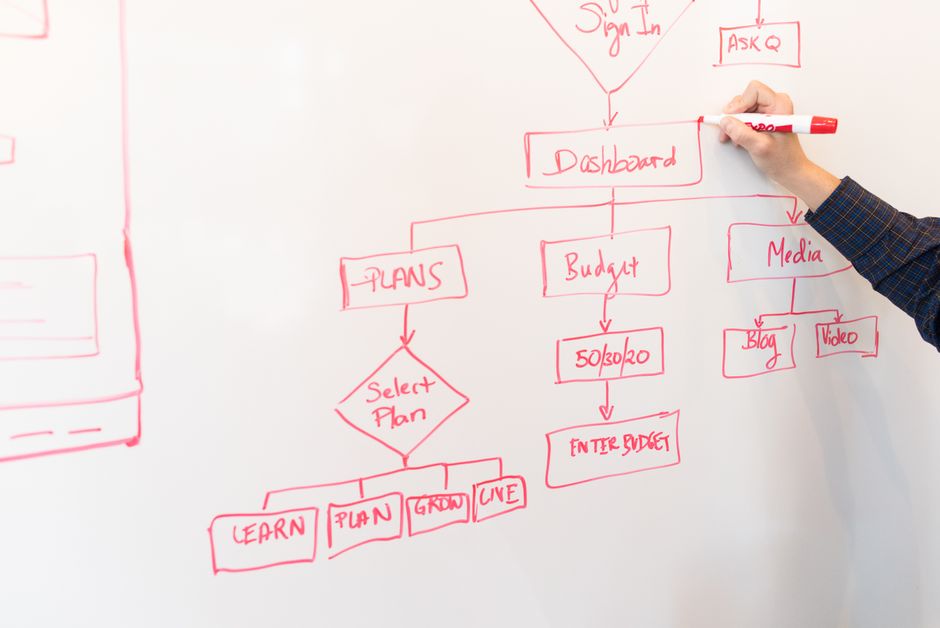
Workflow Map: From Topic Idea to WordPress—Assistant vs Pipeline
The most practical way to understand the difference is to compare the same publishing journey under both models.
Take a simple business goal: publish an article targeting a commercial-intent keyword, connect it to related pages, and push it live in WordPress.
In an assistant-first workflow, the team usually works like this: a marketer chooses a topic manually, opens a document, asks the assistant for an outline, revises it, asks for sections, edits them, checks keyword placement, copies the draft into WordPress, adjusts headings and formatting, adds links manually, finds images, publishes, and tracks performance somewhere else. AI can help at nearly every step. But the steps are not orchestrated by the tool itself.
In a pipeline-first workflow, the system can support or automate the sequence: topic intake, keyword mapping, outline generation, draft production, optimization checks, internal linking suggestions, metadata preparation, image handling, CMS formatting, and publishing. Human review still matters. The difference is that the process no longer depends on someone remembering every step every time.
This chart uses stage coverage as an editorial model, not a universal benchmark. The point is structural. Assistants usually cover part of the journey well; pipelines are designed to cover more of the publishing chain end to end.
To see where that boundary appears in real workflows, Where Grammarly AI Writer Stops and Full-Funnel SEO Content Automation Begins maps the gap clearly.
For businesses operating on WordPress, the publishing endpoint is not trivial. Formatting, categories, slugs, excerpts, featured images, and internal links are recurring operational steps. A pipeline that stops before CMS delivery still leaves a meaningful chunk of manual work on the table. In practice, that is where a lot of hidden labor hides.

Quality Controls and E-E-A-T: Hallucinations, Fact-Checking, and QA at Scale
Scaling content without scaling quality control is a liability. This is where many teams misread AI. They assume better drafting tools automatically create safer SEO output. They do not.
Google’s guidance is direct: ranking systems prioritize helpful, reliable, people-first content, and trust is the most important element in the E-E-A-T framework. According to Google Search Central’s guidance on creating helpful content, content quality cannot be reduced to fluent wording. It has to be useful, credible, and aligned with real user needs.
This creates a sharp operational gap between assistant use and pipeline design. An assistant can generate a plausible paragraph. A pipeline has to decide whether that paragraph is accurate, specific enough, and safe to publish under the site’s standards.
At small scale, individual judgment can carry much of that burden. At larger scale, quality has to become a system property. That usually means explicit controls: source validation, policy checks, factual review, template rules, and editorial signoff thresholds. We consider this non-negotiable for any serious SEO publishing program.
A practical QA framework for SEO pipelines usually includes the following controls:
- search intent validation before drafting begins
- fact review for claims, product details, and definitions
- section-level relevance checks to remove filler
- internal linking logic tied to topical structure
- CMS formatting verification before publication
- post-publication review for accuracy drift and freshness
These controls matter even more when a team scales long-form content in niches where accuracy carries brand or compliance risk. A fluent but weak page can still underperform, mislead users, or damage trust. On our view, this is one of the most underestimated risks in AI-assisted SEO.
That is why the article Why Manual AI Writing Tools Are Obsolete: The Case for Full SEO Autopilot is relevant in a narrow operational sense: the issue is not that manual tools are useless, but that manual coordination and unstructured QA do not scale well for SEO publishing programs.

Migration Path: How to Evolve from Assistant-Only to an Autonomous Pipeline
Most organizations should not jump from ad hoc writing straight into full autonomy. The better path is staged. Each stage removes a real bottleneck and prepares the next one.
Stage one is assistant-led productivity. At this point, the team uses tools for drafting, rewriting, and tone improvement. This is where terms like ai writing assistant free online, grammarly ai writing assistant download, or rytr ai powered writing assistant usually enter the stack. The business gets immediate speed gains, but the process stays manual.
Stage two is workflow standardization. The team starts using repeatable briefs, content templates, basic keyword rules, review checklists, and publishing SOPs. AI still assists, but the process becomes explicit. That may sound less exciting than “automation,” but on our view it is often the stage that prevents future chaos.
Stage three is integrated SEO production. Topic selection, outline generation, draft creation, optimization, and internal linking become coordinated. The team reduces copy-paste work and makes publication more predictable.
Stage four is autonomous pipeline execution with human oversight. The system handles large parts of the workflow, while editors supervise quality thresholds, exceptions, and strategic direction.
The common mistake is trying to skip from stage one to stage four without designing control points. Automation without governance does not create scale. It scales inconsistency.
| Stage | Primary tools | Main gain | Main limitation |
|---|---|---|---|
| Assistant-only | Interactive drafting and editing apps | Faster document creation | Manual coordination everywhere else |
| Standardized workflow | Templates, briefs, checklists | Higher consistency | Still labor-heavy |
| Integrated production | Connected SEO and CMS workflows | Lower handoff cost | Needs process ownership |
| Autonomous pipeline | End-to-end system with QA gates | Scalable publishing throughput | Requires governance and clear quality standards |
A staged transition usually protects quality better than a radical replacement project. We think that is the pragmatic path for most teams.
Decision Checklist: Choose the Right Approach for Your Team
The right choice depends less on the vendor’s marketing language and more on where your bottleneck actually sits.
If your team struggles to write clear first drafts, a writing assistant may solve the immediate problem. If your team already has drafts but cannot consistently move them through optimization, linking, formatting, and publishing, the problem is pipeline design.
Use this practical checklist when deciding:
- Volume: Are you publishing a few high-touch pieces or running an ongoing SEO program across many topics?
- Control: Does every paragraph need expert steering, or can major parts of the workflow follow repeatable rules?
- CMS dependency: Is WordPress publishing a meaningful recurring task?
- Internal linking: Do articles need to fit into a broader topic cluster architecture?
- QA risk: Would inaccuracies create brand, product, or compliance problems?
- Labor cost: Is the main expense typing and rewriting, or is it coordination across multiple steps and people?
- Growth objective: Are you optimizing for better documents or for more publish-ready pages that can drive organic traffic?
Businesses searching for a best free ai writing assistant online are usually still in the productivity phase. Businesses looking for repeatable organic growth are usually in the operations phase. Those are different buying moments. Treating them as the same software category is where bad tool decisions begin.

Where SEO Autopilot Fits
For teams that have moved beyond isolated drafting help, the stronger need is usually not another editor window. It is a system that can turn SEO intent into repeatable output. That includes semantic planning, structured article generation, internal linking logic, and direct publishing flow instead of leaving every step to manual coordination.
That is where SEO Autopilot fits more naturally than a conventional assistant. The platform is built around autonomous SEO content operations: generating semantics, building article structure, producing text and images, and publishing to WordPress without requiring a human to steer every paragraph. For agencies, publishers, and in-house teams scaling organic programs, that operational model is materially different from an assistant that helps with one document at a time.
The distinction is not that assistants are bad tools. It is that they solve a narrower problem. SEO Autopilot is designed for businesses whose constraint is content throughput, consistency, and end-to-end workflow execution.
We think the real takeaway is simple. An ai powered writing assistant is useful when the writer is the bottleneck; a pipeline is useful when the workflow is the bottleneck. For SEO growth, that difference is not semantic. It affects cost structure, output quality, and how fast a team can expand coverage without creating editorial debt.
Our position is pragmatic: assistants will remain part of the stack, especially for editing, language support, and one-off drafts. But the teams that win more organic ground will keep shifting toward systems that connect planning, generation, QA, linking, and publishing. Over the next cycle, we expect the market to separate even more clearly between writing help and true content operations platforms.
FAQ
What is the difference between an AI writing assistant and a content pipeline?
An AI writing assistant helps a person draft, rewrite, or edit content interactively. A content pipeline handles the broader SEO workflow, including topic planning, structure, QA, internal linking, CMS preparation, and publishing. In short, one improves writing sessions; the other improves publishing operations.
When should I use a writing assistant instead of a content pipeline?
Use a writing assistant when your work is low-volume, high-touch, and manually guided. It is a strong fit for emails, reports, proposals, one-off blog posts, and language cleanup. If your main challenge is scaling SEO content across many pages, a pipeline is usually the better choice.
Can tools like Grammarly replace an autonomous SEO content pipeline?
No. They can improve wording, clarity, and draft quality, but they are not designed to run a full SEO publishing workflow with keyword mapping, internal linking, QA gates, and WordPress autopublishing. Put simply, grammarly is an ai powered writing assistant, not a full content operations system.
How do autonomous pipelines handle WordPress publishing and internal linking?
A mature pipeline can prepare article formatting, metadata, and link placement before pushing content into WordPress. It can also apply internal linking rules based on topic relationships, which is hard to maintain consistently in manual workflows. This is one of the clearest differences between an assistant and an end-to-end SEO system.
What’s the ROI difference between assistants and end-to-end SEO automation?
Assistants usually deliver ROI through time savings per document. End-to-end SEO automation aims for ROI through higher publishing throughput, lower coordination cost, and more consistent execution across content clusters. The stronger option depends on whether your bottleneck is individual writing effort or the full content production workflow.