
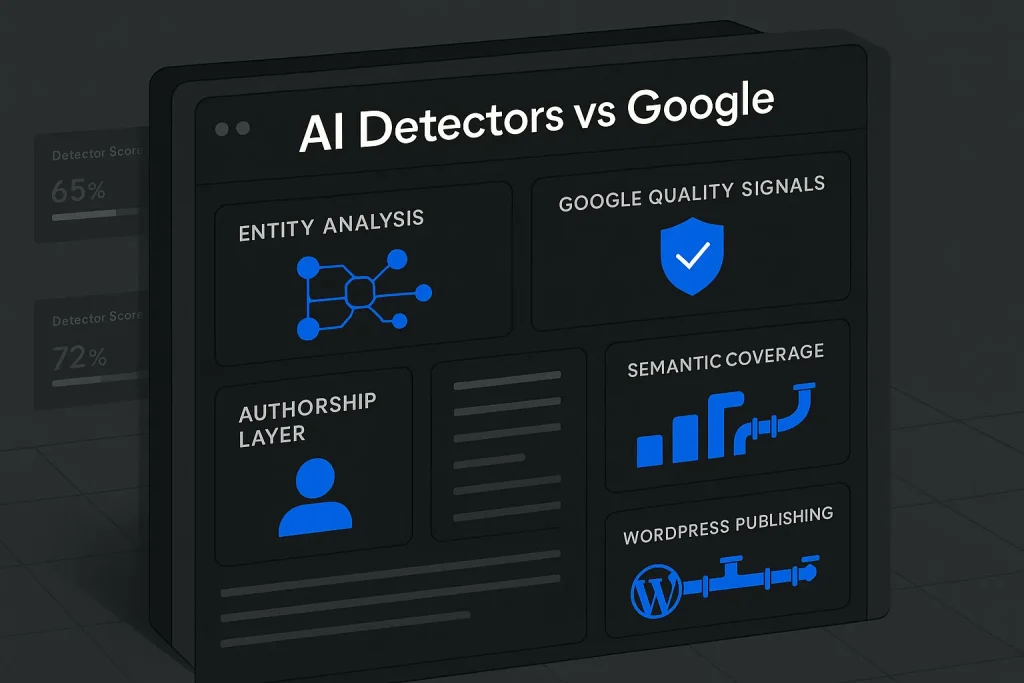
An ai writing detector can estimate statistical patterns in text, but it cannot tell Google whether a page deserves to rank. Search performance runs on usefulness, originality, intent fit, trust signals, and a page’s ability to solve a user problem better than the competing results. That is the gap many teams still miss when they spend more time chasing “human” scores than improving source quality, entity coverage, or editorial depth.
The market has turned a weak proxy into a fake KPI. A detector report looks neat, measurable, and easy to screenshot, so teams start treating it like compliance. Google does not. In Google’s own guidance on AI-generated content in Search, the issue is not whether software drafted a paragraph. The issue is whether the page is original, helpful, people-first, and aligned with quality expectations. On our view, that distinction moves SEO out of optics and into infrastructure.
For content operations, the implication is practical. The target is not “make the text look less machine-like.” The target is “publish pages with better information gain, cleaner structure, stronger relevance signals, and clearer authorship than what is already ranking.” Teams that understand this stop optimizing for detector theater and start optimizing for durable search value.

Thesis: Detectors Are Fallible, Google Rewards Value
The core claim is simple: ai writing detectors are probabilistic classifiers, while Google’s search systems evaluate pages through a much wider set of quality and relevance signals. A detector tries to infer likely authorship patterns from wording, predictability, sentence rhythm, and token distribution. Google, by contrast, is trying to rank results that satisfy a query and help a user complete a task.
That difference is not academic. It changes how content should be built, reviewed, and scaled. A page can score low in a free ai writing detector and still be thin, generic, derivative, and unhelpful. A page can also trigger an ai detector while containing excellent sourcing, first-hand perspective, strong internal linking, clear structure, and meaningful original synthesis. We would bet on the second page over the first every time. Only one of those profiles is likely to support long-term SEO.
Google’s people-first documentation explicitly asks whether a page delivers substantial value versus other results and whether a visitor leaves feeling they achieved their purpose, as described in Google’s helpful content guidance. None of that maps cleanly to the output of an ai detector for writing. There is no public Google ranking factor called “detector score,” and there is no evidence that passing a written by ai detector creates any ranking advantage.
The operational conclusion is blunt. Detector scores are, at best, weak QA signals. They are not SEO goals, and they are not substitutes for editorial standards.
The strategic error is easy to spot. Teams often rewrite usable content simply to reduce the output of a chatgpt essay detector or essay ai detector, while ignoring the improvements that actually move business results.
How AI Writing Detectors Work (and Where They Fail)
Most detector systems do not “know” who wrote a passage. They score patterns. Depending on the tool, those patterns may include perplexity, burstiness, lexical predictability, sentence-length consistency, n-gram familiarity, stylometric features, and model-specific fingerprints inferred from training data. In plain English, a detector looks for text that appears statistically more likely to have been generated by a language model than by a human writer.
That sounds precise until it meets real writing. Human text is not one stable category. Student essays, edited B2B copy, legal summaries, translated drafts, non-native English writing, technical documentation, and templated product pages all behave differently. The boundary between “human” and “AI-like” language is unstable because high-clarity human writing can look statistically regular, while edited AI copy can look more variable. The model is guessing from overlapping signals. That is the key weakness.
This is why the same passage may be treated differently by each ai writer detector. Some tools are tuned for recall and flag more aggressively. Others try to suppress false positives and become too lenient. Some are sensitive to short passages. Some overfit to patterns common in older model outputs. Some break down quickly when text has been lightly edited or translated.
Turnitin’s own model notes show that uncertainty clearly. In its July 2024 update, Turnitin’s AI writing detection documentation states that scores from 1% to 19% are no longer surfaced as a numeric percentage because of a higher risk of false positives. The same notes also say submissions under 300 words are likely less accurate for AI detection. That is not a footnote. It is a structural limitation from one of the most recognized systems in the market, including the turnitin ai detector category that many institutions rely on.

The failure modes usually fall into a few recurring buckets:
- Pattern overlap: concise, polished, repetitive, or highly structured human writing may resemble model output.
- Population bias: detectors may perform differently across native and non-native writers, domains, and essay styles.
- Length sensitivity: short passages often lack enough signal for stable classification.
- Editing fragility: light rewrites can flip a result without changing informational value.
- Domain mismatch: a detector trained or tuned on academic essays may misread marketing, product, or technical content.
From an SEO angle, these constraints make a free ai writing detector unsuitable as a publication gate. A detector can say that text “looks like” AI. It cannot tell whether the article covers the right entities, answers the query fully, demonstrates expertise, or improves on what already ranks. On our experience, that is where many teams confuse pattern recognition with quality review.
A simple comparison makes the issue obvious:
| System | Primary objective | What it can estimate | What it cannot prove |
|---|---|---|---|
| AI detector writer tool | Classify text patterns | Likelihood based on statistical features | Authorship, expertise, usefulness, ranking potential |
| Google Search systems | Rank helpful results | Relevance, quality, satisfaction-related signals | A single universal authorship score |
| Editorial review process | Improve the page before publication | Accuracy, sourcing, structure, intent fit, clarity | Guaranteed rankings |
The detector is reading language shape. SEO success depends on content function. Big difference.
False Positives and Negatives: Real SEO and Legal Risks
The biggest problem with detecting ai writing is not philosophical. It is operational. If a tool flags good human content as synthetic, teams waste time rewriting valuable pages, add friction to editorial workflows, and sometimes make copy worse. If a tool misses genuinely low-value generated text, teams can publish content that fails users and creates search risk. Both errors are expensive, just in different ways.
False positives are especially dangerous when stakeholders over-trust a number. A Stanford HAI summary of research on detector bias reported that 61.22% of TOEFL essays written by non-native English students were classified as AI-generated, according to Stanford HAI’s report on detector bias. The same summary noted that 19% of those human-written essays were flagged as AI by all seven detectors, and 97% were flagged by at least one detector. For any team working with international writers, global subject-matter experts, or edited B2B contributions, that should end the idea that a detector output is proof.
False negatives create a different trap. If teams assume a low detector score means “safe for SEO,” they may publish generic content that still lacks originality, misses user intent, and adds no meaningful value. A best ai detector might miss low-grade AI-assisted copy that has been paraphrased, shuffled, or lightly edited. Google’s systems do not need to identify it as AI to treat it as low quality. We see this mistake often: the page “passes,” but the content still has nothing new to say.
There is also a governance risk. In regulated organizations or enterprises with multiple contributors, a detector score may be stored as if it were an audit-grade signal. It is not. At most, it can justify manual review. It should never serve as the sole basis for disciplinary action, authorship claims, vendor disputes, or publication rejection. Turnitin explicitly warns against over-reliance in edge cases, especially shorter submissions.
These numbers matter because they show how easily a human author can be misclassified under realistic conditions.

For SEO teams, the legally safer and business-safer position is simple: detector outputs belong in a risk triage layer, not in the core quality model.
What Google Actually Says About AI Content and E-E-A-T
Google’s position is far more nuanced than most vendor marketing around the ai written content detector category. Google does not ban AI content as a class. The official framework focuses on quality, originality, and whether content is created primarily to help people or primarily to manipulate rankings.
In Google’s search guidance on AI content, the company states that the use of automation or AI is not inherently against policy. It also states that AI use does not provide any special ranking advantage by itself. That directly undercuts the common industry myth that lowering an ai writing detector score somehow aligns a page with Google.
The real compliance line sits elsewhere. In Google’s spam policies, scaled content abuse is defined around generating many pages mainly to manipulate rankings rather than help users, regardless of whether the content is created by humans, automation, or a mix of both. That means a manually written page can still be spam if its purpose is manipulative, and an AI-assisted page can still be acceptable if it is genuinely useful.
Google’s people-first framework also pushes publishers toward stronger authorship and trust cues. Where users would expect them, clear bylines, author background, and transparent editorial ownership help a page communicate credibility. That is far more actionable than trying to outsmart a writer ai detector. On our view, this is where mature SEO teams should spend their effort.
E-E-A-T is often discussed too vaguely, so it helps to translate it into page-level work:
- Experience: include first-hand examples, implementation notes, observed tradeoffs, or product usage context.
- Expertise: show topical command through precise terminology, complete coverage, and accurate explanations.
- Authoritativeness: connect the page to credible authors, brand expertise, and consistent topical publishing.
- Trustworthiness: use clear sourcing, truthful claims, transparent ownership, and stable page quality.
None of these pillars improves merely because a detector score drops. In some cases, they get worse if a team strips out technical clarity just to sound more “messy” or “human.” That tradeoff is usually a bad one.
| Question | Google-aligned answer | SEO implication |
|---|---|---|
| Is AI content banned? | No, not by default | Focus on usefulness, originality, and trust |
| Does AI use help rankings by itself? | No | Automation is not a ranking shortcut |
| What creates policy risk? | Scaled manipulation and low-value output | Do not mass-publish pages without user benefit |
| What is more actionable than a detector score? | Authorship, sourcing, value, intent fit | Build pages that satisfy users better than alternatives |
The practical reading is straightforward: Google cares far more about what a page does than how the first draft was produced.
Why Detector Scores Don’t Correlate with Rankings
For a metric to correlate with rankings, it would need to measure something close to what search systems value at scale. An ai detector free tool does not do that. It scores textual probability. Rankings emerge from relevance, competition, intent satisfaction, site context, quality signals, link environment, freshness where relevant, and the comparative strength of the results set.
A detector also operates mostly at passage level. Search performance operates at document, query, site, and ecosystem level. A page can rank because it covers the topic more completely, maps well to the query class, uses clearer headings, includes better examples, links internally to useful adjacent resources, and sits within a coherent topical cluster. A detector cannot see most of that in any meaningful SEO sense.
Research comparing detectors reinforces how weak the category is. A comparative study of 16 AI text detectors covering 126 documents in total, including 42 ChatGPT-3.5 essays, 42 GPT-4 essays, and 42 student essays, concluded that while three tools performed well across the tested sets, most detectors were generally ineffective at distinguishing GPT-4 essays from undergraduate human writing, according to the published study indexed in DOAJ. More recent academic work also reported that under strict false-positive thresholds, some detectors’ true-positive rates dropped as low as 0% in certain conditions, as discussed in the late-2024 arXiv detector study.
If a metric cannot consistently classify authorship under controlled testing, it is not a credible proxy for ranking quality on the open web. That is the main reason “pass the ai detector” is a poor SEO objective. We consider this one of the most expensive category errors in AI-assisted content workflows.
The result is not that detectors are useless. The result is that they are too unstable to stand in for SEO quality.

This is also why teams chasing tools like walter writes ai or winston ai as ranking insurance often misallocate effort. Those tools may provide workflow signals, but they do not define what Google rewards.
Optimize for Entities, Information Gain, and Intent Fit
If the detector score is the wrong target, what should replace it? We would use a stack of page-level signals that align better with user needs and search evaluation. Three of the strongest are entity coverage, information gain, and intent fit.
Entity coverage
Entity coverage means the page addresses the important concepts, subtopics, tools, actors, and relationships a competent result should include. For this topic, that might include Google spam policies, helpful content, E-E-A-T, bylines, detector false positives, non-native bias, scaled content abuse, and editorial QA. A page with strong entity density does not just repeat the focus keyword ai writing detector. It covers the semantic neighborhood that shows real topic command.
Information gain
Information gain is what the page adds beyond common SERP repetition. It can come from better synthesis, sharper comparisons, clearer frameworks, more precise operational advice, or first-hand process knowledge. In B2B SEO, information gain often shows up as implementation logic: what to measure, what to deprioritize, how to structure a workflow, and how to reduce failure modes.
Intent fit
Intent fit means the page matches what the searcher is actually trying to achieve. In this query space, users are often trying to decide whether detectors matter for SEO, whether Google penalizes AI content, and what they should optimize instead. A page that wanders into generic AI ethics or spends 1,500 words “humanizing” sentences without answering the ranking question is misaligned.
These three factors are more actionable than any ai written text detector output because they can be deliberately improved in production. On our practical side, this is where SEO becomes less mystical and more operational.
An SEO team can apply them through a simple editorial lens:
- Map the core entities and policy documents a qualified result must cover.
- Identify where the current SERP is repetitive or shallow.
- Add synthesis, examples, or operational guidance that closes those gaps.
- Verify that the page format matches the user’s likely goal.
- Support the page with clear authorship, internal links, and clean structure.
That is a real optimization loop. It improves search value instead of merely changing linguistic texture.
Teams exploring rewriting workflows should also see the difference between superficial text variation and true SEO alignment. The article Beyond Word Spinning: How a Modern AI Rewriter Maintains Search Intent is relevant here because search performance depends on preserving intent and coverage, not just replacing phrases.

Measurement Framework: From ‘Humanized’ Scores to Quality Signals
Many teams want a reporting system, so they default to detector percentages because the numbers are easy to export. The better move is to replace that proxy with a quality framework tied to publication standards and search outcomes.
A useful measurement model has four layers: source quality, content quality, search fit, and trust signals.
1. Source quality
Measure whether the article uses primary documentation, official policies, product pages, standards, or credible research where relevant. In topics involving platform rules, official sources should anchor the page.
2. Content quality
Assess completeness, clarity, factual precision, structural depth, and the presence of original synthesis. This is where editors can judge whether the page merely paraphrases consensus or contributes practical value.
3. Search fit
Check whether the page addresses the dominant intent, resolves likely follow-up questions, and reflects the breadth of concepts present in the result set without copying it.
4. Trust signals
Review bylines, author pages, editorial ownership, update logic, citations where appropriate, and consistency with the rest of the site’s topical authority.
The following table translates that into a working SEO review model:
| Measurement layer | What to review | Why it matters more than a detector |
|---|---|---|
| Source quality | Official documentation, primary sources, credible references | Improves factual trust and defensibility |
| Content quality | Coverage, clarity, originality, examples, structure | Improves user satisfaction and usefulness |
| Search fit | Intent match, SERP coverage, query resolution | Aligns the page with what rank-worthy results do |
| Trust signals | Bylines, author expertise, editorial ownership | Supports E-E-A-T expectations where relevant |
These are the indicators worth standardizing across a content operation.
Where teams still want an ai detector as part of QA, it should sit in a fifth layer called “review trigger,” not inside the quality model itself.
Practical Checklist to Keep Google Happy (Without Gaming Detectors)
Keeping Google happy is less about concealment and more about editorial discipline. The safest and most scalable process is to build pages that deserve to rank even if everyone knows AI assisted the draft.
The checklist below is the version that matters in production:
- Start with a search intent brief: define what the query is trying to solve and what type of page best serves it.
- Use primary sources first: for policy topics, platform rules, or technical claims, anchor the draft in official documentation.
- Build entity coverage before style edits: make sure the page addresses the important concepts, not just the target phrase.
- Add information gain: include comparisons, frameworks, examples, implementation notes, or expert interpretation.
- Preserve factual precision during rewrites: do not trade clarity for “humanized” randomness.
- Include authorship signals where relevant: byline, editor, author bio, or company ownership details.
- Review for scaled-content risk: avoid publishing many near-duplicate pages with only surface variation.
- Strengthen internal linking: connect the page to adjacent resources that deepen topic authority.
- Evaluate the page against competing results: check whether it adds value beyond existing SERP patterns.
- Use a detector only as a secondary signal: if flagged, review manually rather than automatically rewriting everything.
This is the part many publishers get backward. They start by trying to humanize ai text, then check whether the page still says anything useful. The right order is the opposite. Substance first. Surface second.
If your workflow currently begins with detector avoidance, the more useful reference is How to Pass Any AI Text Detector Without Sacrificing SEO Value. The core lesson is that the safest path is not gimmicky obfuscation but preserving substance while improving readability and trust.

When to Use Detectors (If At All): Policy, QA, and Risk Controls
There are still legitimate use cases for detector tools. The mistake is treating them as ranking instruments or truth machines. A mature content team can use an ai detector in narrow, controlled ways.
Appropriate use case 1: Review triage
If a page or contributor triggers unusual outputs across multiple tools, that can justify manual review for originality, citation integrity, policy compliance, or editorial consistency. The detector is not the decision. It is the trigger for inspection.
Appropriate use case 2: Education and policy communication
Organizations may use detectors to explain that heavily templated or low-effort drafts require closer review. In this role, the tool helps set expectations about quality control, not authorship certainty.
Appropriate use case 3: Comparative workflow testing
Teams can test how different drafting and editing processes affect detector outputs, then decide whether additional editing is worth the effort. Even here, the KPI should remain publishable quality, not the detector score itself.
Inappropriate use case 1: SEO pass/fail gate
Rejecting or approving pages based on a single ai written content detector result is poor practice. It neither reflects Google’s guidance nor guarantees content quality.
Inappropriate use case 2: Authorship proof
Detector outputs do not prove whether text was written by a human, AI, or a blended process. They are too sensitive to editing style, writer population, and text length.
Inappropriate use case 3: Outsourcing responsibility
A detector does not replace editors, subject-matter reviewers, or SEO leads. It cannot verify topical completeness or business usefulness.
The late-2024 academic finding that true-positive rates can collapse under strict false-positive settings shows why detector policy has to remain conservative.

For teams operating at scale, a detector should be a weak signal inside governance, never the main signal inside SEO.
How Autopilot SEO Prioritizes Value: Entities, Coverage, and One-Click Publishing
The strongest content systems are not designed around beating a free ai writing detector. They are designed around producing pages that can survive competitive SERPs. That requires better planning, stronger semantic structure, and cleaner execution from keyword to published article.
That is the logic behind SEO Autopilot. Instead of centering the workflow on detector evasion, the platform emphasizes semantic coverage, article structure, topic relevance, content generation, visual asset support, and operational publishing efficiency. In practical terms, that means optimizing for what a search page needs to do: answer the query comprehensively, cover the right entities, align with search intent, and move from draft to WordPress without fragmented manual steps.
For teams comparing manual rewrites to production-grade automation, Why Manual AI Writing Tools Are Obsolete: The Case for Full SEO Autopilot frames the workflow difference well. The gain is not just speed. It is process integrity: one system managing semantics, structure, text generation, and publishing with SEO purpose intact.
There is also a meaningful distinction between “humanization” as cosmetic rewriting and humanization as trust optimization. The article Why Humanizing AI Text Matters for E-E-A-T and How to Do It at Scale is relevant because the useful version of humanization is not detector gaming. It is making content clearer, more contextual, more credible, and more aligned with real readers.
Near the end of the workflow, publishing discipline still matters. Strong SEO content loses value when it stalls in handoffs, inconsistent formatting, or disconnected CMS steps. A system that generates content and pushes it into WordPress cleanly reduces operational drag without changing the core rule: Google rewards value, not detector theater.
For teams that need a production environment built around those priorities, the official SEO Autopilot site shows how the platform approaches article generation, semantic planning, image creation, and WordPress publication as one connected SEO workflow.
The durable advantage is not that the system tries to fool an ai detector or ai detector writer tool. The advantage is that it helps publish search-oriented pages with stronger coverage, better process consistency, and less manual friction.
We think the real lesson is simple. Detector scores are a weak signal, while page value is the durable asset. Teams that invest in coverage, sourcing, authorship, and intent fit will usually outperform teams still obsessing over whether a written by ai detector shows green.
The near-term trend is fairly clear. More ai writing detectors will appear, more vendors will promise certainty, and the underlying reliability problem will remain. Our forecast is that Google-aligned workflows will keep moving toward semantic completeness, editorial accountability, and faster publishing systems that preserve quality instead of gaming surface-level signals.
FAQ
Does Google penalize AI-generated content detected by AI checkers?
No. Google does not say that an ai writing detector score triggers ranking penalties. Google’s guidance focuses on whether content is helpful, original, people-first, and not created primarily to manipulate search rankings.
Why do AI writing detectors flag human-written text?
Because detectors classify statistical patterns, not true authorship. Clear, structured, edited, or non-native English writing can resemble patterns that an ai detector associates with model-generated text, which leads to false positives.
Should I humanize AI text to pass detectors for SEO?
Not as a primary goal. If “humanize ai” means improving clarity, adding expertise, strengthening sourcing, and increasing information gain, that can help quality. If it only means randomizing wording to lower a detector score, it is usually wasted effort for SEO.
Can Google reliably detect AI content?
Google does not frame the problem that way in its public guidance. Its documented position is that AI use is not inherently against the rules; what matters is content quality, trust, originality, and whether the page serves users rather than manipulates rankings.
What should I optimize instead of chasing AI detector scores?
Prioritize intent fit, entity coverage, information gain, stronger sourcing, clear authorship, internal linking, and substantial value compared with existing results. Those signals align far better with Google’s published guidance than any ai writer detector percentage.