
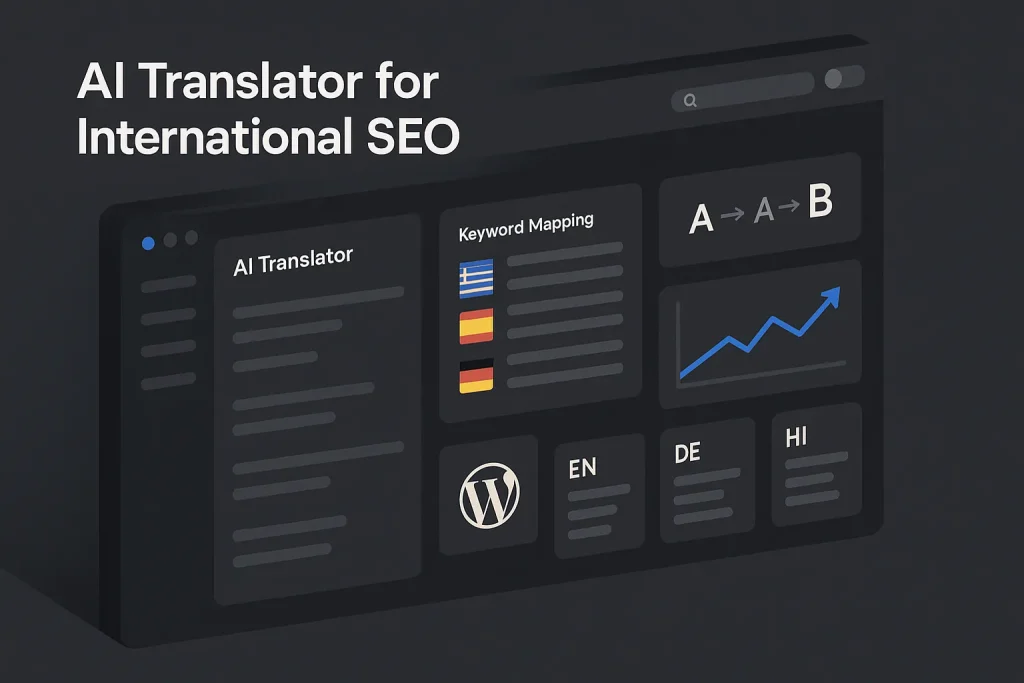
International growth usually breaks not at content volume, but at localization quality. An ai translator can multiply output across markets, yet multilingual SEO works only when translation is tied to keyword intent, crawlable local pages, internal links, and market-specific relevance. That is the real dividing line between publishing translated copy and building a search-ready international content system.
We see the same pattern again and again: teams add a generic translation layer and expect rankings to follow. They usually do not. The reason is practical. Search engines index URLs, text, entities, and linking structures, not the idea that a page was translated. A translated article without localized keyword mapping often targets the wrong query set, keeps the wrong terminology, and inherits internal links that make sense only in the source language.
Demand-side data makes the business case hard to ignore. According to CSA Research, 76% of online shoppers prefer buying products with information in their own language, and 40% would never buy from websites in other languages. For B2B teams, the implication is direct: language coverage is not a cosmetic layer. It shapes discoverability, trust, and conversion efficiency.
The rest is infrastructure. Google recommends separate URLs for each language version rather than dynamically swapping content by cookies or browser settings, as documented in its guidance on multilingual and multi-regional sites. Google also makes clear that helpful, reliable, people-first content still applies to translated pages. Automation can scale the workflow, but it cannot replace local intent alignment. On our reading, this is where many multilingual programs quietly lose momentum.

International SEO vs simple translation: what changes
Simple translation converts source text into another language. International SEO adapts a page so it can compete in a local search environment. That difference is bigger than wording. It affects page targeting, site structure, entity choice, link paths, calls to action, examples, SERP alignment, and sometimes the content angle itself.
An ai language translator can help at the linguistic layer, but the SEO work starts before translation and continues after it. Before translation, the team needs a map of local query patterns. After translation, the page needs local links, localized metadata, localized headings where necessary, and a destination URL that search engines can crawl and index correctly.
Google does not rely on hreflang or the HTML lang attribute alone to determine page language. It needs crawlable localized text. This matters because many teams deploy language toggles or JavaScript-driven switching and assume the technical setup is enough. It is not. If the page content is thin, templated, or mechanically transformed, the page may be indexed poorly or fail to satisfy the query landscape in that market.
Google’s documentation on helpful content and its spam policies draws a clear line for teams using automation. Large-scale translated pages with little added user value can become a quality risk. In practice, raw machine output is not a multilingual content strategy. It is a draft layer. We consider that distinction non-negotiable.
The following comparison captures the operational difference.
| Area | Simple translation | International SEO localization |
|---|---|---|
| Keyword targeting | Mirrors source terms | Maps to locale-specific search demand and query intent |
| Content examples | Retains source-market references | Uses local terminology, units, references, and buying context |
| Internal links | Often points to source-language pages | Links to matching localized URLs and clusters |
| Technical setup | Language switcher only | Separate URLs, hreflang, sitemap and canonical logic |
| SEO risk | Low relevance, duplication, weak rankings | Higher operational effort, stronger market fit |
The takeaway is simple: translation changes words, localization changes performance conditions.
How AI translation fits into a localization workflow
An ai translator is most useful when it sits inside a controlled workflow rather than as a standalone UI. The workflow should decide what to translate, how to protect priority terms, how to rewrite headings for local search intent, and where each localized page should connect inside the site architecture.
In practical terms, AI translation sits between semantic planning and localized publishing. It should receive a structured input package: source article, locale target, keyword map, glossary, forbidden term list, preferred entities, formatting rules, internal-link targets, and metadata constraints. Without that package, even the best ai translator behaves like a general-purpose language engine instead of an SEO production component.
Generic prompts such as chatgpt translate, chatgpt translator, or using ai to translate can produce readable drafts, but readability is not the KPI. In SEO, the output has to match target queries, preserve page purpose, and support indexable information architecture. A page that reads well but misses local demand is still under-optimized. We have seen plenty of polished drafts that had almost no ranking value.
A robust localization workflow usually has these stages:
- Source qualification: decide whether the source article deserves translation based on traffic, conversion contribution, topical fit, and evergreen value.
- Locale keyword discovery: identify the target market’s actual search phrases instead of copying source keywords.
- Translation with constraints: run the article through an ai powered translator configured with glossaries, entity rules, and tone instructions.
- SEO localization: adjust title tags, H2s, examples, CTAs, and internal links to match the locale.
- Technical deployment: publish to the correct URL, add hreflang references, and update XML sitemaps.
- QA and measurement: review search alignment, indexing, rankings, clicks, and conversions by locale.
This is also why an ai language translate workflow should not be judged by translation fluency alone. It should be judged by whether the localized page keeps semantic intent intact while becoming more useful to the destination market. On our experience, that is the metric that separates scalable systems from expensive content churn.

Teams that already scale content with automation often benefit from integrating translation into a wider production system. A useful reference point is AI assistant for SEO content ops and WordPress auto-publishing, where the workflow logic extends beyond writing into publishing operations.
Building market-specific keyword maps before translation
Localized rankings begin with local keyword research. This is the step most often skipped when teams rely on a free ai translator, google translate ai, or a generic prompt-first process. The source keyword is not automatically the best keyword in the target locale. Sometimes it is close. Often it is not.
For example, an English article may target “AI translator,” while a local market may search for an equivalent phrase closer to “AI translation tool,” “automatic translator,” or a term anchored in a local product category rather than a literal translation. The same applies to long-tail intent. A source phrase like ai translate to english may indicate one type of user need, while the equivalent market query may cluster around education, software operations, or business translation use cases.
Before translation, build a keyword map with four layers:
- Primary target term: the main search phrase for the localized page.
- Secondary support terms: related phrases that strengthen topic coverage.
- Entity layer: products, standards, platform names, and terminology to preserve.
- Exclusion layer: terms to avoid because they imply the wrong intent, wrong region, or wrong audience.
This map is what separates SEO localization from language conversion. It also prevents the common mistake of forcing unnatural exact-match phrases into the translated copy. A strong keyword map gives the translator room to write naturally while protecting ranking intent. We think this is one of the most underrated advantages of using ai to translate at scale: constraints improve output.
Some target terms may be very literal, such as ai translate in english, translate ai to english, or ai translate english to hindi. These phrases can appear in supporting sections or examples if they reflect real search behavior, but they should not distort the editorial voice of a B2B article. The operating rule is relevance first, exact-match second.
The table below shows how to structure a pre-translation keyword map for one article across multiple locales.
| Locale | Primary intent | Keyword map focus | Localization note |
|---|---|---|---|
| EN-US | Tool comparison and workflow efficiency | AI translator, SEO localization, multilingual content automation | Commercial SaaS framing often performs well |
| EN-GB | Platform evaluation with local language variant | Terminology and spelling adjusted to regional usage | Do not assume EN-US copy is sufficient |
| ES | Practical SEO implementation | Local equivalents of translator, localization, keywords, indexing | Check whether Spain and LATAM need separate variants |
| DE | Precision and process control | Intent terms tied to business workflow and quality assurance | Entity consistency and formal terminology matter more |
Once the map exists, translation becomes constrained generation instead of blind rewriting.
If your current process still begins with manual prompts and post-hoc fixes, it is worth reviewing why manual AI writing tools are becoming obsolete. The same logic applies to multilingual SEO: the real leverage is in the pipeline, not the prompt box.
This demand pattern explains why localization should be prioritized by market value, not treated as a formatting task.

Preserving entities, tone, and search intent in each locale
Localization quality depends on preserving what should stay stable and adapting what should change. Stable elements usually include brand names, product names, core entities, strategic terminology, and some anchor concepts. Variable elements include examples, wording patterns, idioms, units, cultural references, CTA phrasing, and heading emphasis.
This is where a generic chatgpt translator workflow often loses precision. If the system is not told to preserve branded entities or exact terms, it may paraphrase them away. If it is over-constrained, it may preserve source syntax too literally and produce unnatural output. SEO localization needs a middle path: protect ranking-critical terms, but allow natural market-level expression. On our view, this is editorial work as much as technical work.
Glossaries are central here. DeepL’s developer documentation on supported languages and capabilities notes that some languages have limitations around glossary or formality controls. That matters because glossary support is one of the most practical tools for keeping terms consistent across many translated pages. If a target language or model does not support the same constraints, QA effort rises fast.
Locale variants matter too. The difference between EN-US and EN-GB, or simplified and traditional Chinese, is not cosmetic. Search behavior, spelling, and term preference can shift enough to affect page relevance. The same logic applies to Spanish for Spain versus broader Latin American audiences, or Portuguese for Portugal versus Brazil.
To preserve search intent, review these elements in each localized page:
- Title tag and H1 alignment: does the primary localized keyword appear naturally in the title structure?
- Opening paragraph intent: does the article begin with the same user problem the local SERP implies?
- Heading adaptation: are section labels understandable and search-aligned in the destination market?
- Entity preservation: are brand, feature, standards, and platform terms kept consistent?
- Internal link relevance: do links point to same-language supporting pages?
- CTA fit: does the conversion language match local expectations and business context?
For example, a page that mentions naver papago or naver papago translator may be relevant in a market-aware comparison, but only if the reference fits actual user evaluation behavior and the article’s scope. Likewise, terms such as ai voice translator or ai translator earbuds may attract adjacent traffic, yet they usually point to a product category outside a B2B SEO localization guide. Good editorial control keeps the page tight. That discipline matters more than squeezing in every possible term.

Site architecture for multilingual SEO: URLs, hreflang, and internal links
Multilingual SEO fails quickly when architecture is improvised. Google recommends separate URLs for each language version, not dynamic swapping by cookies or browser detection. In operational terms, every localized page should live on its own crawlable URL and be discoverable through navigation, XML sitemaps, or internal links.
Google recognizes several multilingual URL patterns: country-code domains, subdomains, subdirectories, and parameters. For many teams, subdirectories are the easiest option to scale because they centralize authority and simplify operational management. Examples include /en/, /de/, /es/, or region-specific structures such as /en-gb/ and /en-us/.
Hreflang is then used to signal language and regional alternatives. Google’s documentation on hreflang for localized versions states that alternate pages in a cluster should reference one another, including themselves. Incomplete annotation can be ignored. Google also supports x-default for pages intended for users whose language or region is not explicitly targeted.
For same-language regional pages that are substantially similar, combine hreflang with canonical logic so search engines understand the preferred URL without creating duplicate-content confusion. That guidance is especially important for SaaS brands that maintain near-identical pages for multiple English-speaking markets.
The architecture decision framework below is useful for planning.
| Pattern | Example | Operational advantage | Trade-off |
|---|---|---|---|
| ccTLD | example.de | Strong local market signal | Higher maintenance across many markets |
| Subdomain | de.example.com | Cleaner segmentation by locale | More complex governance and tracking |
| Subdirectory | example.com/de/ | Usually easiest to scale operationally | Requires disciplined content governance |
| Parameter | example.com/?lang=de | Fast to implement | Often weaker for long-term SEO clarity |
Subdirectories are not universally best, but they are often the most practical pattern for content teams scaling across many locales. We have found that simplicity usually wins here, especially when publishing velocity matters.
Internal links are the third part of the architecture. A localized article should not route users into a different language environment unless there is no localized equivalent. If a German article links to English-only cluster pages, the user journey and topical cohesion both degrade. Each locale should gradually develop its own internal content cluster.

Automating translation and localization with Autopilot SEO
Automation creates leverage only when the system knows more than the source text. That is the main distinction between a generic translator and an SEO-aware pipeline. Autopilot SEO is built around content operations, not isolated translation prompts. For multilingual publishing, that means the workflow can be structured around topic selection, semantic control, article generation, localization rules, internal linking, and direct WordPress publishing.
In a practical setup, the source article becomes one input among many. The platform can pair the article with market-specific keyword sets, content structure rules, and localization constraints so translated versions do not lose the search intent that matters in the target locale. This is especially important when a page must preserve branded entities, maintain consistent section logic, and point to localized internal destinations instead of the source language.
That approach is materially different from sending content through a standalone best ai language translator or general translation API and then trying to repair SEO issues later. Post-processing works for small volumes. It breaks when a team manages dozens or hundreds of international articles across multiple site sections. On our side, this is where workflow design starts to matter more than model quality.
Autopilot SEO also fits the economics of scale more cleanly because localization is tied to publishing infrastructure. A multilingual workflow should not end with a translated document in a separate tool. It should end with a search-ready page in the right language folder, using the right metadata, internal links, and publication status. If you want a broader view of this pipeline logic, see AI content creation to scale your blog without sacrificing SEO quality.
Near the end of the workflow, commercial execution matters. Teams evaluating multilingual content automation can review the product flow on the official SEO Autopilot website. The value is not “translation with AI” in isolation. The value is controlling semantic inputs, localization rules, article assembly, internal linking, and WordPress publishing in one operating system for SEO content.

Generic translators vs SEO-aware pipelines: risks and trade-offs
Generic translation tools are good at one thing: converting language quickly. They are usually weaker at preserving SEO-specific intent across article systems. That does not make them useless. It makes them incomplete.
A standalone tool like DeepL, Google Translate, or a prompt-led workflow can be sufficient for email copy, documentation drafts, or temporary internal use. It becomes risky for international SEO when teams publish output at scale with limited market adaptation. Google explicitly warns that scaled content abuse can include automated transformations such as translating pages at scale when little value is added for users. That does not ban automation. It raises the quality bar for automation.
The most common failure patterns are predictable:
- Source keywords are translated literally instead of replaced with local search terms.
- Internal links remain in the original language.
- Titles and headings preserve source syntax that no local user would search.
- Entity names are paraphrased inconsistently across pages.
- Examples and use cases remain tied to the original market.
- Regional variants are ignored, even when locale-sensitive wording matters.
- Pages are published without hreflang validation or XML sitemap updates.
These are not minor defects. They compound. One article may survive them. One hundred localized pages will expose them at the crawl, quality, and conversion layers.
There are also trade-offs to acknowledge. A generic translate ai flow can be cheaper at the draft stage. A dedicated localization pipeline requires more setup: keyword maps, glossaries, locale logic, template controls, and publishing governance. But that setup cost is what makes scale sustainable. Without it, teams end up paying later in QA overhead, rework, indexing issues, and low-performing pages.
When marketers compare options like naver papago, google translate ai, or a broad ai powered translator, the right benchmark is not “which output sounds most natural in one paragraph.” The right benchmark is “which workflow preserves ranking intent, technical correctness, and publishing efficiency across 50 or 500 pages.” We think that is the only comparison that matters for serious SEO teams.
The operational maturity curve is why SEO-aware pipelines outperform generic translators over time, even when the draft output quality looks similar at first glance.
Quality assurance and human review where it matters
Automation does not remove QA. It changes where QA should be applied. The most efficient teams do not line-edit every sentence in every localized article. They review the highest-risk layers: keyword alignment, factual integrity, entity consistency, native phrasing in titles and intros, internal-link correctness, and conversion-critical sections.
A practical QA model is tiered. Low-risk informational articles can pass through rule-based review plus spot checks by locale. High-value landing pages, commercial comparisons, regulated topics, and conversion-heavy articles should receive deeper editorial review from a native or market-aware specialist.
For multilingual SEO, human review matters most in these cases:
- When a localized keyword has multiple near-equivalents with different SERP intent.
- When product terminology could be translated too literally.
- When the article references local regulations, formats, or business conventions.
- When CTA language affects demo requests, signups, or lead quality.
- When same-language regional pages risk becoming near-duplicates.
This is also where automation benefits from templates. If your platform can enforce heading depth, glossary rules, metadata patterns, and localized internal-link requirements before human review starts, editorial reviewers spend time on judgment rather than mechanical cleanup. That lowers QA cost per article and makes scaling more realistic.
Teams still relying on fragmented content tooling often create unnecessary review load. A systemized long-form workflow, such as the one discussed in AI paragraph writer vs long-form AI in a WordPress workflow, is usually more compatible with multilingual QA because structure is standardized before translation begins. We would add one practical note: review depth should follow business value, not editorial perfectionism.

Measuring impact: KPIs, dashboards, and iteration
International SEO should be measured at the locale level, not as a blended global average. The right question is not whether translated content exists. The right question is whether each market is gaining indexable coverage, rankings, clicks, engaged sessions, and conversions from pages that satisfy local search intent.
A strong KPI framework usually includes four categories:
- Indexation quality: localized URLs discovered, indexed, excluded, and canonically interpreted as intended.
- Search visibility: rankings for primary and secondary localized terms, share of impressions, and CTR by locale.
- Engagement quality: engaged sessions, bounce patterns, scroll depth, and path continuity within the same language cluster.
- Business outcome: signups, leads, assisted conversions, and revenue contribution by market.
Google’s translated-results feature, documented in its page on translated search results, is another reminder that foreign-language pages may still appear to users in transformed ways. That is useful context, but it does not replace localized page creation. Search performance should still be tracked on the actual target-language URLs.
A useful dashboard should segment performance by market and page type. Blog posts, landing pages, and feature pages often behave differently after localization. You also need a way to compare source-page performance against localized variants without assuming that all markets should mirror the same funnel path.
Iteration should follow evidence. If one locale shows impressions without clicks, refine titles and snippets. If clicks arrive but engagement is poor, review intent match and internal-link continuity. If engagement is strong but conversions lag, audit CTA language, trust signals, and next-step UX for that market. International SEO rarely fails for one reason only. It usually fails where content, architecture, and measurement are not connected.
We think the main lesson is straightforward: multilingual SEO is not a translation problem with a technical add-on. It is a search strategy with a translation layer inside it. The teams that win treat the ai translator as part of a larger operating system that includes keyword maps, entity control, localized architecture, and QA where it actually matters. The teams that lose usually overvalue draft speed and undervalue workflow discipline.
Our forecast is fairly simple. Over the next cycle, more businesses will use an ai translator or even an ai language translator as a baseline production tool, but the gap will widen between generic output and SEO-aware localization. The likely winners will be teams that combine automation with market-specific keyword intelligence, clean publishing infrastructure, and selective human review. In other words, scale will get easier, but sloppy international SEO will get exposed faster.
FAQ
What is the difference between AI translation and localization for SEO?
AI translation converts text from one language to another. SEO localization adapts the page for local search behavior, keyword intent, entities, internal links, and technical deployment. An ai translator is part of the workflow, but rankings depend on localized relevance and crawlable implementation.
How do I preserve localized keywords when translating blog posts?
Build a locale-specific keyword map before translation. Then apply glossary rules, entity constraints, and localized heading guidance during generation. Do not translate source keywords literally unless local keyword research confirms they match the target SERP intent.
Do I still need hreflang if I use an AI translator?
Yes. Translation does not replace hreflang. If you publish separate localized URLs, hreflang helps search engines understand language and regional alternatives, while separate crawlable pages and local text provide the actual content signals.
Can ChatGPT translate articles accurately for international SEO?
It can produce useful drafts, but accuracy for international SEO depends on constraints and workflow. A prompt like chatgpt translate may generate readable output, yet without keyword maps, glossary control, internal-link localization, and technical deployment rules, the article will often miss search intent in the target market.
How should I measure the impact of translated content on organic traffic?
Measure by locale using indexed pages, rankings for localized keywords, impressions, CTR, engaged sessions, conversions, and same-language internal navigation. Compare performance against source-page purpose, not just total traffic, and review outcomes at the URL-cluster level.