
Ranking gains in 2026 depend less on whether a draft was produced with AI and more on whether the final page reads like credible expert work. That is where natural write ai matters strategically: not as a cosmetic rewriting trick, but as an editorial system for producing content with clear judgment, original structure, useful specificity, and trust signals that hold up under search scrutiny.
Generic AI copy still leaves obvious traces. It flattens nuance, recycles structure, over-explains basics, and avoids decisive language exactly where expertise should show up. We see this constantly in scaled content programs. Google’s guidance keeps pointing to helpful, reliable, people-first content, not pages manufactured mainly to manipulate rankings. In practice, the market has already moved past raw text generation. The real gap now is how teams turn AI drafts into pages that demonstrate experience, topical command, and business relevance.
The strongest teams are not trying to “beat” an ai detector as the main goal. They build workflows that reduce low-value repetition, strengthen semantic coverage, and publish content that sounds like a qualified operator rather than a prompt loop. On our reading, that distinction is now decisive for agencies, SaaS brands, affiliate publishers, and editorial teams working at scale.

Why a natural expert tone matters for rankings in 2026
A natural expert tone matters because ranking systems increasingly reward usefulness, originality, and trust. According to Google’s guidance on helpful content, the priority is helpful, reliable, people-first material. That has direct editorial consequences. Pages built from generic patterns, filler transitions, and shallow repetition may get indexed, but they rarely stand out against stronger competitors.
The addition of Experience to E-E-A-T raised the bar further. In Google’s explanation of E-E-A-T principles, first-hand insight matters alongside expertise, authoritativeness, and trust. For SEO copy, tone is not just style. Tone carries judgment. An expert-sounding paragraph usually does three things weak AI prose often misses: it makes distinctions, reveals process, and gives concrete framing that suggests real familiarity with the topic.
There is also a broader operational reason to care. The Stanford AI Index 2026 reports 88% organizational AI adoption in 2025 and 53% population adoption of generative AI within three years. AI-assisted content is not unusual anymore. It is standard. As more teams publish from similar base models, average prose quality starts to collapse into the same shape unless a serious editorial layer sits above generation. We think this is one of the biggest under-discussed ranking pressures heading into 2026.
Natural tone also intersects with brand trust. Pew Research findings on AI attitudes show a public environment where concern outweighs excitement. When content sounds overtly synthetic, readers get more skeptical of claims, authority, and intent. For B2B publishers, that skepticism affects lead quality, conversion confidence, and how seriously the brand is taken.
The practical takeaway is simple: natural tone is no longer a finishing touch. It is part of ranking resilience.
The AI footprints detectors catch—and why they correlate with low-quality signals
Many teams treat detector scores as a proxy for quality. That is a mistake. An ai detector can identify certain language regularities, but those regularities overlap with editorial weaknesses that also hurt user value. The overlap is real. The mechanism is indirect.
Detectors often react to repetitive sentence cadence, over-balanced paragraph shapes, predictable transition chains, low lexical surprise, and conclusions that simply restate obvious points. Those traits are common in weak AI drafts, but they also appear in rushed human writing, technical prose, or heavily standardized documentation. Originality.ai notes false positives and explains that formulaic structures, statistics-heavy writing, and scientific style can trigger human-written text to appear machine-made, as described in its note on common false-positive causes.
That nuance matters. A page can pass a detector and still be poor SEO content. It can also trigger suspicion while remaining accurate, useful, and authoritative. On our side, we care less about detector theater and more about footprint reduction in the signals that usually come with low-value scaling.
Those signals typically include the following editorial problems:
- Topic expansion without added insight.
- Semantic padding that repeats the same concept with minor wording changes.
- No visible method, framework, or decision logic.
- Unsupported claims phrased with unjustified certainty.
- Weak internal differentiation from competing pages on the same keyword cluster.
- No evidence of audience awareness, use case specificity, or real implementation constraints.
Google’s spam guidance sharpens the risk. In Google’s spam policies, scaled content abuse is tied to generating many pages mainly for ranking manipulation with little user value added. This is not an anti-AI rule. It is an anti-low-value rule. The footprint search systems care about is not “machine wording” by itself, but publishing patterns that signal thin utility.

For SEO teams, the best use of detectors is secondary QA. They can flag drafts for review, especially when the writing is visibly generic. They should not define success. Once the workflow becomes “make the score look human,” teams start optimizing for surface randomness instead of substance. That usually ends badly.
| Footprint | What it signals | SEO risk |
|---|---|---|
| Template-like intros and transitions | Low editorial differentiation | Weak perceived originality |
| Repeated phrasing across sections | Thin topic expansion | Lower usefulness and dwell quality |
| Vague claims without method disclosure | Weak experience signals | Reduced trust and E-E-A-T strength |
| Mass-produced page pattern | Scaling without added value | Closer to scaled content abuse risk |
Detector outputs become useful when they trigger deeper review of these underlying issues, not when they become the publishing target.
AI humanizers vs. expert-level writing: what actually changes in the text
The market is full of tools positioned as natural write ai humanizer, real write ai humanizer, humanwrite ai, or similar variants. Most of them work at the sentence surface. They vary syntax, soften repetitive cadence, swap connectors, inject colloquial phrasing, and try to reduce obvious machine regularity. That can make copy feel less robotic. It rarely turns the page into expert content.
Expert-level writing changes deeper layers of the text. It restructures the argument, clarifies what matters and why, prioritizes decisions over definitions, and inserts judgment where the reader needs guidance. This is not merely “humanizing.” It is editorial modeling. We think that distinction gets blurred far too often in AI content discussions.
The difference becomes obvious in SEO copy. A surface humanizer might change “It is important to optimize content” into “Content should be optimized carefully.” An expert workflow asks a different set of questions: optimize for what, in which context, by which method, with what trade-off, and with what evidence? That shift produces content that sounds like a practitioner rather than a paraphrasing engine.
Three text layers separate weak humanization from credible expertise:
- Structural layer: whether the article follows a useful decision path instead of a generic explainer sequence.
- Knowledge layer: whether it introduces distinctions, constraints, examples, and implementation logic specific to the topic.
- Authority layer: whether claims are supported by method, sources, and contextual judgment.
This is why many natural writing ai free tools disappoint in SEO contexts. They can reduce obvious AI phrasing, but they do not reliably add first-hand framing, semantic prioritization, or conversion-aware positioning. They revise texture, not substance. On our experience, that is exactly why teams keep rewriting the same draft three or four times and still feel it sounds thin.

That distinction is also why branded tools often get compared in the wrong category. A system such as walter writes ai or another rewriter may be discussed as a detector-evasion solution, but that framing is too narrow for serious SEO operations. The real question is whether the workflow improves ranking-relevant quality, editorial consistency, and topic authority at scale.
How Autopilot SEO fine-tunes LLMs to mimic domain experts (not just rephrase)
Autopilot SEO approaches the problem at the workflow level rather than the sentence-spinning level. The core advantage is not simple paraphrasing. It is advanced LLM fine-tuning and orchestration aimed at producing pages that resemble competent domain writing patterns: specific, structured, semantically aligned, and publication-ready.
That matters because SEO performance is shaped by the entire content object, not by isolated sentence style. A page ranks more competitively when keyword targeting, topical scope, section hierarchy, supporting entities, internal links, and on-page signals reinforce the same intent. A natural expert tone emerges more reliably when the model is guided by that full context. We have seen this firsthand: when the architecture is right, the copy needs less rescue work later.
In practical terms, the stronger workflow does several things before and during generation:
- Builds semantic direction from the target keyword cluster, not just one prompt.
- Maps search intent and decides whether the page should educate, compare, convert, or support a workflow decision.
- Generates section-level logic so each block has a purpose instead of repeating the core phrase.
- Uses topic-specific framing and examples that mirror how experts discuss trade-offs.
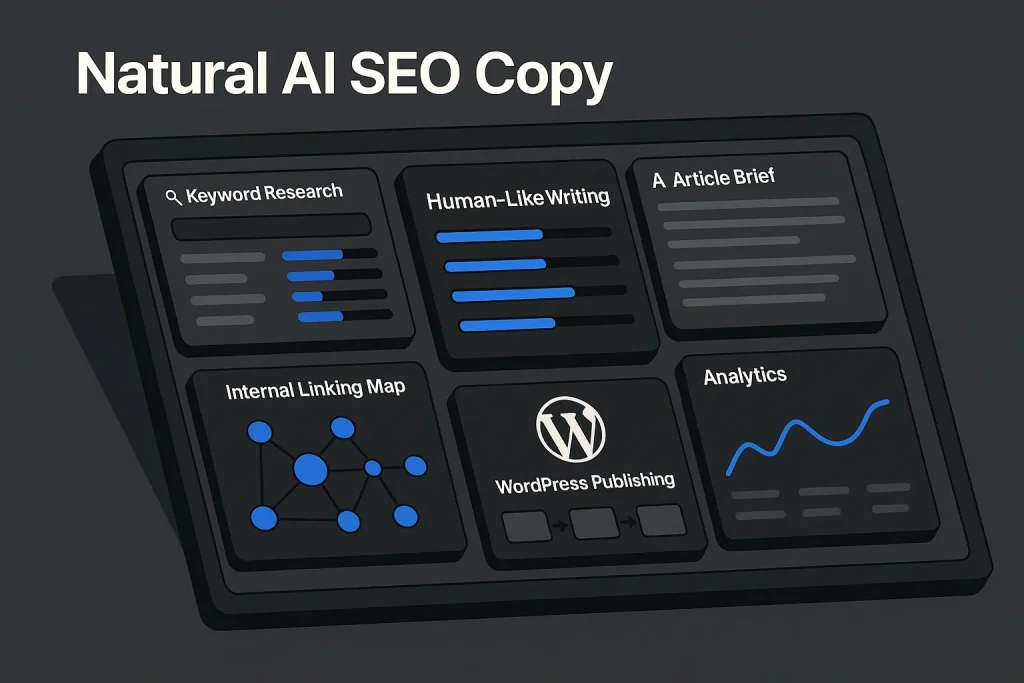
- Prepares internal linking opportunities and WordPress publishing structure in advance.
This is much closer to an editorial operating system than a rewrite utility. Teams looking to scale can see the broader production logic in Building Content Machines: The Ultimate Scale Guide for SEO Agencies, where workflow design matters as much as the drafting model.
Autopilot SEO’s advantage is that it treats expert tone as an output of aligned inputs: semantic planning, article architecture, context-aware generation, and quality control. That is how a draft starts sounding less like “AI trying to explain SEO” and more like “a specialist documenting a repeatable method.”
The business case for this approach is clear. Stanford’s workplace findings summarized in the AI Index show meaningful gains in support, software, and marketing output. The challenge is no longer whether AI improves throughput. The challenge is how to keep quality aligned with search and brand standards while still capturing that throughput.
A repeatable framework to write human-sounding SEO copy
A reliable natural write ai framework does not begin with style prompts. It begins with editorial intent. If the brief is shallow, the output will sound shallow even after multiple rewrites. The most effective framework has five operating layers: intent definition, semantic planning, expert framing, evidence integration, and post-draft QA.
1. Define the real decision behind the query
Start by identifying what the user is trying to decide, not just what they typed. For a keyword around AI writing, the user may be comparing tools, validating risk, choosing a workflow, or trying to improve quality at scale. If the article answers only the surface phrase, it will sound generic. If it addresses the implied decision, it starts sounding more human because it becomes more useful.
2. Build semantic coverage before drafting
Natural writing becomes easier when the model has a strong topical map. Include related terms, entities, objections, comparison angles, implementation steps, and expected outcomes. This reduces rambling and repetition because each section has a defined semantic job. On our view, this is where most weak AI articles fail long before the first sentence is generated.
3. Force judgment into the outline
Weak AI drafts describe. Strong drafts evaluate. Every major section should answer a question like: what works, what fails, when to choose one option over another, or what trade-off matters most. Judgment is one of the clearest indicators of expertise.
4. Add observable experience signals
Experience can be represented editorially even when the article is product-driven. Include process disclosures, examples of failure patterns, QA criteria, comparison logic, and operational constraints. This aligns with Google’s emphasis on experience without fabricating credentials or anecdotes.
5. Review for machine regularity and user value
Final review should check both language and structure. Remove repetitive phrases, split overloaded paragraphs, sharpen transitions, add specific nouns where generic abstractions appear, and verify that each section introduces net-new value.

A practical editorial review often uses these checkpoints:
- Does the introduction state a real market or workflow problem immediately?
- Does each section add a distinct decision point or insight?
- Are examples concrete enough to suggest actual implementation knowledge?
- Are claims sourced where evidence is needed?
- Would a domain specialist find the distinctions credible rather than padded?
- Does the conclusion help the reader act, not just summarize?
Teams that want a stronger conversion layer should also review How to Write Human AI Content That Actually Converts Visitors, because naturalness alone is not enough if the page does not move the reader toward the next decision.
On-page signals that reinforce expertise and trust (beyond passing detectors)
Natural prose helps, but rankings and conversions depend on more than writing texture. Strong pages reinforce expertise through visible on-page signals. These signals reduce ambiguity about quality and purpose.
The most important on-page trust reinforcements include clear authorship context, accurate source references, a well-matched title and section hierarchy, scoped claims, and supporting internal links to adjacent expertise pages. They also include small but meaningful editorial behaviors: defining where a recommendation applies, naming constraints, and avoiding over-claiming.
Google’s public quality framing makes these signals strategically relevant. Helpful content is not only well phrased. It is well evidenced, well organized, and designed for the reader’s need. This is why a detector-first mindset underperforms. It optimizes away from visible markers of trust and toward cosmetic unpredictability. We would go further: that trade is usually a net loss for serious brands.
| On-page element | How it supports trust | Common failure |
|---|---|---|
| Specific subheads | Shows clear topic control | Generic H2s that could fit any article |
| Source-backed claims | Improves reliability and transparency | Unsupported assertions |
| Method disclosure | Signals practical experience | Advice without process detail |
| Internal links to related expertise | Strengthens topical authority | Isolated content with no topical context |
These elements often improve both user trust and editorial consistency, even before any search performance is measured.
Evaluation: AI detectors, editor QA, and reader engagement metrics
Evaluation should run on three layers. First, detector-based review for obvious machine regularity. Second, editor QA for clarity, specificity, and factual discipline. Third, post-publish engagement and search metrics to confirm whether the page is actually useful in market conditions.
The first layer is the narrowest. A natural write ai detector can flag suspicious drafts, but it should never be treated as a ranking oracle. There is no authoritative public benchmark proving that a detector score predicts SEO performance. The article should be judged by whether it demonstrates value, not by whether it performs well in a synthetic classification test.
The second layer is where most of the quality signal is created. Editor QA should check for:
- original framing rather than recycled intros;
- specific nouns replacing abstract filler;
- examples that reveal process knowledge;
- removal of inflated certainty where evidence is missing;
- section sequencing that follows the user’s decision path.
The third layer is behavioral. Watch search impressions, click-through rate from the SERP, scroll depth, time on page, assisted conversions, and internal link click patterns. These metrics do not prove E-E-A-T directly, but they reveal whether the page is acting like a valuable asset instead of a passive text block. On our side, this is where the truth usually shows up fast.
Responsible AI oversight also matters. Stanford notes in its responsible AI reporting overview that reporting still lags capability benchmarking. For content operations, that gap translates into a practical need: document your own QA standards instead of assuming model output is safe or accurate by default.
In other words, readers already approach AI with caution. Quality control is not optional polish. It is part of trust preservation.

If your team needs a control layer specifically for reputation risk, How an AI Writing Checker Can Save Your Brand’s Reputation is a useful companion perspective.
Semantic coverage and internal linking to strengthen topical authority
Human-like tone alone will not establish topical authority. A page also needs semantic completeness and contextual integration inside the site. This is where many standalone humanizer tools fail. They rewrite text, but they do not build the surrounding authority architecture.
Semantic coverage means the article addresses the major entities, distinctions, and subtopics that a well-informed reader expects. For this topic, that includes E-E-A-T, scaled content abuse, AI detection limits, workflow design, on-page trust signals, WordPress publishing, and internal linking strategy. Leave these out, and you may still get readable copy, but not a page strong enough to compete as a comprehensive resource.
Internal linking then turns isolated relevance into cluster strength. A page about natural AI writing should connect to adjacent topics such as quality checking, conversion-focused human AI content, scalable editorial operations, and platform-level limitations of simpler writing tools. That is how search engines and users understand the page as part of a real expertise hub. We consider this one of the clearest differences between content that ranks briefly and content that compounds.
For example, concerns about low-quality automation align closely with Why Using an AI Writer Free Platform Can Lead to Google Penalties. Tool-evaluation context can also be expanded through HyperWrite AI Review: Strong for Inline Writing, Weak for Scalable SEO Operations. These links are not filler. They deepen subject coverage and distribute authority across the cluster.
A practical rule is to link where the user’s next question naturally appears. Do not force links into every paragraph. Use them when they extend the decision path.
Publishing workflow in WordPress with Autopilot SEO
Quality often breaks between draft completion and publication. Formatting degrades, links are missed, metadata becomes inconsistent, and teams lose momentum in the handoff. A strong publishing workflow matters because search performance depends on more than the draft itself.
Autopilot SEO reduces that friction by carrying the article from semantic planning to publish-ready output. For WordPress-driven operations, this means the workflow can generate structure, optimize article elements, insert internal links logically, and prepare content for direct publication without forcing editors to rebuild the page manually.
The operational benefit is not only speed. It is consistency. When every article follows the same quality-aware pipeline, teams reduce the variance that lets weak pages slip through. That matters even more for agencies and multi-site publishers, where scattered manual edits often create uneven standards. We have seen many teams underestimate this until publishing debt starts dragging down the whole content program.

WordPress publishing should include a controlled checklist: verify title alignment, confirm metadata, review heading hierarchy, ensure links resolve correctly, check image metadata, and confirm the final page reflects the intended search intent. These are basic steps. They are also skipped surprisingly often when teams focus too narrowly on generation speed.
Risks, ethics, and compliance when using AI at scale
Using AI at scale is viable, but only when the system is aligned with user value and editorial accountability. The main risks are not abstract. They are operational: publishing too much repetitive content, overstating expertise, relying on unsourced claims, and treating authority as a formatting exercise rather than something the page actually earns.
Google’s spam policies make the compliance boundary clear enough for publishers: if content is generated in volume mainly to manipulate rankings and adds little value, risk increases. If third-party content is published mainly to exploit the host site’s ranking signals, site reputation abuse risk also enters the picture. These are not edge cases for large teams. They are common temptations in scaled content operations.
There is also a trust risk at the audience level. If readers sense that a brand is claiming expertise it has not demonstrated, the damage appears before any algorithmic consequence. B2B buyers are especially sensitive to shallow certainty and generic recommendations because those signals imply weak operational knowledge. On our view, this brand-level risk is often more immediate than the ranking risk.
Ethical AI content use therefore requires four controls: transparent sourcing, careful factual review, no fabricated experience claims, and a documented editorial threshold for usefulness. AI should accelerate production, not lower the standard for what deserves publication.

Checklist: make your AI copy indistinguishable from a human expert
The objective is not theatrical human mimicry. It is credible expert communication. Use this checklist to push any AI-assisted article closer to that standard.
- Lead with a real problem, market tension, or workflow constraint.
- Match the article to the decision behind the keyword, not only the phrase itself.
- Use the focus topic naturally in the introduction, title logic, and core sections.
- Give each H2 a distinct job so the article does not loop over the same idea.
- Add concrete examples, process notes, and implementation trade-offs.
- Replace broad statements with scoped claims and named conditions.
- Support factual statements with reputable sources where needed.
- Reduce template transitions and repetitive cadence.
- Build semantic coverage around entities, subtopics, and objections.
- Insert internal links where they extend the reader’s next logical step.
- Use detector scores as a warning signal, not a publishing target.
- Run a final editorial pass for clarity, authority, and trust.
Teams that do this consistently stop treating natural write ai as a loophole strategy and start using it as a production discipline.
Commercial fit: where SEO Autopilot adds operational value
For teams producing content at scale, the hard problem is not generating another draft. It is maintaining semantic precision, natural expert tone, internal linking discipline, and publication consistency across many articles. That is the gap SEO Autopilot is designed to solve.
The platform combines semantic planning, AI article generation, structural optimization, image support, and WordPress publishing into one workflow. Instead of relying on a disconnected stack of prompts, rewriters, and manual uploads, teams can use SEO Autopilot on the official client website to move from topic to publish-ready article with stronger control over quality and scale. For agencies, B2B sites, and editorial teams, that operational cohesion is usually more valuable than another standalone humanizer.
The practical benefit is straightforward: less time spent repairing generic AI output, more consistency in how articles support rankings, authority, and content operations.
We think the main lesson here is simple: the winning approach is not to disguise AI, but to build a workflow that produces genuinely useful expert-style pages. Surface-level humanizers can smooth phrasing, yet they rarely fix weak structure, thin reasoning, or missing trust signals. In practice, the best-performing teams combine semantic planning, editorial judgment, and strict QA rather than chasing a perfect detector score.
For businesses, that means investing in systems, not tricks. Pages that show method, specificity, and clear audience awareness are far more durable than pages optimized for cosmetic randomness. The risk to watch is obvious too: scaled AI publishing without editorial discipline quickly turns into a quality and trust problem.
Our прогноз is fairly measured. Over the next year, more brands will adopt workflows that blend generation, human review, and structured publishing inside one pipeline. At the same time, detector-focused tools like a natural write ai humanizer or comparison terms such as real write ai humanizer will remain popular, but the market will gradually judge them by business outcomes, not novelty. We also expect interest in branded shortcuts like humanwrite ai and walter writes ai to continue, though the real winners will be platforms that connect writing quality with topical authority and publishing consistency.
FAQ
Can Google detect AI-written content and does it impact rankings?
Google’s public position is centered on content quality and user value, not on punishing AI use by itself. Rankings suffer when AI-generated pages are low-value, repetitive, manipulative, or weak on helpfulness, originality, and trust. That is the part that actually matters.
What’s the difference between AI humanizer tools and fine-tuned LLM workflows?
AI humanizer tools usually change wording and sentence flow. Fine-tuned LLM workflows change structure, semantic coverage, judgment, and editorial intent. In SEO terms, that second layer is far more important for quality and E-E-A-T strength.
How can I make AI-generated SEO copy sound like a human expert?
Start with a strong brief, semantic map, and decision-focused outline. Then add method disclosure, concrete examples, scoped claims, and editorial QA that removes generic repetition and inserts real judgment. If the structure is weak, no rewrite will save it.
Should I optimize for passing AI detectors or for E-E-A-T signals?
Optimize for E-E-A-T signals and user value first. Detector scores can help as secondary QA, but they are not reliable publishing goals and they do not prove that a page will rank or build trust.
How do I evaluate if my AI copy reads naturally to real users?
Review it for clarity, specificity, and credible judgment, then validate performance with engagement metrics such as scroll depth, internal link clicks, time on page, and assisted conversions. If readers move through the content and trust the next step, the copy is usually doing its job better than any ai detector can show.